Wednesday, 8 February 2012

A sign for our age

I am so glad, now that Josephine Bakhita has been canonised, that her feast day should coincide with my birthday. I ask regularly for her intercession for we who live in this age.

I only came to know about her when she was made a canonised saint by JPII in the year 2000. But when the present Holy Father spoke at such length about her in his second Encyclical Letter (Spe Salvi) I came to realise much more her significance for our age.

She is an archetype for our age - a person who was battered and bloodied by the culture she lived in, a culture which was oblivious to the harm that it was doing to her, and a person who, to some degree, accepted the bloodying she received as a normal part of life, unaware of the real dignity of human beings and the beauty of life which they are called to live.

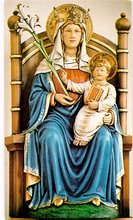
Today for many, the secular project administers a terrible form of bloodying and battering, and we accept this as a normal part of life. Take a look at what contraception has done in our culture; the countless babies shredded in abortions, the despair and loneliness which it has bred. Take a look at what the pagan media has done in our culture; the false expectations, the superficiality of human relatiosnhips, the sadness and the loneliness, the mockery of God and the Church ... I could go on. This saint is a great saint for our age because she symbolises in her life that which takes place in the lives of many today. And yet, her life was suddenly changed - she met Christ. Christ lifted her out of the fallen culture in which she was trapped and gave her a new life. And how did she respond? By spending the rest of her life telling people, not about the awful life she used to live, but telling people about Christ and who He was for her. Her incorrupt body lies now under an altar in a glass coffin (photo above).

What an immense privilage it is for us to be able to celebrate her feast today and to seek her powerful advocacy. And what an immense privilage to be able to celebrate the Mass in her honour each year now, on my birthday.

Monday, 6 February 2012

A martyr in the family


Over the Christmas period I was chatting with my mother about the Catholic-reformation martyr Blessed William Freeman, who we think is one of our family forebears.

William Freeman was born in the Yorkshire village of Menthorpe in 1558. Menthorpe lies on the west bank in the River Derwent, a few miles east of Selby and south of the village of Aughton (home of the Aske family); today it consists of only a couple of farm houses. The photo below is looking west towards Menthorpe from the eat bank of the Derwent. Our family knowledge which has been handed down tells us that the Freemans (my maternal father's line) came from East Yorkshire.


William Freeman was born to recusant parents though himself conforming to the State religion at some stage in his early life. He graduated from Magdalen College, Oxford, in 1581. He re-embraced the Faith in 1586 when he witnessed the martyrdom of Fr Edward Stransham at Tyburn in London. He left England to study for the priesthood in Rheims and returned to England as a priest in 1589, ministering for six years in Warwickshire. In January 1995 he was arrested at Stratford-on-Avon, and since his priesthood could not be proved by the authorities he endeavoured to secure his freedom and the possibility of continuing to minister as a priest. However, he was denounced by a fellow prisoner and sentenced to death. During his trail he spoke with immense freedom and courage about the Faith and about the Priesthood. Both at his trail and at the scaffold he was full of joy and spoke of his loyalty to Queen Elizabeth; he was hung, drawn and quartered at Gallows Hill (photo below), outside Warwick, on 13th August 1595.

I'm sure that there must be a lot of Catholics who have a martyr in their history, and other branches of the Freeman line who can also claim this saint as one of their ancestors. We should be very proud of such forebears and remember the quality of their faith in Christ. In a certain sense they are for us today a measure against which to set our own goals and those of our families in the contemporary context.

May all the martyrs of England and Wales, Scotland and Ireland be a great light for us today.

Friday, 27 January 2012

Mutual enrichment revisited.


Now that we have the new translation of the English Missal it is perhaps easier for us to begin to take an objective look at the 'mutual enrichment' which the Holy Father calls the Church to address; the Tridentine Missal shedding light on the Novus Ordo Missal, and how the new Missal sheds light on the old. There will be many, more able than I, who will be able to lead an objective and genuine enquiry concerning the mutual enrichment of the two forms of the Roman Rite, a process which will bring about the emergence of one single form of the Roman Rite. In any case, it is time which will allow an organic process of genuine reform of the Liturgy to take place. Nonetheless, there are a number of simple ways in which I already see the possibility for mutual enrichment by the two missals.

1. Ways in which the Tridentine Missal can enrich the Novus Ordo Missal:

The greatness of the Offertory Prayers of the Old Missal suggest that the Offertory Prayers of the New Missal could be enriched.

The Old Missal carries the text of the Offertory Antiphon, whereas the New Missal, whilst situating this antiphon in the rubrics, fails to give the text of the Antiphon.

The Liturgy for Ember and Rogation Days still remains to be included in the New Missal; the Tridentine Missal is the objective point of reference for this Liturgy.

The title given to and the sense of the two periods which are now called, in a banal way, 'Ordinary Time'. The Weeks after Christmas and before Lent have a very different sense to those which follow Pentecost. These two periods of the Liturgical Year have a richer sense in the Tridentine Missal.

2. Ways in which the New Missal can enrich the Tridentine Missal:

The development of the Lectionary.

The greater number of Prefaces.

The way in which the Church and the relationships within the Church are better expressed by the New Missal.

The greater variety of 'Masses for various occasions'.

Finally, a word about the Orientation of the priest at the altar. Since the rubrics of the Novus Ordo Missal presuppose that the priest faces east when he stands at the altar, the question of orientation is clearly one which in some sense, in flux. However, the weight of the Tradition obvioulsy falls on the east-facing orientation. I hope that in this process of Liturgical reform which is newly beginning, that the form of the Eucharistic part of the Mass will be appropriately enhanced - the moment when we can participate in that Eternal Return which Christ makes to His Father.

Thursday, 5 January 2012

The proclamation of Christmas


Christmas Day on British television again gave us the contemporary secular haze and again it was only the Her Majesty the Queen who spoke about the love of God revealed in Christ at His birth in her Christmas Day message. Her Christmas message this year was a proclamation of the true meaning of Christmas.

That she stands alone on British television in speaking about Christ reveals just how far we have gone in attempting to dismantle Christian civilisation, and how blessed is the Church of England to have her as its head.

Friday, 2 December 2011

A Social Encyclical?


The prophetic teaching of Paul VI in the Encyclical Letter Humanae Vitae is regarded most for clarifying that artificial contraception goes against the truth about human love. Those who read this teaching Letter for themselves see that Humanae Vitae actually contains a very beautiful teaching about the truth of marriage and, particularly, that it gives a wonderful exposition of "responsible parenthood": the way in which spouses are called to consider authentically the factors which affect or govern the number of children they have.
However, I have long thought that this Encyclical goes for beyond the sphere of marital morality and enters very fully into the social and public sphere. Most societies, down through history, have (correctly) entrusted the transmission of human life to spouses. Occasionally, a society has intervened in this very particular area of life in order to insert some controlling influence; for instance, the Chinese 'one child' policy, or the eugenics of the Nazis. In our era social forces within culture and from governments are entering into this special area: who today has the responsibility for the transmission of human life?
Contraception, by its very nature, introduces a 'third party' into the procreative mission of spouses. But the 'third party' influence might come through a false or contrived vision about the meaning of life, which the contemporary secular project promotes, it may be through the contemporary homosexual lobby, or through the desire of a government that its citizens achieve some pseudo-scientific goal or simply by the crude application of socio-economic forces. All these influences are being exercised today and many spouses probably feel that their God-given mission is indeed somewhat invaded.
Humanae Vitae then, is a Social Encyclical, giving light and clarity of vision to spouses in an age which dares to invade this most special of all human tasks. Spouses uniquely have the mission to transmit human life; no one else can legitimately enter in here, and the vision for marriage and responsible parenthood which Paul VI gave us is something to be made much of in our age. Let the truth shine out!

Saturday, 19 November 2011

Memory and Identity: Modern Democracy


In this chapter John Paul II gives a simple presentation of historical political systems and in which he particularly analyses democracy.

First, he describes the three forms of political organisation (from the perspective of who has power). In a Monarchy power resides in an individual, in an Aristocracy power resides in a social group, and in a Democracy power resides in the whole of society. Each of these systems is valid so long as the purpose of exercising power is to serve the common good, that fundamental moral norms are respected, and that civic virtues are actually exercised. If this is not the case, then Monarchy (and Aristocracy) degenerates into Tyranny, and Democracy into Ochlocracy (domination by the populace).

Democracy, understood not simply as a political system, but also as an attitude of mind and a principle of conduct, does not, in practice, allow for the direct exercise of power by the whole of society; power resides in representatives of the people who are designated by free election.

Catholic social morality favours Democracy because it corresponds more closely to the rational and social nature of man.

Democracy comes into being through a 'state of law', in which social life is established by parliaments with legislative power, and is regulated by law. Thus, Democracy is able to form free citizens who jointly pursue the common good.

Now the Divine Law also comes into play for man, this was given through Moses and is binding, even on those who do not accept Revelation, as natural law. The Decalogue (the Ten Commandments), or natural law, is foundational for any human legislation, precisely because they seek the fundamental good of personal and social life. If any of these commandments is placed in doubt, both human society and man's moral existence is put at risk. This is because law rests not upon human judgement, but upon the truth of being, the truth of God, of man, of all reality.

Saturday, 12 November 2011

Memory and Identity: the relationship between Church and State.


The Council describes this relationship in Gaudium et Spes 76, saying that both Church and State are autonomous and independent of each other, yet both are devoted to nurturing the personal vocation of man, though under different titles.

The totalitarian States of the last century attempted to separate the Church from the State and extinguish it; for them the world belonged exclusively to the State. The Church's view is clearly in conflict with this, because for the Church the world is both a task and a challenge. This is particularly the case for lay people who are called to Christianise society and culture.

Today again, some politicians are trying to redefine the relationship between Church and State, colouring the Church's position as one of purely subjective faith (or opinion). We have seen this for instance from Barack Obama and Tony Blair. And, at the same time we have witnessed a certain passivity from believing citizens and a failure to defend basic human truths and rights. Indeed, we have also witnessed great efforts in society (for instance, the media) to intrude in people's consciences and to lead them to stop believing in Christ.

Here today lies the great challenge for the Church: a new evangelisation, which must begin with the task of rehumanising the world.

(Incidentally, the German wartime theologian Bonhoeffer said that the Christian's purpose in the State is to try to make the State a better State. He was executed by the Nazis two weeks before the end of WWII.)


Wednesday, 9 November 2011

A visit from overseas


On Monday this week George Weigel was the guest speaker at "Theology on Tap" in Sydney. What a tremendous teacher he is and how privilaged we were to host him in our monthly event for young people. He spoke to us about Bl John Paul II and how he showed the world that being a radically converted Christian is the greatest human endeavour.

You may be interested to follow Professor Weigel's weekly column here.

Monday, 7 November 2011

Seventy minutes


If you have seventy minutes to spare I recommend that you listen to a talk given by Archbishop Mark Coleridge. He was speaking last year in Perth, Australia, at a meeting of ICEL on the subject of the renewal of the Liturgy and the new translation of the missal. His understanding of this subject is superb. You can find the link here; scroll down to the bottom of the page to find the audio file.

Sunday, 6 November 2011

Memory and Identity: The Mission of the Church

The Mission of the Church is the context in which we live the Christian life, for the Church is missionary by nature; she is called at all times to proclaim the Gospel, and her attitude must always be humble but courageous. And so today, an enormous ammount of work is needed on the the part of the Church, in particular the lay apostolate.
Christ and the Church are inseparable. There is no Christ without the Incarnation, and the Incarnation is prolonged in history in the Church. The Church exists then, because Christ belongs to the history of all humanity. God's plan has always been to unite and to transform all humanity in Christ His Son.

Today's "secular" world intends to live as if separated from God, yet this same world is called to fulfilment in Christ. The Church is called to pave the way for this "secular" world to receive its glory from God.

(I took the above photo while driving in Sydney a couple of years ago.)

Monday, 31 October 2011

Memory and Identity: The positive fruits of the Enlightenment.


We should not limit ourselves to considering the destructive aftermath of the Enlightenment, but consider also its positive aspects.

The Enlightenment prepared the way for a better understanding of human rights (even if these were already known to be rooted in the nature of man created by God.) During the Enlightenment the rights of nations to exist, to maintain their own cultures and to exercise political sovereignty came into focus, and with it came the idea that "fraternity" is a bond which not only unites men, but nations also.

During the Industrial revolution, which did great harm to the fabric of society, in which men were exploited by industry and commerce, some of the values of the Enlightenment led to a profound rediscovery of the truths contained in the Gospel.

Likewise, the birth of Communism led to a clearer understanding of the Church's social mission. This came to be expressed in her Social teaching.

The teaching of the Second Vatican Council can be seen as a synthesis of the relationship between Christianity and the Enlightenment: that the Church is called to engage with the world, not in a polemical or condemnatory way, but through a desire to lead the world to Christ - to evangelise the world. For, "it is only in the mystery of the Word made flesh that the mystery of man becomes clear." (Gaudium et Spes, 22) Christ is the light of men, first in their interior lives, and then in their vocation and destiny. In Christ, man knows who he is and how he is called to live. For uniquely, in Christ, man's whole life is a unity, his interior life, his spiritual life, his social life, he affective life, his moral life and his political life is united. Man is made whole in Christ. Apart from Christ man remains divided in himself, he remains an enigma to himself.

The mission of the Church then, is to man, wherever he is and in whatever state he is in; the Church's mission is to lead him to transformation in Christ.

(The extraordinary photo above was taken in Sydney city centre in July 2009.)

Thursday, 27 October 2011

Memory and Identity: Europe as native land.


In this cahpter, the Holy Father looks at Europe through the prism of Christianity which, as we will see, is also the root of today's Europe.

The evangelisation of Europe began with a mysterious call which St Paul received, to cross from Asia to Europe and preach the Gospel there (Acts 16: 9). Within a few hundred years Ireland, the western most part of the continent, had become itself a missionary centre of the faith.

Building upon the fabric of the ancient world, it was evangelisation which formed Europe; the Faith favouring the formation of different cultures, different nations, but all linked to the common patrimony of the Gospel. However, it is only with the advent of the Modern Era, when the known world was extended to Asia, the Americas, to Africa and Australia, that Europe was seen in a more objective way.

St Paul's address at the Areopagus in Athens (Acts 17: 22-31) holds the key for what would take place in the wider Europe. In this speech St Paul first recognises the religion of the ancient world and, in so doing, prepares his hearers for a proclamation of the Incarnation and the Redemption. The Church would go on to achieve a profound integration of faith and culture in the peoples of Europe.

The first great 'wounding' of Europe was the 'Great Schism' of 1054 when the Eastern and Western Churches ceased to function together. Then, at the beginning of the Modern Era disputes arose with the Protestant reformation, and the Western Church suffered further divisions.

During the Seventeenth and Eighteenth centuries - the era of the Enlightenment - Christ began to be rejected in Europe. The Enlightenment was not an outright rejection of God, but an attempt to exclude Christ from thought and from Europe's history.

Today a cultural drama continues for those who reject Christ; for the ideas of these secularists are, in fact, profoundly rooted in Christianity, so deeply has the Gospel marked Europe.

Christ himself gives us a Theology of the Incarnation and Redemption. In the metaphore of the Vine and the branches (John 15: 5ff), Christ shows how God cares for and cultivates his creature. He grafts it onto the stock of the divinity of His Son. From the beginning man has been called into existence in God's image and likeness. By agreeing to be grafted onto Christ, man can fully become himself. By refusing this grafting man is condemning himself to an incomplete humanity.

So, in the European Enlightenment man has endeavoured to cut himself off from the Vine, and thereby he opened up the path that would lead to the devastating experience of evil in the Twentieth century.

According to St Thomas Aquinas evil is the absence of good. For man to deprive himself of the good of being a part of the Vine is to deprive himself of that fullness which God intends for man.

(The above photo I took a few years ago in the churchyard in the village of Birstall in North Yorkshire. It is the gravestone of the late Christopher Dawson, the Catholic sociologist whose life's work was given over to helping Europe rebuild itself on the foundations of the Gospel after the Second World War.)

Tuesday, 25 October 2011

Memory and Identity: Nation and Culture.


The origin of history and culture is found in the Book of Genesis: the decision by the Creator to make man in His own image and likeness, blessing man, charging him to be fruitful and placing him at the forefront of the world. In one verse (Gen 1: 28) we have the earliest and most complete definition of human culture.

In the second account of Creation (Genesis chapter 2), we are given man's original experiences of solitude, unity and nakedness, together with the losing of original innocence in sin.

Man's mission then, which belong's equally to men and women, is to discover and confirm the truth about ourselves, and to receive the world as a gift and as a task. In order to undertake this mission we must be guided by the truth about ourselves and about the world.

Man's mission to the visible world has evolved throughout history, and we can see that where there have been problems, we have not been faithful to the truth about ourselves. Civilisation has always been linked to knowledge of the truth about the world, together with knowledge about ourselves.

Deeply ingrained in human culture is the element of beauty; that man reflects in his own life and work the beauty and goodness which is present in the created universe - man's testimony to God's work. This is a foundational element of the human experience and one which is expressed in the culture of a nation. It is this experience, by which man represents what is true, which reveals man's sovereignty in the world, his greatness. And for the same reason, the nation (natural society) is greater than the State (political organisation), for the nation's link to truth is more organic and foundational than is the State's.

Today, it can be said of many Western countries that they have arrived at the stage of "post-identity". That their relationship with truth and their own sense of sovereignty is now much diminished, and that consequently the citizens of these countries cannot give a testimony to their culture (man reflecting his own truth and the truth about the world). Instead, culture has in many cases been overwhelmed by false values, modern destructive trends in liberalism and economics.

Monday, 24 October 2011

A weekend of grace.


This past weekend the Seminary of the Good Shepherd held a public 40 Hours of Adoration (Quarantore) for the intention of vocations to the Priesthood and Religious Life. The Blessed Sacrament was exposed on Friday evening at 9pm and finally reposed on Sunday at 1pm. The Seminary is grateful to the Sydney Archdiocese Vocations Office for their help and for providing such a great range of resources for spiritual reading and disernment during the 40 Hours.

There many times during the weekend, both during the day and during the night when our seminary chapel was vitually full, and you could 'feel' that a mighty work of grace was taking place. It was quite remarkable that there was a constant stream of young people visiting the chapel throughout the weekend. It was wonderful to see the Lord visibly at the head of His Church.

The 40 Hours ended with Solemn Benediction, which was followed by a mighty BBQ for all those who were present. We would certainly like to repeat this again next year.

Saturday, 22 October 2011

Memory and Identity: History.


The whole created universe is subject to history; everything and everyone is subject to the course of events. Man however, unlike the plants and the animals, can reflect on history and give an account of it.

Communities of people, like individuals, have a historical memory; nations, for instance, seek to record what they remember. These histories are among the essential elements of culture, because they go to the heart of a nation's identity.

History for the Christian is not simply a question of acknowledging and understanding the past, it concerns rather, the whole of man's life: his origin, his historical experiences and his future, including his judgement before God. Such a perspective flows out of God's self-revelation; it is called "escatological". In other words, there is a diffrence between the history of nations and the history of man. A nation's history is confined to a course of events which have marked that nation. Man's history, as well as containing a course of events, also includes his divine origin and his divine vocation. This unique value within man's history is something which leaves its mark, and gives meaning to, the history of a nation.

(The above photo I took in 2007 inside the basement of the Bell Tower of the Tower of London. St Thomas More was confined in this cell before his trial and execution.)