Saturday, 19 May 2007

Quebecois liturgy II


Yesterday I had to suffer one of the worst pieces of liturgical terrorism that I have had the misfortune to witness. It was the final Mass of the meeting of Delegates for the International Eucharistic Congress in Quebec. Rather than describe the scene in detail let me give it to you in bullet points:
  • The Mass was celebrated in the room where we had, a few hours previously, had a buffet. The tables which were used as serving tables during the buffet were made into a long table down the centre of the room (making it look like it was prepared for another buffet). Chairs were arranged looking in on either side.
  • Lay people were encouraged to sit where they liked - except for some of the front seat which were reserved for bishops. Priests were supposed to sit mingled with the people (in actual fact the herd mentality took over and we all sat together at one end).
  • In the 'entrance procession', some women (I think they were religious though had nothing visible to show the fact) brought flowers and candles which they placed at strategic places along the long table.
  • At the Offertory, these same women brought chalices and patens on serving trays and placed them upon the table at strategic places, and they themselves poured wine (no water) into the chalices. These were not placed on corporals at all.
  • After the Eucharistic Prayer these same women approached the table beckoning (in an evidently pre-thought out manner) the bishops towards the table to partake of the Eucharist (ugh).
  • The priests were given Holy Communion as though they were lay people.
Some liturgical terrorists had obviously taken over the planning for this Mass. All I can say is Cranmer would have been proud. What struck me most was the inconsistency of having spoken about the sacrifice of the Mass and adoration during his rather pedestrian talk earlier, Cardinal Marc Ouellet then celebrated this Mass without batting an eyelid at the way in which it had been arranged.

The agenda of the liturgorists was evident. They wanted everyone to sit side by side - priests and people - because they have no faith in the sacred nature of the priesthood, and in the difference of nature and not just of grade of the ordained priesthood from the baptismal priesthood. The way they pushed these women forward to do the deacons role, and to 'facilitate' the bishops' celebration of the Eucharist (as if they'd never been to a Mass before) was saying that they believed that women should be ordained to the priesthood.

This was, of course, done under the nose of Cardinal Josef Tomko, the President of the Pontifical Council for the International Eucharistic Congress. And, while he seemed to play along at the time, I know from speaking to his secretary in the Pontifical Council, Fr Ferdinand Pratzner, today that all has been noted, and that a meeting to speak about the liturgy has been planned for Monday. Fr Pratzner was also very critical of the hymn for the Congress which, in its French version at least, seems to suggest that the bread and wine of the Eucharist only become sacramentally the body and blood of Christ by virtue of them being shared among us (step forward again Archbishop Cranmer).

My reaction is that this Congress has been seen (at least by Cardinal Ouellet, I think) as a remedy for the apparent disastrous decadence of the Church in French Canada during the last 40 years. Well it won't be a remedy unless this liturgical playing around, so characteristic of liberal North American liturgy, is jettisoned and the presciptions of Redemptionis Sacramentum and Sacramentum Caritatis are adopted.


Liturgical form.


In the great Letter "Sacramentum Caritatis" Benedict XVI speaks about Liturgical form, and the first dimension he speaks of is beauty: "in Jesus we contemplate beauty and splendor at their source". (SC,35)

Eucharistic Services.

Where did they come from? I ask this because we now know that they are not a Rite of the Catholic Church.
Both "Redemptionis Sacramentum" and "Sacramentum Caritatis" speak very clearly about Celebrations in the abscence of a priest. Such Celebrations are extraordianary events to enable Catholics to pray together on Sundays when there is no priest. There is no intimation that these Celebrations can also be held on weekdays. The distribution of Holy Communion at such a Sunday Celebration requires the Bishop's permission. (Redemptionis Sacramentum, 162ff) Nor can lay people preside at any Liturgy. Only a priest can preside (even at a Liturgy of the Word).

Well, even though the era of experimentation is now over we will probably still find enclaves up and down the country where lay people open the taberbernacle, stand at the altar, give themselves Holy Communion before distributing the Sacred Species to others. These rogue services are more akin to Protestant Communion Services where there is neither Priest nor Sacrifice. The so called "Eucharistic Service" beguiled many for a time and has distracted us from "a genuine hunger for the Eucharist".

In my last parish I had to intervene on a number of occasions to correct a woman who was giving Benediction with the Monstrance to a group of other women!

Friday, 18 May 2007

Quebecois liturgy - and a good homily from Cardinal Tomko

Imagine... Put together the worst of North American liberal establishment liturgy, an array of clerics including a cardinal, a polish bishop with a mitre touching the ceiling and several who didn't know what a mitre was, Byzantine rite priests, and other priests (relegated to sitting behind the laity in the nave of the Church). Add to this a good choir and an excellent organist playing in the style of Marcel Dupré, but a selection of music so eclectic to be neither one thing nor another. But on the other side add two permanent deacons who had no clue what they were doing and did everything in an inept manner (the worst being waving a host around to any bishop who had not received a particle for Communion). Add also the ordinary of the Mass schizophrenically moving from French to English with the occasional utterance in Spanish (I was surprised that the consecration of the host and the chalice were in the same language). You now have a bit of a picture of what the Mass at today's preparatory meeting for the International Eucharistic Congress was like.

The setting was tremendous - the Basilica-Cathedral of Québec. But the well organised disorganisation of the liturgy does not bode well for the Congress itself. I hope someone reads Sacramentum Caritatis before it starts, and that we get the Mass in Latin rather than not knowing what language it is in. I hope they can get rid of the professional looking lay people and religious out of the way, as they are a distraction. I hope that something of the Ars Celebrandi gets improved. But I'm not holding my breath. The thing is, the International Eucharistic Congress is supposed to be about not just adoration, but about improving celebration. Put in that context, today's Mass (or should I call it 'Eucharist liturgy'?) was a fiasco.

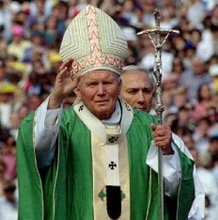
One good point was the homily of Cardinal Tomko (pictured above during the homily), the main celebrant (or should that be 'presider'?) He picked up on the text "A little while longer and you will not see me", and said that Jesus was pointing not just towards his Crucifixion but also to his Ascension. That although he may physically have become remote, in his divinity he is closer than ever. In the time in which we live - of the already of the Paschal Mystery and the not yet of the fulfilment of the ages - the Eucharist is the true living presence of Christ in his humanity and divinity. Although we cannot see - and maybe it is just as well as we would be overpowered by the glory - we can believe, and, as St Thomas Aquinas put it, sola fides sufficit. I just wish the teaching had been reflected in the celebration of the Mass.

The pilgrim way in New France

I spent this afternoon with the other delegates for the International Eucharistic Congress on a small pilgrimage to the shrines of some of the foremost figures of the establishment of the Catholic Church in 'New France'. Of course, first among the saints associated with this part of Canada are the martyrs led by St John de Brébeuf and St Isaac Jogues. The blood they shed was indeed the seed of Christians in this area. However, the vitality of the first Church to be established in North America is seen in three other blesseds, and it was the shrines of these that we visited.
First to be visited was Blessed Mary of the Incarnation. As a child, her father, who was a baker, used to let her take some of the bread to give to the poor. Although she had felt the call to religious life from an early age, she was married at the age of 17, and had a son. Her husband was a business man, but unsuccessful, and was made bankrupt, and died shortly afterwards, leaving Mary with a son and no money. She returned to her father's house, and worked to keep herself and her son. But, as he grew up, the call to religious life returned. Eventually she joined the Ursulines, and, having received in her heart a real conviction that she should serve God in Canada, went there to found one of the first convents in Québec. Her son, incidentally, having been rejected by the Jesuits, became a Benedictine monk, and eventually became Prior. Once, during prayer, Bl Mary was praying for the poor and for the souls of those who were lost to God. However, she felt that God was ignoring her prayers. In the end she felt the voice of God speaking to her, that she should bring all these prayers and lay them on the altar of the Heart of Jesus. In response, Bl Mary wrote this prayer, which I find particularly powerful:
Through the Heart of my Jesus, my way, my truth and my life, I approach You, Eternal Father. Through His divine Heart I adore You for all who do not adore You. I love You for all who do not love You. I acknowledge You for all those wilfully blind souls who through contempt refuse to acknowledge You. Through His divine Heart I wish to fulfil the obligation to all creatures towards You. I go round the world in search of all the souls redeemed by the most precious Blood of my divine Spouse. Through his divine Heart I wish to make amends for all of them. I embrace them all to present them to You through Him; and through Him I ask for their conversion. Will You allow them not to know my Jesus, or not to live for Him who died for all? You see, O heavenly Father, that as yet they do not live. Ah! grant that they may live through His divine Heart.

Oh this adorable Heart, I present to You all who labour for the extension of the Gospel, in order that by its merits they may be filled with Your Holy Spirit. On this Sacred Heart, as upon a divine altar, I present to you especially..............

You know, my Beloved, all I wish to tell Your Father through Your divine Heart, by Your holy soul; in telling Him, I tell You because You are in Your Father and Your Father in You. Grant all I ask; unite Your Heart to mine in order to move Your Father's heart. Since You are one with Him, grant that all the souls I present to You may be united with Him and with You, as You have promised. Amen.

The second blessed to be visited was Bl Catherine of St Augustine. She was not a foundress, but came to Canada at the young age of 16 to serve the sick in the hospital run by the Augustinian sisters in Québec. She died at only 36 years, offering her life for the salvation of the Canadian Church. She was beatified in 1989 by Pope John Paul II. Her bones rest in a reliquary made very shortly after her death.

The third blessed whose shrine we visited is Bl Francis of Laval, who was the first bishop (vicar apostolic) in the whole of North America, ordained bishop at the age of 35. Although his area of pastoral responsibility included most of what is now the USA, his area of work was around the towns of New France, current day Québec province. He continually visited the towns of the province, sometimes making journeys for five months at a time, and established Major and Minor seminaries in the city of Québec itself. He oversaw the establishment of Québec as a diocese in 1674. He died in 1708 at the age of 85 and was buried in the crypt of the Cathedral which he had built. His body rests in the current Cathedral (there have been four in total). He was beatified in 1980 by Pope John Paul II.

Thursday, 17 May 2007

Greetings from (French) Canada


As I write, I'm sitting in the student room which I have been allocated at the University of Laval, Quebec, as I'm here attending a meeting of national and diocesan delegates for the International Eucharistic Congress.

The University itself claims to be 'Catholic', though there is very little evidence of that as you go around. In the centre of the campus, which is an array of overpoweringly sixties edifices, is something which looks like a rather grand Church. Ah, I thought. So it is Catholic. So I went to have a mooch, and found that even if it had been a Church at one time, it was now a library and archive. I did eventually find the chapel. It was locked on first visit, and not easy to find as I easily walked past it. I must say that the chaplaincy at the secular University of Birmingham is much more prominent than this.

Anyway. The meeting. So far it hasn't been terribly inspiring. The idea is that it is a meeting for us to see where the International Eucharistic Congress will take place (in June 2008), and to become so enthused that we will bring hoards of delegates. There are not that many of the national delegates here. Of the European delegates, apart from me, there is one from Spain, one from Switzerland, one from Poland, and a substitute from France. A handful from South America, Asia and Africa are here too. The majority of the delegates are from Canada and the USA. Last night we were treated to a performance of the new Congress hymn. I can't say it's very catchy. And it took forever for them to get round to singing it, after having speeches (everything translated into English and Spanish from the original French too) for what seemed like hours. I hope today takes a new turn in terms of interest. I'm looking forward to the tour of Old Quebec later, and the Eucharistic Congress for young people which I'll be at over the weekend. I'll let you know how it's going!

New life in Christ


We had a great day on Sunday. Bishop Pargeter visited the University chaplaincy and baptised Xiang Francis (1st right) and Helena (1st left) and confirmed Andrew (2nd right) and Tomas (2nd left). It was a great celebration and we were blessed with great graces. One of those graces, however, was not the weather. I ended out bbqing in the rain with my intrepid co-bbqers Dave and Julian (a different one). By the way that's a tea towel on my head to stop the huge drops of rain getting in my eyes.

The era of experimentation is over.

With the promulgation in 2004 of the decree "Redemptionis Sacramentum" the liturgical reform has reached a great turning point. The era of the Liturgical Movement which found its climax in the Second Vatican Council and the period following has acheived a real degree of maturity. Benedict XVI in his letter "Sacramentum Caritatis", an overarching liturgical teaching which corresponds with Pius XII's "Mediatror Dei", defines with some clarity what the Liturgy is now that so much has taken place because of the Liturgical Movement. Indeed, in the light of these two documents, we can say that the period of liturgical experimentation is over and that we are in a better position to undertake a genuine reform of the Liturgy - a reform of the reform you might say.
"Redemptionis Sacramentum" , unlike "Inestimabile Donum" (1981) which set out to correct litirgical abuses, is a clear statement of the true form of the Liturgy in the post-Conciliar Church. In "Sacramentum Caritatis" the Holy Father sets the current form of the Liturgy within the context of history, the Church and the Life of Grace. In doing so, he has enabled a more genuine development of the Liturgy to take place - that which was envisioned by the Council, but which became a period of experimental liturgy instead. Experimental liturgy is over. What we have is a Church which has experienced the experimental liturgy but which is clearer than it was about the nature of reform. The reform of the reform can now proceed with clear markers. Benedict XVI expresses this in one sentence of his letter:
"Concretely, the changes which the Council called for need to be understood within the overall unity of the historical developmet of the rite itself, without the introduction of artificial discontinuites." (Sacramentum Caritatis, 3)
What he is saying is that we need to return to what the Second Vatican Council actually said about the Liturgy and its reform, we have to appreciate what the Liturgy is in itself, we have to understand anew the unreformed Liturgy (Tridentine Liturgy), and we have to enable an organic development of liturgical form to occur (clearly, this is different from liturgical experimentation). We could expect that a reformed reformed rite, one that corresponds more with the intentions of the Second Vatican Council, including the question of the reform of the Tridentine Rite (which has never taken place), could arrive on our shelves within a couple of generations.

Wednesday, 16 May 2007

Another Day of Mission

This coming Friday, 18th May, there is the Day of Mission in my Parish. However, you are also invited to come and join us, with the Friars of the Renewal from Bradford, in joyfully and prayfully evangelising on the streets of Altrincham town centre, and afterwards for Holy Mass and Dinner at High Legh. Saturday 26th May. Meet outside Altrincham train station at 1.00pm. Please contact Mary Jones marycjones42@yahoo.co.uk if you are able to come.

Monday, 14 May 2007

The stakes are high.

Who will be our 10,000th visitor?

Catholic Citizenship.

Last Friday evening Lord David Alton gave a talk, "Time to act", in St Joseph's Parish Wetherby. The evening was sponsored by the Friars of the Renewal and was very nicely introduced by Fr Sylvester CFR.
Lord Alton spoke to us of how people of faith should act in a secular society, emphasising how Catholics not only have their religious faith and the principles which flow from it, which are true and therefore Catholic, but that we also have the whole culture of our human lives and our gifts. It is this human culture which first of all should be enlightened and elevated by our faith and its principles, and then deployed in a true and reasonable way in order to build a better world. In short, we are called to be agents of God in the secular world and in the political world.

Prayer is the first building brick, for our spirituality will be necessary to us if we are to enter into the public arena. Without a real spirituality we will simply be sucked in.

Secondly, "pressure" is the content of our work. We may not be victorious in the public sphere, but the fidelity to our principles and our work in the public sphere means that we will indeed be playing our part in the resolution, for instance, of some issue. And this will cost us!

Thirdly: practicalities. This will necessarily mean that we need to inform ourselves and that we actually get involved in some group or activity - including a voluntary activity. And today, this also means that we should be actively promoting the alternatives to the culture of death
It was interesting that, although God was very much included by Lord Alton in his talk, when we came to question time, God was very much absent from the discussion - the living out of our faith in public life is still a huge issue for the people of our country!
Lord Alton left me with a number of questions, not least the question about the public recognition we should give to God. At another level, I am aware that in order to take our place in the public arena we need to be well formed. The vast majority of Catholics, whether leaving school, University or working, have virtually no formation in the faith, let alone formation in how to apply the faith in the concrete circumstances of a secular neo-pagan Britain. I have posted before in this Blog about what Catholic Journalism should be, and where are the Catholic journalists? Indeed, where today are the Catholic Academies or intellectuals who we need to form us in understanding the genuine principles of Science, Medicine, Law, Business, Politics. Thank goodness for the Linacre Centre, for Maryvale - but what about the other areas of enquiry. The question of Catholic Citizenship is very important and we need leaders in the field; Lord Alton is one. There were about forty people at his talk - the first one that I have ever heard on this issue - but we need formation!

Sunday, 13 May 2007

Lingering on.

It seems that in some places the "Cafeteria years" are still lingering on .... Why?

Friday, 11 May 2007

Day of Mission.

You are invited to take part in a Day of Mission, under the patronage of Our Lady of Lourdes, in my parish next Friday, 18th May. St Patrick's Evangelisation School in Soho are coming to Huddersfield and we have planned a schedule for Friday:
10.30am Street evangelisation near Our Lady of Lourdes church, blessing the streets with Holy Water and handing out leaflets.

12 noon Holy Mass followed by the Blessing to the Boundary of the Parish.

1pm Lunch

Afternoon, more street leafletting inviting people to -

6 - 7pm An hour of prayer and healing in Our Lady of Lourdes Church.
And afterwards to an informal supper at the presbytery.
Do le me know if you can come.

Well anchored.


I hung these two banners on the front of my presbytery last week for our Easter Garden Party. Remember St John Bosco's dream .... with anchorage like this you can't go wrong!

Thursday, 10 May 2007

The right direction.

St Augustine is one of the greatest bishops of the Church ever to have lived, he is also one of the greatest Chrstian personalities (he shows us an interior life deeply marked by a Christian character) ever to have lived. We tend to think of the conversion of St Augustine as the defining event of his life, but as a priest and a bishop we don't tend to think of his life as a journey of conversion right up to his death on 28th August 430.
Last Sunday the Holy Father, while visiting the Italian city of Pavia, where St Augustine's relics are venerated, spoke of the three decisive conversions of this saint.

His first conversion was "the inner march towards Christianity, towards the "yes" of the faith and of baptism." "He desired to find the life that was right and not merely to live blindly, without meaning or purpose." He accepted the humility of faith "which lays down its self-important pride and bows on entering the community of Christ's Body." This is the conversion we remember him for when he gave up his pagan roots and became a follower of Christ. The Holy Father goes on to speak about further huge conversions in his life after being baptised and ordained to the Priesthood.

As a newly baptised Christian, Augustine had wanted to lead a contemplative life and dedicate himself to meditation in solitude. But the people of Hippo forced him to become a priest in order to serve the city of Hippo. Now he had "to live with Christ for everyone. He had to express his sublime knowledge and thoughts in the thoughts and language of the simple people of the city. The great philosophical work of an entire lifetime, of which he had dreamed, was to remain unwritten." "Instead, we have been given something far more precious: the Gospel translated into the language of everyday life and of his sufferings." As a priest he underwent this second profund conversion: "to be available to everyone, time and again, to lay down his life for Christ so that others might find him, true Life." This second conversion was a particularly telling conversion for a priest to undergo. But this is not all ...
A third conversion happened after twenty years as a priest. At this time Augustine wrote his Retractions "in which he critically reviewed all the works he had thus far written." "Augustine had learned a further degree of humility - not only the humility of integrating his great thought into the humble faith of the Church, not only the humility of translating his great knowledge into the simplicity of announcment, but also the humility of recognising that he himself and the entire pilgrim Church needed and continually need the merciful goodness of a God who forgives everyday."
The way forward is not always clear, whether you are bishop, priest or layperson, but conversion is always the right direction.
St Augustine of Hippo, pray for us today.

Wednesday, 9 May 2007

Islands, oases and great stretches of land.

I did not grow up living among Catholics. Yes, we lived in a large and vibrant parish in Leeds where the Masses each Sunday were full of families. But the culture we lived in was the tail-end of God-fearing British culture that was fast adopting the materialist approach to life that has marked just about everyone's lives during the past few decades.
But what if Catholics did live together - not in the same house - but as a community who pray, share and build something of their lives together. The old reasonably Christian-friendly culture died in the 1970's and we are beginning to be aware just how vacant materialist culture is, and where it has lead us. But more importantly, we are beginning to realise how much we need to be a part of a community of faith.


While speaking to young people on 6th April 2006, the Holy Father placed a new vision before them. This is what he said:
Since a consumer culture exists that wants to prevent
us from living in accordance with the Creator's plan, we must have the courage
to create islands, oases, and then great stretches of land of Catholic culture
where the Creator's design is lived out.


What an extraordinary wake up call! Indeed, this is how Europe was once first civilised and evangelised at the same time. Our communities today are indeed driven by consumerism and by the lack of vision which follows in its wake. Young people, especially young spouses, who maybe discerning right now how to establish and develop your family life - hear what the Holy Father is saying. You have a new opportunity to seek and build community with like-spirited Catholic spouses and families.

You may have come across the book "Christendom Awake" by Aidan Nichols. In it, one of the chapters entitled "A society of households" proposes anew how grace can have a social face and how parents can build a concrete Christian spirituality for their home and their family. Young Catholics today - young people of the new evangelisation - already share so much in common. Don't reduce your faith to a private sphere (which is so easy to do), but make God present again in our society. Do this together. Seek one another out and ask God how you can together become builders of a Catholic culture. Live near one another, open up your homes to one another, share much of yourselves with one another. Invite others and invite good priests you know to be part of your fellowship. Make sacrifices in favour of the faith and take responsibility for building, first islands and oases, and then great stretches of Catholic culture.

Tuesday, 8 May 2007

So long, farewell, auf wiedersehen, goodbye


So, farewell Bishop John Crowley. I read on the Bishops' Conference Website that the Holy Father has allowed the Bishop of Middlesborough to step down because of ill health. I don't wish to make any value judgements about the retiring incumbent. But let us pray for the appointment of a courageous and visionary new Bishop. It's about time England had a diocesan bishop who was significantly different from the gentlemen's club don't rock the boat too much type we are used to.

Exam prayers

This is especially for students. Here at Birmingham University we've put up a blog for those who want to request prayers for exams. The blog is here.
So if you have exams - or anyone you know has some - just click on the date on the right when they have the exam (or essay deadline) and in the combox add your intention for prayer. These will be remembered at Mass and Adoration each day, and also be in the prayers of other Christian societies too.

Vocations promotion???


I must agree with Dave Walker, the cartoonist, that the vocations promotion stuff that came out for Good Shepherd Sunday has not exactly hit the spot. I was so appalled by the type of imagery - I understand that 'manga style' is something Japanese - that I chucked the posters in the bin. They didn't strike me as something that would engage anyone over 12, never mind sophisticated (sic) University students. Dave Walker says this on his website:
"I can see why they are only targetting it at 10 year olds - 8 or 9 year olds just wouldn’t be suited to being in a religious order at all.

"The cartoons are in a ‘manga’ style apparently. I don’t really ‘get’ manga, but then I don’t get lots of things because I am old. I have to say I like the stories of real people on the website, but the poster doesn’t really make me want to look at the website in the first place as it doesn’t give me any idea what it is about."

Dave also criticises the Bishops' Conference website, and I quite agree:
"As an aside, the Catholic Church website in England and Wales must be the worst religious website in the UK. I can’t look at most of it because the menus quite simply don’t work. It might just be Firefox they don’t work in, but I’m not about to fire up Internet Explorer to find out in case I break something."
It's about time we really got to grips with communications. Maybe if we had something decent to put out there people might give more to the Catholic Communications collection.

Back with the Blog


It must be about a month since I last wrote on the Blog. Since Easter, apart from my sister's funeral, I've not been too well, but I'm back and feeling much better now. So now I just need to find some things to blog about!