Friday, 3 August 2012

The great teaching on spousal love and conscious parenthood

Support the prayerful petition to the Holy Father and the Bishops honouring the Encyclical Letter Humanae Vitae and asking that its whole content be taught anew with confidence. This petition has been inititated by The Bellarmine Forum.

Sunday, 22 July 2012

Why Children Matter

It is not often that I recommend books on Parenting, but I was given a copy of this book during the Sydney Scene Congress and read it over the next couple of days. It is superb. "Why Children Matter" is wriiten by Johann Christophe Arnold. Its simplicity and directness resonate immediately with both our human nature and with the Gospel. If I were a parish priest I would have a stock of these books to give to newly weds.
Although the author is not a Catholic, when you read this book you realise that truth is definitely not the exclusive preserve of Catholics, and that genuine wisdom is the heritage of humanity.
In our age the whole vision of family is somewhat obscured; in this book it is not. I recommend it without reserve. 

Tuesday, 17 July 2012

Holding out against the truth?

The excellent web initiative "Mercatornet" has published an article by Eamon Duffy about the English Reformation, in association with his new book, "Saints, sacrilege and sedition". Read this great article here.
There were about 320 Catholic martyrs who died horribly at the gallows; many more died in prisons. They suffered horribly. But they absorbed in their own flesh the terrible wrench which was caused when England tore itself off from the great movement of grace. It was England however, who suffered more and has continued to bear this sapping wrench down through the centuries. The suffering of England, cut off from the unity of Christendom has been great. It is impossible to imagine the scale of this spiritual suffering, through the Civil War, through the Industrial Revolution, and through the contemporary age in all its raging anti-life folly. But the Martyrs gained England for Christ; they enthroned Him in the land, they joined England to Him. We will, with God's grace, be merry in heaven together, one day, because of them. 

Monday, 16 July 2012

24 years

Today, the feast of Our Lady of Mount Carmel, is my twenty fourth anniversary of ordination. In that time the world and the Church gave changed so much. Yet, more and more, I am aware that my vocation and my very identity, was fashioned in the heart of Jesus Christ. I celebrate this anniversary in Sydney - I could never have engineered such a thing. Particularly, I give thanks to God for this time in Australia (I have been in Oz for four years now), which has actually been a time of priestly renewal for me, not least because I am living and working in a seminary. May the life of every priest be the cause of helping to engender more vocations to the priesthood. May Our Lady of Mount Carmel be a hinge of grace in all our lives. 

Sunday, 15 July 2012

Scene into the streets

On the third day of the Scene Congress, Friday evening, four processions formed up at different locations in the city (locations which had been hubs of WYD08), to carry an icon of the Saviour through the streets by candlelight. The processions left from The Opera House, the Haymarket, Darling Harbour and the Sacred Heart church in Darlinghurst. I accomapnied the procession from Darlinghurst, which was led by the French Emmanuel Comunity. We prayed the rosary and sang as we walked, and again, so many people were amazed to see us moving through the Friday evening city streets, and many people came up to us to enquire about what was taking place. The processions finally converged on the Cathedral where a group of about 400 strong joined in adoration of our Eucharistic Lord. He really is preparing His Church here in Sydney. 

Saturday, 14 July 2012

Scene III

The third Sydney Congress embracing the New Evangelisation is underway in the city. The Congress began on Wednesday and will conclude tomorrow, Sunday. This year the Congress has focussed on the great grace that WYD08 was to the life of the Church in this city. The majority of the participants are young people who have, again, filled the Cathedral and the city centre with their enthusiastic presence. And again, for the third year running, the Vocations Expo has been set up in Martin Place, 11am - 4pm, Wednesday to Friday.This is an extraordinary witness of faith and Catholic identity right in the heart of secular Sydney. Its presence has drawn many people in, turned many heads, and provoked innumerable moments of reflection. I don't know of another city which has hosted WYD in which the momentum caused by WYD has been so maintained. May the Holy Spirit continue to bring great renewal to the Church in Sydney. 

Friday, 6 July 2012

His heart is in England


"The giving of our hearts surely lies at the foundation of every Christian vocation and it lies at the foundation of every calling to priesthood and diaconate ... " Here is the full text of Bishop Davies' wonderful homliy yesterday in Manchester. 

Tuesday, 3 July 2012

A much awaited visit

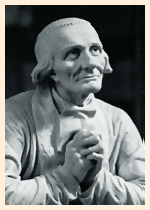
From the 5th to the 9th of this month the relic of St John Vianney will be in England. It is extraordinary just how much this humble parish priest had to offer in life; there has always been a superabundance of priestly life and grace in the person of the Cure d'Ars. The first visit of the relic of his heart to the shores of England is surely a great grace.
Bishop Ullathorne, the first Bishop of Birmingham after the restablishment of the English Hierarchy, relates in his autobiography how he visited the cure in Ars and spoke to him about the difficulties the Church was facing in trying to evangelise England, St John Vianney looked up and said "Ah yes, but it wont always be like that!"
I always visit the shrine of the heart when I'm in Ars and am sorry that I wont be in England for this visit. I wanted to include a photo of the heart's shrine in Ars here but I cant seem to get the software to cooperate on this occasion.
Special thanks go to Bishop Mark Davies for initiating and hosting the visit of this relic. 

Sunday, 24 June 2012

The renewing event

Recently the Sandro Magister Blog had a post on the Hidden Treasure of Pope Benedict, in which he pasted links to all the homilies of Pope Benedict on the subject of Baptism, and he spoke of how these homilies rank alongside some of the homilies of the early Fathers. They do; there are fifteen such homilies. Here is the link to this post.
Baptism is the hinge of the Life of Grace and, in my experience at least, our appreciation of and vision of the difference that Christ makes is often unspoken. Yet our Christian lives are set in relief when we appreciate the world from where we all came, and the world into which Christ has introduced us; the life that we used to live and the life that we live in Him; the secular and the fallen, and in Him, grace and truth. We could spend much time digesting these homilies of our Holy Father in order to develop our apprectaion of Baptism, the way in which we lead people to it, and the way in which we nake it our foundation in life.
Many thanks to Sandro Magister for collating all these homilies and bringing them to our attention. 

Thursday, 21 June 2012

Priesthood and its renewal.

Last week I led the monthly 'recollection morning' at the seminary in which I focussed on the way that the priest is implicated in the celebration of Mass. My point of departure was a part of the Council's decree on the Priesthood, Presbyterorum Ordinis (12-14). John Paul II during his Pontificate developed this teaching of the Council, enabling the Church to see the way-markers which the Council had given us for the renewal of the priesthood, and particularly for the renewal of the Diocesan priesthood.
What is the measure or gauge of the renewal of the Diocesan priesthood? I don't think that we know what a truely renewed priesthood will look like, but what we do know is that the shape and the form of the Diocesan priesthood as it presently is, is not our goal. The priesthood is called to be purified and to be renewed. Essentially, the true glory of the priest is that he is called to be glorified with Christ in the Paschal Mystery. The Council's teaching on the Priesthood was given in the context of modern culture, and because of this, the Church is called to respond in a new way to priestly life and ministry.
Presbyterorum Ordinis outlined three particular dimensions to the priesthood which lie at the basis of the renewal of the Diocesan priesthood. Firstly, that the priesthood should not be seen so much as a ministry which is above the Church, but rather as one which is within the Church, and one which therefore acts as a leven to the whole Church.
Secondly, it spoke about pastoral charity. This is something which can fail to recognise the importance of; John Paul II really opened up the depth of this expression and revealed it as the essence of priestly life and work.
Thirdly, the Decree on the priesthood spoke about the genuine ways in which men who are called to the priesthood are called to actively cooperate with the grace of Holy Orders; the subjective ways in which priests embrace the objective reality of the Sacrament which configures them to Christ the Priest.
These three indicators lie at the heart of the priesthood and therefore also of priestly renewal. The teaching of the Council on the priesthood is also more significant than the models of priesthood which we have grown up with from the recent past, and for that reason calls for renewed reflection; as does John Paul II's Letter Pastores Dabo Vobis, and the 1994 Instruction Directory on the life and mission of priests.
Basically, what I am saying is that the renewal of the Diocesan priesthood, whilst respecting the current discipline of the Church, is today being called to a fuller embracing of the mystery of the Priesthood of Christ. We have saintly individuals who are tremendous examples of Diocesan priests, St John Vianney and St John of Avila, for instance, whose witness will always be timely. But that the recent teaching of the Church on the priesthood calls us to look beyond recent models of the priesthood and to seek genuine renewal.  

Tuesday, 19 June 2012

The intention of the Council

Time and again the Holy Father has spoken about the Liturgy and its reform with such clarity that the intention of the Council might be clearly appreciated by all, and so that we today might be led to enter into and the Liturgy more fully. During his address at the closing of the International Eucharistic Congress in Dublin he again defined with great clarity the heart of the Liturgical reform. I will do no more than simply paste his words here:
  "At our distance today from the Council Fathers' expressed desires regarding liturgical renewal, and in the light of the universal Church's experience in the intervening period, it is clear that a great deal has been achieved; but it is equally clear that there have been many misunderstandings and irregularities. The renewal of external forms, desired by the Council Fathers, was intended to make it easier to enter into the inner depth of the mystery. Its true purpose was to lead people to a personal encounter with the Lord, present in the Eucharist, and thus with the living God, so that through this contact with Christ's love, the love of his brothers and sisters for one another might also grow. Yet not infrequently, the revision of liturgical forms has remained at an external level, and 'active participation' has been confused with external activity.
 ...   How are we to explain the fact that people who regularly received the Lord's body and confessed their sins in the sacrament of Penance have offended in this way? It remains a mystery. Yet evidently, their Christianity was no longer nourished by joyful encounter with Jesus Christ: it had become merely a matter of habit. The work of the Council was really meant to overcome this form of Christianity and to rediscover the faith as a deep personal friendship with the goodness of Jesus Christ." 

Friday, 15 June 2012

Priestly fraternity 3

My third and last post on this subject is to take priestly fraternity to another level and into an area of a priest's life which is somewhat neglected: accountability.
A priest is obviously accountable to his bishop and, in a different way, to his parish or pastoral community. This still leaves huge areas of a priest's life where he is, in many ways, his own agent. A priest does not account to his bishop on a day to day basis, nor necessarily on a year to year basis. Nor can a priest really discuss his life and his personal situation with his parishioners. But what about with his brother priests?
Accountability through priestly fraternity enables the whole spectrum of a priest's life, from the way he spends his days off to the frustrations and misunderstandings that arise in his life, to be enlightened in a human and a priestly way through fraternity. Accountability through fraternity does presuppose that a priest is a part of a genuine fraternity in which priests invest much of themselves. In such a context, life-sharing by brother priests enables re-evaluation and appropriation of the stuff of their lives to take place in a life-giving way. 
Accountability through fraternity takes place through the genuine maturing of priestly fraternity and will inevitably lead to a deepening of the priestly interior life and apostolic vision. In a similar way, Bishops' Conferences can be the context for such a culture to develop.
And while I wish for all of you the grace to rekindle daily the gift of God you have received with the laying on of hands (cf. 2 Tm. 1:6), to feel the comfort of the deep friendship which binds you to Jesus and unites you with one another, the comfort of experiencing the joy of seeing the flock of God grow in an ever greater love for him and for all people, of cultivating the tranquil conviction that the one who began in you the good work will bring it to completion at the day of Jesus Christ (cf. Phil. 1:6), l turn with each and every one of you in prayer to Mary, Mother and Teacher of our priesthood.
Every aspect of priestly formation can be referred to Mary, the human being who has responded better than any other to God's call. (John Paul II, Pastores Dabo Vobis, 82)

Monday, 11 June 2012

Priestly fraternity 2

So, priestly fraternity is a way of being rather than a duty to observe, because the priesthood is rooted in Christ.
The human dimension of priestly fraternity - again, something that is learned - is that a priest must first relinquish his own independence, and accept that his brother priests can help him to be open to what Christ wants of him. This is the first step to building priestly fraternity for it enables the individual priest to invest himself in fraternity and be open to receive from his brother priests. The Holy Spirit is undoubtedly at work when this happens.   
The ecclesial dimension of priestly fraternity is also very rich. All priests share in the same mission - building up the Church. This involves an attachment to both the Holy Father and the Bishops, but what is really at stake here is a missionary dynamic. In other words, genuine priestly fraternity enables priests to remain focussed on their mission, which is the sanctification of souls, and to avoid becoming over-involved with activities which are not essential.  
Another example of priestly fraternity, which was tremendoulsy enriching of my own experience, took place when I was a parish priest in Huddersfield. In 2007 I engaged the parish in a Parish Mission. The Mission was based on a series of waves of house-visiting throughout the Spring. The culmination of the Mission was the visiting of houses by priests. I had sent out requests to other priests to come and help me in my endeavour. Five priests responded and joined me in my parish. So, for a two-week period homes in the parish were visited by priests - and we went out visiting in twos! I was able to accomodate them all in the presbytery and to cook two meals a day for us all. We went out visiting in the afternoons and the evenings. Our priestly endeavour in the parish fed our fraternity and our fraternity fed our priestly identity. It was an extraordinary two weeks which I see, in some way, as a model of diocesan priestly life.

Thursday, 7 June 2012

Priestly fraternity 1

I have been presenting in the seminary over the past couple of weeks the part which priestly fraternity has in the life of the Diocesan priest. This has been drawn, in part, from what Fr Julian Green and I have learned and experienced from being a part of the Societe Jean Marie Vianney. I will post here, in three parts, the vision which I have spoken about in the seminary.
First of all, what are the obstacles to priestly fraternity? They are two-fold: priests being isolated, living on their own, and priests not thinking of one another. Both of these can easily become stumbling blocks to priestly fraternity.
Secondly, priestly fraternity is something which, in my experience, doesn't happen in the normal course of events; it is rather something which has to be learned, received and embraced. This is because priestly faternity is established not upon basic human camaraderie, but upon the charismatic gift of the priesthood, together with those particular charismatic gifts which each priest has been given. This is not to say that the human elements of fraternity are not involved, they are; but that priestly fraternity really comes alive when it is lived at the level of the priesthood.  
In fact, there is only one Priest, who is Christ the Lord; this is the key to fraternity. For although there is only one Priest, we priests are a multitude, for we have been given a share in His Priesthood. Our origin and our priestly nature is identical - this is what we share in common.
How is priestly fraternity received and embraced? The way in which I 'learned' priestly fraternity was by coming to realise my own interior poverty as a priest - that I was maintaining a certain level of interior life, but didn't like to go beyond this. Then, through my contact with the priests of the SJMV I was opened to a deeper experience of the priesthood both in myself and in other priests. This openness, at the level of the charismatic gift of the priesthood was truly enriching of my own priesthood, and I could see that to be the case in the other priests also. Indeed, the focus of priestly fraternity is not so that priests can have a cosy clerical club in which to withdraw, but is for the opening up and nurturing of the interior life of the individual priest, precisely so that he can be a better priest in whatever apostolic mission he has in the Church.
An occasion where this became evident to me took place in August 2007 when both of us were spending a week in Normandy with the priests of the SJMV. One day we went to explore a region of the Normandy beaches and, at midday, had a picnic by the Batterie des Longues (a WWII German gun battery overlooking the English Channel). After the picnic we all stood up in a great ring (about 65 diocesan priests) and prayed aloud together the psalms of Midday Prayer. The place where we were is a very popular tourist spot, and as we prayed many visitors to the site silently joined in our act of worship. It was a most tremendous moment - a great gathering of diocesan priests praying together in public in a totally un-selfconscious way; our priestly hearts came alive together in Christ, our priesthood became stronger. It is because of experiences like this that priests can support and nurture one another in a unique way.

Monday, 4 June 2012

Cultural reference

Today, on the Feast of St Boniface there is an excellent piece about him in the Crisis Magazine website. This post is simply flagging up this website - www.crisismagazine.com - which is operated by the Sophia Insititute of the Thomas More College of Liberal Arts in New Hampshire. The website seeks to underpin our contemporary outlook with the heritage of Western Christian tradition. It is worth a visit.
The Sophia Institute is already well known as the publisher of this same tradition: www.sophiainstitute.com.  

The Year of Grace 2

In 2005 I produced a number of leaflets - The Living Truth series - which covered a variety of themes. Fr John Edwards SJ wrote an excellent leaflet on the theme of grace. I include the text of this leaflet here:
"The life of Grace is absolutely vital for intelligent living in this life and to getting to heaven and avoiding going to a place where all good is rejected - hell - in the next. It is the most important gift I could ever have, and its loss would be the greatest disaster. Christianity is nearly incomprehensible if we do not know about it.
Grace is a supernatural share in the life of God himself. It is already the life we need to live in heaven; it is the equipment we need to endure, let alone enjoy, never ending Goodness, Truth and Beauty, outside space and time, for all eternity. It is a share in the life of Jesus, earned for us at a great cost when he died on the cross.
Grace enables us to enter and enjoy heaven (Without it we would find it un-endurable - it would in fact be hell because we wouldn't have the right tools and equipment.) Right now, every single action we  do draws from the Heavenly Father a "reward". This we receive in heaven. From God's point of view it is important that we are in a state of Grace, because if we are filled with grace we can help to make heaven a reality here on earth.
The Scriptures say a lot about Grace. It's bad to try to argue from "proof texts"' but here are some basic thought-provokers: "I am the Way, the Truth and the Life", "no man can enter into the Kingdom of God unless birth comes to him by water and from the Holy Spirit", "if anyone eats my flesh and drinks my blood, he lives in me, and I in him", "he has chosen us out, in Christ ... marking us out ... to be his adopted children through Jesus Christ."
We receive Grace normally through baptism. We lose it through mortal sin (that is, if we give full and deliberate consent to something against God's law in a serious matter, something that seriously rejects love and goodness.) We regain it through a deep love-sorrow, which is God's gift. This love-sorrow is always given if we receive the Sacrament of Absolution properly; this refers to the reality of being forgiven of our wrongs when we receive this sacrament through the heands of a Catholic priest.
Do we feel the presence of Grace? Not normally. Do only Catholics have Grace? No, otherwise only Catholics would get to heaven. But Grace certainly comes in some way through the Church - which is of course Christ's Body.
There is much more that we can say about Grace, but notice two things especially. First, the life of Grace comes through the gift of Jesus; it is a share in his own life. And he got his life from Mary - that was the way God planned it. Mary is not worshipped, but honoured by Catholics and has a vast part to play in our own state of Grace, in receiving it and in keeping it."

Wednesday, 30 May 2012

The Year of Grace

The Year of Grace which opened in Australian Dioceses on Pentecost Sunday and which runs through until Pentecost next year, is given to the Church in Australia to lead her to a deeper encounter with Jesus.
The word grace, which we use so often, means the gift of sharing in God's life. Grace then, is the person of Jesus Christ and the indwelling of the Holy Spirit, whom the Father and Jesus have sent to us.
In many parts of the world today Jesus is marginalised, people have heard about him and think that this is the time for us all to move on from the Jesus 'story'. The radical truth is that Jesus as both God and man reveals to us now the love of God!
Again in many corners, following Jesus is thought of as a whole series of rules and regulations which must be observed. The reality is very different; following Jesus means living in freedom and truth!
Today many still prefer the opinion that God is either dead or never existed. The fact is that Jesus rose from the dead and is alive in His Church, living  and working today in His followers!
Another contemporary opinion is that to believe means to live in fear of a watchful and judgemental God. The extraordinary truth is that Jesus is full of merciful love and leads his followers into the fullness of life!
Again, many still claim that the Gospel is a purely human text, secretly invented. The real secret is that the Gospel is inspired by the Holy Spirit and introduces human beings into the life of God!
This is grace - the person of Jesus who is proclaimed by the Church and who wants us all to know Him.

Tuesday, 29 May 2012

But when they are gone?

Bob Dylan's award at the White House yesterday - by the way, well done Bob! - puts me in mind of one of our culture's main building bricks: the rock and pop culture of the 60s through to the 90s, which our generation has been fixated with. You can already sense the intensity which is being applied to maintain this culture now that some of the figures of this era are passing. The incesant hype in the media calling us to relive this era, the repeticious playing of the songs of this era in shopping malls, in movies, in mobile phone tones. A strange phenomenon indeed, yet the times are indeed changing and when this generation passes what will there be then. What vision of life has the rock and pop generation handed on to the new generation which is emerging? Is it a vision which deserves to remain?

Saturday, 26 May 2012

A favourite painting

Yesterday evening I gave a talk to the Immaculata youth group in Lewisham, part of a mini-series which we are doing on St Paul. The Scripture passage which we looked at was St Paul's address at the Areopagus in Athens (Acts 17). This section of Acts, together with Paul's departure from Athens for Corinth, is my favourite section of the Acts. I have long known about Leo von Klenz' painting of the Acropolis reconstructed. It is a magnificent painting housed in Munich. I insert here an image of the painting. It does, in fact, depict St Paul's speech at the Areopagus; you can see Paul speaking to a crowd in the forefront of the painting. The crowd even includes soem girls who are laughing at the speaker.

Thursday, 24 May 2012

The seminary and the new evangelisation

Fr Robert Barron brings the two together. Read his article here.