Well we've both been back two days from Ars, but I think there are so many experiences that we've had there that it's difficult to know where to begin.
The Conference - or Colloquium to give it its proper name - had as its subject 'The Diocesan Priesthood: What sort of holiness?' The Conference itself consisted of 14 different papers on various dimensions of the theme - Biblical, Theological, Liturgical, Spiritual, Pastoral.
The Conference began with a major talk given by Cardinal Albert Vanhoye. I remember reading his book 'Priests of the Old Testament, Priest of the New Testament' in seminary - well I remember reading it, but the content is a bit rusty in my memory. He gave a talk on the Biblical dimension of the question of holiness of the priest. He went straight to the heart of the matter, saying that there is no direct reference to the ministers of the Church being priests in the New Testament, but that, because of their intimate consecration to Christ, they share in the priesthood of Christ as described in the letter to the Hebrews. This is a priesthood which is different from that of the Old Testament, where the priest is consecrated because he is separated from the people. The priesthood of Christ is such that he comes close to, and shares in the very nature of the people. The Cardinal concluded that, if we want a true understanding of the holiness of the priest, then we have to look to the image of Christ the High Priest, as presented foremost in the letter to the Hebrews. This indicates a priesthood which is
 not distant or removed from mankind, but sharing fully in the human reality - that doesn't mean conforming to a particular way of living, but to live fully in the culture.
Another speaker on the first day of the Conference, Fr Philippe Vallin, echoed this understanding of how the priest relates to the holiness of Christ and to the culture by referring to priesthood as 'the ministry of the New Man in the house of the Old Man'. In other words, being the New Adam - Christ - while living in the context of the Old Adam - the world. This has many different ways of being incarnate. Unlike religious life, Diocesan priesthood does not have a specific charism. Rather the Diocesan priest is open to all charisms, integrating the triple munera (to teach, to sanctify and to govern) in pastoral charity, which has as its foundation, openness to the person of Christ.
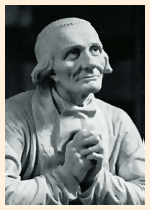
Being in Ars, it is obvious that there had to be a talk on how the Curé of Ars incarnates this figure of holiness. For many, the image of the Curé is rather remote, considering his holiness and the form of his ministry. And yet, St John Mary Vianney embodies 'pastoral charity' in a particularly radical form, and is an example (as well as intercessor) for priests. Fr Jean-Philippe Nault spoke about three aspects of the Curé's holiness. The first of these is that he shared the heart of the poor. This really sums up the way in which the Curé was personally holy: his own poverty gave him a true humility which was open to union with God. Poverty is what made him a friend with God, incarnating the mercy of God for others, and which became a personal strength for him in adversity. Secondly, the Curé was a great pastor, who gave of himself entirely, symbolised by his many hours spent reconciling sinners with God and the Church. As Pope John Paul II said of him, "He was a martyr of the confessional". The Curé was, in other words, a 'total priest' - everything about him spoke of the priesthood of Christ. Thirdly, the Curé lived the communion of saints. This is important for the holiness of all of us - to live in the communion of saints, recognising that we are
 not Christians alone, but in company with saints living and departed.
The clearest talk of the whole conference was given by the Rector of the SJMV seminary in Ars, Fr Sylvain Battaille. He spoke on the structure of the liturgy of ordination and the way in which it reveals the theology of Ordination to the priesthood. He showed how each of the parts of the Ordination Rite represent stages in the call and consecration of the Apostles. It was a tremendous overview of the Rite of Ordination, and something I wish I'd had when I was in seminary.
A very interesting talk was given by Fr Matthieu Rougé on the Eucharist and Love of the Church in the life of the priest. He set the celebration of the Eucharist in the framework of the triple munera (to teach, to sanctify, to govern), showing that there is an intimate relationship between all three of these functions. There can be no Eucharist without the Word - the Liturgy of the Word is not just a message from Christ, but is giving Christ himself to his People. This is why it must be presided over by the priest, and why it necessarily precedes the celebration of the Eucharist. The Word proclaimed in the Liturgy of the Word is quasi(sort of) sacramental. Teaching and sanctifying give rise to the priest's role of presiding over a portion of the faithful. The priest, in the Mass, gathers all the People into the Heart of Christ: it is about drawing people into communion. This is then the role of the priest outside the Mass when he is leading his people. Finally, Fr Rougé concluded that the priest has a threefold way of drawing people into sanctification: fraternally, paternally and spousally. He is a brother to all the faithful, based on baptism. We are placed in a fraternity by Christ, and we as priests do not lose that basic baptismal sanctification. But the priest is also 'father'. There can be no brothers if there is no father. The priest represents Christ, who is the 'paterfamilias' - the head of the household of the Church. The priest also has a spousal relationship with the Church. Just as Christ is bridegroom of the Church, his bride, so the priest is drawn into that very same relationship. That demands love and total self-giving, as well as fidelity.

Developing the theme of the holiness of the priest in the exercise of the three functions of teaching, sanctifying and governing the People of God, Fr Jean-Pierre Battut showed how there is an objective holiness to the priesthood. The priest is holy - that's a gift from God. It comes to the priest through his consecration in Ordination. Nobody can take it away, not even the priest himself. But the priest is human, and needs to grow in subjective holiness. And so, although we realise that sacraments are valid when celebrated by a priest who is not committed to growth in holiness, the People are certainly helped by a priest who lives in the search for holiness. The Curé again is an example of this. His personal holiness drew people to conversion. His sacraments were no more valid than anyone else's. But it was his personal holiness which was a draw to the sacraments for those who flocked to Ars.
The Moderator of the SJMV, Fr Philippe Caratgé gave a talk on prayer and the holines
 s of the Diocesan priest. He said that prayer was necessary for the priest so that he might meditate on the Word which he has to proclaim, find real communion with the Church, and find Christ in the poor. The first stage of knowing Christ is to be known by Him. Meditation on the Word of God is truly a lifelong task of the priest. For the priest the Eucharist is the source of his living vocation, and so a truly prayerful celebration of the Mass together with Adoration of the Blessed Sacrament are indispensable for the priest. Finally, it is prayer that leads us to recognise the needs of others. The priest never prays just for himself. He has the duty to pray for the whole Church, and especially those in need. This prayer leads him to recognise the needs of others, and to have the grace to serve them in their needs.
It was a great blessing to have Mgr Guimaraes from the Congregation for the Clergy at the Conference. He spoke about the demands of the minstry and holiness. After a consideration of scenes from the life of the Curé of Ars, he spoke of the priesthood as the daily exercise of the gift given in Ordination, of acting in the person of Christ for his Church. Although the priesthood is a gift which has been given, and lived, for centuries, it is still a contemporary gift, and it will become more contemporary the more we are disposed to put into practice in the realities of life the grace received in ordination. There is no room for mediocrity. Activism (lots of activity and no prayer) is also no answer. The priesthood today - more than ever - demands the holiness of a life completely given over and consecrated. Mgr Guimaraes then made a great link to the teaching of the Holy Father, who underlines the private prayer of the priest before receiving Holy Communion: "never let me be separated from you." Christ calls us his 'friends' - if we remain faithful to Him, we will never be parted from Him.
 Finally (phew!), the Bishop of Belley-Ars, Mgr Guy-Marie Bagnard, gave a final talk summing up how holiness is the call of the life dedicated to God in the Sacrament of Holy Order. He mentioned the example of Fr Max Thurian, the Taizé brother who was Protestant, but became Catholic and was ordained as a priest. He said he recognised how Protestantism has robbed the triple munera of the role of sanctification. Protestantism does not see ministry as a sacrament, but as a commission or blessing in order to preach the Word and to direct the community. But these functions end out being just functions, because they are robbed of their Heart - which is the task of sanctification through the sacraments. For Catholics, therefore, the true identity of the priest as the man consecrated to the mediatory priesthood of Christ (although all the baptised share in the priesthood of Christ, only the ordained priest shares in his priesthood of mediation) is paramount for the progress of the Church in holiness. For the priest, it means there is the task of personal sanctification.
Well that was rather exhausting. Not as exhausting as listening to these hours of talks in French however. But it was certainly worth the experience. I may post again on the Conference, about my personal experience of it, but I thought I'd do this task of summarising the talks first.