Showing posts with label priestly fraternity. Show all posts

Saturday, 3 March 2007

Practical advice from the Holy Father for priests

On ZENIT yesterday there was a second transcription of a Q & A that the Holy Father recently had with a group of seminarians. This answer particularly stood out to me because it basically echoes the aims of the Société Jean-Marie Vianney, which I wrote about earlier.

Marco Ceccarelli: Diocese of Rome, (Deacon): Your Holiness, in the coming months my companions and I will be ordained priests. We will move from a well-regulated seminary life to the broader context of parish life. What advice can you give us to enable us to adjust as well as possible at the beginning of our priestly ministry?

Benedict XVI: Well, here at the seminary you do have a very good routine. I would say as the first point that it is also important in the life of pastors of the Church, in the daily life of the priest, to preserve as far as possible a certain order. You should never skip Mass -- a day without the Eucharist is incomplete -- and thus already at the seminary we grow up with this daily liturgy. It seems to me very important that we feel the need to be with the Lord in the Eucharist, not as a professional obligation but truly as an interiorly-felt duty, so that the Eucharist should never be missed.


Another important point is to make time for the Liturgy of the Hours and therefore, for this inner freedom: with all the burdens that exist, it frees us and helps us to be more open, to be deeply in touch with the Lord.
Of course, we must do all that is required by pastoral life, by the life of a parochial vicar or of a parish priest or by another priestly office. However, I would say, never forget these fixed points, the Eucharist and the Liturgy of the Hours, so that you have a certain order in the daily routine. As I said at the outset, we learned not to have to plan the timetable ever anew; "Serva ordinem et ordo servabit te". These are true words.

Next, it is important not to neglect communion with other priests, with one's companions on the way, and not to lose one's personal contact with the Word of God, meditation. How should this be done? I have a fairly simple recipe for it: combine the preparation of the Sunday homily with personal meditation to ensure that these words are not only spoken to others but are really words said by the Lord to me myself, and developed in a personal conversation with the Lord.
For this to be possible, my advice is to begin early on Monday, for if one begins on Saturday it is too late, the preparation is hurried and perhaps inspiration is lacking, for one has other things on one's mind. Therefore, I would say, already on Monday, simply read the Readings for the coming Sunday which perhaps seem very difficult: a little like those rocks at Massah and Meribah, where Moses said: "But how can water come from these rocks?". Then stop thinking about these Readings and allow the heart to digest them. Words are processed in the unconscious, and return a little more every day. Obviously, books should also be consulted, as far as possible. And with this interior process, day by day, one sees that a response gradually develops. These words gradually unfold, they become words for me. And since I am a contemporary, they also become words for others. I can then begin to express what I perhaps see in my own theological language in the language of others; the fundamental thought, however, remains the same for others and for myself. Thus, it is possible to have a lasting and silent encounter with the Word that does not demand a lot of time, which perhaps we do not have. But save a little time: only in this way does a Sunday homily mature for others, but my own heart is also touched by the Lord's Word. I am also in touch with a situation when perhaps I have little time available.

I would not dare now to offer too much advice, because life in the large city of Rome is a little different to what I experienced 55 years ago in our Bavaria. But I think these things are essential: the Eucharist, the Office of Readings, prayer and a conversation every day, even a brief one, with the Lord on his words which I must proclaim. And never lose either your friendship with priests, listening to the voice of the living Church, or naturally, availability to the people entrusted to me, because from these very people, with their suffering, their faith experiences, their doubts and difficulties, we too can learn, seek and find God, find our Lord Jesus Christ.

Sunday, 25 February 2007

The John-Mary Vianney Society

As Fr Richard said, we're off to Ars today for a few days - probably a few blogless days therefore - for a Colloquium (Conference) entitled "Diocesan Priests - what sort of holiness?". It should be an interesting programme. The lead speaker is the well respected theologian Cardinal Vanhoye. We'll no doubt post some blogs on our return to let you know more about the conference.

Ars is of course well known as the parish of the Holy Curé of Ars, St John Mary Vianney. But it is also, today, the site of a renewal in seminary and priestly life. Here is an excerpt which I've lifted from the AD2000 website

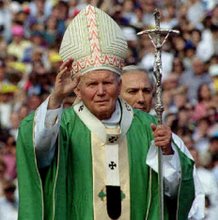
Because of St John Vianney, Ars became a major shrine of France, visited by thousands. Among them was the young Polish priest, Fr Karol Wojtyla, who came there on pilgrimage in 1947. He came again in 1986, this time as Pope John Paul II. Before the Pope's visit, a group of French clergy petitioned him not to go to Ars, alleging that John Vianney's concept of the priesthood was wrong, and unfit for the present day. The Pope's response was to proceed according to plan. He gave a three-part meditation and a homily in Ars, and proclaimed in the clearest terms the essential role of the priest as the one who makes the work of salvation present everywhere in the world.

By his visit to Ars and by what he said there, Pope John Paul stressed that John Vianney's life and teaching were as relevant and as necessary for the world's priests and seminarians today as they were when Pope Pius XI made him their patron in 1929. This also underlined the universal importance of Ars as the heartland of the priesthood.

A year after the Pope's visit to Ars, the local diocese of Belley was given a new bishop. Until his appointment, Bishop Guy Bagnard had been rector of a seminary at Paray-le-Monial. His experience in seminary formation had shown him that God is still calling men to the priesthood, and that, given the right circumstances, many are willing to answer that call. However, unlike most clerics of former years, today's seminarians are older, with a great variety of home backgrounds and personal experiences. Many have given up lucrative professions in order to study for the priesthood; they come with high ideals and expect high standards. Therefore, a new approach to formation is needed.

Bishop Bagnard was acutely aware of the loneliness which affects many priests who live alone; as the local bishop he was very conscious of his duty to guard the charism of St John Vianney on behalf of the whole Church. He took care of both concerns by founding the Society of John Mary Vianney, an association of priests who wish to live their priesthood under the patronage and guidance of the Curé of Ars. Grouped in small fraternities, the Society aims to provide the spiritual and human support necessary for the diocesan priest today.

Bishop Bagnard gave an important task to the Society of John Mary Vianney when he asked it to take charge of the seminary which he opened at Ars in 1988. It began with six candidates; today there are one hundred and twenty men preparing for the priesthood there. About eighty are from France; the rest represent various countries and continents.

The formation begins with a year of discernment; during this year the candidates receive a basic spiritual and doctrinal training. Then follows a two-year course in philosophy and three years of theology.

The seminarians live in groups of about fifteen in various houses in Ars. Each house has an oratory, and one or two resident priests. One of the seminarians is responsible for the day-to-day running of the house. The mid-day meal is taken in the seminary, where the lectures, apart from those in theology, are given.

A happy, friendly atmosphere prevails. The seminarians are loud in their praise of the seminary and the formation which they receive. All professors are required by the statutes to "adhere without reserve to the magisterium ... since they teach in the name of the Church." This is a major contributory factor in the success of the seminary.

One seminarian summed it up as follows: "The crisis in so many seminaries today is due to the lack of proper teaching and formation rather than to the lack of vocations."

Thus the flame lit by St John Mary Vianney and fuelled by Pope John Paul Il and Bishop Bagnard is beginning to radiate through France and beyond.

And beyond it certainly goes, for both Fr Richard and myself are, with the permission of our respective bishops, seeking to become members of the John Mary Vianney Society of priests (SJMV), and so become it's first members in England (it has, at present, members in France, Germany and Canada).

The Society is a Clerical Association of Pontifical Right for Diocesan Priests. That means it is not a religious order, or a clerical institute, but an association which is specifically for Diocesan Priests to support them in their ministry. The life of the Association is guided by the Statutes, which list 10 'Exigences Communes' which each member is expected to live:
  1. The daily celebration of Mass
  2. The Liturgy of the Hours celebrated with attention, as praise and intercession in the name of the Church
  3. Daily prayer, above all other things, in that one cannot of one's day without prayer
  4. Confession at least monthly
  5. A regular meeting with a Spiritual Director
  6. Adoration of the Blessed Sacrament at least one hour per week
  7. Daily Marian prayer
  8. Personal study of theology
  9. An annual retreat
  10. Participation in the life of a local fraternity.
Apart from number 10 these are what one would hope from any diocesan priest. In other words, the principle demands of the SJMV are the same as those of Diocesan Priesthood lived in the way the mind of the Church expresses it. The final element - the meeting in a fraternity - is the way of living out this Diocesan priesthood supported by a community dimension. The ideal of the SJMV is priests actually living in community, but the minimal participation in this community dimension is a monthly meeting of between 3 and 6 priests. The meetings which we already have each month include an overnight stay, Mass celebrated together, Adoration of the Blessed Sacrament, a time of sharing about our priestly ministry over the past month, a good meal (or two), and joint study.

The whole life of the SJMV is an expression of the particular charism, which is priesthood lived under the inspiration of the Curé. This is a priesthood of kindness and mercy, as well as a personally demanding. The charism of the society seeks to encourage vocations to the priesthood, to see all things in the light of evangelisation, and to serve the poor most especially.

In order to become a member of the SJMV, the first thing is to gain the permission of one's bishop and admission as a probationary member for two years for the purposes of discernment. This is then followed by a temporary engagement of three years, followed by a definitive engagement for life. The probationary period can begin from Ordination to the Diaconate. Most members at the moment come from the Ars seminary - which is the seminary of the Society not of the Diocese - but the SJMV is now beginning to expand further afield. The seminary also houses the priests' residence which many English priests have already experienced - the Foyer Sacerdotal Jean Paul II.

Both Fr Richard and I would like to hear from any Diocesan priests who are interested in finding out more about the SJMV. We would invite priests who would wish to come to one of our meetings, with no pressure or obligation to join, but simply to share in our priestly fraternity. There is also a group of lay associates who join the Society. It is for those lay people who wish to support priests and priestly vocations through prayer and active work. It would be good to hear from interested lay people. In any case, please pray for us as we pursue membership of the Society.

The French SJMV website is here