Monday, 19 March 2007
Learning to love each other
Thursday, 15 March 2007
Phos Hilarion
Have you heard of the "Lucenarium"? I can't tell you a great deal about it, but the Lucenarium is a Vigil of Light which is kept on the vigil of Sundays and great Feasts. The word refers to the ceremony of lighting candles while singing the ancient hymn "Phos Hilarion" (Joyful Light).O Radiant Light, eternal joy of the
Father,Holy and Blessed Jesus
Christ.Worthy are You at all times to be
praised by the song of all the Saints,Son of God, who gave us life, let
the world sing forth your praise.
Monday, 12 March 2007
Bad events & Moral evil
The Holy Father also spoke on this Gospel in his Angelus address. He said that it indicated that we need constant conversion:
This is, therefore, the point to which Jesus wished to lead those who were listening to him: the need for conversion. He does not present it in moralistic, but rather in realistic terms, as the only appropriate response to events that put human certainties in crisis. In the face of certain misfortunes, he advises, it is no good to blame the victims. What is truly wise, rather, consists in allowing oneself to be questioned by the precariousness of existence and to adopt an attitude of responsibility: to do penance and improve our lives...In short, conversion overcomes evil at its root, which is sin, though it cannot always avoid its consequences.
Friday, 9 March 2007
Describing the New Evangelisation
During the Jubilee Year, the then Cardinal Ratzinger gave a superb address to Catechists, in which he described the nature of the New Evangelisation. Lest this great discourse be forgotten by our readers, I have placed a PDF file of this discourse on the Community of Grace website. You kind find it by visiting the "Holy Father" page on the site. Thursday, 8 March 2007
Condom culture
01.jpg)
of God for us goes unrecognised.Vatican Lent Website
Tuesday, 6 March 2007
Gestures of mercy
This year, following the presedent of the past two years, we are holding the Stations of Cross weekly in the streets. Where I live in Huddersfield the culture of death is very strong: gangs, guns, drugs, alcohol and serial sex - I didn't feel that, as a parish, we should huddle all of our prayer and spirituality inside the church. It is too late in the day for that. Our culture needs to see signs of grace and mercy. If we do not give those gestures, who will?
The Gospels day by day
Sunday, 4 March 2007
A late e-pilgrimage for February
The e-pilgrimage for February arrived on the World Youth Day website rather late, but it's well worth looking at. There is a part of Pope John Paul II's great letter Dilecti Amici as well as testimony, life of a saint, prayer ideas. You can find the e-pilgrimage stuff here.
Here he is

Saturday, 3 March 2007
Into the brotherhood
Practical advice from the Holy Father for priests
Marco Ceccarelli: Diocese of Rome, (Deacon): Your Holiness, in the coming months my companions and I will be ordained priests. We will move from a well-regulated seminary life to the broader context of parish life. What advice can you give us to enable us to adjust as well as possible at the beginning of our priestly ministry?
Benedict XVI: Well, here at the seminary you do have a very good routine. I would say as the first point that it is also important in the life of pastors of the Church, in the daily life of the priest, to preserve as far as possible a certain order. You should never skip Mass -- a day without the Eucharist is incomplete -- and thus already at the seminary we grow up with this daily liturgy. It seems to me very important that we feel the need to be with the Lord in the Eucharist, not as a professional obligation but truly as an interiorly-felt duty, so that the Eucharist should never be missed.
Another important point is to make time for the Liturgy of the Hours and therefore, for this inner freedom: with all the burdens that exist, it frees us and helps us to be more open, to be deeply in touch with the Lord. Of course, we must do all that is required by pastoral life, by the life of a parochial vicar or of a parish priest or by another priestly office. However, I would say, never forget these fixed points, the Eucharist and the Liturgy of the Hours, so that you have a certain order in the daily routine. As I said at the outset, we learned not to have to plan the timetable ever anew; "Serva ordinem et ordo servabit te". These are true words.
Next, it is important not to neglect communion with other priests, with one's companions on the way, and not to lose one's personal contact with the Word of God, meditation. How should this be done? I have a fairly simple recipe for it: combine the preparation of the Sunday homily with personal meditation to ensure that these words are not only spoken to others but are really words said by the Lord to me myself, and developed in a personal conversation with the Lord. For this to be possible, my advice is to begin early on Monday, for if one begins on Saturday it is too late, the preparation is hurried and perhaps inspiration is lacking, for one has other things on one's mind. Therefore, I would say, already on Monday, simply read the Readings for the coming Sunday which perhaps seem very difficult: a little like those rocks at Massah and Meribah, where Moses said: "But how can water come from these rocks?". Then stop thinking about these Readings and allow the heart to digest them. Words are processed in the unconscious, and return a little more every day. Obviously, books should also be consulted, as far as possible. And with this interior process, day by day, one sees that a response gradually develops. These words gradually unfold, they become words for me. And since I am a contemporary, they also become words for others. I can then begin to express what I perhaps see in my own theological language in the language of others; the fundamental thought, however, remains the same for others and for myself. Thus, it is possible to have a lasting and silent encounter with the Word that does not demand a lot of time, which perhaps we do not have. But save a little time: only in this way does a Sunday homily mature for others, but my own heart is also touched by the Lord's Word. I am also in touch with a situation when perhaps I have little time available.
I would not dare now to offer too much advice, because life in the large city of Rome is a little different to what I experienced 55 years ago in our Bavaria. But I think these things are essential: the Eucharist, the Office of Readings, prayer and a conversation every day, even a brief one, with the Lord on his words which I must proclaim. And never lose either your friendship with priests, listening to the voice of the living Church, or naturally, availability to the people entrusted to me, because from these very people, with their suffering, their faith experiences, their doubts and difficulties, we too can learn, seek and find God, find our Lord Jesus Christ.
Priests' Conference in Ars
The Conference - or Colloquium to give it its proper name - had as its subject 'The Diocesan Priesthood: What sort of holiness?' The Conference itself consisted of 14 different papers on various dimensions of the theme - Biblical, Theological, Liturgical, Spiritual, Pastoral.
The Conference began with a major talk given by Cardinal Albert Vanhoye. I remember reading his book 'Priests of the Old Testament, Priest of the New Testament' in seminary - well I remember reading it, but the content is a bit rusty in my memory. He gave a talk on the Biblical dimension of the question of holiness of the priest. He went straight to the heart of the matter, saying that there is no direct reference to the ministers of the Church being priests in the New Testament, but that, because of their intimate consecration to Christ, they share in the priesthood of Christ as described in the letter to the Hebrews. This is a priesthood which is different from that of the Old Testament, where the priest is consecrated because he is separated from the people. The priesthood of Christ is such that he comes close to, and shares in the very nature of the people. The Cardinal concluded that, if we want a true understanding of the holiness of the priest, then we have to look to the image of Christ the High Priest, as presented foremost in the letter to the Hebrews. This indicates a priesthood which is
not distant or removed from mankind, but sharing fully in the human reality - that doesn't mean conforming to a particular way of living, but to live fully in the culture.Another speaker on the first day of the Conference, Fr Philippe Vallin, echoed this understanding of how the priest relates to the holiness of Christ and to the culture by referring to priesthood as 'the ministry of the New Man in the house of the Old Man'. In other words, being the New Adam - Christ - while living in the context of the Old Adam - the world. This has many different ways of being incarnate. Unlike religious life, Diocesan priesthood does not have a specific charism. Rather the Diocesan priest is open to all charisms, integrating the triple munera (to teach, to sanctify and to govern) in pastoral charity, which has as its foundation, openness to the person of Christ.
Being in Ars, it is obvious that there had to be a talk on how the Curé of Ars incarnates this figure of holiness. For many, the image of the Curé is rather remote, considering his holiness and the form of his ministry. And yet, St John Mary Vianney embodies 'pastoral charity' in a particularly radical form, and is an example (as well as intercessor) for priests. Fr Jean-Philippe Nault spoke about three aspects of the Curé's holiness. The first of these is that he shared the heart of the poor. This really sums up the way in which the Curé was personally holy: his own poverty gave him a true humility which was open to union with God. Poverty is what made him a friend with God, incarnating the mercy of God for others, and which became a personal strength for him in adversity. Secondly, the Curé was a great pastor, who gave of himself entirely, symbolised by his many hours spent reconciling sinners with God and the Church. As Pope John Paul II said of him, "He was a martyr of the confessional". The Curé was, in other words, a 'total priest' - everything about him spoke of the priesthood of Christ. Thirdly, the Curé lived the communion of saints. This is important for the holiness of all of us - to live in the communion of saints, recognising that we are
The clearest talk of the whole conference was given by the Rector of the SJMV seminary in Ars, Fr Sylvain Battaille. He spoke on the structure of the liturgy of ordination and the way in which it reveals the theology of Ordination to the priesthood. He showed how each of the parts of the Ordination Rite represent stages in the call and consecration of the Apostles. It was a tremendous overview of the Rite of Ordination, and something I wish I'd had when I was in seminary.
A very interesting talk was given by Fr Matthieu Rougé on the Eucharist and Love of the Church in the life of the priest. He set the celebration of the Eucharist in the framework of the triple munera (to teach, to sanctify, to govern), showing that there is an intimate relationship between all three of these functions. There can be no Eucharist without the Word - the Liturgy of the Word is not just a message from Christ, but is giving Christ himself to his People. This is why it must be presided over by the priest, and why it necessarily precedes the celebration of the Eucharist. The Word proclaimed in the Liturgy of the Word is quasi(sort of) sacramental. Teaching and sanctifying give rise to the priest's role of presiding over a portion of the faithful. The priest, in the Mass, gathers all the People into the Heart of Christ: it is about drawing people into communion. This is then the role of the priest outside the Mass when he is leading his people. Finally, Fr Rougé concluded that the priest has a threefold way of drawing people into sanctification: fraternally, paternally and spousally. He is a brother to all the faithful, based on baptism. We are placed in a fraternity by Christ, and we as priests do not lose that basic baptismal sanctification. But the priest is also 'father'. There can be no brothers if there is no father. The priest represents Christ, who is the 'paterfamilias' - the head of the household of the Church. The priest also has a spousal relationship with the Church. Just as Christ is bridegroom of the Church, his bride, so the priest is drawn into that very same relationship. That demands love and total self-giving, as well as fidelity.
Developing the theme of the holiness of the priest in the exercise of the three functions of teaching, sanctifying and governing the People of God, Fr Jean-Pierre Battut showed how there is an objective holiness to the priesthood. The priest is holy - that's a gift from God. It comes to the priest through his consecration in Ordination. Nobody can take it away, not even the priest himself. But the priest is human, and needs to grow in subjective holiness. And so, although we realise that sacraments are valid when celebrated by a priest who is not committed to growth in holiness, the People are certainly helped by a priest who lives in the search for holiness. The Curé again is an example of this. His personal holiness drew people to conversion. His sacraments were no more valid than anyone else's. But it was his personal holiness which was a draw to the sacraments for those who flocked to Ars.
The Moderator of the SJMV, Fr Philippe Caratgé gave a talk on prayer and the holines
s of the Diocesan priest. He said that prayer was necessary for the priest so that he might meditate on the Word which he has to proclaim, find real communion with the Church, and find Christ in the poor. The first stage of knowing Christ is to be known by Him. Meditation on the Word of God is truly a lifelong task of the priest. For the priest the Eucharist is the source of his living vocation, and so a truly prayerful celebration of the Mass together with Adoration of the Blessed Sacrament are indispensable for the priest. Finally, it is prayer that leads us to recognise the needs of others. The priest never prays just for himself. He has the duty to pray for the whole Church, and especially those in need. This prayer leads him to recognise the needs of others, and to have the grace to serve them in their needs.It was a great blessing to have Mgr Guimaraes from the Congregation for the Clergy at the Conference. He spoke about the demands of the minstry and holiness. After a consideration of scenes from the life of the Curé of Ars, he spoke of the priesthood as the daily exercise of the gift given in Ordination, of acting in the person of Christ for his Church. Although the priesthood is a gift which has been given, and lived, for centuries, it is still a contemporary gift, and it will become more contemporary the more we are disposed to put into practice in the realities of life the grace received in ordination. There is no room for mediocrity. Activism (lots of activity and no prayer) is also no answer. The priesthood today - more than ever - demands the holiness of a life completely given over and consecrated. Mgr Guimaraes then made a great link to the teaching of the Holy Father, who underlines the private prayer of the priest before receiving Holy Communion: "never let me be separated from you." Christ calls us his 'friends' - if we remain faithful to Him, we will never be parted from Him.
Well that was rather exhausting. Not as exhausting as listening to these hours of talks in French however. But it was certainly worth the experience. I may post again on the Conference, about my personal experience of it, but I thought I'd do this task of summarising the talks first.
Friday, 2 March 2007
Year of St Paul?
On ZENIT yesterday:Cardinal Andrea Cordero Lanza di Montezemolo, archpriest of the Basilicia of St. Paul Outside the Walls, said this at a press conference Wednesday. In the meeting the cardinal presented the archaeological research which made it possible to rediscover what is traditionally accepted as St. Paul's sarcophagus under the basilica's main altar.I think this is a great idea. What better springboard for New Evangelisation than a year consecrated to studying St Paul, and to invoking his prayer for radical and courageous Catholic Evangelisation today? When I was a student at University, I always thought St Paul was more for Evangelicals. After all, ever since Luther, St Paul's letters have been the mainstay of Protestant theology. But then when I was in seminary, I systematically read the letters of St Paul as lectio divina - and it opened up a most wonderful new perspective. When I read St Paul now I see how central the person of Christ is, such that we become Christ himself. On my Ordination card I quoted St Paul's letter to the Galatians: "I have been crucified with Christ. Now it is no longer I who live, but Christ who lives in me..."(Gal 2.19-20). Also the figure of Bl Elizabeth of the Trinity, who based her spiritual life around the identification of the Christian as being 'the praise of God's glory'. Our whole life is to be a glorification of God. That is our sole purpose and vocation - to glorify God. Maybe we could write to the Holy Father and support this project for a year of St Paul?
Cardinal Lanza commented that the idea to dedicate the year 2008-2009, beginning and ending on June 29, the solemnity of St. Peter and Paul, is being considered. The year would also coincide with the second millennium of the Apostle Paul's birth.
The cardinal added that he has mentioned the idea to Benedict XVI, who received it favorably.
However, "no decision has been taken," he stated.
Thursday, 1 March 2007
Congratulations
Sunday, 25 February 2007
The John-Mary Vianney Society
As Fr Richard said, we're off to Ars today for a few days - probably a few blogless days therefore - for a Colloquium (Conference) entitled "Diocesan Priests - what sort of holiness?". It should be an interesting programme. The lead speaker is the well respected theologian Cardinal Vanhoye. We'll no doubt post some blogs on our return to let you know more about the conference.And beyond it certainly goes, for both Fr Richard and myself are, with the permission of our respective bishops, seeking to become members of the John Mary Vianney Society of priests (SJMV), and so become it's first members in England (it has, at present, members in France, Germany and Canada).Because of St John Vianney, Ars became a major shrine of France, visited by thousands. Among them was the young Polish priest, Fr Karol Wojtyla, who came there on pilgrimage in 1947. He came again in 1986, this time as Pope John Paul II. Before the Pope's visit, a group of French clergy petitioned him not to go to Ars, alleging that John Vianney's concept of the priesthood was wrong, and unfit for the present day. The Pope's response was to proceed according to plan. He gave a three-part meditation and a homily in Ars, and proclaimed in the clearest terms the essential role of the priest as the one who makes the work of salvation present everywhere in the world.
By his visit to Ars and by what he said there, Pope John Paul stressed that John Vianney's life and teaching were as relevant and as necessary for the world's priests and seminarians today as they were when Pope Pius XI made him their patron in 1929. This also underlined the universal importance of Ars as the heartland of the priesthood.
A year after the Pope's visit to Ars, the local diocese of Belley was given a new bishop. Until his appointment, Bishop Guy Bagnard had been rector of a seminary at Paray-le-Monial. His experience in seminary formation had shown him that God is still calling men to the priesthood, and that, given the right circumstances, many are willing to answer that call. However, unlike most clerics of former years, today's seminarians are older, with a great variety of home backgrounds and personal experiences. Many have given up lucrative professions in order to study for the priesthood; they come with high ideals and expect high standards. Therefore, a new approach to formation is needed.
Bishop Bagnard was acutely aware of the loneliness which affects many priests who live alone; as the local bishop he was very conscious of his duty to guard the charism of St John Vianney on behalf of the whole Church. He took care of both concerns by founding the Society of John Mary Vianney, an association of priests who wish to live their priesthood under the patronage and guidance of the Curé of Ars. Grouped in small fraternities, the Society aims to provide the spiritual and human support necessary for the diocesan priest today.
Bishop Bagnard gave an important task to the Society of John Mary Vianney when he asked it to take charge of the seminary which he opened at Ars in 1988. It began with six candidates; today there are one hundred and twenty men preparing for the priesthood there. About eighty are from France; the rest represent various countries and continents.
The formation begins with a year of discernment; during this year the candidates receive a basic spiritual and doctrinal training. Then follows a two-year course in philosophy and three years of theology.
The seminarians live in groups of about fifteen in various houses in Ars. Each house has an oratory, and one or two resident priests. One of the seminarians is responsible for the day-to-day running of the house. The mid-day meal is taken in the seminary, where the lectures, apart from those in theology, are given.
A happy, friendly atmosphere prevails. The seminarians are loud in their praise of the seminary and the formation which they receive. All professors are required by the statutes to "adhere without reserve to the magisterium ... since they teach in the name of the Church." This is a major contributory factor in the success of the seminary.
One seminarian summed it up as follows: "The crisis in so many seminaries today is due to the lack of proper teaching and formation rather than to the lack of vocations."
Thus the flame lit by St John Mary Vianney and fuelled by Pope John Paul Il and Bishop Bagnard is beginning to radiate through France and beyond.
The Society is a Clerical Association of Pontifical Right for Diocesan Priests. That means it is not a religious order, or a clerical institute, but an association which is specifically for Diocesan Priests to support them in their ministry. The life of the Association is guided by the Statutes, which list 10 'Exigences Communes' which each member is expected to live:
- The daily celebration of Mass
- The Liturgy of the Hours celebrated with attention, as praise and intercession in the name of the Church
- Daily prayer, above all other things, in that one cannot of one's day without prayer
- Confession at least monthly
- A regular meeting with a Spiritual Director
- Adoration of the Blessed Sacrament at least one hour per week
- Daily Marian prayer
- Personal study of theology
- An annual retreat
- Participation in the life of a local fraternity.
The whole life of the SJMV is an expression of the particular charism, which is priesthood lived under the inspiration of the Curé. This is a priesthood of kindness and mercy, as well as a personally demanding. The charism of the society seeks to encourage vocations to the priesthood, to see all things in the light of evangelisation, and to serve the poor most especially.
In order to become a member of the SJMV, the first thing is to gain the permission of one's bishop and admission as a probationary member for two years for the purposes of discernment. This is then followed by a temporary engagement of three years, followed by a definitive engagement for life. The probationary period can begin from Ordination to the Diaconate. Most members at the moment come from the Ars seminary - which is the seminary of the Society not of the Diocese - but the SJMV is now beginning to expand further afield. The seminary also houses the priests' residence which many English priests have already experienced - the Foyer Sacerdotal Jean Paul II.
Both Fr Richard and I would like to hear from any Diocesan priests who are interested in finding out more about the SJMV. We would invite priests who would wish to come to one of our meetings, with no pressure or obligation to join, but simply to share in our priestly fraternity. There is also a group of lay associates who join the Society. It is for those lay people who wish to support priests and priestly vocations through prayer and active work. It would be good to hear from interested lay people. In any case, please pray for us as we pursue membership of the Society.
The French SJMV website is here
Saturday, 24 February 2007
New Papal teaching document coming soon

Young people in the first place
In a Q&A session with priests of the Diocese of Rome, the Pope spoke about priests working with young people. At the moment it's just reported on ZENIT, and the full text isn't available, mainly because the Pope spoke off the cuff and they have to get a transcript sorted out. His main points were:- Young people must be a priority for priests, as they live in a world that is so remote from God.
- Priests need to provide opportunities for young people to find the space to have an encounter with Christ.
- Many young people see Jesus as merely a great prophet - but they need to be invited to encounter into the Mystery of Christ, and encounter the true God who is full of mercy.
Friday, 23 February 2007
Stations at Birmingham University


Weekend exercises
This evening sees the start of a Youth 2000 Retreat in Harrogate, Yorkshire, for 16 - 35 year olds. It is taking place at St John Fisher High School, HG2 8PT. If you can come - register on the door. For more info visit www.youth2000.org. I will be taking part in this and look forward to an opportunity to be with Him. Then on Sunday Fr Julian and myself are going to Ars in France (where St John Vianney was Parish Priest), in order to take part in a Colloquium of diocesan priests from all over. This is basically an opportunity for secular priests to enter into conversation together. What we will be taking about is the kind of holiness that we are trying to embrace. Isn't it grea
t that there is a priestly movement going on in the Church, and that there are loads of priests who are creating this movement in friendship with each other and with Him.Thursday, 22 February 2007
More from the Holy Father on Lent

As we know, man was created to be a friend of God, but the sin of our first parents broke this relationship of trust and love and, as a consequence, humanity is incapable of fulfilling its original vocation. Thanks, however, to the redeeming sacrifice of Christ, we have been rescued from the power of evil: Christ, in fact, writes the apostle John, has been the victim of expiation of our sins (cf. 1 John 2:2); and St. Peter adds: "Christ also died for sins once for all" (cf. 1 Peter 3:18).
On dying with Christ to sin, the baptized person is also reborn to a new life and is freely re-established in his dignity as son of God. For this reason, in the early Christian community, baptism was considered as the "first resurrection" (cf. Revelation 20:5; Romans 6:1-11; John 5:25-28).
From the beginning, therefore, Lent was lived as the time of immediate preparation for baptism, which is administered solemnly during the paschal vigil. The whole of Lent was a journey toward this great encounter with Christ, toward immersion in Christ and the renewal of life. We are already baptized, but often baptism is not very effective in our daily life. Therefore, Lent is also for us a renewed "catechumenate" in which we again go out to encounter our baptism and rediscover and relive it in depth, to again be really Christians.
Therefore, Lent is an opportunity to "be" Christians "again," through a constant process of interior change and of progress in knowledge and love of Christ. Conversion never takes place once and for all, but is a process, an interior journey of our whole life. Certainly this journey of evangelical conversion cannot be limited to a particular period of the year: It is a journey of every day which must embrace our whole existence, every day of our lives.
From this point of view, for every Christian and for all ecclesial communities, Lent is the appropriate spiritual season to train with greater tenacity in the search for God, opening the heart to Christ.
St. Augustine said on one occasion that our life is the sole exercise of the desire to come close to God, of being able to let God enter into our being. "The whole life of the fervent Christian," he says, "is a holy desire." If this is so, in Lent we are invited even more to uproot "from our desires the roots of vanity" to educate the heart in the desire, that is, in the love of God. "God," says St. Augustine, "is all that we desire" (cf. "Tract. in Iohn," 4). And we hope that we really begin to desire God, and in this way desire true life, love itself and truth.
Particularly appropriate is Jesus' exhortation, recorded by the Evangelist Mark: "Repent and believe in the Gospel" (Mark 1:15). The sincere desire for God leads us to reject evil and to do good. This conversion of the heart is above all a free gift of God, who created us for himself and has redeemed us in Jesus Christ: Our happiness consists in remaining in him (cf. John 15:3). For this reason, he himself anticipates our desire with his grace and supports our efforts of conversion.
But what does conversion really mean? Conversion means to seek God, to walk with God, to follow docilely the teachings of his Son, Jesus Christ; to be converted is not an effort to fulfill oneself, because the human being is not the architect of his own destiny. We have not made ourselves. Therefore, self-fulfillment is a contradiction and is too little for us. We have a higher destiny.
We could say that conversion consists precisely in not considering ourselves "creators" of ourselves, thus discovering the truth, because we are not authors of ourselves. Conversion consists in accepting freely and with love that we depend totally on God, our true Creator, that we depend on love. This is not dependence but liberty.
To be converted means, therefore, not to pursue personal success, which is something that passes but that, abandoning all human security, we follow the Lord with simplicity and trust, so that Jesus will become for each one, as Teresa of Calcutta liked to say, "my all in all." Whoever lets himself be conquered by him is not afraid of losing his own life, because on the cross he loved us and gave himself for us. And, in fact, by losing our life out of love, we find it again.
I wished to underline the immense love God has for us in the message on the occasion of Lent, published a few days ago, so that Christians of the whole community can pause spiritually during the time of Lent, together with Mary and John, the beloved disciple, before him who on the cross consummated for humanity the sacrifice of his life (cf. John 19:25).
Yes, dear brothers and sisters, the cross is also for us, men and women of our time -- who all too often are distracted by earthly and momentary concerns and interests -- the definitive revelation of divine love and mercy. God is love and his love is the secret of our happiness. However, to enter into this mystery of love there is no other way than that of losing ourselves, of giving ourselves to the way of the cross.
"If any man would come after me, let him deny himself and take up his cross and follow me" (Mark 8:34). For this reason, the Lenten liturgy, on inviting us to reflect and pray, stimulates us to value penance and sacrifice more, to reject sin and evil and to conquer egoism and indifference. Prayer, fasting and penance, works of charity toward brothers, become in this way spiritual paths that we must undertake to return to God in response to the repeated calls to conversion that the liturgy makes today (cf. Galatians 2:12-13; Matthew 6:16-18).
Dear brothers and sisters, may the Lenten period that we undertake today, with the austere and significant rite of the imposition of ashes, be for all a renewed experience of the merciful love of Christ, who on the cross shed his blood for us.
Let us listen to him with docility to learn "to regive" his love to our neighbour, especially those who are suffering and experiencing difficulties. This is the mission of every disciple of Christ, but to carry it out it is necessary to listen to his word and to nourish oneself assiduously on his body and blood. May the Lenten journey, which in the early Church was the journey to Christian initiation, to baptism and the Eucharist, be for us, the baptized, a "Eucharistic" time in which we take part with greater fervour in the sacrifice of the Eucharist.
May the Virgin Mary -- who, after having shared the sorrowful passion of her divine Son, experienced the joy of resurrection -- accompany us during this Lent to the mystery of Easter, supreme revelation of the love of God.
Novena Prayer

V. Lord, have mercy
R. Lord have mercy
V. Christ, have mercy
R. Christ have mercy
V. Lord, have mercy
R. Lord have mercy
V. Christ hear us
R. Christ, graciously hear us
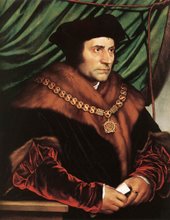
V. St. Thomas More, Saint and Martyr, R. Pray for us (Repeat after each invocation)
St. Thomas More, Patron of Statesmen, Politicians and Lawyers
St. Thomas More, Patron of Justices, Judges and Magistrates
St. Thomas More, Model of Integrity and Virtue in Public and Private Life
St. Thomas More, Servant of the Word of God and the Body and Blood of Christ
St. Thomas More, Model of Holiness in the Sacrament of Marriage
St. Thomas More, Teacher of his Children in the Catholic Faith
St. Thomas More, Defender of the Weak and the Poor
St. Thomas More, Promoter of Human Life and Dignity
V. Lamb of God, you take away the sin of the world
R. Spare us O Lord
V. Lamb of God, you take away the sin of the world
R. Graciously hear us O Lord
V. Lamb of God, you take away the sin of the world
R. Have mercy on us
Let us pray:
O Glorious St. Thomas More, Patron of Statesmen, Politicians, Judges and Lawyers, your life of prayer and penance and your zeal for justice, integrity and firm principle in public and family life led you to the path of martyrdom and sainthood. Intercede for our Statesmen, Politicians, Judges and Lawyers, that they may be courageous and effective in their defense and promotion of the sanctity of human life — the foundation of all other human rights. We ask this through Christ our Lord.
R. Amen.
Wednesday, 21 February 2007
Strong winds