Monday, 27 October 2014

One of the great Company.

Blessed Thomas Tunstall from the Lake District, a Douay priest, ordained in 1610 was executed at Norwich on 13th July 1616. Earlier this year I went to pray at the site of his execution.
The photo above shows "The Library" - now a restaurant - just behind the Guildhall, which is the site of the old City Gaol. It would have been here that Fr Tunstall was held, after his arrest in King's Lynn, while awaiting execution. He had already spent four or five of his six years of priesthood in one or another gaol in England.
Norwich, like York, was a place of frequent execution over the centuries. But, whereas Norwich Castle, or its ditches, were a usual place for criminals to be executed, a special gallows was set up for the execution of Fr Tunstall. This was just outside the Magdalene Gate on the north side of the old city.
If you walk up Maudlin (or Magdalene) Street you come to a cross-roads just outside the old city walls. It was here, on this open space that Fr Thomas Tunstall was hung, drawn and quartered.
A part of the old city walls is still visible, but there is no memorial for this Blessed, who stands forever before the Throne, and before Norwich, pointing to the Mystery of Christ.
The Grid reference of the site is TG232096. There should be some commemoration of him here.
Blessed Thomas Tunstall, be a light for us today, and especially be a strength to your brother priests who are still on the mission.

Thursday, 23 October 2014

Hearty smoke.

For all you paella fans out there; leave aside the gas hob and light yourself a woodfire. The difference between a paella cooked on gas and a paella cooked on an open woodfire is massive. The insipid gas tends to create hot spots, on which the rice sticks. The woodfire gives a fuller but even heat, which together with the smoke, makes the paella rich, unctious and life-enhancing. Unless prevented, all my paellas will be cooked on an open woodfire from now. This is one of the greatest dishes ever. Viva la paella Valenciana!

Monday, 20 October 2014

Set in relief.

I have been following some of the media coverage of the Synod about the Family, as well as the occasional presentation by the Synod itself. I have been quite alarmed by the way in which the media, for instance the BBC, has referred to the Synod, showing how far detached from reality both the secular world and its media are.
The BBC recently said that it was "dissappointed" in the "vote" taken by the Synod Father's about the nature of the family. Fifty years ago, and even twenty-five years ago, the "world" would have been very glad that the Catholic Church was discussing the Family. But today's response to the Synod shows that the secular world, and its unhinged media, has really lost its points of reference, and its way-markers. The way in which the media has spoken about the Synod shows how idealogically led it is. Individualism, relativism and agnosticism, the form of this vaccuus ideology, are creating the basis for quite an unpleasant future.
The Synod of Bishops looks at reality; the secular media looks to idealogy. In fact, so much so is this the case, that I think that the secular media is the measuring stick for our culture today. If you want to see how far from reality our culture is, then just listen to the media.
Of course, all this is quite alarming, because an ideology-led society can do some very unpleasant things. We have some awful examples from the recent past. Today, it seems, the pre-born are taking the brunt of the fall-out.
However, the Church stands in reality, and Christ said that no evil would overcome it. We do not rely on ourselves, but on Him who governs all things.

Saturday, 4 October 2014

Such a great guide.

With great sadness I learn of the death of Fr Benedict Groeschel CFR; he died at 11pm on 3rd October, the eve of the feast of the founder of the Franciscan friars. May the Lord give him a special place in His Kingdom.
I first met him in Henley-on-Thames in December 1998 and was immediately struck by his integrity and his witness. I have met him on many occasions since then. He once gave me the best spiritual direction that I have ever received from another human being - that was in Leeds.
This humble friar had one of the best minds that I ever knew; he must have had a photographic memory for he could draw precise quotes from a huge range of texts, and draw out from them their meaning.
As a leader in the Christian life, he is one of the towering figures of the 20th century, particulary in the way that he guided many through the chaos of the past few decades. I will remember him very fondly for the rest of my life, especially as I regularly listen to his recorded talks. I will miss him. While I was in Sydney I had hoped to make another priest's retreat under his direction, but by the time I had returned to the UK he was no longer strong enough to give retreats. I am immensely grateful to him for all he did for us priests of the new evangelisation.
The friars of his community - the Friars of the Renewal - will be saddened at his passing, but he has given them a very good foundation.
I remember him saying, that as he was from New Jersey, going to Purgatory would be a "big step up". In fact, he said, "I'm looking forward to Purgatory!" Well, he has the prayers of many to support him in this last journey. And may he, who humbled himself before the Cross of Christ each day, be now transformed by Mercy.

Friday, 26 September 2014

Grateful thanks.

For just three years Cardinal Mauro Piacenza was the Prefect of the Congregation for the Clergy. During that time his leadership of the priests of the Church was wonderful. The way he spoke to priests, and the way he spoke about the priesthood was a great grace. He placed the identity and mission of the priest firmly in the priest's sacramental conformation to the Priest, Jesus Christ. The rather secular and soulless notions about priests being aligned with a function or with a socio-political role in the Church or in the world he set aside and, taking up the great movement, which is the New Evangelisation, Cardinal Piacenza has, in such a short time, given priests a whole vision for the renewal of our lives and mission. Cardinal Piacenza, along with all Curial Office-holders stepped down from his post when Bendict XVI retired as Pope. His last work was to give us a new edition of the 1994 Directory on the Life and Ministry of Priests. This new edition of the Directory is an inspiring and grace-filled document to guide priests in this new era. In the St John Vianney Fraternity we are presently making our way through this document, and I, for one, am extremely grateful to Cardinal Piacenza for all that he has done for the Priesthood.

Monday, 15 September 2014

The beauty of the Priesthood.

Celebrating the Mass on the site of the original Holy House of Walsingham is a great grace. To see the lawn, where once the nave and chancel of the Priory church stood, thronged with a great crowd of young people was a moment fo great joy in the Church. Bishop Mark Davies celebrated the Mass - the joy on his face was evident, and the delight of the company of priests who concelebrated with him is something that I will remember always.
When priests come together there is a coming together and strengthening of the priestly charism. I am personally honoured that my presbytery is a house which is frequented by priests, but taking part in the mission of the Church in such an event as the Youth 2000 Festival at Walsingham, is such a wonderful confirming of the identity and dignity of the priest That the priest facilitates the action of the Holy Spirit through the gift of self. At Walsingham on this day there was no hint that any of us priests had a managerial, administrative or functional role. No, the Church was alive in Christ, and we were enabling that life through our sharing in the Priesthood of Jesus.
 

Thursday, 11 September 2014

The beauty of God's plan.

For the first time at the Youth 2000 Prayer Festival, one of the Masses was celebrated in the ancient Priory grounds. Twelve hundred young people walked the Holy Mile singing songs of praise to the Holy Trinity and in honour of Our Blessed Lady. This was the high point of the Festival this year; the Church on the move is a something that is both visible and attractive.
The column of young people just kept coming from the Festival site by the Slipper Chapel, following the ancient pilgrim route, some of them barefoot, as they approached the 'Holy Land of Walsingham'. The enthusiasm was tangible.
As the young pilgrims passed through the old Priory gatehouse on the High Street, to the open lawns where the original Holy House had stood, and where now an altar had been set up for this Mass, I could suddenly see how Our Lady Herself is writing the history of the New Evangelisation of this country, through these striking events at Her Shrine in Norfolk. In drawing these young people to Her simple Shrine at Walsingham, She is drawing them to Her Son, in whose gentle, but life-giving presence, we are formed into the Church.

Saturday, 6 September 2014

The beauty of conversion.

At The Youth 2000 Prayer Festival in late August in Walsingham, about 1200 young people from across the country came together and spent for and a half days in the close company of the Blessed Eucharist enthroned in their midst. 
This year's Festival marked the 25th anniversary of the founding of Youth 2000. This movement, founded in England, but represented now in many countries, has held a summer Prayer Festival for young people in England since the early 1990s. In August 1999 they first set up the Festival next to the Slipper Chapel at Walsingham, and for fifteen years now they have drawn an enormous crowd of young people to engage in time of joyful encounter and growth, awakenng them to the person of Jesus and to the new life of grace which he gives. Lives are changed, light is received, purpose is engendered and vocations are born.
For the priests who come to serve the Festival it is a time of great joy as we see young people drawing life from the Saviour and becoming established in His Church. Youth 2000 was born from World Youth Day in 1989, which that year took place in Santiago de Compostella, and mirrors those prophetic events: Christ at the centre surrounded by a community of disciples. The building up of the Church in this country lies at the heart of the mission of Youth 2000. The whole event takes place under the care of Our Lady of Walsingham, to whom we entrust the Christian formation of this generation.
And of course, when you are camping out in the open fields of Norfolk there is always space for a paella!
 

Saturday, 30 August 2014

A living fraternity.

At the beginning of August I was in Ars for nine days, taking part in the Summer Session of the Society of St John Vianney. This session incorporates the feast of the saint, when hundreds of priests come and join us for the solemn Mass on 4th August. The photo above shows some of us after the Mass.
The theme of our reflections this year was priestly fraternity; bringing to the fore this essential dimension of the priesthood and enabling it to be lived within the Diocesan priesthood. What a tremendous grace this Society is!
However, the Society of St John Vianney does not see priestly fraternity in the sense of a caste or privilaged status, but rather, it is the humility and weakness of the priest which is the source of our brotherhood, set in relief by the sacrament of Ordination.
When you look at St John Vianney, you know what the priesthood is. He doesn't lead to a particular priestly spirituality, and for this reason he is the model for all priests. St John Vianney was all for Christ, and so claiming him as the model is actually opening ourselves to a universal model. St John Vianney is the answer to all the critics of the priesthood over the past fifty years.
It is the missionary witness of this Society which first attracted me and drew me to become a member, for it witnesses not so much to the man who is a priest, but to the reality of priesthood itself.
Our days in Ars were divided up between celebrations, trips out and time spent together with the Lord, and in reflection. One day we even went rowing on the River Saone at Lyons. It is a mighty river and I was surprised that no one fell in. I took this photo of the river before we embarked; boats and cameras don't mix well!

Sunday, 27 July 2014

Defence of the realm.

When will England be open to God's plan?
Defending itself against the truth has been been its predominant attitude for almost five hundred years. So long that you almost want to fall in line. From women bishops to guarding cyclamen against slugs, it is as though we must see ourselves, in this island, as competent in all fields, including most importantly, overriding the beauty of God's plan.
Wearing herself out across the past five centuries, and yet God's plan still shines with beauty.

Friday, 11 July 2014

Set in relief.

The New Evangelisation sets the Christian life in relief; this is becoming clear as this new era in salvation history gets underway. I became very conscious of this during Eastertide as we read the Acts of the Apostles during the Liturgy. The movement of the New Evangelisation is causing the Scriptures, the Seasons and the feasts, indeed, the Christian life itself to be set in relief.
Today's feast of St Benedict, the towering Patron of Europe, is an example of this. Monasticism, seen in the light of the identity of the Church today, was and is a gift to the Universl Church, an enabling of its mission.
Pope Francis in Evangelii Gaudium 262, describes "spirit-filled evangelisers" as those who "pray and work". The ora et labora of a past, golden age of evangelisation is newly seen today as the kernel of the New Evangelisation as its actually is. In the future we will look back and see the truth of the Holy Father's contemporary description of the New Evangelisation. That unity of prayer and activity, rather than mere talk (or blogging), seen again, through the prism of the New Evangeisation for its tremendous value. A Church which is unself-consciously engaged in prayer and work is a Church which will mark this age that we are living in, not through any desire to achieve self-importance, but through the transformation which grace alone acheives.
St Benedict, lead us to live under God.

Sunday, 6 July 2014

Paella above Hartlington.
Just in case you were wondering what cooking a paella on the hillside above Hartlington looked like.

Thursday, 3 July 2014

The other vision of reality.

Campion College Australia, where I worked for two years as its first full-time Chaplain has, this year, recorded its largest intake of new students. Forty one first year students brings the student roll to one hundred.
I applaud the College in its work; it was such an extraordinary privilege for me to have been asked to be its Chaplain. The new students, at the start of the year, were introduced to the vision of the College which is founded upon two great Englishmen: Edmund Campion and Christopher Dawson. I wonder how many people today in England would have heard of either of them.
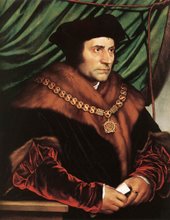
Edmund Campion is the pearl of the English Renaissance. He lived in the 1500s, became a Jesuit priest and is now a Saint. He, better than anyone in his day, enunciated the call to live the Christian life. He was executed at Tyburn, London, on 1st December 1581.
Christopher Dawson, a Yorkshireman (1889-1970), enunciated the same vision, probably better than anyone else, in the 1950s and 1960s. While British and Western culture was going headlong into an empirical-scientific and technological vision for understanding reality, he presented anew that vision of life which is based upon Salvation History.
Salvation History is today disregarded in a peculiarly irrational way, in favour of rationalistic hypotheses about reality. However, not everyone has gone over to looking at the world according to the modern pseudo-rationalistic fashion. Although Campion College is small, its endeavour is genuine and many will, one day, come to reap the benefits of the genuine vision of human life which is being nurtured and explored by the College and its students.
When we see the difference between the two visions of reality; one perportedly scientific, the other attuned to grace, we begin to see the dire state that the Western World is in and, at the same time, the tremendous light that is being mediated by colleges such as Campion College.
I have read some of Dawson's works and I want to read more. His works are tremendously important for our age, and we should not let them be forgotten. The other day I parked up on the hillside behind Hartlington in order to make a paella, and fondly remembered him and his endeavours - which are to enable modern people to see the world as a gift from God, and its renewal through the saving work of Jesus Christ, and to take part in that great endeavour.  

Monday, 30 June 2014

Lying with a saint.

What a tremendous mystery is the Priesthood; to lie in prostration alongside the relics of a priest-saint, awaiting the imposition of hands!
Congratulations to the three men who were ordained on Saturday, the feast of St John Southworth, at Westminster. The relics of this holy martyr priest had been brought into the centre of the Cathedral for the ordination ceremony, and the Cardinal, in his sermon, linked the ordination to the priesthood of this saint. The more we draw on our martyrs, the more we are marked by the Mystery of Christ.
It was a particular joy for me to see one of the former Youth 2000 Mission Team members being clothed with the Priesthood of Jesus Christ.

Thursday, 26 June 2014

A celebration of Priesthood.

Last week I took part in the Silver Jubilee celebration of Fr Stephen Langridge, the Vocations Director of the Southwark Diocese. It was a tremendous celebration of the Priesthood; a sung Mass with a great homily by Fr Alexander Sherbrooke.
Following the Mass there was a Hog Roast, outside The Vocations Centre, for the crowd of participants in the celebration.
Celebrations of the Priesthood are not that common but are very important in the Church. Not only do they mark a priest's service, but they honour God's plan for the life of the Church.
Congratulations to Fr Stephen on his 25th Anniversary!

Wednesday, 25 June 2014

Congratulations!

Congratulations to my 100,000th visitor, whoever you are. You should receive a New Evangelisation medal!

Monday, 23 June 2014

A House of witnesses.

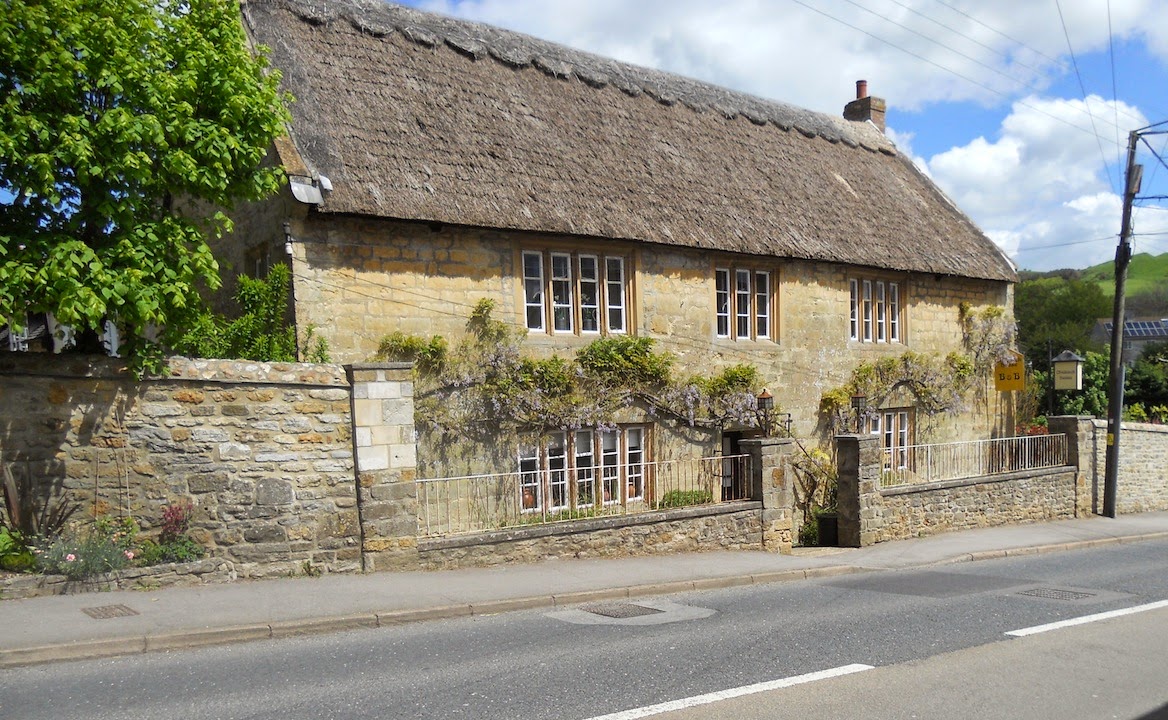
Another site in the village of Chideock which should not be overlooked in Chideock House on the High Street. This house, now a B&B, is the place where the trail of Fr John Cornelius, Thomas Bosgrave, John Carey and Patrick Salmon took place. They gave their witness to Christ in this building before being taken to the gaol in Dorchester, and from there to the gallows.
The pub on the other side of the road is also worth a visit!

Thursday, 19 June 2014

A household of faith

No pilgrimage to the gallows site in Dorchester is complete without also visiting the Dorset village of Chideock. Here, the Arundell family kept the Faith through the darkest part of the Penal days. The Arundell family of Cornwall became the ownners of Chideock Castle in 1479. They remained Catholic as the sixteenth century progressed. In the late 1500s Sir John Arundell was imprisoned various times for recusancy and for nurturing a household of Faith in his castle. All the martyrs who were executed at Dorchester had been a part of this centre of formation and evangelisation. The castle was destoyed folowing the Civil War. 
In 1786 the Weld family of Lulworth, also Catholics, bought the Chideock estate and, in 1872, a new Church, honouring Our Lady and the martyrs was opened just north of the village.
This exquisite church is now a beautiful place of pilgrimage, its interior adorned with images of the martyrs of both Dorset and beyond.
The site of the castle, about half a mile from this Church, and entered via Ruins Lane, is now just an open field overlookiing the village. In the 1950s a cross was erected in the centre of the castle site to honour all those who were nurtured in this former household of faith.
The course of the original moat can still be clearly picked out, but there is not one stone standing on another. It is now a very partoral scene with the field given over to ewes with their lambs. However, the site is a wonderful place to pray the Rosary and to ask for the new evangelisation of this island. With such a great cloud of witnesses as our forbears, let our endeavours not fall silent.


Tuesday, 17 June 2014

An everyday matter.

Passing along the South Walk in Dorchester one sees a group of figures whose presence and demeanour do not catch one's attention until one draws near. Suddenly the figures, which seems like a group of friends in conversation stand out from the other people on the pavement.
In fact, these are stautues cast in metal. They are set on the site of the former Gallows, which, four hundred years ago would have stood just outside the old town walls of Dorcehester. They represent the Catholic Martyrs of Dorset, six of whom were executed at this site. The statues depict two people who are facing death, and although lacking a certain comeliness, could in fact, stand for any casual group of people. Therein lies the significance, to my mind, of this memorial. For the people who were executed here for Christ, were ordinary people. What distinguishes them is that they gave public witness to the Mystery of Christ before the people of Dorchester, of Dorset, and of the whole country. This memorial is quite extraordinary, given the culture and attitude of this country today. Its human dimension together with its very public, yet urbane nature, places these martyrs right at the centre of our life and our culture. Before any religious distinctions can cloud the reality, and before any polemic can take away from the directness of their example, six men, gave public witness, before all the authorities and before all the people, to the reality of the saving Mystery of Jesus Christ. What an extraordinary sign for any town in our country to be marked with.
Blessed Thomas Pilchard, priest, hung, drawn and quartered here 21st March 1587.
Blessed William, Pike, layman, hung, drawn and quartered here in 1591.
Blessed John Cornelius, Jesuit priest, hung, drawn and quartered here 4th July 1594.
Thomas Bosgrave, layman, executed here 4th July 1594.
John Carey, layman, executed here 4th July 1594.
Patrick Salmon, layman, executed here 4th July 1594.
Hugh Green, priest, hung, drawn and quartered here 19th August 1642.
Martyrs of Dorchester, pray for us, that the witness we give may also give life to many.
The memorial stands at the south end of a road called Icen Way. This road begins at the High Street where, in former times, the gaol stood.
I took the above photo from the High Street looking down Icen Way, the lane down which the martyrs would have been dragged. The site of the gaol is now a take-away. Much of the town of Dorchester was burned down in the 1700s and therefore very few of its mediaeval buildings remain. It was in this gaol that the martyrs were held before their execution.


Sunday, 15 June 2014

A centenary approaches.

On 28th July we will observe the 100th anniversary of the start of the First World War. I hope that it will be a moment when the whole world will stop again and recognise the terrible destruction that this war caused and the incalculable sacrifice which was made by so many. We should never let a single year go by without observing Remembrance Day, and more importantly, without holding up this moment of our history before the Throne of Grace.
The vaunting hopes of that age of technology, science and rationalism came to a unexpected and sudden end in the Battle of Verdun. A century of human advances, hoping for a future in which we would establish firmly the dominance of human reason and resourcefulness over shreds of all the previous attempts to build human civilisation. Such a vast hope was contained with the 1800s and so few saw its weakness - the stone rejected by the builders ... 
The tale of Nineteenth Century atheism should be told again in our day, and the way in which Christian Europe dropped the ball; yet the way in which grace was never withdrawn. This is the most important lesson that we can learn one hundrfed years on, especially at a time when our culture is turning is gaze away from the Divine Initiative and is again regarding confidently the possibilities of human resourcefulness 'set free'.
Apologies for my absence; it was not intended. A holiday, a busy time in the parish and dose of flu are bound to upset regular posting. I do intend to maintain this Blog and will do my best to keep it up.