Friday, 25 January 2008

The State Creche

In Education the secular movement is now in full swing and is heading along its logical course; today you can't speak about God, spirituality or morality, but you can develop a hedonistic approach to life among children and young people, leading them to take up pursuits that are the answer to the question - "What will give me the greatest pleasure now?". The secular movement is even leaving behind the goals of academic excellence, as we can see.
For Catholics the watershed was the 1944 Education Act, which brought our schools under the Government's wing, and for that matter also initiated the contemporary project of the Church - that of being a Church of maintenance, not a Church of Mission. Gradually, the secular movement has overtaken our schools also and, their lay-run administration seems, more or less, to have caved in under the incoming tide. Perhaps if our schools were still run by priests and religious there would be a different story.


Nevertheless, one of the most important consequences of the modern secular movement has been the subbordination and relegation of the role of parents in the education of their children by the State. So much so is this the case that in many (most) communities, parents now are glad to absolve themselves of their duty to their children and to hand over their children to the State for a huge portion of their young lives, seeking work, leisure and other pursuits while free from their children. And all the while the State has been happy to allow the secular movement to manipulate schooling at will. We can see this especially in communities of immigrants to our country who have fostered their own cultures more than they have given themselves over to State control, and in so doing we see families and communities in which traditional values are still maintained.


So, it is already late in the day, but how can we rebuild a climate and a culture in which parents recover their primary role as educators of their children? First of all, I think that quite a bit of personal interest and initiative by parents is necessary; an interest and initiative whereby parents actively seek to build a culture and a way of life for themselves and their families in which they embrace their God-given mission to form and guide a family. Secondly, by building friendship and association with other (like-minded) families. John Paul II spoke loudly about this on numerous occasions. In Familiaris Consortio he said:


Family associations should "foster among the faithful a lively sense of solidarity, to favour a manner of living inspired by the Gospel and by the faith of the Church, to form consciences according to Christian values and not according to the standards of public opinion; to stimulate people to perform works of charity for one another and for others with a spirit of openness which will make Christian families into a true source of light and a wholesome leaven for other families."
Recent news reports have made us aware of the strength of Catholic family life in Spain and of how families have recently rallied together to oppose Spanish Government interventions in schooling. Visit http://www.familiasnumerosas.org/ for a closer look at this huge family movement. (Click on the Union Jack for the English language version.) I have been involved for some years now with "Teams of Our Lady" and I have seen how influential this Catholic Association of Spouses has been in rebuidling the spirituality and culture of marriage and family life, and how powerful if has been in rebuilding the culture of Catholic communities and even parishes. You will be aware of other similar associations where this is the case.


What we're speaking about here is parents becoming parents again. The State runs a creche for every parent in the land, should they so wish to reliquish their own role. Catholics should be a the forefront of the re-embracing of the tremendous parental mission and accompanying skills which God has given them. Nor should we delay or doubt the influence that we can have here. But don't follow the culture!


Friday, 18 January 2008

A navigator's starter pack


I have recently come across a website which I recommend to you: Mercatornet is a site in which the dialogue between the Gospel and culture is made in an intelligent and extensive way. This is the kind of site which provides the basis for understanding as well as for forums and blogs.

Wednesday, 16 January 2008

Politicised schooling

I'm back with a new Dell machine after my last laptop crashed out just after Christmas.
The present educational environment in the UK in very concerning and surely points Catholics towards creating a new environment for the education of their children. Indeed, there is so much change and manipulation in education today that this is not the era in which to be a pupil in a school in which the State has any control whatsoever! Our Government is doing by stealth what the Spanish Government recently did by law (Law of Historical Memory.)
Whilst the Government seeks ways of challenging and closing Catholic Schools because of their Faith; Catholic schools, by and large, are far more concerned about being winners in the community than being Centres of Faith. So much so is this the case that their prevailing ethos is Pelagianism not Catholicism (and Pelagianism is not at all at odds with British culture.)
State schools on the other hand are focussing more on their ethos and the development of the new secular orthodoxy, rather than being winners in the community. If I were a child now, I would not want to be in either a Catholic or a State school.
Eric Hester has recently reviewed Robert Whelan's new book The Corruption of the Curriculum, a book which expresses how Blair's proclamation "education, education, education" has in fact meant "politics, politics, politics", and that the curriculum is now subject to the tenets of feminism, gender discrimination, racism, environmentalism and homophobia. Independent schools, he points out, still constitute a real hope for they are mainly rejecting the new code. (One thinks also of the recent Australian initiative of Campion College - a Liberal Arts College on the outskirts of Sydney which teaches a secular curriculum from a genuine Catholic perspective.)
It is in such a climate that Catholic families should come together to discern how best to educate their children, how they can support one another, inform one another and develop new ways of creating an environment and a culture in which their children can be educated. I for one would help.

Sunday, 6 January 2008

Please wait about a week ...

I know that various people have contacted me via the Blog, Facebook and email. My computer is brok (yorkshirism) and I can't reply to you yet. I'll be back online about 12th Jan and will get back to you then. (Don't ask how I've been able to post this!)

Friday, 4 January 2008

Father-daughter

I had to paste this in - for those who didn't see it in Zenit:
The way a father treats his daughter is a strong indicator of how she will relate to men for the rest of her life, says author and teen-health expert Doctor Meg Meeker.
Meeker, who has practiced pediatric and adolescent medicine, as well as teen counseling, is the author of
"Strong Fathers, Strong Daughters: 10 Secrets Every Father Should Know," by Regnery Publishing. The book highlights how the fundamental relationship of a girl with her father can affect all areas of her life.
In this interview with ZENIT, Meeker, who also wrote "Epidemic: How Teen Sex Is Killing Our Kids," talks about the profound role a father plays in his daughter's life, whether he knows it or not.
Q: A father is a daughter's best ally seems to be the consensus of your book. While studies say that it is parents who are the key to their children's happiness, what is the unique offering of a father to a daughter that a mother cannot offer, especially in her relationship to God?
Meeker: I think that one of the reasons I wanted to address this issue head-on, is that a father is a daughter's great ally, which today is not only overlooked, but is directly attacked. If you look at the typical sitcom, the father is portrayed as someone who is comical, humorous and just plain dumb, and as though he has something to learn from his daughter.
Research shows that a father's influence builds up self-esteem, helps his daughter to avoid sex, drugs, alcohol, and stay in college. What it is that a father offers is that he carries an authority in his daughter's eyes. This authority is not ascribed to the mother, not that she is not important, but a father's influence is different.
When a girl is little, her dad is her primary male love relationship. When he gives her something as a man, she learns lessons about men, setting a template in those early years on her heart about what to expect, to think, to feel, and know about men from there on out, affecting even her relationship to God, because Christ is a man.
Q: What are the specific characteristics of a dad that help daughters in their development?
Meeker: One of the big ones is a sense of protectiveness. It is intuitive in a dad's heart to protect and guard a daughter. Our culture, however, has been training men not to do that because gender neutrality has become such a big deal.
The reason this is very important is because, particularly in the area of sexuality, dad has an enormous role. Girls are under sexual siege, with aggressive marketing, especially in clothing, from the age of 6 on. If a father, feeling protective, says, "I don't want my daughter going to school in a jog bra," and mom says, "No, this is the way girls dress," a father needs to trust his judgment. Sometimes his intuition is better on this one.
Another is that dads in general tend to be very pragmatic and solution-oriented, discovering first what the problem is, and then how to get to the solution. Sometimes women are insulted, because we think differently, but this difference is wonderful. A man says, "Now, what's the problem? What can we do?" This pragmatism can serve a daughter well in teen years.
For example, perhaps a boyfriend has broken up with her. A girl will feel sad, think she is too fat, too stupid -- all kinds of things get added to the situation in her own mind. But dad compartmentalizes, "What's the problem? What can we do to solve it? Just because he broke up with you, doesn't mean all these other things are true."
However, the most important thing a father can do is live a life of integrity -- living truthfully. A daughter, within 15 seconds, can tell if her father is in a bad mood, good mood, telling the truth or not, etc. Those fathers who don't live truthfully do a great disservice because a daughter doesn't believe in him, doesn't trust him. Dads think they need to earn heroism, but they really don't. The role of a hero is just given to him until proven otherwise. Most dads don't know this.
One thing I try to do is help fathers get behind their daughter's eyes, see you as she sees you. If you compared your vision of yourself to how she sees you, your life would never be the same.
Q: You say that there is a clear connection between depression in girls and young women and sexual activity. How can a father's love help protect against this in our sexually saturated culture?
Meeker: Depression in girls is all about ungrieved losses accumulated in the heart. This connection can be backed up with medical data, although no one has studied it extensively. But what I have found is that as a culture, we are bombarded with sexual saturation. Sexual activity is through the roof and sexually transmitted diseases (STDs) are at an all-time high.
When girls approach sexuality, a huge emotional component is involved. When a girl is sexually active once, and it doesn't matter if it is oral sex or intercourse, she incurs a loss. In the physical act, she has lost something in her heart, her virginity, her respect for herself. When girls feel this, if they don't acknowledge that they are hurt and that something that happened to them, then they will live with unresolved grief, which leads to depression.
Another interesting phenomenon is that if a young person has a bad sexual experience that didn't meet their expectations, both boys and girls, they will immediately think they did something wrong -- not, "Maybe I shouldn't be doing this." In order to correct this "wrong," they will try to make up for it in some other experience, which leads to a downward spiral of messy relationships, physical risk and emotional damage.
Ironically, while our culture is now immunizing girls against STDs, we endlessly market sex to them, paying little attention to all the layers of risk. This, incidentally, would never happen with cigarettes or alcohol, where we would give kids an immunization against lung cancer yet promote smoking. This problem is missed by many because sexual freedom has come to be seen as a right.
Q: You suggest the importance of raising a daughter with humility, emphasizing that she should see the world like a pioneer, asking, "What can I do for others," instead of like a princess who lives with a sense of entitlement. How can this contribute to her long-term happiness?
Meeker: One of the greatest mistakes that parents make in their kids is a misunderstanding of what happiness and joy is in their kids. Parents just want their kids to be happy, but they perceive incorrectly that it comes from receiving pleasure, so when children receive, receive, receive, happiness does not come, resulting in a lot of unhappy kids.
Despite our material wealth, depression rates have never been so high. Clearly we are missing something. Parents have been duped. What works is when we teach kids to serve, to look beyond themselves. Real joy and happiness comes when kids understand that they have a purpose in life, and a mission to fulfill. The only way to get them to understand this is to look beyond self and doing good for others.
This is the source of real transformation, but this can't happen without humility, the opposite of which is pride. When parents instill humility, a kid understands that he or she is important, and lovable, but not separate from others in their humanity. If a kid really wants to feel good about himself, humility brings people closer, whereas pride separates.
A kid raised without humility will always strive to be better than others, smarter than others, but can only bring a frustrated "happiness" because no one can always be the best at everything. True happiness for kids, then, is to give them a purpose to fulfill through working, striving, giving to and for others.
Q: There is repeated mention in the book that a father should do all he can to keep a family together. Why is this so important, and what can men do to care for their daughters if they find themselves divorced or widowed?
Meeker: First, we as a culture have failed to teach boys to live courageously, which means to live with profound discomfort. In not being taught how to live, men have been failed.
All the psychology, pediatric, and medical literature says divorce is at the top of the list for of putting kids at risk for all high-risk behaviors. It is an enormous factor in kids' emotional, mental and physical health. My job is to try to help fathers stick it out with difficult wives until their daughters are older. The longer they can wait, the better it is for kids. Kids need full cognitive skills to cope with the trauma of divorce, and men need to call upon courage to gut it out.
A father who is separated from his daughter must maintain as strong a connection as possible, which means big phone bills, letters, pressing his way into her life in a gentle but firm manner. Stick with her over the long haul. Even when the daughter pulls back, the father has to be the grown-up. If you get your feelings hurt, forget it, it's not about you. Don't take it personally, maintain your integrity and rely on God to give you the strength to persevere.
And angry mothers need to know that you can divorce your daughter's father, but she can't. She has emotional needs, no matter what damage has been done. Give her the right to have a relationship with her dad.
If a father refuses to stop loving, a daughter will respond eventually. A daughter will follow where a dad leads when she knows she is loved.

Thursday, 3 January 2008

Short Bloggap

My computer is bust. I'll be back in about 10 days.

Wednesday, 26 December 2007

Was St Joseph a strict father?

Today's studies of parenting styles reveal the effect of different styles on the personalities of children, and they can be a good indicator for parents who are endeavouring to be the best parents they can be to their children.
Maccoby and Martin in the late 80s undertook an extensive study of parenting. Their work was measured according to two variables:

1. The demandingness of parents - ranging from authoritarian to permissive.

2. The responsiveness of parents - ranging from reciprocative to negligent.

Thus, the opposite of authoritarian/reciprocative parents are permissive/negligent ones, and the opposite of permissive/reciprocative parents are authoritarian/repressive ones. So, with that in mind we could describe permissive/reciprocative parents as non-traditional and lenient, but conscientious and committed to their children. Authoritarian/repressive parents are obedience and status oriented who give a structured environment to their children. Authoritarian/reciprocative parents give clear standards, asserting and supporting (rather than permitting) their children. Permissive/negligent parents are basically uninvolved with their children.
Which category do you think St Joseph and Our Lady would represent?
It is also very indicative to look at the consequences of these parenting styles in the personalities of their children. These studies found that children of permissive/reciprocative parents had only average behaviour and low academics, but high self-esteem and good social skills. Children of authoritarian/repressive parents had good academics and behaviour, but poor social skills and low self-esteem. Children of authoritarian/reciprocative parents had good academics and behaviour, and good social skills and high self-esteem. Children of permissive/negligent parents showed little sense of educational development.
For a fuller treatment of this put Maccoby and Martin into a Google search - you will find a host a very accessible web pages.

Monday, 24 December 2007

Live Christmas with the Holy Family!

The circumstances surrounding his birth were most unpromising for the founding of a universal religion. For what God asked of Joseph, his spouse and the baby, the challenges were very great.

A new start


Yesterday the News carried reports that Catholicism was the leading religion in the country. The statistics show that attendance at Anglican Sunday services has dropped by 20 per cent since 2000. A survey of 37,000 churches shows the number of Catholics going to Sunday Mass in England last year averaged 861,000, compared with 852,000 Anglicans ­worshipping, and thatthe rise of Catholicism has been bolstered by an influx of immigrants from eastern Europe and Africa, who have packed the pews of Catholic parishes that had previously been dwindling.
However, beyond the sensationalism of the Headlines, that Britain is now Catholic, lies another reality: the reality of pagan Britain. These religious statistics reveal that proportionally the number of Christians in the country is very small in a society whose predominant culture is antithetical to the Gospel, a culture marked by consumerism, alcohol and drugs poisoning, pornography, chav, gay, violence, and the culture of death, and a mass media which operates at an IQ level of 14 and which is utterly opposed to the Gospel. Indeed, in choosing to give up the Gospel our country is reverting to its original indigenous state, adopting cultures which are virtually impossible to evangelise, as we are experiencing. What’s more, those who are the forefront of evangelisation today are neither the Catholics nor the Anglicans, but the Evangelicals – they are doing our work for us!
Last week’s headline statistics put one in mind of the first evangelisation of our country which was carried out, after the long brutal centuries of the ‘Dark Ages’, largely by celibate Cistercian monks. These monastic communities gradually first civilised, brought order, then evangelised and baptised the peoples of this country. It was a task which took hundreds of years and which brought spiritual, material, social and political benefits. It is that same task which we must begin again, except that today, this task is being experienced as a new Pentecost and is rightly called the New Evangelisation.

Saturday, 22 December 2007

A private religion?

When bombs expode in Afghanistan and the news report is at pains to tell us that this act by Muslims is not faith-based but merely an abberation by some citizens, it is yet another way in which our culture has separated religion and life, spirituality and culture; making religion an unhappy tag which really doesn't help any more. Our whole western culture separates spirituality and life. We do it best of all by promoting abortion and saying that a person has a right to choose quite apart from what God says. And the media downplays the meaning of spirituality so as to promote the culture of death with more impunity.
Of course spirituality is connected with life, in fact, it is spirituality which informs our life. At least, this is the case with Christianity which is an incarnate faith - our spirituality is the very substance of our lives.
How then can someone who has been at the forefront of promoting the culture of death become a Catholic except by a radical change of heart. How can someone who has been, in the most public way, an architect of the culture of death become a Catholic?
Tony Blair's conversion seems very much like a disincarnate conversion. His public life was given over to promoting the culture of death, but his religious life on the other hand is a private matter. This 'cafod catholicism', a catholicism in which the personal and the social have no real connection, is deameaning to the Church. The Church needs to hear Tony Blair's testimony of conversion so that the grave matters, of which he had governance, can be seen anew by many in the light of Christ. After all there are many others, much better than he, who we should seek to convert.

What a terrible thought ...

I had a dream Joseph. I don’t understand it, not really, but I think it was about a birthday celebration for Our Son. I think that was what it was all about. The people had been preparing for it for about six weeks. They had decorated the house and bought new clothes. They’d gone shopping many times and bought elaborate gifts. It was peculiar though, because the presents were not for Our Son.They wrapped them in beautiful paper and tied them with lovely bows, and stacked them under a tree. Yes, a tree Joseph, right in their house. They decorated the tree also. The branches were full of glowing balls and sparkling ornaments. There was a figure on the top of the tree. It looked like an angel might look. Oh, it was so beautiful. Everyone was laughing and they were very happy. They were all excited about the gifts.They gave the gifts to each other, Joseph, not to Our Son. I don’t think they even knew Him. They never mentioned His name. Doesn’t it seem odd for people to go to all that trouble to celebrate someone’s birthday if they don’t know Him? I had the strangest feeling that if Our Son had gone to this celebration, He would have been intruding. Everything was so beautiful Joseph, and everyone was so happy, but it made me want to cry. How sad for Jesus not to be wanted at His own birthday party. I’m glad it was only a dream. How terrible Joseph, if it had been real!

Lay Chaplain required

St Wilfred's Catholic High School near Wakefield/Pontefract is recruiting a Lay Chaplain. 32 hours per week (£15,800 - £16,900). Further details and information pack from the school: swhschool@aol.com Closing date 25th January 2008.

Friday, 21 December 2007

Living in abberation

Today we are seeing what it means to live 'after Christ'. The usual course of events for most people is to be in period 'before Christ', and then, when Christ is revealed, to begin to live 'with Christ'. Indeed, Advent is the representation of this: the world is in darkness and is enlightened uniquely by the coming of God, an event which leads us to embrace the mystery of Christ.


The architects of today's culture have created an abberation, for having lived in the light of the Mystery of Christ, and then to have choosen to help create a post-Christian culture, is an abberation. Living 'after Christ', but apart from him. Yet, it is this culture of abberation which is the setting for the New Evangelisation.


Let us not forget however, that many still live in a culture that can genuinely be called 'before Christ', and who still await the full revealing of God's light. The New Evangelisation is for them also.

Saturday, 15 December 2007

From the perspective of humility

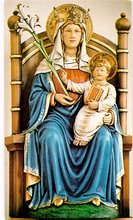
This is what the original statue of Our Lady of Walsingham may have looked like after it was dragged to London in 1539, by Royal Decree, to be burned on Chelsea Old Bridge, along with the statues of Our Lady of Glastonbury, Doncaster and Coventry. The statue of Our Lady Vulnerata (wounded), originally in the Jesuit church in Cadiz was broken and spoiled there by English soldiers of Drake's warring squadron in 1586. It is now enshrined above the high altar in the English College, Valladolid, where she is honoured weekly, and annually with her own Feast Day. Smashed up as it is, this is the image of she who, as B16 has said, opened up the windows of the world to let the light in. Not surprisingly she is honoured still by many.
But in one long slow blow England went from being part of a Universal Communion to become a religion of museum culture and of shopping. Yet still the Holy Spirit insists on our company, and during this Advent there "are those whose interior sensitivity enables them to see and hear the subtle signs that God sends into the world to break the dictatorship of convention." (B16, "Jesus of Nazareth) The Festival of Consumption is almost over. Keep watch!

Living Christmas with the Holy Family

"The family is the basic cell of society. It is the cradle of life and love, the place in which the individual is born and grows. Therefore a primary concern is reserved for this community, especially in those times when human egoism, the anti-birth campaign, totalitarian politics, situations of poverty, material, cultural and moral misery, threaten to make these very springs of life dry up." (Christifildeles Laici, 40)

Sunday, 9 December 2007

Another tale for rediscovery

Here's a great find. I have looked for this for years; it used to be shown on TV every Christmas during the 1970's. It is a tremendous animated cartoon version of Oscar Wilde's top short story, "The Selfish Giant". This is another great tale for Advent and Christmas, a tale of conversion and salvation. But you'll have to watch it here in three parts:


Reclaiming Advent culture

Do you remember the days before "Harry Potter and the clinting crag", "Shrek", or "Golden Compass", when sotries would be read aloud to amusable and expectant children. There are two book which come to my mind as exceptional stories for this time before Christmas.

The first is "Bill Badger's Winter Cruise" by "BB". It is a tale of how badger and his friend Izzy Bizzy, a hedgehog, go down the canal on a barge in deep winter. They share together many of the simple experiences which you and I cherish during Advent - hope, expectancy, friendship and generosity.

The second is "Little Grey Rabbit's Christmas" by Alison Utley. This is probably my favorite children's (or adult's) book. It is the story of how a family of rabbits prepare their home, and by way of that, themselves, for Christmas. Such a story as this is set to help create just the kind of atmosphere in a family that you would wish for in Advent. One in which there is a simple but genuine joy and expectancy because a great Feast is approaching.
These books come from a less self-consciousness age and we have much to regain in this respect. May they take their place again in our lives and the lives of our children.

Friday, 7 December 2007

Reality check

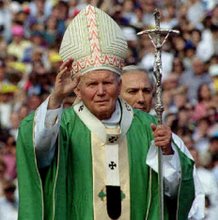
I wanted to share with you a passage from JPII's book "Memory and Identity" which he published shortly before his death. This book is a genuine source book for today's 'apostles' for it covers a huge spectrum of human identity and knowledge. In the passage I want to quote (from page 137) JPII speaks realistically about European countries, such as ours, at the very beginning of the era which we call the "New Evanglisation". I am reading this book for the second time and, when I came to this passage I was struck by the force of what the New Evangelisation of our countries means. We are rebuilding civilisation. What looks today as though it is civilisation, is really the remnant of civilisation. Our part in Christ's Body is far more real and we are called to help build "brick by brick" the Civilisation of Love. (This is not a photo of Niamh's car.)

In the twentieth century great efforts were made to stop people believing, to make them reject Christ. Towards the end of the century, the end of the millenium, those destructive forces were weakened, yet they left a trail of devastation behind them. I am speaking of a devastation of consciences, with ruinous consequences in the moral sphere, affecting personal and social morality and the mores of family life. Pastors of souls, who engage every day with the spiritual lives of their flocks, know this better than anyone. When I have occasion to speak with them, I often hear disturbing admissions. Sadly, one could describe Europe at the dawn of the new millenium as a continent of devastation. Political programmes, aimed principally at economic development, are not enough to heal the wounds of this nature. On the contrary, they could even make them worse. Here an enormous task opens up for the Church. The evangelical harvest in today's world is great indeed. We have only to ask insistently, that he send labourers for this harvest, ready and waiting to be reaped.

We need to give our lives to Christ and follow him. No one else will do. He will help us build. That's how it happened before in Europe and that is how it will happen again.

Thursday, 6 December 2007

There's a pagan festival on its way ...

... and it's very hard to completely avoid it, especially if you are hoping to celebrate Christmas. The Virgin website is offering ways that seems to avoid the Yule, but as you can read, their ways are extremely pagan:
There'll be ice and snow but the absence of civilisation in Antarctica means you won'tbe subjected to any Christmas merriment there, besides whatever celebrations your fellow cruise passengers arrange...
Virgin has put its finger on it - the absence of civilisation. Anti-civilisation is the new Yule! (Oliver Cromwell, here we go!)
We, however, do want to celebate the birth of he who is the civilisation builder - he who builds the Civilisation of Love. And with the help of grace we want to be a part of the building of the Civilisation of Love. Families are at the forefront of this season, and I can't help but quoting JPII's call from the Letter to Families:
To the family is entrusted the task of striving, first and foremost, to unleash the forces of good, the source of which is found in Christ the Redeemer of man. Every family needs to make these forces their own so that ... the family will be strong with the strength of God.
I'd welcome any suggestions or discussion about how Christain families can avoid the Yule but celebrate the Feast.

Tuesday, 4 December 2007

A leader in the north.

Bishop O'Donoghue is setting the stage to clear Pelagianism out of Lancaster Diocese. His "Fit for Mission: Schools" report has just been published and, although its style is not that of the Holy Office it does say that the congregation should kneel for the Eucharistic Prayer and that the Theology of the Body must guide teaching about the person in Catholic schools.
However, what makes this report so important is its main concern: "Is Jesus Christ the true centre of our schools and colleges?"
He distinguishes between the focus of Ofstead for schools and the focus of the Church - its Catholic ethos. Today we must create this ethos anew, since there is a crisis of values, relativism is a dogma, the secular vision sees education only in terms of career and bases happiness firmly in consumerism.
That the basis of the Catholic ethos is located in the dignity of the person and in the Sermon on the Mount, and that such an ethos comes about only through the living presence of Jesus and in embracing gthat presence.
He names other factors which affect the Catholic ethos: the parctice or non-practice of the staff, and even if they are practicing, are teachers modelling themselves on Christ? Do Heads, Senior Management and Governors know what the identity and mission of a Catholic School is? Are the parents embracing their own primary role under God? Is the Gospel proclaimed in schools?
There is an interesting comparison with Cardinal Pell's goals for Sydney's Catholic Schools: proclaim a Christ-centered life, embrace the full teaching of the Church, formation for Mission. Very sucinct!
We have been labouring under Pelagianism for far too long; let's support Bishop O'Donoghue with our prayers as he now begins the renewal of his schools. (You can find the report on "What's new" on the Diocese of Lancaster website.)