Sunday, 24 October 2010

Where is virtue today?


Today's culture of moral relativism and scientific determinism does not lead us to engage the virtues. In such a context, one either sees a wonderful opportunity to live the virtues, especially the theological virtues and be a light in the darkness, or one can't see virtue. But we are living (in the West) in a culture which sees itself as emerging from a hierarchic, oppresive and impoverished past, into an era of economic and social freedom, free from the moral structures of the past and its traditional values. Our culture sees itself as a victim of the past, at last recovering its true life through new-found freedoms. For a few, there are designer lives or training schemes based on notions of success, wealth and beauty. And for these newly conceieved life-styles one needs character traits, not virtues, traits such as efficiency, self-confidence and credibility. For the rest of us, these same goals are presented in a virtual way by the mass media. Where in such a vision of life does virtue belong?

The Holy Father in his Motu Proprio Ubicumque et Semper declares that today we have seen a loss of "a common understanding of basic human experiences: ie, birth, death, life in a family, and reference to a natural moral law. Even though some consider these things a kind of liberation, there soon follows an awareness that an interior desert results whenever the human being, wishing to be the sole archtect of his nature and destiny, finds himself deprived of that which is the very foundation of all things."

Prophectic words indeed. Yet the secular vision of a humanity transformed through new opportunities, at last within our reach, has captured the gaze of the world. And even the concurrent realities of disillusionment, failure, depression and loneliness, do not moderate the sheer power of this secular dynamic. In such a culture, Christiuans and others whose seeking has not been overwhelmed by contemporary culture, tend to live their lives cautiously, not wanting to appear naive about the truth of human nature. In such a context as this, the New Evangelisation is being engendered - in this culture, at once so full of overweening attitudes of self-affirmation and yet empty of, or insufficiently possessing of meaning, and which leaves others defeated or resigned to passivity, where do we begin to locate virtue?

I pose the question here and will return to this theme in the next post.

The new Motu Proprio


I can't say how glad this makes me; the Holy Father's Motu Proprio Ubicumque et Semper in which he establishes the Pontifical Council for promoting the New Evanglisation - a small thing perhaps, but like Martin who cut his cloak into two pieces in order to share it with a beggar, there were huge consequences. You can read the whole Motu Proprio here. In it the Holy Father declares:

"Making my own the concerns of my venerable Predecessors, I consider it opportune to offer appropriate responses so that the entire Church, allowing herself to be regenerated by the power of the Holy Spirit, may present herself to the contemporary world with a missionary impulse in order to promote the new evangelization. Above all, this pertains to Churches of ancient origin, which live in different situations and have different needs, and therefore require different types of motivation for evangelization: in certain territories, in fact, despite the spread of secularization, Christian practice still thrives and shows itself deeply rooted in the soul of entire populations; in other regions, however, there is a clearly a distancing of society from the faith in every respect, together with a weaker ecclesial fabric, even if not without elements of liveliness that the Spirit never fails to awaken; we also sadly know of some areas that have almost completely abandoned the Christian religion, where the light of the faith is entrusted to the witness of small communities: these lands, which need a renewed first proclamation of the Gospel, seem particularly resistant to many aspects of the Christian message.
This variety of situations demands careful discernment; to speak of a “new evangelization” does not in fact mean that a single formula should be developed that would hold the same for all circumstances. And yet it is not difficult to see that what all the Churches living in traditionally Christian territories need is a renewed missionary impulse, an expression of a new, generous openness to the gift of grace. Indeed we cannot forget that the first task will always be to make ourselves docile to the freely given action of the Spirit of the Risen One who accompanies all who are heralds of the Gospel and opens the hearts of those who listen. To proclaim fruitfully the Word of the Gospel one is first asked to have a profound experience of God."

How can we not harken to such a call!

Wednesday, 20 October 2010

A new presence in the Church


During the two and a half years that I have been in Sydney, Bishop Porteous, one of the auxiliary bishops, has published three books; quite an undertaking. His latest book published recently, called "New wine and fresh skins", is a presentation of the new communities and ecclesial movements which have appeared in the Church largely since the late 1960s. The presence in the Church of the new movements is something which most of us do not really understand, precisely because they break the mould of convention and do not readily submit themselves to categorisation. Nonetheless, there is something providential about their appearence in the Church, and successive Popes from Paul VI have reached out to embrace and guide their growth.
Bishop Porteous' book is like a snap-shot of the Church today, making explicit the experience of the Christian life which many baptised people presently rejoice in.
I hope that this book, the only one of its kind that I am aware of, will be read widely, because it is such a thorough presentation of the contemporary phenomenon of the new movements, many of which are becoming very robust expressions of Catholic faith and life, life-giving to many.

Sunday, 17 October 2010

Holiness for Australia

Holiness is Australia's first call and greatest challenge. Today Mary of the Cross is proclaimed a Saint of the Universal Church; she who made the Gospel visible in Australia is Australia's first saint. Her name tells us much - St Mary of the Cross exchanging "MacKillop" for "the Cross" - has claimed Australia for Christ. Who could have expected that this humble, but very real woman, would in this very secular age stand at the very forefront of Australian civilisation and reveal its true calling. Australia will not be the same from this day; the character of holiness is subject to no earthly forum. The Church, for all ages, will now give thanks to God for having raised up such a noble woman, such a beautiful saint in this Southern Land.
Some weeks ago the seminary community made a pilgrimage to her tomb in the Josephite church in North Sydney. The very dignified tomb of St Mary MacKillop has been drawing huge numbers of pilgrims, both the baptised and the non-baptised. Indeed, St Mary of the Cross is the pioneer of the movement of holiness in Australia, and she is already the friend of a multitude.

Last week the Catholic University of Notre Dame in Sydney held a day of Festival in her honour. The photo below was taken in the University courtyard just before the afternoon Mass. How wonderful that a whole generation of students are having their young lives impacted by the joy, sensibility and holiness of the grace of Australia's saint - this will have a greater effect on the life of this country than whole empire of modern secularism in all its pathetic emptiness.

Friday, 15 October 2010

Hot off the press


How small the world is: a mile from the seminary in Sydney is the parish of St Dominic, where its Parish Priest, Fr Peter Joseph, has spent the last few years working on a new and enlarged edition of Richard Simpson's 1867 biography of St Edmund Campion. What an extraordinary work this 650 page volume is; Cardinal Pell in his forward to the book says that his prayer is "that this biography of St Edmund may help Catholics to appreciate the grit and heroism of our Saints, and inspire and challenge other Christians to understand more fully the reasons for the turmoil that led to their separation from the Catholic Church."

And how important it is, especially for Catholics in Britain, that they might be lead to rediscover their roots, and be better motivated and guided to live the Christian life in today's context and be channels of grace to others. St Edmund Campion is a leading figure and saint of the English Reformation; he was a real Christian leader in England in his day. Through his priestly life and preaching, through his witness under trial, and by his martyrs death, numerous conversions occured. How did this happen? Because he allowed the light of Christ to shine even in the most difficult and complex of circumstances.

I look forward to getting into this new biography. Thank you, Fr Peter, for renewing the legacy of this great saint in our day.

Wednesday, 13 October 2010

A new statue of the great martyr


On entering the grounds of Campion College in Sydney, the visitor is now welcomed by two statues; to the left, the older statue of St Peter Chanel whose mortal remains were once held on the site, and to the right, a newly made statue of St Edmund Campion. This striking image of the saint now holds a worthy position in the College grounds.
What a great model he is for us today, and especially for the people of Great Britain. Campion stands out precisely because he did not simply follow the prevailing culture of his day, but rather, from the midst of a so much change and confusion, he looked to build his life upon the genuine foundation of Christ, even at great cost to himself. He sought a formation that would really build him as a Christian man, a man who was surrendered to God. And this seeking lead him to become a priest, and ultimately to give his whole life in service of the Gospel, even at great cost to himself. Ultimately he gave his life in service to Christ.
What great inspiration he offers us today, pointing us to Christ who live in today's context of change and confusion, to seek our true greatness in Christ. He shows that we can step beyond today's bewildered culture to take hold of the life of grace. How timely and how valuable are his story and his witness for us today, especially in England, that many may aspire to and embrace a genuine vision for buidling up the Christian life there, where once Christ was so loved and welcomed.

Monday, 11 October 2010

A recurring theme


Hardly a week goes by when the Holy Father does not speak about friendship with Christ. In his General Audience on 6th October he said that the "school of Christian life, of the straight path, which shows us that the center of a happy life, of a true life, is friendship with Jesus the Lord."
This friendship, the Holy Father said, "is learned in love for sacred Scripture, in love for the liturgy, in profound faith, in love for Mary, so that one will increasingly really know God himself and thus true happiness, the goal of our life."

Thursday, 7 October 2010

The Friars new mission in the Sudan


Fr Sylvester CFR who I worked with in Yorkshire has just been appointed to the new Friary in the Sudan where Fr Herald Brock has already begun their mission. Fr Herald was the very first friar of the Renewal who I met. He and I joined forces with the Youth 2000 group for Paris World Youth Day in 1997. You can follow their mission on a new Blog: www.cfrsudan.blogspot.com I am glad that these friars have been able to establish this Blog because they really are at the 'cutting edge' and it is good for us to have some idea about where the mission is in today's world.

Tuesday, 5 October 2010

A silent terror


Yes, the Salt Water Crocodile at large! The day after visiting the Reef, John and myself hired a self-drive boat for a few hours and, crossing the estuary from Cairns - some 200 mtrs - we encountered our very first wild croc.
It was lying still and silent waiting for some unsuspecting visitor to come within range. It was about 7 ft in length. Shortly after we spotted another one amongst the mangroves. Then suddenly, our engine packed up and we were drifting back towards our first croc! Fortunately, help was only a mobile phone call away and we were soon on our way again, eventually sighting a third croc further up the Trinity Inlet. We thoroughly enjoyed these our first sightings ever of this deadly predator. On average there is one fatal attack each year in Australia. Trinity Inlet then remained quiet and undisturbing for its two passing visitors in a light craft.

Sunday, 3 October 2010

Plunging into the Coral Sea

Of all the things that one can see and do in Australia, the one experience that so many Australians have said is top of the list is seeing the Great Barrier Reef. So, with a few days break from work I set off with John Pridmore, who is currently on a speaking tour in Australia, to the tropical north of Queensland in search of the Great Barrier Reef. We flew to Cairns and caught our first sight, from the plane, of parts of the Reef; turquoise and coral patterns glistening in the azure blue sea. We had three day trip and, on the first day, we booked on a catamaran to go out the next morning to the Reef. We left at 8.00am and had a journey of one and a half hours to the first location where we stopped to explore. It was at a part of the reef which is called Flynn Reef. The photo below shows some of our company preparing to snorkel.
A part of the reef if visible in the photo, just below the surface and reflecting back the light of the sun. Onboard I was loaned some prescription goggles and a snorkel. We entered the sea, which was an immensely pleasant 27C and set off to explore. Well, even now I find it hard to describe the experience or to describe what I saw. What I saw under the ocean's surface was beyond all expectations, and I found myself thanking God for the wonder which He had brought us to. We snorkelled for about an hour and a half before coming back onboard for lunch. The boat at this time took us to another location - Tetford Reef, where again we doned our snorkels and explored for an hour. There were sharks, three of them, maybe two metres in legth and maybe twelve meters away; we had been told not to worry about them so we didn't. I have been swimming with sharks! The second photo, below, I didn't take. Eventually we set of back to Cairns arriving about 4.30pm.
I first heard about the Reef way back in the early 70s on 'Blue Peter', but I never in my wildest dreams thought that I would visit it. The Reef is so beautiful that it is hard to take it in. And to be snorkelling in and around the various coral formations, with fish of all kinds going about their business, is a sheer wonder. I have to say that this visit to the Barrier Reef and seeing it in the way that we did, is the most wonderful experience that I have had. If I have the opportunity, I would certainly return.

Thursday, 23 September 2010

A new dialogue


Who among us expected that heart would speak to heart in the way which we have just witnessed. The Holy Father has spoken to Britain and Britain has engaged in a new dialogue. The Holy Father's encounters with the British people at large, with representatives of the State as well as with its Head of State, with the leaders of many Christian communities, with representatives of many religions, and with the Church in Britain; an encounter which, at each step, was thrown into relief by the mass media - yes, the Pope has spoken to Great Britain. Perhaps not since the time of Gregory the Great has such a thing taken place! And this dialogue has been illumined in the most providential way by the Beatification of Cardinal Newman. The Cardinal now stands as a grace-filled advocate for a New Evangelisation of Britain, and everyone who has been a part of the dialogue which the Holy Father has initiated is now placed to be a part of that Spirit-led movement which we call the New Evangelisation.


No one who looks realistically at our world today could think that Christians can afford to go on with business as usual, ignoring the profound crisis of faith which has overtaken our society, or simply trusting that the patrimony of values handed down by the Christian centuries will continue to inspire and shape the futue of our society. ... But each of us in accordance with his or her state in life, is called to work for the advancement of God's Kingdom by imbuing temporal life with the values of the Gospel. (Holy Father's address at the Vigil in Hyde Park.)
Yes, the Holy Father has spoken to Britain (the very place that proclaims the value of dialogue), initiating a new dialogue of faith and reason, and Britain has already begun to respond. A New Evangelisation is underway at last - and who among us could have imagined it. Only God could do this, and the Holy Father has been His intrument of grace. I can hardly believe what I have witnessed!

Tuesday, 21 September 2010

A new springtime of grace


The Holy Father's visit was a grace beyond all expectations; and how long this nation has waited for such a great grace. Perhaps the anti-Papal frenzy of the media helped to set the Visit in relief, or perhaps it was a deep and ancient longing of the British people, somewhat hidden, but suddenly released by the presence of the Holy Father. One thing was certain: the immense and spontaneous joy on the faces and in the hearts of a multitude, from Her Majesty to the casual tourist, caught up in this grace-filled encounter. I remember so well, a joy and an excitement that was hard to contain when John Paul II visited the UK in 1982; I was then twenty one.
Frankly, I am overwhelmed by the nature and content of this State Visit. I imagine that that is also the case for many back home in the UK. It will take me some time to re-visit the tremendous papalvisit.org.uk website and to contemplate the Holy Father's discourses on video. As for the Church in the UK, and for its society as a whole, I can only state the obvious; that nothing will be the same from now on. Even the 'neo-pelagian congress of Twickenham' was not unaffected by the presence and message of the Holy Father.
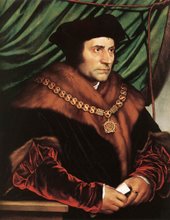
Before beginning to digest the the huge number of wide-ranging addresses of the Holy Father, I have to say that one address really stands out for me - the address in Westminster Hall. Again, it is hard to begin to appreciate the meaning of this event - the Holy Father, in the heart of the capital, speaking to the British establishment. And not only that, but he places before the citizenry of the UK the person of St Thomas More as a model of Britishness! And he invites us all to ponder the values of his witness to faith and reason, his witness to Christ; timeless values that anyone in any age can espouse to the betterment of the common good. How wonderful that this great Martyr of the English Reformation should be taken out from the devotional niche which has become his present-day place of honour, and has been placed again right of the heart of the public forum as a genuine point of reference for all the people of the UK.
I will, in due course, post again on the Visit, and I offer my own thanks to God for the extraordinary channel of grace that we have been given in the person of Benedict XVI. Thank you, Holy Father, for coming to the UK.

Friday, 17 September 2010

Ode to the United Kingdom


This, could I paint my inward sight, this were Our Lady of the Night; she bears on her forehead's lunacy the starlight of her purity: For as the white rays of that star the union of all colours are, she sums all virtues that may be in her sweet light of purity. The mantle which she holds on high is the great mantle of the sky. Think, O sick toiler, when the night comes on thee, sad and infinite. Think, sometimes 'tis our own Lady spreads her blue mantle over thee, and folds the earth, a wearied thing, beneath its gentle shadowing; then rest a little; and in sleep forget to weep, forget to weep!
(Our Lady of the Night by Francis Thompson)
No, weep not, for "the Kingdom of God is very near to you." With these words, Benedict XVI began his homily in Glasgow!

Wednesday, 15 September 2010

The two civilisations


It was in his Letter to Families that John Paul II contrasted the two civilisations which live side by side in the world today. The expression the "civilisation of love", he said, comes from the Second Vatican Council; that "Christ fully reveals man to himself and makes known his sublime calling." The Church is the herald and the promoter of this civilisation, and the family lies at its heart.

Another civilisation exists today, one which is linked to scientific and technological progress. It is agnostic in theory and utilitarian in practice. It is a civilisation of production, use and things, not of persons. In this civilisation, persons are objects for other persons, children and parents are a hindrance to each other. In this civilisation, the loss of truth about one's own self and about the family, leads to a loss of freedom, which leads to a loss of love.
The civilisation of use and things is embraced with particular vigour within the UK; excluding God and seeking success in whatever it decides to achieve. As Benedict XVI prepares to visit this island, I think of the visit of Gandalf to the Hall of Theoden in The Lord of the Rings; in the story Gandalf frees Theoden from the spell. May England be free to embrace the message of God's love which he brings, may England be free to embrace the Gospel.

Monday, 13 September 2010

Protecting the human embryo in Ireland

Thanks to Fr Sylvester CFR for this video. I first met Fr Sylvester at WYD 2002 in Toronto; subsequently he came to the Friary in Bradford where we did quite a bit of evangelisation together. He and the other friars are real trojans for the Gospel of Life.

Friday, 10 September 2010

A very reduced vision


Why is that there should be such anger shown towards the Holy Father from England? Leaving aside the question of whether this is a Media campaign or a widely held attitude from the people of the country, or both; the intensity of the invective against the Pope is quite surprising. Why?
I have been pondering this question from the other side of the globe as I have read some of the views which the Media has been disseminating. Now, I recall that John Paul II in speaking about contemporary secularism, once said that it arose from, what he called, a rationalist prejudice against the supernatural. In other words, rationalism has taken hold of so many people in this age, that they cannot admit even an enquiring mind, a mind that seeks to know, to love, to contemplate, to adore. In such a climate as this, the vision of what life is, is immensly reduced; rationalism and atheistic secularism have so reduced, clipped, trimmed, dulled and oppressed the soul of England, that it now lives in fear of its tiny world being shown up for what it is, and blown open by a greater vision of what human life is about. Today's anger springs from this fear.
What do I mean by the tiny vision of life which England has created for itself? Well, we see this in its extreme use of abortion and contraception, in its excessive focus on shopping culture, in the uncritical embracing of the media and media culture, in the un-thought-out rejection of the Christian life in favour of harsh and violent life-styles and moralities, and in its self-imposed individualism and culture of loneliness. How can human beings live in this culture? No wonder there is terrible anger and fear, now that a herald of the Kingdom of God is approaching.
What a tremendous grace then, the Holy Father's visit is; that in such an era of closedness and darkness, a light should shine. England's fear and anger arises, not from the Holy Father, but from its own inadequacy, its own self-imposed darkness. This is in no way a bad starting point - it's the real story of the human race - and this is why Christ came to us. The gentle herald of the Gospel who approaches will help England as best he can, to see a much greater horizon. England, step out from the darkness, see, hear, breathe and flourish!

Wednesday, 8 September 2010

Truth proclaimed


John Paul II, embracing the vision of the Council, taught the world how Christ saves man by enabling him to comprehend his true dignity and to live according to that dignity. This is what lies at the heart of all his teaching.

His first Encyclical Letter in 1979, Redemptor Hominis, was a proclamation of this vision. He taught that the central truth of man's life is the Redemption. In the Redemption God shares His life with man, and man is revealed for who he truly is.

The Church is the herald of this truth, and humanity, wherever it is found, and in whatever condition it is in, this same humanity is the place where the Church is called to go as a herald of the Gospel.

The New Evangelisation then, consists in embracing man's hopes and his anxieties and showing that they find their full response in Jesus Christ. Today's Christians are called to a 'Kingly' mission: service to Christ who uniquely reveals the full truth about man, and service to humanity which, although wounded by sin, is called to receive the healing love of God.

This in a nutshell is the message of grace of John Paul II in the midst of a world bewildered by secularism. Yet, alongside, there is a new generation which has received this message and welcomed it; the fruits are already beginning to ripen.

Sunday, 5 September 2010

Receiving the gift


Whatever happened to the Rogation and Ember Days? They were simply left aside by the Liturgical reform and still wait to be included into the celebration of the Christian life. This is the case in the UK, and in consequence, how impoverished and lacking in appreciation is our culture. In Australia however, one Ember Day is kept at the start of Spring and another at the start of Autumn.
Most of the world has seen a radical change in terms of life and progress. The preparation of the land and the sowing of crops, consigning ourselves to God's Providence, then the gathering in of the harvest and giving thanks to God for His munificence; these are now feint images from the past. Today, through the rise in prosperity for many nations and the acquisition of goods and utensils never before imagined, we are replete with material things of all kinds. But with our materialism has come an almost total lack of responsiveness to God; we neither depend upon Him, nor return to thank him.
All the good things we have today; not just food and drink, but our mobile 'phones, our broadband, our 'on suite' showers, our four-liter four-wheel drives and our airports of convenenience - these things are given to us, not for us to lose ourselves in, but in order to develop and perfect our humanity and that of our neighbour. We are all bound to the earth; the Church is bound to the earth, but this bond needs to be purified. It is purified and perfected precisely by not allowing ourselves to get lost in things, but to offer all the bounty of the earth to God.
How important were the Rogation and Ember Days, and how important in our material and profligate age that we reform our lives upon the basis of the gifts which the Creator bestows upon us, appreciating anew our part in preparing creation for its ultimate transformation. And by preparing ourselves for our ultimate transformation.
The old Liturgies of the Rogation and Ember Days can be found in the Liber Usualis. We need a renewed Liturgy for these today together with the development of a genuine human culture, recognising the Creator and the true meaning of His gifts to us. He gives us material and spiritual riches that we might become perfect in our humanity.

Friday, 3 September 2010

An icon of the realm


Congratulations to Edmund Adamus, Pastoral Director of the Westminster Archdiocese, for a very representative evaluation of many aspects of England today, as it awaits the visit of the Holy Father. His important discourse has been made available by Zenit; you can find it here. In the interview, he comments on the mosaic which stands above the entrance to the Cathedral; an image coming from the realm of faith, which expresses, symbolically, much of the truth about England which has been occluded in modern times.

Thanks also to Zenit for publishing this interview.

Thursday, 2 September 2010

What's up with men?

Jonathon Doyle has just launched a new blog which focusses on the essentials about men and masculinity; their identity and their mission. Jonathon is a leading agent in this field having already coverered much ground with his www.choicez.com.au . He and his wife, Karen, are very well known in Oz through their seminars and publications.