Friday, 23 November 2018

Dawson, Part V.

The secularisation of Western Culture and the rise of the Religion of Progress.
In two short paragraphs of pages 140 and 141, we have one of the best analyses of the Reformation ever made in a sociological frame.
Medieval Europe was civilized by the Church. The State was essentially the cultural tradition of a Christian people. The unity of peoples within Christendom was torn apart by the movement which we call the Renaissance.
In Southern Europe the Renaissance was a movement which sought the recovery of the culture that had been before the Middle Ages. In doing so it found a newly Christianised, Classical past, which led it to re-embrace its Catholic inheritance.
In Northern Europe this same movement led it back to its culturally barbaric roots, and so it sought a new form of expression. What took place was a quest for independence by a re-moulding of Christianity. The Renaissance in Northern Europe was the Reformation. To the north it was Lutheran and to the south it was Calvinist (which appealed to the Latin mind), and in the middle, England was Calvinist with a Catholic minority, and France was Catholic with a Calvinist minority (including the Calvin-influenced Catholics, the Jansenists.) In England the Church is Protestant, but Anglican. In France it is Catholic, but Gallican.
The Reformation, which was originally a religious and theological movement, is propelled by social forces. People sought independence from any influence that was felt to be repressive or foreign. Nietzsche called the Reformation “a spiritual, Peasant revolt” – the elimination of everything that was intellectual, complicated, Catholic.
However, the Reformation did not follow the Oriental path of centuries before, where people had turned away from human experience to contemplate the Divine. Rather, it led to an accentuation of what had taken place in the West centuries before, where faith became a dynamic force. Now, in Protestantism, faith was no longer seen as one’s participation in the Divine life, but was seen as a purely non-rational experience, the conviction of personal salvation.
For Catholics, God was the principle of the intelligibility of the created Universe. For Protestants, God was a despotic power who saved or damned men by mere arbitrary will. This understanding did not lead to an attitude or fatalism or apathy, but rather to a sense of practical moral duty. Having abolished spiritual ‘works’, Protestantism invented a new code of activism.
In the Catholic south there was also a movement from the cloister to the world. The active, or apostolic life of lay people came into focus.


Friday, 12 October 2018

Boundary rosary.

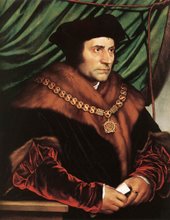
In January of this year my parish was amalgamated with one of its neighbouring parishes, that of St Thomas More. This was a difficult experience particularly for the parishioners of St Thomas More who saw their church closed.
A consequence of the amalgamation is that we now have a new, larger, parish boundary. In January 2019 I will use the Rite of Blessing of a Parish, from the Roman Ritual, to bless our new, larger, parish on the first anniversary of the amalgamation This will be the third time that I have performed this Rite.
In preparation for this blessing groups of parishioners have prayed the Rosary while walking sections of the boundary. We hope to have completely ringed the parish with prayer before the Blessing in January. This prayer has been offered for everyone who lives within our parish territory.
The above photo was taken about a month ago on the northern part of the parish boundary, looking north to Leeds. The M1 motorway is just visible in the right of the photo. What gorgeous, sweeping fields we have in the parish, intersected by a wonderful network of footpaths.

Saturday, 6 October 2018

27th Sunday, Cycle B.

Mark 10: 2-16.
Ideology or God's plan.
It isn't easy to speak openly today about the Church's teaching on marriage. But Jesus did!
Ideology is so strong today - attitudes, lifestyles, me, myself and I.
It was strong in those days - legalistic prescriptions, which covered over attitudes, lifestyles, me myself and I.
But God's plan in beautiful and includes my transformation in grace so that I am made fit for the Kingdom. And if being fit for the Kingdom means being called to model your nuptial relationship on the spousal relationship of Jesus with the Church - then enter into that nuptial relationship and allow yourself to be transformed.
Ideology or the Gospel? 
We hear a lot from the ideologues, but not enough proclamation of the Gospel.

Monday, 1 October 2018

Walsingham on Saturday 29th September.

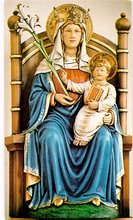
On Saturday our group joined in the Diocesan Pilgrimage to Walsingham. We were around 500 people in all from across the Leeds Diocese. It was a beautiful day, seeking Our Lady anew as our model for saying "yes" to God.
This year is the 70th anniversary of the 1948 Cross-carrying pilgrimage which fourteen groups made from different parts of the country in reparation for the evil of WW2. It was an inspiration to us about how we can carry our (baptismal) crosses in reparation today for the evil which we all know about.
The pilgrimage ended very poignantly, with the praying of the "Prayer for England" at the site of the original Holy House. We all came away much uplifted.

26th Sunday, Cycle B.

Have you ever been in a place that's being remodelled? It's usually quite messy, with signs apologising for the inconvenience, but promising a great new look. Well, that's what we can be like too when we are endeavouring to get rid of the evil that is in us. And that's good, and we should support one another in this great process.
Today, with the fall off in recognising our sin, and in the consequent fall off in receiving the sacrament of penance, we end up going about our lives with that evil, poorly concealed and hanging around. Grace doesn't flow and we are atrophied.
The Lord is right, let's attend to the evil in us, undergo the remodelling and be free.
(Sorry, I was a bit late with this Sunday's. I was on pilgrimage in Walsingham on Saturday.)

Saturday, 22 September 2018

25th Sunday, Cycle B.

Jesus predicts his passion. His self-gift is contrasted with human selfishness.
We all sense the call of love, to call to love, but we can err in the way that we go about it. But being his disciple trains us to respond to the truth. Jesus has the best place – last of all. Being with him is the promotion.
Moving from living by our own surging and arbitrary passions to accompanying, living with his heart, is the way to really constructing human life. This call is made to us again. He is full of love, and this is the call He makes to us.

Saturday, 15 September 2018

24th Sunday, Cycle B.

As we go through the Gospel, things get very real. The Gospel is not a story but is given to us so as to bring us into it, so as to change us.
Jesus suffers and speaks of our share in that. What is our suffering? Whatever it takes for us to accept Jesus’ act of love, so that we are animated by Him (rather than by fallen human nature.) This 'suffering' saves!
Our suffering takes the form, not of crucifixion, but of humiliation, of rejecting our pride, of changing our life, of going against the culture.
But if we really embrace Jesus' act of love, nothing can get in our way.
Note in the Gospel that when Peter answers Jesus' question, he gives the right answer. But he has not learned yet what that means for him. This is why Jesus tells him not to tell anyone about him; Peter is not yet ready to give an authentic witness or understanding. Jesus knows that Peter still has to change - to be transformed by grace. In grace he will give an authentic witness.

Friday, 14 September 2018

The Eucharistic Congress in Liverpool.

Last week I took part in the Eucharistic Congress in Liverpool. Together with parishioners from St Ignatius' we were part of the Congress on Saturday in the Echo Arena.
It was a superb day with wonderful interventions from Bishop Barron, Youth 2000, The Rise Theatre Group, Mary's Meals and others. The whole day took place in "the shadow of the monstrance" which was unveiled at the end for a period of adoration. Eight to nine thousand people with a tangible desire to be in the presence of our Eucharistic Lord prayed Vespers together, with extended silences in which so much love was exchanged.
The interventions which made up the bulk of the day came from the "grass roots" and from the Movements. The day was about inspiring us, rather than equipping us. It expressed a deep desire from the participants for a perfomative, life-changing engagement with the Lord, rather than a day of information.
The Church of the National Eucharistic Congress is the Church that we long to see in all our parishes.
I took the above photo during Bishop Barron's first talk on the Mass, and the below photo during the lunch break - this photo shows the venue, and how it looked when it became for that day, a place of grace.

Tuesday, 11 September 2018

Images from Rosary on the Coast.

On 29th April this year we took part in the tremendous initiative "Rosary on the Coast". I did upload some images onto the lead website at the time, but they didn't seem to appear on the public domain. So, I place some of these images here below. 
Our parish group from St Ignatius', Ossett, were joined by the Friars of the Renewal from Bradford. There were about 35 people in the group, and we established ourselves just a few hundred meters east of the Humber Bridge on the north bank on the Humber, close to Hull. 


After the time of prayer for the country we went into Hull to visit the Lord in the wonderful church of St Charles Borromeo. It was a remarkable afternoon.

Thursday, 6 September 2018

23rd Sunday, Cycle B.


I think of Handel’s Messiah and the passage of Haggai 2:6 “And he will shake the heavens and the earth … “ The vengeance of God is the healing of human woundedness, while he himself takes on the price of the healing; Christ heals and becomes a penitent. Responding to Christ means moving from alienation to friendship. A transfer of power from ourselves to Him. He has real power. What does real conversion look like today? Friendship with Christ.
This Sunday I will speak about the Eucharistic Congress in Liverpool which I will be taking part in.

Wednesday, 5 September 2018

Dawson, Part IV.

A summary of our considerations so far.
Ancient societies built their lives around the powers of nature. Nature was united with the spiritual.
In Classical times, nature was rejected in favour of a transcendent ordering principle.
With the advent of the Church, the transcendent is revealed as a personal God, indeed a Trinity of Persons, whose life is directed to the restoration of human life and activity, and in which human progress is suddenly expressed.
Because of the Incarnation, human beings are the place where the spiritual and the material are united. A new intellectual synthesis, during the Middles Ages, brought together the value of humanity and the natural order, and gave rise to science and law.
But as the European mind began to exploit the riches of the new scientific knowledge, as well as worldly power, it turned away from this flowering of mind and spirit enlightened by the Gospel, and sought a purely rational or empirical ideal of knowledge.
And so in the late Middle Ages there was a reaction against the idealism of Christian culture; nominalism grew and, as a result, a secular understanding of the world came into being – one in which God and life are separated.

In art, realism took the place of symbolism. In politics, the unity of Christendom was broken up by the growing forces of nationalism and secular culture; there was an emancipation from ecclesiastical tutelage, in favour of a new and self-made independent culture.