Thanks to the Spanish Bishop's "Campaign for Life 2011" for this expression of the renewed pro-life message.
Monday, 28 March 2011

Sunday, 27 March 2011
A sign for our times

For many parishes the New Evangelisation will start here - leaving the door of the church not simply unlocked, but wide open. This is especially important when Mass is being celebrated. Many churches do leave their doors unlocked, but for the newcomer or passer by the door may as well be locked. The church door needs to visibly open. An open door is both a sign of welcome and a sign of life. Some of the parishes where I have been Parish Priest liked to keep the church doors closed during the Mass; this is a sign that a congregation has gone into 'private members club' mode and that the focus of the parish is inward looking, or has become, simply, neo-pelagian. I had to work hard to convince my parishioners that an open door was a better sign to give. In one parish, the church was on a main road which clogged up with peak-hour traffic twice a day. I was so glad that when the doors were eventually left open, the slow stream of drivers crawling along could look straight in through to the altar and see the early morning Mass happening. Moreover, a slow realisation grew in the district that this was one church that was actually used each day - becuase, unlike the others nearby, people could see that this one was opened up everyday and that daily Mass was celebrated there.
Incidentally, the churches where I was Parish Priest all had a second set of glass doors within, which kept the church warm in the colder months.
Wednesday, 23 March 2011
Something new in the harbour

It was very good to see, the other day, that one of the Watsons Bay ferries is named after Australia's first saint. Many will see, or journey on, this ferry between Circular Quay in Sydney and Watsons Bay near the South Head. This a avery fitting gesture to this saint who is, and was, so active in witnessing to the Redemption in Australia.
Sunday, 20 March 2011
A Roman visitor
Last week Cardinal Raymond Burke the Prefect of the Supreme Tribunal of the Apostolic Signature came to Sydney, his first visit to Australia. Much of his time he gave to young people. His address to the Australian Catholic Students Association was very well received as he addressed the contemporary challenge of living and building the Christian Life in a neo-pagan culture. A summary of his talk has been published by Zenit.

The Cardinal also spoke at the tremendously formative monthly "Theology on Tap" in Parramatta (photo above). He addressed the question of how to concretely promote the Culture of Life: I was present for this talk and was very struck by how the Cardinal held the attention of maybe five hundred young people in a city pub. The new generation of young people in Sydney are so keen and so glad to have their spiritual fathers come to visit and are happy to hear any message of truth.
The Cardinal also treated us to a celebration of a Pontifical Mass in the Extraordinary Form. The Mass was celebrated in a city Parish Church and drew one of Sydney's Auxiliary Bishops together with a huge throng of young people. It is a rare occasion today for people to witness the older form of the Liturgy with full pontificals, and to experience the Liturgy as it used to be. First of all, it is essential that young people have a point of reference in the old Liturgy so that they can see where we have come from - what the Liturgy used to look like. Fortunately this is possible today, and clearly the young Catholics of Sydney were very grateful to Cardinal Burke for allowing them to experience this rare form of the Liturgy. For a number of decades, people both young and old were denied this experience (apart from England and Wales where from 1971 a Pauline Indult had allowed the use of the older Liturgy), and the opportunity for having a greater appreciation of the Church's Liturgy.
Many young Catholics are seeking "form" both in the Liturgy and in their Spiritual lives, and it is appropriate that the Church is now responding to this desire. I think that it is also necessary that the other part of the equation be attended to; namely, to provide formation and catechesis about the older Liturgy and its structure, so that Christ rather than Liturgical forms might be whole focus of these expereinces. In other words, as well as the older Liturgy being celebrated, it needs to be studied and appreciated from the perspective of Christ, rather from that of mere ritual.
Friday, 18 March 2011
A renewed vision

I have been reading Scott Hahn's recently published book "Covenant and Communion" and am full of praise for this masterpiece. Scott brings together some of the main seams of Benedict XVI's theology into a unified Biblical Theology. The Vatican Council asked that Theology be renewed upon the foundation of Sacred Scripture; Scott Hahn shows us how the Holy Father has done this, giving us not just a renewed appreciation of the Scriptures, but of God's plan for us expressed in the Church, the Liturgy and the Eucharist. This is not a beginners Theology book, but I do recommend it particularly to priests and all those who have already gone some way in studying Theology. Scott's new book shows us just how far our very dear Holy Father has taken us, by remaining so close to the message of Truth given in the Sacred Scriptures.
Tuesday, 15 March 2011
A sacred language for the Liturgy

Zenit reproduced a fine article, on 11th March this year, by Fr Uwe Michael Lang about "the sacred language" of the Liturgy. You can visit the link here. It is always good to have Liturgical formation at this level.
Sunday, 13 March 2011
Placing the text

The study of Sacred Scripture is related with Theology; I offer here a schema to show the basic relationships which are involved.
Fundamental Theology concerns the study of Theology in itself; what it means to study God. Its methods, sources, parameters and its relationship with other sciences. Sacred Scripture is here, one of the sources of Theology.
Theology is the science of revealed religion; a disciplined reflection on divine revelation (as against the "study of religions" - which is a human science.)
Within Theology there are three main branches:
1. Positive Theology, which is an inventory of dogma and draws on the two soucres of Revealed Truth - Scripture and Tradition. It also includes the historical development of dogma.
2. Scholastic Theology, which is a systematisation of the Faith into a unified structure, using reason.
3. Biblical Theology is the unified understanding of the saving truths contained in the Scriptures which are given to us in the Church's Tradition. Biblical Theology draws only upon Scripture and its work is to collect the results of exegesis, so that they can be compared, assigned a place in the history of Revelation, and so that Scholastic Theology can be given with a firm foundation. Biblical Theology then, flows out of exegesis and is the foundation of Scholastic Theology.
A word about exegesis. Exegesis is the interpretation of biblical texts. Its method, which has come out of the Enlightenment, is analytical and scientific; it looks at the parts of the whole.
Biblical Theology, on the other hand, is synthetic; it looks at how the parts of Scripture relate with the whole. As such it complements exegesis by making exegesis a Theological discipline, rather than it being a purely secular study. Biblical Theology bridges the gap between exegesis and Theology: the Second Vatican Council taught that Sacred Scripture was to be the soul of Theology. In the past, Theology sometimes tried to do its work without referring to the Scriptures. However, Biblical Theology is not autonomous, it is not the whole of Theology as it draws only on Sacred Scripture. Theology must draw on both sources of Revelation, Scripture and Tradition.
Tuesday, 8 March 2011
XT3 moves into Lent

XT3's new Lent Calendar App. is available to download now with daily readings, reflections, podcasts and video apologetics. The Sydney-based Catholic Network have produced a tremendous resource here for young people and are making very good use of their presence in the digital world. Congratulations and thanks to the XT3 team. Visit http://www.xt3.com/
Fr Benedict on Scripture, Part 2

Continuing and concluding my notes from a talk given by Fr Benedict Groeschel CFR in Leeds in 2002, we can begin to appreciate Fr Benedict's own clarity of understanding about the nature of Scripture scholarship during the twentieth century, and particulary the impact of rationalism in the form of the "historical-critical method" of interpreting Scripture, which came to the fore in both Protestant and Catholic circles as a result of the Enlightenment. Fr Benedict in his talk continued to present the problem for the Church which came from a rationalist perspective on Scripture.
-
Today’s Catholic Scripture Scholars have arisen largely from the pro-Enlightenment group. In other words, today’s Catholic Scripture Scholarship is the Enlightenment’s enlightenment of Scripture. And this project does not sit well with Mystery; it is Mystery which makes rationalists ill at ease with the New Testament. The basis of this movement is the idea that the human mind can understand everything, and that we are embarked on an irresistible upward human journey, that science and reason are all powerful. This project, in effect, came to an end with the two World Wars.
A contemporary example of this current is Fr John Meier’s book “The Marginal Jew”, which endeavours to propose that common understanding which Catholic, Protestant, Jewish and Agnostic Scripture scholars would agree about what Jesus said, did, knew and meant. Intending to refine the essential truth which lies at the heart of Scripture. However, asks Groeschel, what is an agnostic, or a Protestant, or a Catholic? But, since no one can really define these categories, how can one determine the essence of Christianity from such vague premises?
At the end of the Kulturkampfe a remarkable priest emerged: Fr Matthias Scheeben, who was able to see that Scripture scholars had reshaped the Mysteries of Christianity upon the basis of rationalism. His great work, “The Mysteries of Christianity” is a masterpiece of Catholic thought in the midst of a rationalist and mystery-denying era.
No one however, saw the Rationalist impact on Christianity as it was happening, better than Newman. We Catholics tend to know better the devotional side of Newman, yet his clarity of theological vision in the context of the impact of rationalism is most important. (See Fr Bouyer’s book “Newman’s vision of faith”.) Newman speaks about faith submitting reason to Mystery; having faith in spite of the darkness that surrounds me, removing the obstacles to faith so that the mind can believe in God. That Faith is a thankful and obedient experience. That Sacred Scripture are the words of God, and that we cannot therefore treat them like the words of men.
Concluding his talk, Fr Benedict indicated the place from which to start the study of Scripture: that Scripture is given to us by the Providence of God to guide us on the way to Salvation (CCC,107), and that this is the primary purpose of the Scriptures.
A contemporary example of this current is Fr John Meier’s book “The Marginal Jew”, which endeavours to propose that common understanding which Catholic, Protestant, Jewish and Agnostic Scripture scholars would agree about what Jesus said, did, knew and meant. Intending to refine the essential truth which lies at the heart of Scripture. However, asks Groeschel, what is an agnostic, or a Protestant, or a Catholic? But, since no one can really define these categories, how can one determine the essence of Christianity from such vague premises?
At the end of the Kulturkampfe a remarkable priest emerged: Fr Matthias Scheeben, who was able to see that Scripture scholars had reshaped the Mysteries of Christianity upon the basis of rationalism. His great work, “The Mysteries of Christianity” is a masterpiece of Catholic thought in the midst of a rationalist and mystery-denying era.
No one however, saw the Rationalist impact on Christianity as it was happening, better than Newman. We Catholics tend to know better the devotional side of Newman, yet his clarity of theological vision in the context of the impact of rationalism is most important. (See Fr Bouyer’s book “Newman’s vision of faith”.) Newman speaks about faith submitting reason to Mystery; having faith in spite of the darkness that surrounds me, removing the obstacles to faith so that the mind can believe in God. That Faith is a thankful and obedient experience. That Sacred Scripture are the words of God, and that we cannot therefore treat them like the words of men.
Concluding his talk, Fr Benedict indicated the place from which to start the study of Scripture: that Scripture is given to us by the Providence of God to guide us on the way to Salvation (CCC,107), and that this is the primary purpose of the Scriptures.
-
As an end note, could I just point out that Pope Benedict has, in his Apostolic Exhortation "Verbum Domini", declared that the "historical-critical method" has an important role in Scripture Scholarship, but that it needs to undergo a self-purification in order that it can be uselfully applied to the Scriptures without it adding its own agenda.
Sunday, 6 March 2011
Shadows of men

It should not surprise us at all, nor should we be condemnatory, that in our secular age which has lost sight of the love of God, an age in which by and large people do not believe that they are really cherished by God, that many men should enter into the culture of homosexuality.
The great platform upon which human life is lived is the relationship we have with God. Are we on our own in facing life? Is God concerned about us at all, or is He merely moved from afar when we encounter all that is bad in the world, Himself remaining hidden and silent? How could we be expected to believe that God has become man and entered into the very situation of our lives? Could this be true?
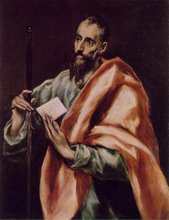
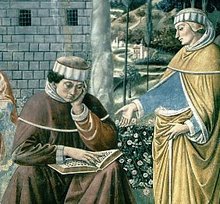
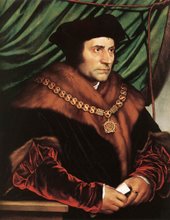
The Christian transformation of men, in history, through the action of the Gospel has revealed the greatness of masculine personality and character. What do the Apostles, St Paul, St Augustine, St Thomas More, Bl Louis Martin (the father of St Therese of Lisieux) have in common? They all pointed people towards God. In the light of Revelation which shows the first man blaming his wife and then hiding in the bushes, male greatness comes about when, in the Gospel, men accept God's company and lead others towards God. When is a man truly a man? When, by his life and example, he directs others on the path towards God.
Historically, we can see a number of contexts, in both the Church and society, where men truly embrace their masculinity. In the family, a father and a husband takes up an essential role of guiding, fostering and protecting the spiritual life of his wife and children. Bishops and priests have an indispensable Christian role of fatherhood, pointing out and leading the way. Single men also have assumed their God-given personality. It is the case that most men take up the role of becoming biological fathers, but before embracing this vocation all men have the vocation to spiritual fatherhood.
In our age, which has turned its back on the Mystery of Faith, it is sadly true that many men instead of aspiring to the fullness of their mission in the world, embrace a lie about themselves instead. Does God love and cherish these men? Of course he does. Can these men be saved? Of course they can. But that is precisely the point; it is not Salvation which is at stake, but our willingness to embrace that relationship with God which Salvation reveals.
There is a great need that today, many men will be open to God and to being loved by Him in Christ, and shake off the cultural lies that prevent them from embracing their true greatness. Every society, every community needs real men, men who point out to others and lead the way to God.
Saturday, 5 March 2011
Speaking about Scripture scholarship

Reading Pope Benedict's new letter 'Verbum Domini' put me in mind of a talk which Fr Benedict Groeschel CFR gave in Leeds in 2002 about Scripture scholarship during the twentieth century. He outlined very simply the origin of the main difficulty - rationalism - which we have had to deal with in Scripture scholarship, together with that attitude that leads to a genuine embracing of the Scriptures. I took notes during Fr Benedict's talk and enclose a summary of my notes here. Acknowledgements to Fr Benedict Groeschel CFR.
-
At the beginning of the twentieth century many Catholic Scripture scholars, people like Loisy and Tyrell had gone into the rationalism of Protestant scholarship and taken Scripture with them. So, in order to protect the Scriptures Pope Pius X commanded Catholic Scripture Scholars to get out of contemporary Scripture studies because of where they were going.
Almost half a century later in 1943 Pope Pius XII reversed the command of Pius X and opened dialogue between Catholic theologians and the Critical Methods that had been used by Protestants and in secular studies of the Bible. In his Encyclical - Divino Afflante Spiritu - he made many cautela and limitations, which as the Catholics moved into academic circles tended to be ignored. But in any case the Catholic Scholars had to enter into this circle with the rules that were in play.
The environment which the Catholic scholars encountered in 1943 was materialistic, sceptical, reductionist and profoundly anti-supernatural. One of its most important protagonists was Rudolf Bultman, whose basic hypothesis was that Scripture exists for preaching (the truth is that this is only one of its purposes), and that you can only preach that which people will believe. For Bultman, modern people do not believe in the miraculous and, he would go on to propose that the miraculous doesn’t even exist. This attitude comes from scientific reductionism, which says that if there is something which you can’t comprehend, pretend that it isn’t there.
Later, Raymond Brown the Catholic scholar, following this tradition, would propose in his book “Jesus, God and man”, that Jesus did not know who he was. In this book he declared that the only words in the Gospel which we know Jesus said are “This is my body”. These words are so extraordinary that they could not have been made up by the evangelists. However, Brown fails to ask how someone who doesn’t know who he is could have said these words, unless he thought he had divine power. The problem which all these exegetes have is a problem with accepting Mystery.
The origin of this whole attitude to the Scriptures is rationalism, which entered into Scripture Scholarship in Germany at the time of Von Bismark’s Kulturkampfe (1871-1878). This was a basically non-political attempt to bring cultural unity to the newly unified Germany. It’s principal goal was to bring Catholics into line with ‘enlightened’ Protestants. By the end of the Kulturkampfe Catholics were divided into two groups: those who embraced the achievements of the Enlightenment, represented today by Karl Rahner (that it is possible to Baptise the Enlightenment, including Kant and Freud, and get something good from it), and those who would not embrace the Enlightenment, represented by Romano Guardini, Karl Adam and von Balthasar.
Almost half a century later in 1943 Pope Pius XII reversed the command of Pius X and opened dialogue between Catholic theologians and the Critical Methods that had been used by Protestants and in secular studies of the Bible. In his Encyclical - Divino Afflante Spiritu - he made many cautela and limitations, which as the Catholics moved into academic circles tended to be ignored. But in any case the Catholic Scholars had to enter into this circle with the rules that were in play.
The environment which the Catholic scholars encountered in 1943 was materialistic, sceptical, reductionist and profoundly anti-supernatural. One of its most important protagonists was Rudolf Bultman, whose basic hypothesis was that Scripture exists for preaching (the truth is that this is only one of its purposes), and that you can only preach that which people will believe. For Bultman, modern people do not believe in the miraculous and, he would go on to propose that the miraculous doesn’t even exist. This attitude comes from scientific reductionism, which says that if there is something which you can’t comprehend, pretend that it isn’t there.
Later, Raymond Brown the Catholic scholar, following this tradition, would propose in his book “Jesus, God and man”, that Jesus did not know who he was. In this book he declared that the only words in the Gospel which we know Jesus said are “This is my body”. These words are so extraordinary that they could not have been made up by the evangelists. However, Brown fails to ask how someone who doesn’t know who he is could have said these words, unless he thought he had divine power. The problem which all these exegetes have is a problem with accepting Mystery.
The origin of this whole attitude to the Scriptures is rationalism, which entered into Scripture Scholarship in Germany at the time of Von Bismark’s Kulturkampfe (1871-1878). This was a basically non-political attempt to bring cultural unity to the newly unified Germany. It’s principal goal was to bring Catholics into line with ‘enlightened’ Protestants. By the end of the Kulturkampfe Catholics were divided into two groups: those who embraced the achievements of the Enlightenment, represented today by Karl Rahner (that it is possible to Baptise the Enlightenment, including Kant and Freud, and get something good from it), and those who would not embrace the Enlightenment, represented by Romano Guardini, Karl Adam and von Balthasar.
(To be continued.)
Thursday, 3 March 2011
The mustard seed, again.

A new initiative has begun in parishes in the UK; small groups meeting informally to grow in faith using as their guide "The Compendium of the Catechism of the Catholic Church". I wish that there had been such groups in my parishes, when I was a Parish Priest. Visit the website to find out more. From small beginnings ....
Monday, 28 February 2011
An opportunity not to be missed

With the new English translation of the altar missal only months away I do hope that you have been able to attend, to whatever degree, to the preparatory catechetical material. Indeed, the opportunity for Liturgical formation which was unfortunately omitted at the time of the reform in the late 60s, is now again possible. The need for Liturgical formation is probably not universally appreciated, even though the lack thereof is staring us in the face. And what is such a great grace to the Church is that the present Holy Father has a profound Liturgical awareness, and has given so much of his time and energy to offering genuine Liturgical catechesis to the whole Church.
The DVD resource "Become one Body, one Spirit in Christ" is a necessary part of our Catholic education at this time. The section "Receiving the new translation" should be given particular attention. Some sequences on the DVD have limited value and in one section and English priest gives a very inadequate definition of the Priesthood. I would also say that the very heart of Liturgical formation, "active participation", which is joining ourselves to the action of Christ in the Mass, is not treated adequately. However, this DVD is an indispensible resource for personal and communal use in an age which has, to a degree, lost sight of the Mass.
Another resource is available on the internet and you can watch its videos directly on-line, without purchasing a DVD. I recommend this website for its content: http://www.romanmissal.us/
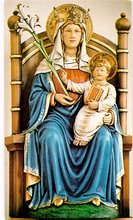
The image above is a photograph I took a few weeks ago of a gothic statue of Our Lady in the old church in Perouges, France, near Ars.
Thursday, 24 February 2011
Then saw they how there hove a dusky barge
The other day a couple of us went down to the harbour in Sydney and behold, not a hand clothed with white sammite, but an enormous volume of water displaced by two queens; the largest passenger ships on the planet. Yes, together in the harbour were the Queen Mary II and the Queen Elizabeth. We caught a harbour taxi and got up close - quite a sight! The Queen Mary II is the larger ship; I could scarcely get the whole ship in the frame in order to photograph it.


Tuesday, 22 February 2011
Important sources

While I was back in the UK for Christmas I was asked by someone about the 'reform of the reform' and what elements comprise it. This is an important matter, and here, in essence, was my reply. The 'reform of the reform' is the way in which the contemporary liturgical movement is developing the Liturgical reform of the Second Vatican Council and the implementation of the 'Novus Ordo' Mass, so that it better expresses the nature of Catholic Liturgy. The main promoter of the 'reform of the reform' is Benedict XVI.
Two important factors are involved in understanding this movement. First, it is important to have a genuine understanding of the Liturgy (a liturgical catechesis), what the Liturgy of the Church is in itself. I would cite here just two sources: The Catechism of the Catholic Church, paragraphs 1066 - 1209, and Joseph Ratzinger's book, "The Spirit of the Liturgy", especially its Preface and the whole of Part 4.
Secondly, it is important to recognise that the Liturgy develops over time, and that we are still very close to the reforms of the late 60s, and that the whole sense of a reform of the reform is only about five years old. Time is on our side and we shouldn't expect sudden developments; we are looking at an organic process of development/reform which will probably take 50-100 years.
So, with these things in mind, here are the main sources for appreciating the 'reform of the reform':
1. We should read, reflect upon and know the Council's document on the Liturgy, "Sacrosanctum Concilium".
2. We should have some knowledge of the previous Liturgy of the Mass, the so-called Tridentine Mass, in order to see where we have come from.
3. We should read and refect upon Benedict XVI's Apostolic Exhortation "Sacramentum Caritatis", which gives us an over-arching vision of the reform of the Liturgy which has taken place.
4. We should note Benedict's teachings on the Liturgy in his homilies, addresses etc. For instance, what he says in his new book "Light of the World", pp105-106, 155-158, is very important.
5. The 'Benedictine' altar arrangement of the candles and crucifix.
6. The new English translation of the Altar Missal.
7. The Motu Proprio "Summorum Pontificem", in which the Old and New forms of the Rite are brought together in order to shine light on each other; for the two forms to be reformed by each other, as it were.
Of course, there are lots of other sources, but my intention is to point out simply the heart of the matter and I hope that these indications will be helpful to others.
(I took the above photo last month in the old church in the village of Perouges, near Ars in France.)
Two A levels

Cardinal Heenan commented in a letter to Evelyn Waugh in 1964 about the rise of the new Catholic pseudo-intelligentia, saying how anyone with two A levels considered themself an intellectual whose opinions were worthy of public interest. Well, what appeared in the 60s certainly gained momentum in the UK as the years wore on, and I have encountered this syndrome so many times that it really does seem to have become an obstacle to the Christian Life.
As a newly ordained priest I remember in 1988 a lady striding into the sacristy as I was vesting for Mass and wanting to know if I would be using inclusive language in the Mass. Five years later, I remember another lady, addressing a conference of the Leeds clergy, telling us that she would give the new Catechism, which was about to be published, a shelf-life of four years. In one of my parishes, in North Yorkshire, I encountered a culture of opinion to such a degree that the Parish itself was disfuntional. I was told, as Parish Priest, that it didn't matter if young people didn't go to Mass or Confession, that we mustn't burden them with Sacred Scripture, and that if Joseph Ratzinger were elected Pope there would be a schism in the Church. Now all of these were personal opinions, but opinions which actually were an obstacle to the Gospel and to the life of Church in that place.
Today the culture of opinion is all-pervading; signs of it are clearly evident in the Catholic world. The religious interest magazine "The Tablet" would be an example of this culture and how it places itself as a guiding and moderating influence upon the teaching and the message of the Holy Father and the Church, developing its own sort of orthodoxy, one which runs parallel to that of the Church.
What Cardinal Heenan noted with some concern in 1964 is a paralysing phenomenon of our age: Catholics applying a secular critique to Christianity. In fact, it is the opposite which is true - that it is Christ and the Church who enables us to understand our lives and the world in which we live. We see this formative attitude especially in people who actually listen to the Holy Father and the Church, and in those who participate faithfully in the Mass.
Saturday, 19 February 2011
An un-ergonomic encounter

Just before I entered seminary in the Autumn of 1982, an acquiantance recommended a particular book to me. Indeed, he said that this book should be compulsory reading for all seminarians. He seemed to think that there was a very important message in this novel for all aspiring seminarians. So, I took up his recommendation and acquired a copy of David Lodge's novel "How far can you go".
It was as though in an instant I was introduced, through this book, into the whole malestrom of dissaffection with Christianity which I had somehow skipped over in the past decade. The book was trying to describe how far a Christian could go in trying to live according to the world's lights, and still call himself a Christian.
I should have asked my acquaintance why he thought all seminarians should read this book. The book was a real 'turn off' for me, for I couldn't understand why anyone who wanted to follow Christ would actually try to put a huge distance between Christ and himself. Of course, from another point of view, this novel introduced me for to a whole growing culture, among British Catholics, of dissaffection with the Church and the Christian Life, which I would not encounter again until I returned from seminary in Spain six years later.
Friday, 18 February 2011
The bravest route

My own experience of the new catechetics/religion did not happen until I went to Grammar School in 1972 - in my case to St Michael's College in Leeds. Earlier, during my years at Infant School, and even well into Junior school I had benefitted from traditional religious instruction. This was probably because my teachers had not been sent to attend courses on the new stuff, or were not ready to implement it, or because they had decided to keep teaching the Catholic Faith instead. I was also Confirmed when I was 8, and again prepared in a traditional way for this Sacrament. So, together with the whole background of Catholicism which I was growing up in, from family and parish, I emerged as a young teenager, untramelled by the new religion.
The Infant and Junior schools which I attended were later to adopt, in the early 70s, along with all other Primary schools in the Diocese, the "Veritas" RE scheme. Looking back, it is hard to imagine what lunacy drove the decision to inplement this Scheme, and in so doing to exchange the teaching of the Mysteries of Christ's life for reflections on pebbles and flowers.
At St Michael's College, where we were taught that Jesus wasn't God, and were subjected to coffee-table class Masses, I cannot now remember if a particular Scheme was followed. Certainly, I passed through High School long before "Here I am" or "Weaving the Web" were foisted upon RE departments. However, it was clear that the Catholic background in which I was brought up had instilled the Faith in me to such a degree, that the nonsense I was exposed to at St Michael's washed over me without gaining a foothold. And that, emerging from High School as a late teenager, I was eager to really deepen my undertanding and experience of the Catholic Faith. This I did as a "grace-led" project untill at the age of 21 I heard a call to be a Priest.
I sense that my experience holds two important ingredients for today's context. First, the Faith is planted and nurtured at home, rather than at school. Secondly, that the age to really form young people in living the Christian life (and of course this varies according to the individual) is precisely when they are emerging into young adulthood. Of course, the question of a person embracing the Catholic Faith concerns the whole vision which God has for a person's life, which we are all called to put ourselves in tune with.
Saturday, 12 February 2011
With hindsight

In the last post I mentioned a Catechetical College which had formerly existed in London called Corpus Christi College. This was the national catechetical centre set up by Cardinal Heenan in the late sixties and which he closed in 1975. The college was in the former Convent of the nuns of Our Lady of Sion (pictured above), on the corner of Chepstow Villas and Denbigh Road in Notting Hill near Paddington Station. The building is now divided into residential flats.
The first director of the college, Fr Hubert Richards, together with Fr Peter de Rosa and others set about producing a new catechesis and training others in its vision and method. Indeed, at the time, representatives from every Catholic school in the land were obliged to attend courses here. By 1971 it became clear that the college was a centre of heresy and a new director was appointed to re-align the college, Fr Michael Keegan, who also oversaw the closure of the college in 1975. But the damage had already been done. The original directorate and staff of the college had successfully purveyed within the Catholic Church in the UK their own new religion. With hindsight we can see that this new religion is actually a form of Pelagianism - the doctrine that human beings do not need grace in order to be saved, they can achieve salvation on their own. The new religion of Richards, de Rosa and others was spread, not so much through lay teachers but through religious and priests who thronged to Corpus Christi College to imbibe its noxious teachings. Most priests and religious who attended courses at the college returned to their posts with totally wacky ideas and many abandoned their vocations. I remember the lay RE teacher who took the class that I was in at St Michael's College in Leeds, teaching us in 1973 (I was 12/13 years old at the time) that Jesus was not God but was given a mission from God at his baptism in the Jordan. He also taught us, that same year, about all the different methods of contraception and how to put on a condom. This man, who went on to become the Head of RE at another High School in the Leeds Diocese, was for many decades paid an excellent salary in order to teach the Catholic Faith. I remember thinking, as he was speaking to us in the class, that this man was "off his rocker". We have been duped!
In the mid-nineties, Claire Richards, ex-nun and wife of the ex-priest Hubert Richards, published the heretical school RE curriculum "Roman Catholic Christianity". This book, although officially discredited, may still be in use in some Catholic schools.
There are many agents of Corpus Christi College still around in the UK today, and you will find signs of of its influence in these ways (amongst others):
1. Any explicit or implicit diminishing of the nature or mission of Jesus Christ the Redeemer of mankind.
2. Any explicit or implicit diminishing of or undermining of the nature and mission of the Church, the Pope or the Priesthood.
3. Refering to the Teaching of the Church as "Church or Vatican policy", disassociating it from the Gospel and from truth.
4. Speaking of the Christian Life in terms of those things that Catholics "do", disassociating Catholicism from the Mystery of Christ.
5. Moralising instead of showing how the Moral Life of Catholics flows from the Mystery of Christ.
6. Placing the emphasis on social issues and campaigns.
How did the phenomenon of Corpus Christi College come about? I'm not going to go into the history of how the College came about; others have written about that. But is does seem to me, looking back, that after the Second Vatican Council was over, those who did have a vision were precisely those who were wanting to change the Catholic Faith into something else. And that they were lacking who had real vision for planting and nurturing the Catholic Faith in the changing world of the 60s and 70s. But what is absolutely clear is that both our present Holy Father and his predecessor are men of great vision, and that we need many others, at every level in the Church today, to have a genuine vision for living and handing on the Faith.
Monday, 7 February 2011
A half century

Apologies for my prolonged abscence while being away from substantial internet access; I will endeavour to return again posting when I have the opportunity.
Tomorrow is my fiftieth birthday. 1961 was, as you know, a good year for babies and much has changed in life since then. For twenty-three of my fifty years I have been a priest. In fact, for me the greatest change of my life was when God not only took me and transformed me from being a man of the world to being a man of God, but went on to give me a share in the Priesthood of His only Son. I never expected this when I was young and I am still full of wonder because of it. A second 'transition in grace' took place two and a half years ago when I was called on mission to Australia and now find myself helping to form future priests; and I know that the Holy Spirit has found many generous young hearts in His great Southern Land.
In some way, I am amazed when I look back at the five decades of my life and wonder how I have emerged so untramelled by the bewilderment and confusion of this age. Take for instance, the new religion spawned by Corpus Christi Catechetical College in London and its agents, who came to virtually every school and parish in the late 60s and 70s pedelling their neo-Pelagianism (many of whom are still abroad in the land), but inspite of their crazed activity I imbibed the Faith of the Church instead.
I love the Church in Sydney and my little part in its Mission, but I miss too all my family and friends in the UK, not least the great crowd of priests and young people (and not so young), mostly from Youth 2000, who held a magnificent surprise party for me yesterday just outside London. I was overwhelmed!
Incidentally, Bob Dylan will be 70 in a few months time!
Subscribe to:
Posts (Atom)