Saturday, 13 June 2009

Familiaris Consortio revisted 8


Marriage is also the hinge of the wider family of relatives and members of a household. The Christian family is a new and richer experience of the purely human family, for the Holy Spirit gathers believers and links them with Christ and with each other in the Church. The Christian family is a specific revelation of the Church. So, every family member is called build the family into a community of persons, making the family the school of a deeper humanity. This happens through love, servive and sharing.

The basic opportunity for building communion is the educational exchange between parents and children. Through love, respect and obedience, children contribute to the construction of the family. Through an unrenounceable ministry, parents serve the needs of their children, especially by enabling children to acquire their freedom. This takes place through a living awareness of the gift which parents receive from their children.

Like any society, real communion in the family requires sacrifice, understanding, forebearance, forgiveness and reconciliation. Selfishness, discord, tension and conflict can wound coummunion. But every family is called by God to unity, and the Sacraments are the means by which the Christian family can move towards the kind of communion which is willed by God. (Familiaris Consortio, 21)

Friday, 12 June 2009

Drawing near


On the eve of the beginning of the Year of the Priest, the Holy Father outlined the profile of the priest, citing a description of Cardinal Emmanuel Suhard (1874-1949), archbishop of Paris during the Second World War: "The eternal paradox of the priest: He has the contraries within himself. He reconciles, at the price of his life, fidelity to God and fidelity to man. He has the air of poverty and powerlessness. He does not have the political means, financial resources, or weapons, which others use to conquer the earth. His power is to be disarmed and 'to be able to do all things in him who gives him strength.'"

Thursday, 11 June 2009

A time of grace approaches


The Year for Priests promises to be an intense moment of faith for the priests of the world, together with Benedict XVI. We are called every day - and much more so during this year - "to be ever more authentically that which we already are, [to] conversion to our ecclesial identity of which our ministry is a necessary consequence, so that a renewed and joyous awareness of our 'being' will determine our 'acting,' or rather will create the space allowing Christ the Good Shepherd to live in us and to act through us." (Archbishop Piacenza)

"Our spirituality must be nothing other than the spirituality of Christ himself, the one and only supreme High Priest of the New Testament and his mission to reveal the Father and his wondrous plan of salvation. This mission of Christ carries with it the building up of the Church: Behold the Good Shepherd who gives his life for the Church."

"We must be laborers for the building up of the one Church of Christ, for which we must live purposefully and faithfully the communion of love with the Pope, with the bishops, with our brother priests and with the faithful. We must live this communion with the unbroken pilgrimage of the Church within the very sinews of the Mystical Body."

"Run spiritually in this year with a 'wide open heart,'" the archbishop urged, "so as to inwardly conform to our vocation the better to say, in truth 'it is no longer I who live but Christ who lives in me.'”
(The Photo above was taken in Ars with priests of the Society of St John Vianney.)

Friday, 5 June 2009

Website re-launched


And Registrations are now open: www.scene.org.au
The first Congress of its kind in the Southern Hemisphere - here in Sydney, this July.

Thursday, 4 June 2009

Familiaris Consortio revisited 7

With paragraph 17 we begin with the real meat of this letter - a full understanding of what the family is and a complete vision for its life.
God's plan for the family shows us what the familys is and what it is called to do. The mission of the family flows out of its identity. Every family holds a responsibility which comes directly from its own dignity. So, the Holy Father calls families to become what they are.
Every family is called to embrace its inner truth, for in doing this the family will embrace its mission, a mission which finds its fulfillment in the Kingdom of God. The inner truth of the family is that it is called to guard, reveal and communicate love - it is called to be a living reflection of and a sharing in God's love for humanity, and the love of Christ for the Church.
Looking at the concrete life of the family we can see how it is called to embrace its mission. Love has a fourfold mission in the family:
1. To form a community of persons.
2. To serve life.
3. To participate in the development of society.
4. To share in the life and mission of the Church.
Forming a Community of Persons.
This is the first task of the family. The power for this task is love, for it is love which gives meaning to human life. The love given and received between members of a family is the essential basis of this community.
The foundation of family communion is the communion between husband and wife. Marriage taps the natural basis of human love, enabling spouses to fully express the true inclination to love which the human person has. In Christ, God takes this basic human inclination and confirms, purifies and elevates it in the Sacrament of Marriage. In this Sacrament, the Holy Spirit enriches human love with Divine Love. This is how marriage becomes a Sacrament of Christ's love for the Church. The gift of the Holy Spirit transforms the love of the spouses, bringing their lives together on all levels - body, character, heart, intelligence, will and soul, and reveals a new communion of love between them. This is what Christ does with marriage between baptised people.
Marriage then, reveals the personal dignity of husband and wife - a dignity acknowledged by mutual and total love. Polygamy, on the other hand, is a direct negation of God's plan.
(Paragraphs 17 - 20)

Deluge

When I spoke in the previous post about a shower, I meant to say that it was a real shower. The car is parked and stationary!

Tuesday, 2 June 2009

Atmospheric Heads

Over the weekend a group of us visited the coastline of Sydney's Eastern Suburbs. After a period of morning sun, showers began to develop and the photo below is a view from the towering cliffs of the South Head, looking across the mouth of Sydney Harbour to the North Head. A cohort of little tornados was visible to the eye, whipping up sea spray into the low clouds; the shower passed and the sun came out again.

Sunday, 31 May 2009

Catholic Underground comes to Sydney


The Franciscan Friars of the Renewal are sending a company of Friars to Sydney in order to be a part of the New Evangelisation Congress this July. You can see them:

Saturday 18th July, 7.30pm Catholic Underground at St Mary's Cathedral

Sunday 19th July, 6.00pm Mass for Young People at St Mary's Cathedral

Wednesday 22nd July, 3.30pm Workshop at the Cathedral school.

Wednesday 22nd July, 5.00pm Holy Hour in the Cathedral Crypt.

Thursday 23rd July, 3.30pm Workshop at St Mary's school.

Friday 24th July, 3.30pm Workshop at St Mary's school.

They will also be holding another major event in Sydney which will be announced at the Congress.


Friday, 29 May 2009

At Pentecost, the Church was not established by human will but by the power of God's Spirit.


"The Church which is born at Pentecost is not primarily a particular Community - the Church of Jerusalem - but the universal Church, which speaks the languages of all peoples. From her other communities were to be born in every part of the world, particular Churches which are all and always actualizations of the one and only Church of Christ. The Catholic Church is therefore not a federation of Churches but a single reality: the universal Church has ontological priority. A community which was not catholic in this sense would not even be a Church." Benedict XVI

Tuesday, 26 May 2009

Gloria Estefan singing before JPII in 1997

Here is the video of this occasion when she sang the song "Mas alla del rincor". Gloria Estefan is the most Catholic and Pro-life singer that I know of. Her album "Abriendo puertas", for which this song was recorded, is a tremendous celebration of the family. Although all her songs are recorded in Spanish, only some are recorded in English.

Familiaris Consortio revisited 6

Children are the crowning gift of marriage. They reveal that love is a gift. Love is not simply a subjective experience, but something that we are called to receive. Children are the sign of this love. Indeed, when spouses become parents, they are called to represent God's love to their children.
So true is this that spouses who cannot have children are still called to express God's love to others.
The Christian family has a profound relationship with the Church: the Church is formed by the family and the family is formed by the Church. The person enters the Church through the family, and the Church enters into humanity through the family.
Virginity or celibacy for the sake of the Kingdom does not contradict the dignity of marriage, rather marriage and celibacy are a mutual enrichment of the other.
Virginity or celibacy is a waiting for the great Union which will take place at the end of time - the Union of Christ with His Church. A celibate person anticpates in the body, the future union with Christ. Celibacy also witnesses to the greatness of marriage, defending its value from being diminished.
Celibacy enables a liberation of the human heart so that it can have a greater love for God and humanity, it bears witness to God's Kingdom by showing a preference for it before all others. It is in this sense that celibacy is a greater charism than marriage.
Celibacy nurtures a spiritual fruitfulness which can, in its turn, promote the growth of the family according to God's plan.
The faithfulness of celibate persons and married persons should be mutually enriching.
Reflections such as these can also help people who have been unable to marry but who can live a single life in a spirit of service. (Paragraphs 14, 15 and 16)

Saturday, 23 May 2009

Intellectual vanity, but the way forward is even clearer

The Archbishop of Denver throws light upon the Notre Dame phenomenon, stating "There was no excuse - none, except intellectual vanity - for the university to persist in its course, and Father Jenkins compounded a bad original decision with evasive and disingenuous explanations to subsequently justify it."

"The most vital thing faithful Catholics can do now is to insist - by their words, actions and financial support - that institutions claiming to be 'Catholic' actually live the faith with courage and consistency. If that happens, Notre Dame’s failure may yet do some unintended good."
There is a very fine article on the Mercatornet website in which Dr Kozinski likens Obama's Notre Dame address to the "Speech of Saruman" in Tolkien's "The Lord of the Rings". I think that Dr Kozinski here puts his finger on the 'new' and beguiling spin that contemporary statesmen like Obama and Blair are trying to build a new Church/State relationship upon. Follow this link:

Thursday, 21 May 2009

A different journey


I have just read this book by the Irish Passionist Priest, Fr Brian D'Arcy. It is a sort of biography in which he narrates his experiences as a boy, novice and later priest. He was ordained priest in 1969. He speaks frankly about his own experiences of sexual and psychological abuse within the clergy. He writes beautifully and openly. It is a book which narrates both terrible sadness and great joy. Sadness, because he leads the reader into the shocking culture of oppression and abuse amongst clergy, and joy, because he has come through this dark era and yet is able to express a deep humanity, albeit a wounded one.
It is a book which prompts the question about the origin of the culture of abuse; how did the notion arise in the Irish Church that humanity is unworthy and must be thwarted and repressed?
Towards the end of the book I became very struck that whilst Fr D'arcy is calling for a reform within the Irish Church, he speaks about this in terms of the contemporary liberal agenda which we are so used to hearing - that there should be General Absolution not meaningless confessions. Celibacy should not be mandatory. Women should be admitted to the Priesthood. The 'new' sexual morality should be embraced, etc, etc - yet in no sense does he seem to be aware of the call to a New Evangelisation!
I applaud his analysis of the Irish Church - that any clerical or institutional model which no longer expresses the Gospel should be dismantled - but it is precisely a New Evangelisation which can renew the Church from the grass roots upwards, and enable the development of a new kind of culture within the Church, one which does respond to people's needs today. This awareness is absent from the book. Why?
I can't answer that important question; perhaps things got so dark in Ireland that many could not sense the call of the New Evangelisation. But something that I have learned about the history of Irish Church during the past five decades or more, seems to suggest that this 'strong' outpost of Catholic Europe has remained somewhat remote from the great evangelical Movement which has been growing elsewhere.
The New Evangelisation is the answer to the needs of the Church in Ireland today; indeed, I know that it is already taking root there and a new springtime of the Christian life will blossom there.
If you have the opportunity to read this book, I recommend it wholeheartedly.

Tuesday, 19 May 2009

Like the Caesars of old

President Obama's presence and discourse at Notre Dame University brings to mind the way in which the Caesars of ancient Rome pleased their people with spectacle and heady public intervention, making little of matters of great import, so that they were able to prosecute, behind the scenes as it were, their real and intended policies.

However, much more important is the question of the Church. This is a point which George Weigel has drawn attention to. Why are members of the Church surrounding this leader with their applause; what do they take they membership of the Church to mean? The Pastors of the Church in America are the hinge of the Church's communion - that bond of unity which has been created by God and which is the essential relationship within the Church. The reception of Obama into Notre Dame, into a community of the Church, is like an event which is taking place at the heart of the Church. But it is not. The applause which you see on this video is a sign of unreality. Those who here applaud, are called to surround Christ their Lord and to demonstrate this through witnessing to the reality of communion - which is the Catholic Church. What we see in this video is a total abberation in the life of the Church. President Obama, given his public policies, is not being received with open arms by the Catholic Church. What then are these people in Notre Dame doing? Why are they applauding? What group or church do they represent? Why are they not with their Pastors?

Mass in the old city of Rome

Fr Tim posted on this video recently - the old Mass celebrated by an Australian priest in the Pantheon in Rome last week. I have to say that this video is stunning. The Pantheon is my favourite ancient monument in Rome - a place which draws me with fascination every time I visit.

The mighty Hawksbury

A few weeks ago I went out with a friend in a small boat near the mouth of the Hawksbury, just to the north of Sydney. I didn't take a camera becuase the weather was quite formidable that day and we found ourselves from time to time in a 2 - 3 metre swell. Quite magnificent.
Last Saturday I was back out on the river a bit further up stream. The weather was idylic and I had my camera with me this time. It is a truly magnificent river.


I have never seen boats trawling on a river before!

Friday, 15 May 2009

Familiaris Consortio revisited 5

It is Christ who reveals the truth about marriage - by taking man away from his 'hardness of heart' and opening him to marriage's original meaning. Then, through his death on the cross he reveals the plan of God from before time - that God has wished to unite humanity to Himself. So, married love, between two baptised people becomes an expression of this Mystery, and by which spouses are called to incarnate Christ's love in the world.
Tertullian, one of the ancient Fathers of the Church famously spoke of marriage in these words: "How can I ever express the happiness of the marriage that is joined together by the Church strengthened by an offering, sealed by a blessing, announced by angels and ratified by the Father? ...How wonderful the bond between two believers with a single hope, a single desire, a single observance, a single service! They are both brethren and both fellow-servants; there is no separation between them in spirit or flesh; in fact they are truly two in one flesh and where the flesh is one, one is the spirit."
The Catholic Church teaches that marriage between the baptised is a Sacrament. So, when two baptised people marry they are inserted into the Redeeming action of Christ's love for the Church, and are sustained and enriched by His saving power. Christ's love for the Church is unbreakable - so too is its sacrament. Spouses then, become witnesses to the Church and to their children of the saving Mystery of Christ's death and Resurrection.
Through the sacrament of marriage spouses are able to witness to the way in which God has revealed His love. Furthermore, they are able to make that love present through the manner in which they relate to each other and to their children. And, they are able to point to the full revelation of Christ's love at the end of time.
Not only does Christian marriage express the reality of Christ's love for the Church but, first it is a real communion of two persons. The spouses participate in Christ's love in real ways - through their bodies, instincts, feelings, affections, aspirations and will they bring about a unity of persons - a unity of heart and soul. In other words, all the characteristics of married love: indissolubility, fidelity, exclusivity and openness to life are given a new meaning by Christ. (FC, 13)

Thursday, 14 May 2009

A day of grace


Last Saturday I was Chaplain for a Day of Recollection for mothers. The Day was organised by the Sydney Archdiocese Marriage and Family Life Office and took place outside Sydney at the Schoenstadt Shrine and Centre. The location is stunning, set on high ground overlooking the rest of that part of the State. The Day was so popular that after 60 confirmations the Office closed the bookings and had to turn 15 mothers away. This Day was another example of how the Church in Sydney is responding to the call that many are experiencing at this time - to build their lives upon grace.

Tuesday, 12 May 2009

My translation of the prayer being prayed in Mexico at this time.


Our Lady of Guadalupe,
you who loves us with great tenderness,
and watches over us with motherly care;
we turn to you for protection and help,
and ask you to overcome the epidemic
which is upon our nation.
Cover us with your mantel,
free us from this evil.
Pray for all those in authority
that they might be given the wisdom to act in favour
of all our people, especially the most vulnerable.
Grant to us the prudence and serenity in order to be
responsible in the face of this disease.
Be with all medical personnel,
watch over those who are sick,
be the consolation of those who suffer most.
Mother of the true God,
you who have rescued us from many dangers,
commend us to the mercy of Him in whose wounds we have been healed,
and whose Resurrection has freed us from death.
Teach us to unite our pain to His that we might encounter him, our Redeemer,
and through this adversity, be strengthened in faith, hope and love.
Amen

Photographic update


Here's a pic of me addressing the throng at Theology on Tap last week in Parramatta just before "The Priests" stole my spot!

There is nothing after Jesus Christ except a void.


Last week Archbishop Chaput delivered an address to the American Bible Society in New York about understanding our own times and being possessed by the God of Truth. He said that we need to recognise the impact which the mass media has on thought and action through vanity and compromise on the part of Catholics.

The tools we rely on to inform us are the same tools we use to delude ourselves about the real world: the news and entertainment media, which now so often overlap, are the largest catechetical syndicate in history, helping create a culture based on immediacy, brevity, visual stimulation, celebrity and self-absorption.
As a remedy, give up computers, televisions, cell phones, and iPods for 'just one night' a week. One night a week spend reading, talking with each other, listening to each other and praying over Scripture. And if we do, we'll discover that eventually we're sober again and not be drunk on technology and our own overheated appetites.
What's new about our current moment is that too many Christians have made peace with sinfulness, baptized it with the language of personal conscience, and stopped trying to convert anybody -- including themselves.

While a 'post-Christian' society may seem similar to the world St. Paul confronted, it is in fact much worse because the old pagan world was ignorant of Christ, but today's paganism involves a specific choice against Jesus Christ.
There is no such a thing as a 'post-Christian' society. The redemptive mission of Jesus Christ is unique, unrepeatable and forever. Christ is the center and meaning of history. There is nothing after Jesus Christ except a void.

When Jesus commissioned the apostles to make disciples of all nations and baptize them, he was talking to you and me.

The lesson of St. Paul, now and for every generation, is that we need to engage the world with intelligence, a creative spirit and, most importantly, charity, which 'bears all things, believes all things, hopes all things, endures all things.' Real charity depends on truth, not 'shallow courtesies' and 'false compromises.' St Paul reminds us that charity 'does not rejoice in unrighteousness, but rejoices with the truth' (I Cor 13:6). In fact, no greater gift of love exists than sharing the truth with others. Only God's truth sets us free.

Jesus himself did not claim to 'preach' the truth but to be the truth. That's why a Christianity based only on technique or useful ideas or a system of good social principles will always fail. Christianity can only be anchored in a love for Jesus Christ.
What a great Bishop and Pastor the Church has in Denver!

Sunday, 10 May 2009

Christian marriage in secular culture

Today, marriage is partially hidden by a variety of newly accepted forms of sexual bonding between individuals: casual sex, men and women living together, serial relationships and homosexual and lesbian unions. The Catholic Church teaches that only marriage is able to respond to the demands of a life shared between a man and a woman because it accords with God’s plan for humanity.

Historically, human wisdom has recognised the weakness of human beings and has sought to guard and support married love. Thus, we speak of marriage as an institution. The great declarations of human rights have always supported marriage and the family; humanity has never found better solutions to men, women and children’s need for communal life.

The social norms which traditionally surrounded the institution of marriage were an attempt to guarantee the authenticity of human love. Civil marriage is true marriage for it contains the necessary elements of marriage: a man and a woman publicly expressing their intention to establish life together.

Catholic men and women are obliged to marry in the Catholic Church, and not in any other Christian church. Christian marriage represents an act of faith in God, and an act of reverence for the greatness of marital union in its openness to God’s plan, in its openness to children and in its power to meet the needs of the human heart. Moreover, Christian marriage is a sacrament. Sacramental marriage in the Church expresses the fullness of what God intends for marriage. Christ has made marriage, by his death and resurrection, a unique way of participating in the new life of Grace. This Sacrament happens automatically with spouses who are baptised. In the United Kingdom Christian marriage is recognised by the State.


The sacrament of marriage not only expresses the human elements of marriage; that it is exclusive and indissoluble, open to procreation and seeks to good of both spouses, but also, that it is a means to holiness. The Church considers that a civil marriage between Catholics is an irregular and imperfect union because of the disassociation of civil marriage from its sacramental meaning. A civil marriage entered into by a Catholic is absolutely invalid.

Depending on circumstances, such irregular situations may be corrected by celebrating the canonical form of marriage in the Church. Catholics who remain in a civil marriage are unable to receive the Sacraments of the Church, nor can they hold any positions of responsibility or public witness in the Church, but they are not separated from the Church.

Christian marriage in the Church is entered into as an intimate community of life and love. It represents a mutual self-giving marked by fidelity and perpetuity. The two spouses become ‘one flesh’, living a life of self-gift to the other. Moreover, such a union is a source of grace and is a constant symbol of the union of Christ with His Church. In sacramental marriage Christ sanctifies married love, converting it into an act of worship. Thus Christian spouses are inserted into the saving work of Christ and are called to give themselves as much to Jesus Christ as to one another. Spouses also give themselves to the Church since their very marriage reveals the mystery of the Church. In fact, a Christian marriage is called a ‘domestic Church’.

What is necessary for a person to enter into Christian marriage?

1. The person must be baptised and should be living his or her Baptism and Confirmation in a spirit of faith.
The person must be capable of marriage. First, he or she must have reached the age recognised by Civil and Canon Law for marriage. Secondly, there must be no impediment to the marriage such as an already existing marriage bond, Holy Orders, impotence or consanguinity in the direct line and to the fourth degree in the collateral line.
The person must be capable of giving his or her personal consent in marriage. That is, the consent must be free, sincere and must accept all the essential elements of marriage.
Furthermore, without a dispensation from his or her Bishop a Catholic cannot marry a non-baptised person. A dispensation is also required for marriage with a non-Catholic baptised person. In preparing for a marriage, the Church asks couples to participate in pre-marriage counselling and to complete the ecclesiastical pre-nuptial documents.

The form of Christian marriage consists in expressing marital consent before a priest or deacon and before two witnesses. Such a marriage is considered as the culmination of a spiritual journey and as an expression of love that is blessed by God.

Friday, 8 May 2009

The Pilgrim Icon revisited

The Icon of Our Lady, Seat of Wisdom, given by the late Holy Father to Catholic University students was with us in Campion Colllege during three days. The icon was actually a mosaic and extremely beautiful - something which all our cameras failed to capture well.
By the time the Icon left the College is bore two Campion College emblems on its reverse side - along with a host of emblems of Catholic student insitutions representing the pilgrim journey which the Icon has made so far across the world.

Tuesday, 5 May 2009

Thinking about dating 2

Are you a man looking for a woman? Look for a woman who is a daughter, sister and mother. Look for a woman who is a spiritual mother now, someone who is a spiritual daughter now, a woman who is a good sister to both men and women. If all her friends are men – what does this mean? Don’t make up a list of qualities that you would want in a potential spouse – this is what you do when you go to buy a car or a house.

Where do we find such people?
In Christian families and the relationships which comprise them; these yield good fruit and this is the source of the man or woman of our dreams. However, we need to transform our parish communities and their ministries so that single people are drawn into the life of the Church. Our parishes are not working if they are not bringing us together to be mothers, fathers, sisters and brothers to one another.
The need for renewal here requires a radical response - such is the urgent call of the New Evangelisation.

Thinking about dating 1

Are you a woman looking for a man? Look for a man who is a son, a brother and a father. Look for a man who is already a spiritual father – he’s a protector, a defender, a leader, he is a brother to both man and women. Look at the way he treats other men. Look at who his friends are, at who he is close to – he can’t fake this. How does he treat other women. Is he is good spiritual son; does he serve, does he obey, does he say “how can I help?” Does he show up early and contribute. Does he do humble things behind the scenes?

(Thanks to David Sloan for this idea.)

Monday, 4 May 2009

The Priests

Yesterday evening saw well over 500 young people coming to "Theology on Tap" in Parramatta to meet and hear "The Priests". These three Northern Irish priests, escaping from their parishes for an opportunity to come "down under", raised the roof with their singing and the applause which followed. Most interesting of all were their answers to questions about how they managed to hold together humble priesthood and international stardom. Meanwhile, upstairs in the Pub, other priests, including myself, were hearing the Confessions of young people. "Theology on Tap" is beoming even more an evangelising environment. Thanks go primarily to Patrick and his team who set this venue up and organise it every first Monday of the month.

Sunday, 3 May 2009

Walking on water

Apologies for the quietness of this Blog but, this past week I was in Queensland helping with the Queensland Catholic Homeschoolers Family Camp. What a great grace homeschoolers are! Here was a group of about fourteen families from all over Queensland (and one from New South Wales) who are building another kind of culture to the one prevalent in our societies. A culture which springs from the family itself and bears the hall marks of real humanity and grace. Thanks are due to these spouses and parents who are endeavouring to embrace the whole call which God makes to them through Marriage and, in openness to His will, to form communities of persons which are breathing life, culture and grace into the Church and into society.

The location of the Camp - a Retreat Centre set on the edge of an ancient volcanic crater near the Gold Coast - was idyllic, and the schedule of the week enabled individuals of all ages, families and the Church to be seen for who they truly are. We had Morning Prayer, activities, talks for the different age groups, Holy Mass, games, canoing, bush-walks, Adoration, films, and three excellent meals every day. Thanks especially go to the experienced organisers of this Camp, and thanks too for inviting me to take part in this grace-filled week.

Sunday, 26 April 2009

Familiaris Consortio revisited 4

What is God's plan? (paragraphs 11 and 12.)
God created humanity to love - that is our fundamental vocation. The human body expresses this call. Christian Revelation recognises two ways in which man can fully express this vocation: marriage and celibacy.
Our sexuality then concerns the very core of our person - who we are called to be, and is not something which is a purely biological function.
Physical self-giving is a lie if it is not a sign of total self-giving. Married love includes the fertility of the spouses. Marriage is the only place in which the total self-gift of the person can take place. This community of life and love comes about through the free consent of a man and a woman. Marriage does not come from society or from culture, rather, society and culture affirm the consent which arises from the interior of a man and a woman, so that they can live God's plan in fidelity to each other.
God's own communion of love with humanity is expressed in Revelation with the image of human marriage. Married love then, is an expression of the Covenant of love between God and His people. On the other hand, sin is an image of the infidelity of people to God. God however is always faithful - for this reason His love is the model for married love.

Friday, 24 April 2009

How hot is it going to get

Fr Tim's great blog recently gave coverage to the BBC TV programme "The Big Questions" and praised the courage and ability of the young Catholic father James Preece, who took part in the programme and defended the Pope against the onslaught he was receiving from others on the show.This makes me wonder just how hot things are going to get, and at which point Catholics need to turn and run for the hills (like we did all those years ago when St Stephen was stoned). Certainly, we need people who have the courage and, whatsmore, the charism, to appear in public before an agnostic and even hostile audience and be able to gently express the truth. However, when we acknowledge that such shows as this are planned and produced by powerful and clever atheists within the media, who want to show how the ordinary person in the street should think about, react to and speak to Christians; to show how far they can go with us, as it were, in terms of expressing derision and hatred, then we need to be discerning about which forums to engage with. The culture of death hates the Gospel, something which was so well expressed in the film "Sophie Scholl", when the Nazi judge screams at the young defendents who are on trial for their lives.
Thank you James for witnessing to the truth in such a difficult environment.

Thursday, 23 April 2009

One for the road ...

Many of you will already know who The Good Counsel Network are, they are one of the few 100% Catholic, pro-life groups in Britain. They work with women who have already decided to have an abortion and offer counselling, advice and support ( which includes housing, childcare, regular ongoing financial support, baby goods such as clothes, food, baby milk, prams, toys etc, and in getting their life back on track) in order to help to save the life of their unborn baby. Approximately 70% of the women and girls that The Good Counsel Network see choose life for their babies.

This June Conor Carroll who is 21 and works with The Good Counsel Network is going on the Chartres Pilgrimage, which is a 75 mile walk in just over two days, and is trying to gain as much sponsorship as possible while he is going. Conor will also pray for anyone who sponsors him every day of the Pilgrimage. Please click on the following link and sponsor him a generously as you can.

www.justgiving.com/conorcarroll

Wednesday, 22 April 2009

Familiaris Consortio revisited 3

Christ at work and man refusing that love, paragraphs 6 to 10.
On the one hand, there is today a more lively awareness of the person and the value of relationships, on the other hand there is a disturbing degredation of some fundamental human values. At the root of this is a false notion of freedom - not freedom for self-giving, but freedom for self-affirmation. We also have the hugely contrasting circumstances between rich and poor countries. The world today is an interplay of light and darkness, which shows itself not to be in a state of progress but rather in a state in which human freedom is in question. St Augustine described this as a conflict of loves: the love of God to the point of disregarding self, and the love of self to the point of disregarding God.

Our secular culture today is very good at obscuring fundamental human values and we have not been good at fostering in ourselves the necessary critical apparatus which we need in order to be active in building up a genuine culture.
In fact, divorce, the acceptance of purely civil marriage - which contradicts the vocation of baptised people and the rejection of moral norms have further prejudiced marriage and the family.
The whole Church now has the responsibility to evangelise secular culture - to make it more human, more open to God.
Science is essentially good, but is often used, as a consequence of political choice, against its original purpose - which is to promote the good of the human person.
Moral values are the first kind of values to direct the good of the human person. In order to see this one needs first to appreciate the ultimate meaning of human life. But once we know what the basic moral values regarding human life are, then we know how to go about advancing human life.
Since it is the good of the family which is at stake today - real wisdom is urgently needed. Wisdom will not be forthcoming from humanity unless our consciences are formed. Indeed, such is our need today, that we must come close to God - the source of life and wisdom.
The world gives us the structures that come from sin; we are called to conversion - conversion of mind and heart. This is the only route to renewal.
Indeed, we need an on-going conversion - only in this way can we build our lives and our culture upon God's gifts to us. It is a question of opening up our lives and our civilisation before God and being lead by Him towards embracing the full truth about human life.
The relationship between the Church and culture: humanity is the source of culture, the Church receives this and on the basis of culture which can support the Mystery of Christ, she expresses her Faith. So, human culture must be compatible with the Gospel and the Communion of the Church. In the context of marriage and the family, any culture which upholds these principles can be evangelised.
The evangelisation of culture leads to the restoration of the Covenant with God in Christ. The goal of our journey was pointed out by Christ himself, when he referred in the Gospel to the original plan of God for marriage and the family.

Tuesday, 21 April 2009

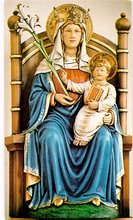
Our Lady, Seat of Wisdom

To celebrate the Jubilee year of universities in 2000, Pope John Paul II commissioned a mosaic depicting Mary as Our Lady, Seat of Wisdom. This icon travels to universities around the world, uniting students and staff in our shared faith and pursuit of knowledge. At present the icon is in Sydney and today, Campion College welcomed this gift of the late Holy Father to Catholic Universities and Colleges worldwide.


After the welcoming Ceremony we set the Icon up on the sanctuary of the College Chapel and celebrated Mass. The Icon has was placed in some of our lecture theatres during the day and then, back in the chapel, we prayed the Rosary and Litany in candlelight.


The Icon will stay at the College until Thursday before moving on to be welcomed elsewhere in Sydney. Its presence here on Campus has been received as a grace for us as a Catholic College; not only is it a tangible sign of the immense love which John Paul II had for young people, but, as an icon, it is a portal through which we can encounter Christ and His Mother, Our Lady, Seat of Wisdom. Our College chapel has become a place of renewed encounter with grace. May she confirm the charism of learning and openness to divine Wisdom which Campion College seeks to embrace.

Do you know ...

I wonder if anyone could help me. I remember hearing some years ago, that the French existentialist philosopher Jean Paul Sartre had become a Catholic some months before he died. However, I cannot find a word about this on the Internet - perhaps this is one event which the atheist powers want to cover up. If anyone has information about this I'd be glad to hear from you.

Monday, 20 April 2009

Familiaris Consortio revisited 2


Paragraphs 4 and 5.

Since the family is the hinge of human civilisation - everything about human society depends ultimately upon the family - the Church must come to appreciate the culture which the family inhabits today. This is necessary if the Church is to engage in the evangelisation of the family. More importantly, the Church must listen to the needs, the hopes and fears of families themselves. And again, the Church must come to recognise those prejudicial forces which affect families today. The Church, with her evangelical discernment is able to do this and is able to offer families her own service to the truth. Indeed, the Church understands the family so well that she is able to offer a complete and true vision of marriage and the family.

The discernment which the Church makes is based upon the presence in her of the Holy Spirit, through the different gifts and charisms which the Spirit bestows, especially to the lay faithful who have "the specific role of interpreting the history of the world in the light if Christ".

This however, doesn't mean that the Church's disecernment is based on consensus or power, but upon conscience. It is here that the Church discerns what it is about human life that is an expression of the truth of Christ. Christian spouses are here at the forefront of an authentic evangelical discernment - testing themselves against the rule of faith - because of their specific charism, the sacrament of marriage.

Demographic Winter

Familiaris Consortio revisited 1


I shall begin here a paraphrasing of John Paul II's great Letter about the Family - the greatest statement about the family which has ever been made. Herewith, paragraphs 1 - 3:


The family, more than any other part of the human community, has suffered the impact of the changes which are taking place in the world. The Church, who has a special care for all things human, wishes to offer her help to the family. It is especially important that young people today be able see the greatness of the family.
As a sign of this the 1980 Synod of Bishops chose to focus on the family, since the family is the first community which can announce the Gospel to an infant and then lead him or her to full human and Christian maturity. Indeed, it is the family which can form individuals who are socially responsible.

The Synod Fathers asked me, John Paul II, to be the spokesman before humanity of the Church's concern for the family and to indicate ways in which the family must be cherished today. In so doing, I am fulfilling in a special way the apostolic ministry entrusted to me.

It is the Gospel which shows forth the full truth about marriage and the family, and so the Church wishes to proclaim the Gospel, so that men and women today can fully embrace those truths. Marriage and the family are given the fullness of meaning by Christ.

Even though many forces today are set against the family, the Church sees the greatness of the family and its unique and powerful role in creating, forming and re-setting correctly, the fabric of human civilisation.

Sunday, 19 April 2009

Grasping at straws.

Gordon Brown declares that Britain must become digital: "We may not compete with them (Asian countries) on scale or low pay, but we can compete on high value-added goods, and services," he told the Digital Britain summit last Friday.
I don't know what the Asian countries think of this arch-archtect of the culture if death refering to them in this manner. My question is: when is this generation of blind 'leaders' going to be overtaken by a generation who are filled with light?

Transcendent beings or not?


As the Church carries the light of Christ into the dark age which the world has created in this period of history, in which the world makes the great secular claim - that humanity is limited to its own subjective being, that there is no God, let us remind ourselves about reality, objective reality. The secular claim is based upon the negation or suppression of an objective fact about humanity - its transcedence - its openness to God as an objective dimension of human nature.

The CCC, Paragraph 33, speaks about man's nature in an objective way, naming his "openness to truth and beauty, his sense of moral goodness, his freedom and the voice of his conscience ... his longings for the infinite and for happiness [realities] which are irreducible to the merely material ... ". Then, in paragraph 357, man is spoken of as "not just something, but someone. He is capable of self-knowledge, of self-possession and of freely giving himself and entering into communion with other persons." None of this, which the CCC speaks of, can be refuted or reduced to the level of psychology or sociology, still less to the level of feelings. No, the fact is that man has an openness to the transcendent and that this is a an objective dimension to his being.

When you look at the history of mankind in different cultures, this fact is expressed in many ways. However, most objectively of all - how can one explain the presence in the world of the Gospels, indeed, all Sacred Scripture, the Church, the Eucharist and the witness of countless human lives to these realities - which haven't blown in from Mars - as merely a subjective urge or formulation from within human beings.

No, human beings are transcendent, they have an objective openness to God, and if the secular movement is leading people to say "No" to God - then that is the objective spirituality of many people today. The overriding question is not whether God exists, but rather, have we allowed ourselves to fall under Satan's influence and to believe his lies.

(The photo above was taken in Sydney CBD and shows Cardinal Pell following the Blessed Sacrament in the Corpus Christi Procession.)

Sunday, 12 April 2009

Wednesday, 8 April 2009

Look for the love

As we approach these days in which human nature has been plunged into the life of the Holy Trinity, look here for love.

(Holy week in Valladolid.)

On Palm Sunday Benedict XVI affirmed that Christ's kingdom is "universal" and "knows no more borders ... because it is not a political kingdom, but is based solely on the free adhesion of love - a love that, for its part, answers to the love of Jesus Christ that has given itself for all.
Universality includes the mystery of the cross - the overcoming of ourselves, obedience toward the universal word of Jesus Christ in the universal Church.
Universality is always an overcoming of ourselves, a renunciation of something that is ours. Universality and the cross go together. Only in this way can peace be created.
He who wants to have his life for himself, live only for himself, squeeze out everything for himself and exploit all the possibilities - he is the one who loses his life.
It becomes boring and empty. Only in abandoning ourselves, only in the disinterested gift of the 'I' in favor of the 'Thou,' only in the 'Yes' to the greater life, precisely the life of God, our life too becomes full and more spacious.
Love, in fact, means leaving yourself behind, giving yourself, not wanting to hold on to yourself, but becoming free from yourself: not getting preoccupied with yourself - what will become of me - but looking ahead, toward the other - toward God and the people whom he sends to me.
It is this principle of love that defines man's journey, it is once again identical with the mystery of the cross, with the mystery of death and resurrection that we encounter in Christ.
Our "Yes" to the Lord must be repeated every day, especially when we just want to hang on to that 'I.' There is no successful life without sacrifice.
Though it is difficult, we can pray like Jesus, who felt driven to ask that he be spared the terror of the passion.
Before God we must not take refuge in pious phrases, in a world of make-believe. Praying also means struggling with God.
In the end, God's glory, his lordship, his will is always more important and more true than my thoughts and my will.
This is what is essential in our prayer and in our life: understanding this right order of reality, accepting it interiorly; trusting in God and believing that he is doing the right thing; understanding that his will is the truth and is love; understanding that my life will be a good life if I can learn how to conform to this order.
The life, death and resurrection of Jesus are the guarantee that we can truly entrust ourselves to God. It is in this way that his kingdom is realised."

So, don't listen to Tony Blair's totalitarian ideas about grace, or the Tablet's neo-Pelagian notions about Christianity, don't attend to the BBC's mockery of the Gospel; follow the Liturgy of Holy Week - there we will find the love.

Monday, 6 April 2009

Spiritual support

I ask for your spiritual support for the Sydney Congress of the New Evangelisation and its preparation.
Please pray for the Congress, 19th - 26th July 2009, that it will help the Church in Sydney come close to the Heart of Christ and be His witness in the city and beyond. Please support Bishop Porteous' organising Team by praying the Congress into existence, by praying for its protection from any evil, and by praying that all those who God wants to bring together for the Congress will be open to His call.

Full details about the Congress, including Registration, can be found on
http://www.scene.org.au/

Saturday, 4 April 2009

Street witness


For our last Stations of the Cross before we break for the Easter holiday, we took our cross out to the local town centre and were joined by parishioners of St Anthony's Parish in Toongabbie. This kind of Stations of the Cross, made as a public witness to Christ, is a powerful expression of the Faith, claiming the streets for Christ and making a very easy-to-read sign for many to see. We stopped every few hundred metres to recall each of the fourteen stations, carrying the heavy cross as we went. Each word, each gesture, an emphatic expression of faith which was experienced, reverenced and glimpsed by many who were out and about that morning.

Friday, 3 April 2009

A new leader for the English Church


May the Holy Spirit be with him, and may he be a witness to the Gospel and point the way forward.

Responding to the crisis

"TV adverts for condoms outside the UK are often lighthearted", declares a BBC webpage. How are we to view the screening of adverts for abortion and a round the clock condom message on Bristish TV. The first thing I would say is get rid of your TV (if you haven't done that already).
The response of humanity in the modern era to the matter of child-bearing and rearing has been unprecendented. Formerly, child-bearing and rearing was given a very high value. The incidence of women dying during labour and of the death of babies and young children was always quite high. And, partly because of this, married people and society wanted a high birth rate. Only in the modern era has this statistic diminished to such an extent that spouses and societies have needed a new way of approaching child-bearing and rearing.
It was in response to the circumstances of the modern era that the Church presented, through the voice of Paul VI, a concrete vision of responsible parenthood - how spouses should approach their mission of transmitting human life now that the death during childbirth is scarcely heard of.
We know what the response of most has been to the beauty of Paul VI's Humanae Vitae - it is a vision and a teaching which has been overwhelmed by a holocaust. It is hard to think that anyone today could refer to child-bearing and rearing in anything but a tramelled way, since just about everyone living in the western world is a survivor of a holocaust. And not just a survivor, for we are living in the midst of an intensification of the holocaust. The plans of the President of the USA for this are scarcely credible. Our perspective, yours, mine, is coloured not so much by the vision of responsible parenthood but by the decisions of many which say - we only want life for ourselves, and if for children, then only for a very few.
Why is the world today having difficulty in accepting God's plan? Becuase the darkness of the holocaust which we are in is obscuring God's generosity. Abortion and the contraception mentality is certainly a political issue, it is a social issue and a personal one, but first of all it is a spiritual one. We are the subjects of God's love and becuase of that we can make other people the subject of our love. Humanity's greatest need today is to emerge from the holocaust and stand before God. Mother Teresa was right when she so many times taught that abortion is the cause of the world's ills. Any one who can see this, and especially spouses who are embracing the vision of responsible parenthood which was meant for the world today, are great lights. We should all reserve a particular space in our spiritual lives for bringing supporting graces to all those who are beacons of truth and light, and for the overcoming of this holocaust and the turning towards God by many. This is a central task for all of us who have any glimpse of light at all.