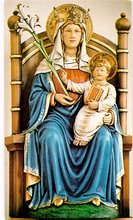
Recently I joined the new Facebook group "What would Mary wear" and I support the new blog www.wwmaryw.blogspot.com becuase they are addressing a foundational element of civilisation - the garb of women. Today, there is an urgent need to take ground from the secular vision which is the current basis for women's clothes, a culture and its accompanying vision for education which has failed women so badly. When I was studying in Valencia, Spain, ten years ago, I was aware that just about all young women from about 13 to 25 years dressed as though clones of a most inappropriate model. The need for a whole new sense of women's garb is much overdue but, I suspect that it will be a renaissance of Christian life rather than a new genre of designers, who will enable women to regain their dignity and femininity through clothing - this is a real need today. It is the spiritual which needs to be given form.
 Tuesday, 30 March 2010
What would Mary wear?
Recently I joined the new Facebook group "What would Mary wear" and I support the new blog www.wwmaryw.blogspot.com becuase they are addressing a foundational element of civilisation - the garb of women. Today, there is an urgent need to take ground from the secular vision which is the current basis for women's clothes, a culture and its accompanying vision for education which has failed women so badly. When I was studying in Valencia, Spain, ten years ago, I was aware that just about all young women from about 13 to 25 years dressed as though clones of a most inappropriate model. The need for a whole new sense of women's garb is much overdue but, I suspect that it will be a renaissance of Christian life rather than a new genre of designers, who will enable women to regain their dignity and femininity through clothing - this is a real need today. It is the spiritual which needs to be given form. 
Sunday, 28 March 2010
Staying up late
 I'm surprised that no one has commented ever on the time which my postings are made; some of them seem to have been posted in the middle of the night. Actually, I keep my laptop registered on UK time so that I have a UK clock close at hand. My blog postings, made on my laptop and uploaded in Oz, are not then given local time, but UK time.
 Another mystery solved.
The full version
 What did Christ most criticise? False religion. An example of this was when one of the scribes revealed that he couldn't honour his parents because the money he had was corban - in some way contaminated. Jesus immediately reveals the inadequacy of this scribe's religion. A deformed view of humanity means an impoverished relationship with God. Honouring God begins with honouring humanity.
 The Church has embraced a full and truthful vision of humanity since Pentecost becuase she knows that God intends a totally complete and free humanity for every person. The secular vision of human life is somewhat different, based upon a partial vision of the person and changing social trends. It is this vision which has become particularly strong in this era, so strong that it actively challenges and attacks the Christian vision fo humanity. The sexual revolution, which was well underway in the 1950's, lies at the heart of the secular vision today and has been so deformative of humanity for at least half a century.
Why is it so unacceptable that this deformed humanity has entered into the Church? Becuase so many children have been abused, yes, and because it is the Church and not secularism which is the hinge of humanity's real development. How keen then was the request for renewal which entered into the Church at the Second Vatican Council, and how profound is the Church's need for renewal at a human level. Priests, religious and all baptsied people are called to be fully human - to know their humanity, to know who they are and to be free.
With hindsight we can see how inadequate was the veneer of Catholicism of so many in the past. And today, how inadequate is the response of liberal Catholics who offer nothing more than bare-faced Pelagianism, or the response of those Catholics who promote an empty orthodoxy - orthodoxy for orthodoxy's sake without it helping anyone. No, today's signs shout out that the renewal we have been asked to engage in must start with the renewal of Christians as human beings. The Church is called to form her members in their humanity. It is only as human beings that we can really engage with the Gospel, making it a living reality in our lives and then in the life of the world.
Wednesday, 24 March 2010
Without God we are nothing
 Earlier this month, 11th March, a public debate took place at Macquarie University in Sydney upon the statement "Without God we are nothing". Cardinal Pell spoke for the affirmative and Dan Barker for the negative. The debate was the first of its kind, theist versus atheist, that I have ever heard.
Cardinal Pell defended the clause speaking about the reasonableness of Faith; how the Universe does not find meaning in itself, and how spiritual values, found in the human person, cannot be reduced to matter but point to a source, who is God, a loving Creator. His defence was rational and non-aggressive.

Dan Barker used epistemology and logic to try to undermine the theist position, attempting to defend a negative hypothesis with clever answers. His proposal involved some thinly-veiled vitreol against the Catholic Church, an unusual claim that Hitler was a Catholic throughout his life (albeit a bad Catholic during some of it), and a scathing personal attack on Mother Teresa.
Now, although I am biased towards Cardinal Pell and what he said, I do think that this public debate was a good thing precisely because it brings both the discussion and reason to the fore. It shows us something of where this argument is today and the need we have to inform (and form) ourselves. I would be interested to know what happened in Dan Barker's life that changed him from being an evangelical preacher to become an outspoken defender of atheism.
The audio files of the debate can be downloaded from www.xt3.com and the video can be downloaded from the Macquarie University website.
Incidentally, rather like myself, http://www.xt3.com/ is no longer operating out of West Yorkshire, but out of Sydney. It is now owned by the Archdiocese.
Tuesday, 23 March 2010
Scene II, Act II.

Plans for The Sydney Congress of the New Evangelisation 2010 (Scene 2) are underway. Last year saw the first Scene, and the first Congress of its kind in the Church - a city-based Congress of the New Evangelisation. The second will take place in the heart of Sydney's CBD, 12th - 16th July 2010. The Church in Sydney is on the move.
Sunday, 21 March 2010
Images from the heart of the Church
The Forty Days for Life team in Sydney have produced this very evocative video which expresses something of the spiritual power which so many are investing in the defence of human life at this time. The Vigil continues now for just one more week. Please support it with your prayer.
The Benedictine altar at Campion

On the feast of St Joseph we inaugurated the Benedictine altar arrangement at Campion College with a new altar crucifix and candlesticks. The Mass began with the rite of blessing for these furnishings which were bought through our Sydney suppliers, Sarks, from Luis Molina Acedo of Madrid.
The crucifix placed in the centre of the altar means that when the priest approaches the altar he is definitely approaching an altar and not merely a table. The Holy Father has asked every parish church in the world to place a crucifix on the altar - a part of the "reform of the reform" which he is helping to engender within the Church. And here at Campion we are trying to respond.
One could ask: why was the crucifix ever taken off the altar? I imagine that it was because of the over emphasis, in recent decades, on the Mass as a meal. And indeed there is a meal in the Mass, but it is a meal which flows out of the sacrifice. Without the sacrifice there would be no Mass at all.
I think that the "new" arrangement indicated by Pope Benedict isn't best termed a Bendictine altar, but simply a Catholic altar.
Wednesday, 17 March 2010
Free and faithful

The recent Campion College Retreat was a true high-point in the College year; a way of asking God to fill us with grace as we begin our academic studies. We expressed in our demeanour during the retreat and by our happiness, what it is to be free and faithful in Christ. What it means to be Christian men and women today, open to God and open to one another. This retreat was just the beginning of a process of human and Christian maturity - that it is in seeking to live the Christian life at the heart of the Church that we are building the Catholic identity of Campion College.
During Sydney World Youth Day the Holy Father said that "the grace of the Spirit is not something we can merit or achieve, but only receive as a pure gift. God's love can only unleash its power when it is allowed to change us from within. We have to let it break through the hard crust of our indifference, our spiritual weariness, our blind conformity to the spirit of this age. Only then can we let it ignite our imagination and shape our deepest desires."
As chaplain to the College, I do believe that the Holy Father's words took real shape for us during the retreat, and that Christ's company during those days has lead us all to know that building our relationship with Him is our greatest and truest challenge. A challenge that will lead us to make Campion College a seed-bed of the life of the Church, and for each one of us to desire to make a truly human contribution to the world in which we live. But we ask for that gift of the Spirit to continue to make our lives and our studies bear fruit for God. That "power", the Holy Father said, "which the Holy Spirit is even now prepared to release within [us]."
Sunday, 14 March 2010
Growing in wisdom and stature

Having led the annual retreat for the Sydney seminarians a few weeks ago, I was engaged this past weekend in a three night retreat for Campion College students. The retreat, entitled "Growing in wisdom and stature", took place at the Schoenstatt Shrine just outside Sydney in the foothills of the Blue Mountains. The setting was ideal for our group; all thirty-four of us were able to take part in Mass and different Hours of the Prayer of the Church in the tiny shrine chapel. And at night we found our way to adoration by torchlight.
  We had some marvellous input from the Nashville Dominican Sisters on the Spiritual Life, and from Fr Bernard Gordon on the place and meaning of the emotions in our lives. There was lots of time and space for recollection and for high jinks too (near the Nepean Gorge).

 And there was lots of hearty home-cooking too - a very important element of a retreat!
  We have returned to the College envigorated, inspired and enlightened. May the grace of this retreat be a real corner-stone in our building of the new civilisation.
The setting was ideal for our group; all thirty-four of us were able to take part in Mass and different Hours of the Prayer of the Church in the tiny shrine chapel. And at night we found our way to adoration by torchlight. We had some marvellous input from the Nashville Dominican Sisters on the Spiritual Life, and from Fr Bernard Gordon on the place and meaning of the emotions in our lives. There was lots of time and space for recollection and for high jinks too (near the Nepean Gorge). And there was lots of hearty home-cooking too - a very important element of a retreat! We have returned to the College envigorated, inspired and enlightened. May the grace of this retreat be a real corner-stone in our building of the new civilisation. Wednesday, 10 March 2010
40 days for Life

This Lent in Sydney many are taking part in a 24hr a day, 40 day vigil outside an Abortion Clinic (on the ground floor in the photo) in the centre of Sydney, an initiative which shows how closely bound together is the new evangelisation and the recognition of the sanctity of human life. The grace of this Lent is being focussed here by Catholics for the building of a new culture. In fact, the 40 days for Life vigil is at the cutting edge of building civilisation. Many will one day be so grateful for this initiative and its vision.
You can join your prayers to this Vigil which is taking place throughout the day and night, and comes to an end late on Palm Sunday.
Tuesday, 9 March 2010
A new Benedict for a new dark age

In November the Holy Father will consecrate the Holy Family Church in Barcelona, one of the most famous Churches in Europe, known predominantly for its architecture and its architect -Antoni Gaudi. This gesture comes at a time when Spain, led by its government, has built a terrible anti-life and anti-family culture. The Sagrada Familia Church will be a beautiful sign of true civilisation, built upon virtue and God's plan, and a shrine to the Holy Family
In England we have long had a shrine for the family: the Holy House of Nazareth in Walsingham. Our shrine is very low key at present, but perhaps the Holy Father will help us and our pastors, when he comes to the UK in September, to see Our Lady's shrine anew as a place of great light for the family in the darkness of England's present culture.
(Acknowledgements to http://www.mercatornet.net/ for the title of this post.)
Saturday, 6 March 2010
Fit for a King

We began the new year at Campion College with the return of the College's monstrance, newly refurbished. It had been in a very poor state and used for many years but, through Sarks Bros of Sydney, was sent to Luis Molina Acedo in Madrid to be refurbished. They did a magnificent job with it. Our regular periods of Exposition and Adoration have begun again at the heart of the College's life.
Thursday, 4 March 2010
A new pastor

Yesterday evening Bishop Anthony Fisher OP was inaugurated as the third Bishop of Parramatta. The Mass of inuaguration was magnificent, if a little long. We entered Parramatta Cathedral at 7pm and were coming out about 10pm. Hundreds of priests concelebrated with a mighty contingent of the Australian Hierarchy and two Australian Cardinals (Pell and Cassidy). There were many State and political leaders present also.
The new Bishop preached beautifully declaring that his pastoral program is the Person of Jesus Christ. He vowed to defend the family and human life from conception to natural death. And he asked the young people to be his right hand men and women for the new evangelisation.
Parramatta Diocese which covers the whole of western Sydney and beyond has the largest proportion of Catholics of any Diocese in Australia (40%). It is also the youngest Diocese, demographically. A veritable springboard for a new evangelisation. We ask God to bless the new Bishop and his Diocese, that there would be a new flourishing of the Christian life here.
Sunday, 28 February 2010
A cause for celebration

At the end of the annual seminary retreat, here we were celebrating, on the day that the Holy Father announced that Bl Mary McKillop is to be canonised. The retreat we held at a Retreat House in the Sounthern Highlands, about 2hrs drive south of Sydney.
Saturday, 27 February 2010
Heart of the Priest

The priestly dignity is "not based upon comfort, position, or honour, but on the fact that Jesus Christ is always close to the priest's heart - an intense union stemming primarily from his ability to make Jesus present in the celebration of the Most Holy Eucharist, a bond that offers the priest the necessary strength to endure all the demands his vocation implies."
Acknowledgements to Fr Michael Caridi and The Sower for these magnificent words.
Wednesday, 24 February 2010
Remarkable words
 "The Church will never and nowhere be destroyed as long as her priests give a clear and irresistable testimony of a life that can be lived only through Christ and in God's strength." Fr Werenfied van Straaten
Thanks to Cardinal O'Brien for his straight talking about the UK Labour Government.
Tuesday, 23 February 2010
One moralism versus another
 Ed Ball's new step in building atheistsic secularism in Britain with regard to Sex Education in schools (via a thinly disguised totalitarianism), rounds upon the teaching of the new secular moralism. However, it is said of Catholic Schools that they teach another moralism - one which is not fit for this age - one in which contraception, abortion, homosexuality etc, are wrong. What can we say about this?
Well, Catholic schools are not supposed to be teaching any form of moralism but rather, the Mystery of Faith. The moral life of the Christian flows out of the Mystery of Faith, but the hinge is the Mystery of Faith. Are Catholic Schools in Britain teaching the Mystery of Faith? Not in my experience.
The matter at hand raises two issues. First, why send our children to school (Catholic or otherwise)? The culture of British schools is not a fitting context, in any case, for children and young people to be formed in (unless they are bastions of Faith). Secondly, who will build a context in which our children and young people can be formed in? Our parishes, spouses, associations of spouses and families, the new movements? We can't leave our children to the mercy of the British Goverment or secular society and its culture (which is what we are presently doing, in the main).
Monday, 22 February 2010
Loud and clear
 For the new evangelization to become a reality, laypeople have to step up. This proclamation was made by Archbishop José Gomez of San Antonio, Texas, in a pastoral letter and reported by Zenit.
"The proclamation of Christ is not an option or an obligation reserved for bishops, priests, deacons and religious. It is the duty of every believer". He said that evangelization begins "in the heart that has been evangelized, the heart that has heard the Good News and been converted. We cannot be silent about what we have seen and heard and felt ... We cannot help but to proclaim and testify to the great difference that Jesus Christ has made in our lives." Evangelization is a duty, but it is a "duty of delight, a duty we carry out with joy and thanksgiving. We want the world, beginning with those nearest to us, to share in what we have been given -- the free gift of God’s grace and the joy that comes with knowing the truth that sets us free," The duty to proclaim Christ falls upon every member of the Church, he recalled. But, he said, his pastoral letter is addressed particularly to the laity."I want to speak especially to you who live out your faith in the midst of the world and all its secular affairs ... As the Catechism of the Catholic Church teaches, lay people are given the 'duty ... to work so that the divine message of salvation may be known and accepted by all men throughout the earth. This duty is all the more pressing when it is only through them that men can hear the Gospel and know Christ.'" He noted how laypeople have been fundamental for the process of evangelization since the very beginning of the Church. "The primary apostolate of lay people, since the early Church, has always been to spread and defend the faith among their families and neighbours and to bring the teachings of Christ to bear on the issues facing their communities". Lay believers, he said, have a "priestly soul," with a primary mission in the world, "not inside the sanctuary of the church or inside a Church office. Your first duty," he stated, "remains to heed the commission every one of us receives at the end of every Mass -- to go out into the world to love and serve our Lord." Nourished by the gift of his Body and Blood, you are called to bear witness to this gift by making your lives a form of worship to God. Your evangelization must always be profoundly ecclesial and intensely Eucharistic. You are calling people to Christ and to his Church -- and to the heart of the Church, which is the Eucharist." He urged the faithful to have a renewed awareness of their priestly souls and to "seek to serve God and your brothers and sisters every day, through all that you do and say, through the way that you live your life. People respond more to example than to 'teaching,'" he acknowledged. "Testify to your faith through your daily habits and actions. You will find that your witness to the Christian life will be attractive to others and will afford you regular chances to talk about the 'source' of your happiness in Jesus Christ and your Catholic faith."
"To my mind the deepest problem we face is the 'secularization' ... The tendency under secularism is to reduce religious identity to a kind of 'cultural Catholicism.' " Lay evangelizers must "be convinced of the truth that the Apostles knew, that everyone in some way is searching for Christ.""People used to seek out the Apostles and say to them: 'We wish to see Jesus,' ... The men and women of today still want to see Jesus. You are the disciples they will come to with their questions and doubts, interests and needs. You are the ones who must lead them to our Lord."
This is the vision for the Church in the UK also. Let us embrace it and make it known.
The voice of Saruman

I know that this has been blogged about before, but the below mentioned author has described so well what took place when Obama visited Notre Dame University last year, that what he says deserves being roundly appreciated. Any fans of Tolkien will not fail to miss the clever title of the article which appeared on the Net last year: "Saruman at Notre Dame".
The author of the article, Dr Thaddeus J. Kozinski is Assistant Professor of Humanities at Wyoming Catholic College, in Lander, Wyoming, presents us with a keen glimpse at one of the main architects of the new relativist world which is being built around us and how Relativism is newly spinning its relationship with the Church.
The author of the article, Dr Thaddeus J. Kozinski is Assistant Professor of Humanities at Wyoming Catholic College, in Lander, Wyoming, presents us with a keen glimpse at one of the main architects of the new relativist world which is being built around us and how Relativism is newly spinning its relationship with the Church.
" ... for now, allow me to shed light on what I consider to be the central philosophical/theological reason that Obama would advocate a social and political ideal favoring conversational fairness over truth, and use as his main example what the majority of Americans consider to be a life and death issue. Here is the master key, as it were, that unlocks Obama’s speech:
But remember too, that the ultimate irony of faith is that it necessarily admits doubt... This doubt should not push us away from our faith. But it should humble us. It should temper our passions, and cause us to be wary of self-righteousness. It should compel us to remain open, and curious, and eager to continue the moral and spiritual debate that began for so many of you within the walls of Notre Dame.
I propose this more philosophically and theologically transparent translation:
Whatever “values” and “commitments” we may hold to be true, those that stem from or involve in any way our “faith” must be held with a certain amount of irresolvable doubt—for the “truth” in these sorts of matters can never be known. And this is why we should seek above all to continue, not ever resolve, the “moral and spiritual debate,” whose quite attainable goal is not the truth of any political matter, no matter how life-threatening, but “fair-mindedness.”
I think this interpretation, or something like it, is best able to make sense of why a pro-life Christian doctor revealing his tolerance of the mass-murder of baby-humans in the womb is held up by the President of the United States as a model of civic virtue to a group of graduating Catholic college students. Needless to say, such a relativistic notion of faith and truth is completely irreconcilable with any genuinely religious worldview, and according to Obama, that means over 90 percent of the American people.
What “fair-minded” voices, then, would be permitted to speak in this sort of “vigorous debate”? ... But with truth eclipsed by “fair-minded” rhetoric as the political summum bonum, what is to prevent the strongest and must ruthless – but, of course, rhetorically “fair-minded”—from exerting power over the weaker? Sure, the pro-life doctors would be speaking quite nicely with all the pro-abortion abortion doctors, while the baby humans are slaughtered in their wombs.
Pace the president of Notre Dame, I, fair-mindedly, or perhaps not, decline to participate in Obama’s “renewal” of political life, in solidarity with all the baby humans killed in the past and who will be killed in the future due to the amoral cultural, spiritual, and political climate only exacerbated by Obama’s cleverly cloaked relativism, wherein the weakest and most defenseless are given a, not-so-fair-minded, silent treatment. Obama asks us not to caricature other American citizens—fine—but let us ask, nay, demand that he not allow them to be murdered."
What “fair-minded” voices, then, would be permitted to speak in this sort of “vigorous debate”? ... But with truth eclipsed by “fair-minded” rhetoric as the political summum bonum, what is to prevent the strongest and must ruthless – but, of course, rhetorically “fair-minded”—from exerting power over the weaker? Sure, the pro-life doctors would be speaking quite nicely with all the pro-abortion abortion doctors, while the baby humans are slaughtered in their wombs.
Pace the president of Notre Dame, I, fair-mindedly, or perhaps not, decline to participate in Obama’s “renewal” of political life, in solidarity with all the baby humans killed in the past and who will be killed in the future due to the amoral cultural, spiritual, and political climate only exacerbated by Obama’s cleverly cloaked relativism, wherein the weakest and most defenseless are given a, not-so-fair-minded, silent treatment. Obama asks us not to caricature other American citizens—fine—but let us ask, nay, demand that he not allow them to be murdered."
This excerpt is taken from this great article, "Saruman at Notre Dame", which you read in full on the site http://www.mercatornet.com/. This is a Catholic website, well worth visiting frequently.
Saturday, 13 February 2010
The fate of many bound to such a small thing

In the film version of the "Lord of the Rings", while the Fellowship are trying to cross the Misty Mountains, Boromir recovers the the Ring after Frodo has slipped. What he then says is taken from that part of the book when he tries to take the Ring from Frodo:
"Is it not a strange fate that we should suffer so much fear and doubt for so small a thing? So small a thing."
In reality, that small thing, so small a thing that we hardly reference it for what it is, that has taken hold of our whole civilisation with such an impact, and yet remains such a small thing, somewhat hidden, apparently harmless and puzzling only if you stop to think about it, beguiling but essential, so small a thing.
The creator of the Contraceptive Pill himself, Carl Djerassi, regrets the advent of this 'remedy', a 'remedy' which has paved the way not just for the condom, abortion, sterilisation, but every other distorted behaviour which has followed upon the separation of the unitive act from procreation.
This small thing is bringing an end to our civilisation. The British birthrate is now below the recovery threshold. Britain as we know it is ending, and along with it many other Western nations.
It has taken such a small thing to convince us that having (things) is more important than being (persons). Western civilisation has changed its focus; what is important is now the peripheral and the ephemeral - what we can own, possess and affirm ourselves by. That which is essential: life, the family, neigbour and God are, in contraceptive civilisation, almost totally removed. This tiny matter of contraception has so invaded human life that it has taken hold of civilisation and cut at its roots. The place where we used to seek life and refreshment, the inexaustible riches of Jesus Christ, has been set aside by contraceptive mentality, for the shops, the mass media and the ever desirous self.
Contraception has not simply changed sexual behaviour, it has taken hold of human nature in its pride and has cast out virtue and faith. Such a small thing, but the fate of many is now bound to this small, almost insignificant thing. The fate of the West now hangs by a thread, in fact, an even smaller thing - the tiniest group of cells, not visible to the naked eye, which is the beginning of human life, and by which God breaks into our lives. However, irksome it may seem, we should follow the teaching of the Church.
Subscribe to:
Posts (Atom)