Thursday, 29 September 2011

Growing light


While back in the UK in July I came across an article in the UK "Standpoint" magazine by George Weigel. The article, titled, "Benedict XVI and the future of the West" is the text of a lecture given by George Weigel at St Patrick's, Soho, this June. This magnificent article is a presentation of the "evangelical Catholicism" which both JPII and B16 have nurtured in the Church. Weigel is certainly someone who sees what is going on and is able to communicate that vision to others. Reading this article you will see the big picture of the new evangelisation as it is unfolding today. I agree with Weigel who, writing in another place, understands the polarity within the Church today not as traditionalist and liberal, but that on the one hand there are evangelical Catholics, and on the other insitutional Catholics.

And who are "evangelical Catholics"? They are "the men and women ... persons, families, communities, who decide to work in the vineyard of the Lord (Matt 21:33-43). Humble and generous workers, who do not ask any other recompense than participating in the mission of Jesus and the Church." B16, 18th September 2011.

Thursday, 22 September 2011

Walsingham and Fr Rear's new book.


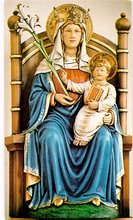
During July, while I was back in the UK I read Fr Michael Rear's new history of Our Lady's Shrine at Walsingham, England, Walsingham: Pilgrims and Pilgrimage. Without doubt, this is the finest and fullest history of the Shrine that I know; Fr Rear has done a great service to Our Lady and to the Church. His research into the original house of Our Lady in Nazareth, the early documentation about the foundation of England's Nazareth (which certainly does point to the year 1061), the Shrine at its medieval greatness and its destruction, together with a presentation of the people and events (Catholic and Anglican) that surround the re-founding of the Shrine at the beginning of the twentieth century, give us a greater sense of the significance of this shrine. I hope that Our Lady's shrine at Walsingham will become, more and more, a real centre of the Faith in England; that many will be converted, awoken and renewed through the grace of Walsingham, and that the mission of the Church in England might be seen anew because of Our Lady's presence there. We are seeing this already, especially during August, when the great Festivals of Faith take place on the fields opposite the Slipper Chapel; "New Dawn", "Youth 2000" and other huge groups come there because She is there.

Finding gold


While participating in the IPF Course at Creighton University in Omaha in June, I ventured into the university library. On my first visit I proceeded to the Sacred Scripture section and my eyes lighted upon a set of volumes claiming to present the comments of the Fathers of the Church across the whole corpus of Sacred Scripture. I couldn't believe what I was seeing. Some of the vloumes had been published in 2000; how had I not known before about this extraordinary set of volumes!

Yes indeed, a group of scholars, Catholic and non-Catholic, have combed through the entire corpus of writings of the Fathers and aligned each reference to Book, Chapter and Verse of the Bible. This is Lectio Divina at its best; a work which allows us to read the Scriptures without this intervention of "Historical Criticism", and to see how the Scriptures have been interpreted directly in the light of Christ.

On returning to Sydney, I find that the Seminary has its own copy of the complete set of volumes in its own library, just ten yards from my office!

The "Ancient Christian Commentary on Scripture" is published by Intervarsity Press in twenty six volumes, and is also available for purchase on CD-rom.

Tuesday, 20 September 2011

The first shall be last.


Britain has wanted to be first, first in 'freeing up' Contraception (at the Anglican Synod of Lambeth in 1930), first in legalising Abortion (1968), first in embryo research, and now desiring full legal recognition of same-sex unions. It is impossible to promote human life and to build society with these laws.

In singular contrast, the Hungarian Parliament, adopted a new Consitution in April this year, a Constitution will come into being at the start of next year, 2012. The Magyar State, a somewhat remote enclave within the greater Europe, is acknowledging its Christian foundation and heritage, that society is founded upon marriage between a man and a woman, and that the foetus should be protected from the moment of conception!

This is an extraordinary development in the world. You can read the whole text of the Constitution here. It makes you want to be Hungarian! I think that we should find out more about what the Hungarians are doing.


Saturday, 17 September 2011

Madwyd


I'm still catching up on things; flying round the world sets one back a little. You will already have read enough about World Youth Day but I'll post here briefly on it.

I accompanied the Sydney 02 group. Sydney 02 group was made up of about 90 young Sydneysiders, travelling first to Barcelona for the Days in the Diocese. About three and a half thousand young Australians came to WYD, one third of these were Sydneysiders! Our group was very warmly welcomed by the Parish of St Mary Magdalene in Barcelona, who also provided guides to accompany us in the city, including the elderly parish priest, Fr Joachim, who was absolutely thrilled that his parish facilities had been taken over by ninety young Aussies.

From all that we saw in Barcelona, the Sagrada Familia church stands out in our memory. The superb architecture of Gaudi, and that of some of his successors, is a true contemplation of the Mystery of Faith. The columns rising above the ssnctuary and giving way to a light from above. Outside, on the Portico of the Passion, the extraordinary sculpture of Christ tied to the scourging pillar, caught our attention.

After Barcelona we travelled to Maresa and the cave of St Ignatius of Loyola, then onto Montserrat, before heading for Zaragoza where we spent the night.

On our first full day in Madrid all the Australians came together for a two-hour welcome event. The centre piece of this event was a tremendous proclamation of the Gospel by Bishop Chris Prowse.

One of the finest articles which I have read on Madwyd is by Michael Cook of Mercatornet.net: "7 reasosn for good cheer after Madrid". I attach the link here.

Finally, we came across this excellent still-life performer near the Plaza Mayor:

The Offerory Antiphon


Twenty fifth Sunday in Ordinary Time.


Si abulavero in medio tribulationes, vivificabis me, Domine: et super iram inimicorum meorum extendes manum tuam, et salvum me fecit dextera tua.
This is taken from Psalm 137, 7. My translation: If I walk is the path of tribulation, You will give me life, O Lord: and you will extend your hand against the hatred of my foes, Your hand will save me.

Tuesday, 13 September 2011

The awakening of a tremendous ministry


The Course which I undertook at the hands of the Institute for Priestly Formation in Omaha was called "A seminar for seminary Spiritual Directors".

The ministry/charism/gift of Spiritual Direction is something that I have been a part of since before I went to seminary; first in receiving spiritual direction, then later in giving it as well as continuing to receive it as a priest. Yet, I was never introduced to a vision of Spiritual Direction, nor led to better undertand it. I really do take my hat off to the IPF for having created the opportunity for the sharing of skills and insights, inspiring a greater appreciation of the nature of Spiritual Direction, especially in the context of priestly formation.

The Course was given by three priests: Fr George Aschenbrenner SJ, one of the founders of the IPF who, for many years now, has lent his considerable experience and skill to supporting the Diocesan priesthood. Fr Joseph Kelly of the New York Archdiocese, an experience seminary SD who originally fashioned this Seminar, and Fr Vincent Fortunato OFM, a seasoned director with a particular gift for teaching. We course participants are indebted to these three priests who 'took the lid off' the world of Spiritual Direction and guided us towards a much greater vision of this ministry.

I had expected that most of the priests undertaking the Seminar would have been mature, experienced priests, and yes they were there; but there were also many young priests, already sensing the importance of refining their skill and aptitude for this work. Every priest is a Spiritual Director by virtue of Ordination, but this ministry is so important that it should have special training and formation. And how wonderful that priests can develop their skills as directors in the early years of their priesthood. I wish that I had undertaken this Course some fifteen years ago!

The Seminar was given alongside afternoon sessions dedicated to presenting us with the whole vision of Diocesan priestly spirituality which the IPF has developed and which they form the seminarians in. The afternoon sessions were given by Fr Nicholas Rouch and Mgr Rob Panke, both gifted teachers and experienced priests who expertly led us to link Spiritual Direction with a concrete vision of priestly spirituality.

We were awoken to the tremendous nature of Spiritual Direction during this three week Seminar at Creighton University, Omaha, and I am indebted to the Sydney Archdiocese for giving me the opportunity to be a participant. I whole heartly recommend this Seminar to other priests, whether you work in the Internal or External Forum, or in a parish. The Seminar is first and formost a priestly experience.

The photo above shows the clouds gathering as a storm formed over Omaha and we were all called down to the basement; but no tournados developed. The photo below was taken some 30 mins drive outside Omaha; the bison of the great plains, still around, magnificent, if somewhat primordial in appearance.

Friday, 9 September 2011

A priestly movement in Nebraska


In June I flew out of Sydney and across the Pacific to take part in a course at Omaha, Nebraska. Here at Creighton University the Institute of Priestly Formation runs its summer sessions, comprised of a whole raft of courses and retreats for Diocesan priests and seminarians, with a special focus for the priest agents of priestly formation. This year was the seventeenth year that they have run their programs.
Briefly, the Institute for Priestly Formation was founded to assist bishops in making spiritual formation the heart of Diocesan priestly formation. Before arriving in Australia, just over three years ago, I had never heard of the IPF, but on reading some of their publications I was immediately struck by the endeavour which the IPF has made to form and renew the Diocesan Priesthood. And, speaking as a member of the SJMV (who have a similar endeavour), I was immediately enthusiastic about going to Omaha when I was offered the opportunity by the Good Shepherd Seminary here in Sydney.

I arrived in Omaha to find almost two hundred seminarians and about fifty priests taking part in summer courses. I was joining sixteen other priests participating in the "Seminar for Seminary Spiritual Directors". The concern for, and the joy of embracing the Diocesan Priesthood was palpable on the campus of Creighton University, which was almost totally given over to hosting the IPF courses. In Omaha city centre we encountered the magnificent bronze scuptures depicting the first pioneer wagon trains to cross the great plains (photo above), and the hugely swollen Missouri River (photo below), during its worst flood in 150 years. I'll post again, commenting on the course which I took.

The twenty fourth Sunday


This Sunday's Offertory Antiphon (from the Graduale Romanum, 1979) is:


Sanctificavit Moyses altare Domino, offerens super illud holocausta, et immolans victimas: fecit sacrificium verspertinum in odorem suavitatis Domino Deo, in conspectu filiorum Israel.
This is taken from Exodus 24: 4-5. My translation reads: Moses made holy the altar to the Lord, offering on it a holocaust, and immolating victims: he made an evening sacrifice of sweet perfume to the Lord God, before the sons of Israel.

Friday, 2 September 2011

The Offertory Antiphon


The Offertory Antiphon for this coming Sunday, 23rd of the Year is:


Oravi Deum meum ego Daniel, dicens: Exaudi, Dominem preces servi tui: illumina faciem tuam super sanctuarium tuum: et propitius intende populum istum, super quem invocatum est nomen tuum, Deus. (Taken from The Roman Gradual.)
A translation from NAB: "I prayed to the Lord, my God, and confessed, I Daniel: hear the prayer and petition of your servant; let your face shine upon your sanctuary: be attentive and act without delay, my God, because your name is imvoked upon your city and upon your people."

Tuesday, 30 August 2011

Still catching up on things.


Today I learned of the fatal shooting of Facundo Cabral. This Argentinian novelist, singer-songwriter was shot dead in Guatemala City on 9th July. It seems that the gunmen were intending another target. How evil breeds evil! May he rest in peace and rise in glory.

You may already know of this extraordinary singer's work, if not you can find him on YouTube. I recommend the song, "No soy de aqui, ni de alla".

And of course, two years ago the other great Argentinian singer, Mercedes Sosa, died. Sadly, I never saw either of them in concert.

Saturday, 27 August 2011

Who sets the agenda?


Before coming to post on my jorneys overseas I wanted to make a comment on the demise of the UK Sunday newspaper the "News of the World". Its demise is a great thing to have happened; it is just a shame that more British newspapers did not fall in the "phone hacking" scandal. Who now will pick up where the "News of the World" left off.

The scandal revealed just how embedded in the media is British society, to the point of extensive corruption. Is it society or the media who sets the agenda? The classical answer has always been that society must set its own agenda; that the media must never control us. My point is that this recent scandal reveals that the media is no longer a passive mirror, reflecting society, but that the secular media has now expressly crossed a line.

There is scarcely a newspaper in the UK which is worthy of the name. Instead of "news" they feed us with sensationalism, propaganda and the mindless secular project. "Media objectivity" (the alignment by the media with the truth about humanity - a concern for true human values) is now very hard to find, and what we see is a form of human neurosis which which flows from the fact that the media empire has abandoned its relationship with the truth. Perhaps the best newspapers in the UK are the local and regional ones in which one can detect an attempt to communicate that which is actually going on.

A major issue in this matter in the integrity of journalism. Jornalism is a very great skill - a God-given skill - by which the truth of (often complex) human affairs can be communicated in an accesible way to those who don't have the opportunity to see or discern this for themselves. Both JPII and B16 have this gift but, of course Popes have a different mission to that of the journalist. George Weigel, amongst others, has this gift, and we should be discerning of all those who call themselves journalists or presenters, or editors, to look for the authentic gift in them. I have said before on this blog - we need authentic journalists.

The overriding concern for Catholics is to situate ourselves within the context of truth. We do this first by entering into the Liturgy of the Church, for here the essential truth about reality is revealed and formed in us. Secondly, by praying with the Scriptures (Lectio Divina), in the sense of actively endeavoring to read the signs of the times in the light of the Gospel and so to live our lives in faith. And if we are unable to do these things, to ask. We human beings cannot rely on the secular media empire to form our lives.

Friday, 26 August 2011

"Well, I'm back", he said.


The last words of Tolkien's "The Lord of the Rings" are a fitting expression of my return from having circumnavigated the world in about ten weeks. It's very good to be back and I will return to posting in a few days.

I left Sydney in early June and arrived back there yesterday; my journey took me first to Los Angeles, then Omaha, Nebraska, Chicago, England, Barcelona, Zaragoza and then to Madrid for World Youth Day, then on to Hong Kong, and so back to Sydney. All told, about 28,000 miles - a lot of jet-setting!

Monday, 6 June 2011

Blog-gap coming up


Tomorrow is the first day of my world tour; back in a few months.

Saturday, 4 June 2011

A teacher of the New Evangelisation


While I was at seminary in Spain, the archbishop of Madrid was Cardinal Angel Suquia. In 1992 he gave an address to the Spanish Bishops about the New Evangelisation; this address was published in the Winter 1992 edition of Communio. I would like to comment here on some of the ideas which he spoke about in his address. (The Cardinal died in 2006.) I recomend the original article to you, particularly if you have a good Theological library that you have access to.


1. First the Cardinal speaks about what the New Evangelisation is not. It is not the recovery by the Church of privilages she used to have in society. Nor is it a seeking to (re)impose Christian values on a pluralistic society. It is not a question of placing Catholics in strategic positions in society, nor a removal of the 'enemies' of the Church from places of power, so that Catholics can hold centres of power. The reason for this is that these ways of thinking imply, on our part, a lack of trust in the redemptive power of Christ. Such ways of thinking are actually an obstacle to the New Evangelisation, becuase by thinking thus we relegate our responsibility to witness to Christ, in favour of relying upon political, cultural or social influence. Indeed, many in our era have yielded to these ways of thinking, and today we see two strong, but impotent currents: those who identify themselves with the dominant culture (those who have indicated that we should allow ourselves to be evangelised by the culture), and those who have endeavoured to preserve a Catholic identity within a bastion mentality, thereby renouncing the significance of Christianity for humanity.


2. Secondly, the Cardinal speaks about what the New Evangelisation is. It is the proclamation of the Gospel to a humanity that is 'new'. 'New' because post-Christian humanity has lost the sense of the Mystery of God and of its own mystery. Today's culture has deformed our humanity, such that men and women today need to be 'touched' by the Redemption so that they can incarnate it into their lives.


In what then, does this 'newness' of proclamation consist? It means that the Catholics must stop trying to legitimise themselves through culture and society, and dare to be who they really are, living the Mystery of Christ. It also means that the Catholics must become the companion of today's men and women. To do this they must renounce their lack of understanding for all those false ideologies and ways of living which have wounded so many people in our age, so that they can be concerned for people as they actually are.


The Church of the New Evangelisation is a people that carries in its life the signs of the Redemption, a people whose communion and whose life is a testimony that the Redemption has happened in them. The New Evangelisation then, is not a witness to 'Catholicism', nor to Catholic culture or prestige, but is the call to witness to Jesus Christ who has freed us. Our riches lie not in our own resourcefulness, but are the riches of Jesus Christ, who is able to fill to overflowing the hearts of today's men and women, just as He did twenty centuries ago.


Monday, 30 May 2011

More thoughts on the New Evangelisation


The relationship between the Church and the world is somewhat misunderstood today. Both have a life and a mission, but the Church's life and mission are for the world. Whereas presently, the world does not value in the Church. This disparity lies at the heart of the New Evangelisation as a challenge.


I say that the Church's life and mission is for the world; the Church calls both us and the world to transformation in Christ. The New Evangelisation then, does not seek to promote the power or the prestige of the Church as an Institution, but seeks to make room in the world, and in the Church, for He who is Life. For the Church, transformation in Christ is the clear project for all humanity to embrace; the world however, does not see this clearly, even though transformation in Christ is its way forward. Thus, the Church today finds herself called to a new evangelisation. That which brings the Church and the world together is transformation in Christ. It is Christ alone who brings about an ecology of relationship between the Church and the world. The proclamation of Christ by the Church causes an effect in both the Church and the world.


Christ and the Church are bound so closely that they cannot be separated. Indeed, the New Evangelisation rounds upon the saying of St John the Baptist: "I must decrease, He must increase." Human issues, whether inside or outside the Church, revolve around one single issue, which is man's relationship with the one person who is necessary to him: God. Here the Church is called to help men and women (both the baptised and the non-baptised) to discover and express their issues in the light of this overriding truth. For human issues - whatever they are - are the hinge upon which the necessity of transformation in Christ can be proclaimed. Any human state of affairs is an opportunity for the Gospel to come to life. The primary way that Catholics do this is in showing by our lives that Christ is the answer. In other words, it is all about Christ and, who today, will be bothered about telling the world about Christ!


The fact is that all issues (unemployment, sexual orientation, climate chaos etc) can all be expressed in the context of our deepest aspiration: to be united with God. Issues, in a sense, condition the way in which the Gospel is proclaimed; that is, if people are involved in a particular activity and lack Christ, how can Christ be proclaimed in that context? It must be seen by Catholics then, that the New Evangelisation contains no element of judging, still less of condeming, but is wholly a mission of pastoring towards and in Christ.


Having said this, it seems to me that there are some fundamental questions for Catholics to reflect upon and embrace, and upon which, in some way, the New Evangelisation itself depends (since, in fact, the New Evangelisation depends upon me):


1. What does it mean to be at the heart of the Church; that place from which my life and my mission spring?


2. What does it mean to hear the Gospel, especially for those who have never heard it or live lives far from Christ?


3.What does transformation in Christ mean?


4.What does it mean to discover one's life within the Church and to participate in the mission of the Church?


5. What does it mean to contribute to the proclamation of the Gospel with my life?


6. What does it mean to learn from Christ?


7. When do I speak about Christ and what He has done, and what He has done for me?


8. How has Christ changed me and how is He calling me to change?

Thursday, 26 May 2011

What is the New Evangelisation?


The New Evangelisation is a movement of grace in the Church which is changing it from being a Church of maintenance to being a Church of mission.
It was Paul VI who first saw the need for a new evangelisation. in his 1975 Apostolic Letter Evangelii Nuntiandi he saw, prophetically, that "a new period of evangelisation" is needed because, he said, the “split between the Gospel and culture is without doubt the great drama of our time" (Evangelii Nuntiandi, 2, 20).
John Paul II, recognising the insight of his predecessor's intuition, endeavoured to help the whole Church to see the need for a new evangelisation. He described it as new "in ardour, methods and expression". (Address to the Latin American Bishops, 1983) The New Evangelisation then, looks to new ways of proclaiming and witnessing to the Gospel, because so many people in the world are so affected by the kind of culture in which they live that they cannot hear the Gospel being proclaimed by the older methods of evangelization. Yet he said, "the vital core of the new evangelisation must be a clear and unequivocal proclamation of the person of Jesus Christ." (Ecclesia in America, 66).
For John Paul II our task is not simply one of re-evangelisation, but of a new evangelization; because faith and culture have come apart the Church must discern new ways of sowing the Gospel in culture, as was the case originally in the Apostolic era, and then later in that era which began with the Christianisation of the Roman Empire.
John Paul II spoke of the New Evangelisation as a task of the whole Church; "God is opening before the Church the horizons of a humanity more fully prepared for the sowing of the Gospel. I sense that the moment has come to commit all of the Church's energies to a new evangelisation and to the mission ad gentes." (JPII, Redemptoris Missio, 3) In this new task, Dioceses, parishes, families, new movements and communities, young people, older people, priests and religious are called to take part.
"The Spirit”, he said, “is the principal agent of the new evangelisation." (JPII, Tertio Millenio Adveniente, 45) This means that God himself, through the presence of the Holy Spirit, is the principal cause of this new movement within the Church, a movement which touches upon the very identity of the Church, for the Church is both communion and mission.
In his 2001 Apostolic Letter Novo Millenio Ineunte, John Paul II expressed the ethos of the New Evangelisation at its beginning. He called Christians to fall in love with Christ again and to put out into the deep, courageously taking the Gospel into the heart of contemporary culture. "We must rekindle in ourselves”, he said, “the impetus of the beginnings and allow ourselves to be filled with the ardour of the apostolic preaching which followed Pentecost." (NMI, 40)
John Paul II spoke many times with great optimism about our era. In his 1990 Encyclical about the mission of the Church, he said, "If we look at today's world, we are struck by many negative factors that can lead to pessimism. But this feeling is unjustified: ... God is preparing a great springtime for Christianity, and we can already see its signs." (Redemptoris Missio, 86)
“The present generation of Christians is called and sent now to accomplish a new evangelization among the peoples of Oceania, a fresh proclamation of the enduring truth evoked by the symbol of the Southern Cross. This call to mission poses great challenges, but it also opens new horizons, full of hope and even a sense of adventure.” (Ecclesia in Oceania, 13)
"Church in Europe, the new evangelisation is the task set before you!" (JPII, Ecclesia in Europa, 45)
John Paul II named Our Lady as the "Star of the New Evangelisation", pointing to her "as the radiant dawn and the sure guide for our steps" (Novo Millennio Ineunte, 58).
In his Jubilee 2000 address to Catechists in Rome, the then Cardinal Ratzinger spoke of evangelisation as teaching "the art of living." The New Evangelisation, he said, starts with the sign of the mustard seed; it does not mean great numbers but rather, "new evangelisation must surrender to the mystery of the grain of mustard seed and not be so pretentious as to believe to immediately produce a large tree. The method of the new evangelization”, he said, “consists in making the voice of the Lord accessible and comprehensible. Jesus had to acquire the disciples from God. The same is always true. We ourselves cannot gather men. We must acquire them by God for God."
Bendict XVI wishing to help the Church to embrace the New Evangelisation has created a new Pontifical Council for promoting the New Evangelisation. In doing this he said that, “without doubt a mending of the Christian fabric of society is urgently needed in all parts of the world. But for this to come about what is needed is to first remake the Christian fabric of the ecclesial community itself present in these countries and nations.” (Ubicumque et Semper) The Holy Father is teaching us that evangelization flows out of the very being of Christians; that if we are truly living the Redemption, then the New Evangelisation will arise organically from within the Church.
The New Evangelisation then, has been set in motion by the Holy Spirit who is guiding the Church to respond to the need of the world today, by bringing the Gospel and culture together, so that people can be transformed by Christ. Today’s era is similar to that of the Early Church; we are living in a newly pagan culture, in which the Church is being called to proclaim and witness to the truth and the power of Christ. New Evangelisation involves the whole content of faith right from the start, witnessing to Christ and the Redemption and inviting others to live the new life of grace in the universal communion of the Church.
As in the Apostolic era, so today, we do not know what the Church will look like in the future; what we can see is what the Church looks like today at the start of this era of the New Evangelisation, and we can offer ourselves humbly to God, that He might find us full of faith-filled hope in the mission of His Son, Jesus Christ.

Wednesday, 25 May 2011

Every priestly vocation is a mystery


Here is the link to the Cardinal's homliy at the Ordination Mass last Saturday, 21st May 2011, in Sydney.

Sunday, 22 May 2011

Five new priests in New Antioch


Yesterday the Archbishop of Sydney ordained five men to the Priesthood in his Cathedral. It was a wonderful ordination Mass; "almost the whole city gathered to hear the Word of the Lord" (Acts 13:44). The Cardinal preached a tremendous sermon (which I will endeavour to post on the Blog), and the enormous congregation burst into a spontaneous applause as the recessional procession made its way from the sanctuary. The five new priests finally emerged into the sunlight shimmering with grace and joy. There is great happiness at present in the Church in Sydney - this is a grace in itself. Another grace, not to be overlooked, is simply the grace of being ordained priest by Cardinal Pell, who exhibits a real charism of fatherhood of priests.

Friday, 20 May 2011

Less than 100 days


World Youth Day certainly does create a kind of excitement and culture which is unparalleled, and with less than 100 days to go the enthusiasm is mounting. MADWYD will be the fourth WYD that I have participated in, and I am looking forward to connecting with Spain again. The Australian contingent for MADWYD is now forming up - from Sydney alone, 1030 young people have registered, together with one Cardinal, two Bishops and thirty five priests. Many pilgrims are coming from other parts of Australia too. If you are still deliberating whether you should go or not, all I can say is that there is still time to register. Registration is open till the end of May. The rest of the world is waiting for you to say "yes"!