Saturday, 9 March 2013

Who would the world choose now?

The coming Conclave will be the fifth during my lifetime. I was too young to remember the first of these which elected Pope Paul VI, but the others were a real focus of expectation and of excitement. 
A Conclave is first and foremost the moment when the Cardinals of the Church come into their proper role, but for the rest of us it is a time of humble prayer to God - almost a time of vigil - endeavouring to place the Church and especially the Cardinals under the mission of the Holy Spirit - that the choice which the Cardinals make will be God's choice. We all have a role to play in this matter, then.
I sense that the world, and particularly the Media, do not know who to look for in this Conclave. The gap between the Church and the (western) world has grown since the last Conclave, partly because of clerical scandals but much more because of the world's distain for the Christian life. I would expect to see the Media's own focus on the Conclave to miss the point entirely, which will help the Church and the Cardinals in their task.
Come Holy Spirit, come by means of the powerful intercession of the Immaculate Heart of Mary, your well-beloved spouse.

Wednesday, 6 March 2013

Prepare yourself well.

With the closure of the centres of Christian formation in England one of the most important things that you can do is to better equip yourself to take part in the future mission of the Church in this country.
In the past we relied largely upon the Religious Orders to lead us in developing our Christian formation. Those days are gone and the Church now comprised of just parishes, many of them merely Mass centres. Your presence and your gifts are needed today, but just as in the past, the Church needs us to be formed so that we can more competently take part in Her mission.
I know of no better place in England than Maryvale Institute in Birmingham where you can prepare yourself for an apostolic role in the Church today. The photo above is of me receiving my MA in Theology from Archbishop Csabo Ternyac, in St Chad's Cathedral in Brimingham in 1998. In those days Maryvale offered just two MA courses. Today there are five:
1. Personal, moral and spiritual development in a Theological perspective (which I studied).
2. Spiritual formation.
3. RE and Catechetics.
4. Marriage and the Family.
5. Apologetics.
Alongside these there are two Pontifical Licenses in Catechetics, and in Marriage and the Family. There are a whole range of under-graduate courses and more post-graduate ones. Check out the Maryvale Institute website and consider undertaking one of their courses this year. The Church needs you and it needs your skills, your enthusiasm and your desire to grow in God-given role in the Church. 

Saturday, 2 March 2013

Aglow

Last weekend Youth 2000 held its weekend-long "Aglow" retreat in Leeds at Notre Dame Sixth Form College. Two hundred young people took part, many of them from Leeds and Yorkshire, but there were people from all over the country. I was able to devote the best part of Saturday to the event and was so pleased to walk into the presence of the Blessed sacrament and the throng of young people in the college's gym. It too me back to the very first Youth 2000 event which I took part in in this country at the end of 1997. A whole new generation is now being led into the Presence, and I felt again that same enthusiasm for the Faith in young people, which I had encountered then.
Thanks to the Youth 2000 organising team; the venue was great - it would be good to have more than one annual event in Leeds.

Thursday, 28 February 2013

Witness to love.

Benedict XVI's predecessor was known as the 'witness to hope', but I think that this Holy Father will be remembered as the 'witness to love'. From the very first moments of his papacy, when he embraced the Church so profoundly, teaching us about love, pointing to its fullness in Christ and witnessing to the humble simplicity of Christian love - in his face, his gestures and in his sheer graciousness - Benedict XVI has given of himself for the life of the Church.
I am sorry that he did not have the time to do two things: to appoint more English bishops and to write the Post-Synodal Apostolic Letter on the New Evangelisation. I say this not by way of criticism, but rather to reveal something of my own expectations. But God's plan is much better than my expectations. Benedict's successor will have the responsibility of these tasks.
But much more than my expectations of any Pope is the way in which our lives have been embraced by Benedict XVI. He has been such a tremendous father to all of us. We will miss him. I hope that God will greatly bless the rest of his life from the store of His grace

Monday, 25 February 2013

The two Kingdoms.

I said in my last post that the secular world no longer wants a relationship with the Church and that this is mainly an implicit reality at present, but there is an inevitablity to it soon becoming an explicit state of affairs.
There will be pros and cons to this lack of relationship. On the "cons" side there will be a lack of common ground upon which to discuss human affairs. The two Kingdoms, that of man and that of God, have radically different understandings of who man is. Metaphysics has long been eschewed by the secular vision, but now it is clear that the way in which the two Kingdoms approach morality, anthropology and freedom are utterly distinct. Christianity has an integral vision in which these three foundational dimensions of our life are clearly understood. But along with rejecting the Christian life, these building bricks are also rejected by the secular world. This will make communication between the Church and the world difficult.
In the Kingdom of man, there is a refusal to claim any foundational basis for morality. Secular morality can be summed up in the phrase, "seek success in whatever you attempt". A very dangerous principle!
Likewise, an integral and adequate anthropology is neither present in, nor required by, the secular world, and the riches of the Christian vision of man are regarded as mere opinion. It is very reckless to abandon milennia of acquired wisdom.
When we look at freedom, the most interior and personal dimension of man's life, we find a immediate problem. Bl John Paul II spoke frequently about this, describing freedom as the great dilemma for contemporary man: is it a terrible burden or is it a great gift? We have seen in history that human beings cannot live for long with an internal division. The secular world has yet to end its wrestling with this dilemma, and in what way will it bring its wrestling to an end? 
On the "pros" side the two Kingdoms will increasingly be seen for what they are. Christianity will be seen again in its radical truth: a human life marked, transformed and living by grace, which is the person and the power of the Risen Lord Jesus. In Christianity man's most intimate possession, his freedom, is not a burden, but is his radical surrender to the person of Jesus Christ.
The radical distinction between the two Kingdoms will be a moment of great power in the new evangelisation and will give great glory to God.
The above photo was taken when I was being vested at my ordination is St Anne's Cathedral, Leeds, in 1988.

Sunday, 24 February 2013

No relationship at all.

The relationship between the Church and society, or the State, has gone through many changes in its history; most notably with the Edict of Milan and then with the rise of the nation States in the modern era. Today another permutation of this relationship is taking place as the newly secular Western States come to terms with their identity. I believe that what we are seeing today is an implicit move by Western democracies away from any relationship at all with the Church. I don't think that we have woken up to this state of affairs.
I say this because of the widespread rejection of the Christian life by our societies, together with an increasingly firm adherence to a secular way of living. So many baptised people have been going along with this movement for decades. The State's involvement in this movement is explicit in its anti-life laws and, latterly, in moving to change the definition of marriage. Whether or not Western democracies move to explicitly reject the Church remains to be seen, but we can't pretend that they have not rejected the Christian life. The bases for the Christian life and for secular living are radically different and those differences will become more apparent as secular societies become more established.
All of this has taken place during the last four decades. It is a movement somewhat akin to the Renaissance - a complex and largely non-rational movement from deep within humanity which sought to bring about change by returning to an older culture. In the case of the Renaissance, societies took their Christian inheritance with them, sometimes in vastly diminished forms; but today's movement from deep within humanity seeks to free itself totally from its Christian inheritance. The relationship between Church and State is drawing to a swift close and we will soon be living in the same context as the Early Church: pockets of Christian communities within a neo-pagan culture. The Church will soon look very different indeed.
I took the above photo about three years ago during the refurbishment of Our Lady of Lourdes church in Huddersfield. I had been parish priest there. I visited one day while the work was being done and found the tabernacle had been despoiled and set aside, to be replaced by a new one.

Monday, 18 February 2013

Hunting in Hertfordshire.


I am not a great fan of any of the Tudors (as you might imagine), but last year I drove through the village of Hunsdon in Hertfordshire, hoping to catch a glimpse of the old Tudor retreat of Henry VIII and especially of his daughter, Mary Tudor. She spent much of her teenage years at this former royal palace before becoming queen. It was from here that many a royal hunting party set out.
The house is now privately owned and I only caught the merest glimpse. The house was built in the late 1400s of brick. It has been re-modelled, in stone and brick, many times over the centuries. The photo above shows the house as it is now; the image below is a drawing of the house from (probably) the late 1700s. At the time of Mary Tudor the house is thought to have been four times its present size.
The village church stands very close to the house and there appears to be a private access between the two buildings. It was a shame that the church was locked as, no doubt, Mary Tudor would have taken part in the Mass many times here. I find that, these days, Anglican churches are more often than not locked up; even as architectural links to the age of faith, they are falling silent.
What was most intriguing to me, as I drove through Hunsdon, was the distance between the church and house, and the village itself. They are a mile apart. I can imagine that such a heavy Tudor presence in the area would have required the ordinary people to establish their dwellings some distance away. 

Friday, 15 February 2013

Searched but not found.

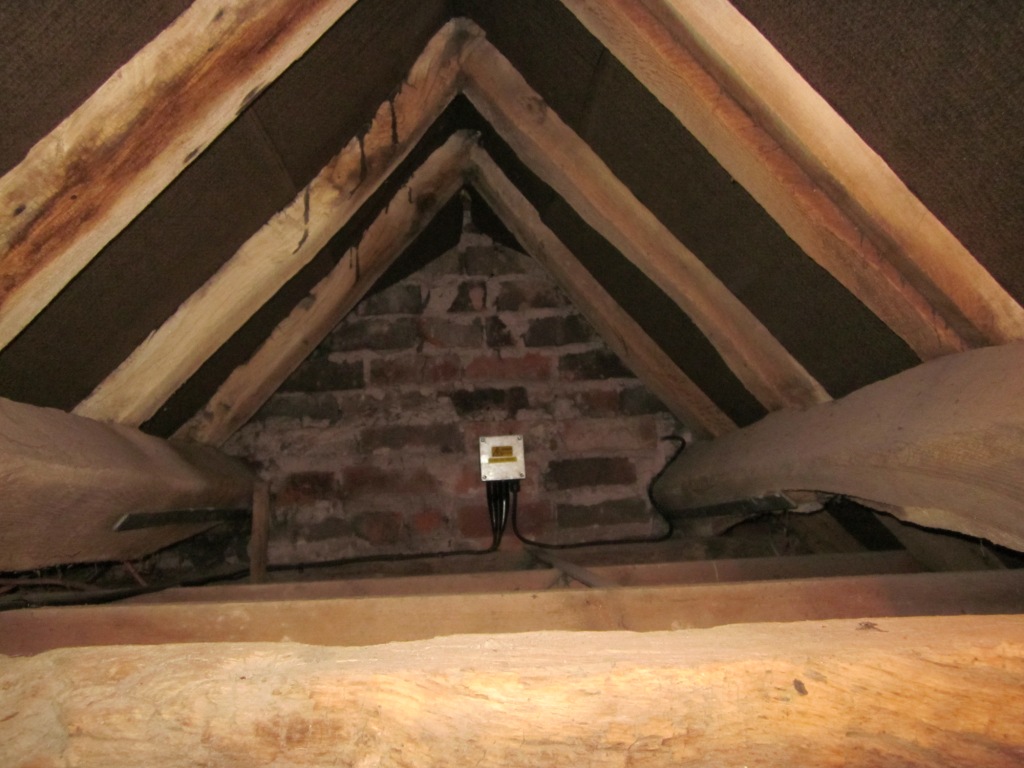
St Edmund Campion stayed at Samlesbury Hall at Easter 1581, just a few months before he was captured at Lyford Grange. We know that the Hall was searched  on 21st November 1592 in the roof space above the great hall of the house. Another hide, which was not described at all by the searchers, was also found during this search. I am not aware of any other documentary evidence above Samlesbury's hides.
When I visited the Hall I was asked to sign a form stating that I could not publicly use any photos which I took of the hides. I did take photos of the three places which are regarded as hides, but I will not use them here.
The first hide is in the room that you first enter and pay for your admission. The hide is within the hearth and chimney, and to the left, of the open fire. It is a space which you can climb into, if you wish. I wonder if this is actually the remains of a hide. It would be very dangerous to be closeted so close to the fire and its smoke. Perhaps it was a a way into or out of the hide itself, or simply a discrete place for Catholic items.
The second hide cannot be seen. It is within the ornamented and painted fireplace in the larger chamber to the right of the entrance. The Hall is listed and, although the presence of this hide is known, it remains out of bounds in order to protect the remaining fabric. This is a shame. In fact, the most interesting part of priest holes, in my estimation, is not the hide itself but the means of access. It would be good to see something of this hide's means of access.
The third hide is on the first floor in the roof space near, but not quite over the great hall. This space is very large indeed but its entrance is, presumably, not the original, since it would easily have been discovered. 
Samlesbury, like most houses, has been adapted and refurbished over the years; 19592 is a long time ago and much has changed in the fabric of the Hall. Nevertheless, what remains is a wonderful for it takes us back into the time of our recusant forbears and their heroic witness.

Thursday, 14 February 2013

Another centre of faith in Lancashire

Samlesbury Hall, near Preston, during the fourteenth to the seventeenth centuries, was the home of the Southworth family. In the late sixteenth century, John Southworth was a recusant. His son, Christopher, was ordained priest in 1583 but was captured in London and     imprisoned in Wisbech Castle. He managed to escape after thirteen years. 
The Hall was then a quadrangular building, but only two of the wings now remain. The old chapel and, what is regarded as three hides, still remain.
I took the above photo of the rear of the long wing. There is thought to be hides in two of the three chimney stacks in this photo; the massive one on the left and the one on the right. A third possibility is in the attic space. More in the next post.
The Hall is now owed by a Trust; it is well worth visiting, but check times of opening before you set out.

Tuesday, 12 February 2013

Priesthood: a long term vision.

The Holy Father's announcement yesterday has been a humbling event for me. Pope Benedict has made me more aware than ever before of the greatness of the priesthood - how great it is in itself, how far it can go, what it achieves, and to what lengths it breaks through any notional understanding of what it is. And that I am a sharer in this priesthood!
The Holy Father, in allowing the priesthood to encompass his life, has shown just how deeply Christ has marked human life and events. What we frail men, who call ourselves priests, are taking part in is something far greater than human capacity could begin to imagine. It is indeed Christ's work; it is His Priesthood, and he gives us a part in it. 
Benedict XVI's own humility in the face of the mission that he was entrusted with, is giving us a deeper glimpse Jesus Christ, Risen from the dead, right in our midst, and of His way of transforming humanity. The priesthood is about Him, not about us. This is why it is so humbling - that He has chosen all of us to be a part of what He is doing.
(I took the above photo at the Opening Mass for the "Days in the Diocese" in Barcelona, just before MADWYD.)

Monday, 11 February 2013

62 years as a priest.

Everything thing that I know about Joseph Ratzinger, especially from the time he  received a vocation to the priesthood as a young man, and the way in which he responded to it, speaks to me of a very great man. His greatness became particularly evident when, during the Pontificate of John Paul II, he laboured behind the scenes for the good of the Church. As Pope, Benedict XVI, he is another of those Popes who makes me think that I having been living in a time of Greatness. Even now, with his announcement that he is soon to renounce the Office of Bishop of Rome, his character is marked by greatness. 
For him, I wish that God has saved the very best wine till last.

Friday, 8 February 2013

25 years of priesthood

Since this year is my Silver Jubilee year and today is my birthday, a day in which I always remember Mary, Queen of Scots and, since the year 2001, celebrate the Mass of St Josephine Bakhita, I will make here an itinerary of my priestly appointments.
September 1982 till June 1988 - preparation for priesthood at the English College, Valladolid, Spain.
11th April 1987 - ordained deacon in Valladolid.
16th July 1988 - ordained priest at St Anne's Cathedral, Leeds.
17th July 1988 - First Mass at Our Lady of Lourdes church, Headingley, Leeds.
August 1988 to September 1990 - Curate at St Anne's Cathedral, Leeds. During this time I was also chaplain at the Leeds General Infirmary.
September 1990 to August 1994 - Curate at St Gregory the Great parish, Leeds.
May 1991 to September 1998 - Part-time chaplain at HM Prison Thorpe Arch, near Wetherby.
August 1994 to September 1998 - Parish priest at St Peter's, Leeds.
October 1996 to May 1998 - MA studies through Maryvale, Birmingham.
September 1998 to June 2000 - Licentiate studies at the John Paul II Institute in Valencia, Spain. During this time I worked in the parishes of Nuestra Senora del Remedio, Valencia, San Jose in Torrente, and Nuestra Senora de Serra in Serra.
August 2000 to August 2004 - Parish Priest at St Aelred's in Harrogate. During this time I was also chaplain to the Harrogate Hospital.
September 2000 to December 2004 - Chaplain to the Youth 2000 Mission Team in East Keswick, near Wetherby.
August 2004 to September 2007 - Parish priest at Our Lady of Lourdes in Huddersfield. During this time I was also Chaplain to Huddersfield University.
September 2007 to July 2008 - Parish priest at St Briget's in Leeds.
August 2008 to August 2010 - Chaplain to Campion College, Sydney, Australia.
August 2009 to August 2012 - Assistant Spiritual Director at the Seminary of the Good Shepherd, Sydney, Australia.
September 2012 to present - acting supply to St Joseph's parish in Pontefract.

As you can see I have been a Parish priest four times already and I have lived abroad for twelve years; eight years in Spain and four years in Australia. Everything that has happened to me above was chosen for me - I had no part in it! I never in my wildest dreams thought that any of the above would happen to me as a priest. God is in charge and God is very, very great indeed. Where will He send me next? 

(The above photo of me with Bishop Julian Porteous and Fr Julian Green was taken in July 2009 in the sacristy of St Mary's Cathedral, Sydney.)

Wednesday, 6 February 2013

The ss"m" vote

Yesterday's vote in the House of Commons in support of Same-sex "marriage" has come upon us so suddenly that it has taken most of us by surprise. What strikes me most is the power within the contemporary anti-theist movement; it is like a tidal wave, an image which St Augustine used to describe paganism.
Paganism, when unleashed, has a power in it which seems almost unstoppable - a massive movement of self-seeking from deep within humanity. We live in the aftermath of such a tidal wave - the World Wars of the last century. No one now knows how the force within this present wave will wear itself out. What we do know is that Christ's victory is complete, it is present, it is unassailable.

Monday, 4 February 2013

A winter's grace.

On behalf of all those who took part in events at the Vocations Centre in Whitstable during the last two weeks of January I would like to express thanks to Fr Stephen and his energetic staff for their hospitality and support. The new Vocations Centre is already a place of warmth and grace; may it go from strength to strength.
One day, at dusk, we ventured to the sea-front where a throng of locals had established a busy tobogan run. It was a great sight to see - a sight sadly not well reflected in my poor photograph.

Friday, 25 January 2013

Soft light on a winter shore

Last week the SPES mission school retreat took place at the Vocations Centre in Whitstable. The whole week was lovely and, with God's grace, will bear fruit in the lives of the young mission school members.
I was out on the sea front earlier today and took this picture looking east towards Herne Bay. In a short while another group will be arriving at the Vocations Centre to take part in a Marriage Discernment weekend. Hopefully there will be more soft winter sunlight during the weekend so that this young might likewise enjoy a walk along the seashore.  

Wednesday, 16 January 2013

One cold winter's afternoon in Whitstable

The bleak, shuttered, row of beach huts along the seafront at Whitstable stood in stark contrast to a very warm welcome at the new Vocations Centre in the town. I am here with the SPES missionary school members giving them their mid-year retreat. Our thanks go to Fr Stephen, the Director of the Centre, for the way in which he has prepared the Centre for use by such groups and for his warm hospitality.

Saturday, 12 January 2013

A deeper glimpse


I took some photos inside the remains of the old Manor at Ince. Do you think that it is a building which could be renovated as a piece Catholic legacy for the future? 

Friday, 11 January 2013

A glimpse of Lancashire recusancy

In the grounds of Ince Blundell Hall just north of Liverpool is a remnant of the old Blundell Manor House of Ince. The Manor House dates back to the 1100s but the remaining wing is early 1500s. Robert Blundell, born 1575, was a recusant and established priests in his home,  building a secret chapel (no longer extant) nearby in the woods of his estate. 
In 1720 the Blundells began building a new Hall, a short distance from the old Manor, which remained a centre of faith down to the present day. Today the Hall is a home for retired priests run by Augustinian Canonesses. The wing of the old Manor which you see in the photograph is now derelict, but still allows you to see the brick and stones of a house that survived the Reformation and the Civil War with its Catholic life intact.

Wednesday, 9 January 2013

A powerful perspective.

I have read many histories and commentaries on the Reformation, many of which are loaded with partisan rhetoric, some of which I enjoy using myself. But the historical perspective on the Reformation which I regard as second only to that given by the Martyrs themselves (which should be evident from this blog), is that of Christopher Dawson. 
In his book "Progress and Religion" he speaks very pithily about the Reformation in about four pages (pp140 - 144) from the perspective of sociology. What he says speaks volumes, I think, about the history and culture of England since the early 1500s, by speaking about it in with reference to the Renaissance.
His point is essentially that the Renaissance was a movement in Europe which sought to move away from the Medieval world and to return to an older form of culture. In southern Europe this culture was obviously Classical culture, a culture which was now linked to the Catholic Faith, a Faith to which southern Europe maintained its embrace. In Northern Europe however, what had preceded Christianity was pagan culture, and so what took place there was not simply a rejection of Medievalism but of the Catholic Faith as well. In other words, rather than re-embrace its pagan background again (which, incidentally, it is doing now), the focus of the Renaissance in Northern Europe was to re-mould Christianity.
Such a perspective helps us to appreciate the force with which the Catholic Faith and Church was rejected in the North, and how that rejection is still so firmly in place. As Dawson says, "The Renaissance of Northern Europe is the Reformation." (p141) 
No where more than in England did this rejection take place in such a powerful way, incorporating all the energies of the State to scour out, in a detailed way, the very substance of Christianity from the fabric of English life, and to impose in its place an idealistic form of Christianity.
So, when we look at such topics as the Royal Succession or Ecumenism itself, Dawson helps us to see beyond merely Theological or cultural arguments, to something which lies very deep in the psyche and personality of a people who have gone through a profound and complex revolt. Making England Catholic again must involve a deep respect for what has transpired here; many of the prejudices and now subconscious attitudes to whatever is Catholic, can only be undone by grace. 
Dawson's book, "Religion and Progress", is a book which you should all have and imbibe, especially its second Part.

Tuesday, 8 January 2013

Towards an honest posture.

The questions being raised by the Prince of Wales about the Royal Succession are a step in the right direction. However, it would be reasonable to ask, for instance, why stamp collectors are not barred from the British Throne as are Catholics? 
The most important question to ask is what is the basis for barring Catholics? Once this question can be publicly asked then there is a chance that the present discussion about the Succession become one that goes beyond another round of posturing. Surely the English have it in them to come to terms with truth.
I paste the above image of King James III of England, not as a pro-Stuart gesture, but simply a reminder that the 1702 Act of Succession was set in place specifically to exclude Catholics. 

Monday, 7 January 2013

Lincoln Green

On the western side of the castle at Lincoln, away from the Cathedral and city centre is the old execution site. The only evidence that it was here is the pub which is called "The Strugglers Arms" (photo above). The place of execution itself was probably where the Phone Box is. In the past, his site would have commanded a tremendous view looking out west to the countryside below. On 1st July 1600 two priests were here hung, drawn and quartered for their priesthood. Frs Thomas Hunt and Thomas Sprott; both were beatified by Pope John Paul II in 1987.
Fr Thomas Hunt had previously been captured and imprisoned in Wisbech Castle; Fr Thomas Sprott had also been captured and imprisoned in the Bridewell, London. Both priests had escaped and were brought together by the then Jesuit Superior, Fr Henry garnet and sent north as missionary companions. While staying in the Saracens Head pub in Lincoln they were arrested and condemned. At the scaffold they were prevented, by the authorities, from addressing the crowd, who then insisted that both priests should hang till dead before they were butchered.
Their witness remains unmarked at this former gallows site, and it would be very fitting for a public memorial to be placed near this place. It is not every town that has a beatified saint; and Lincoln has two! 

Friday, 4 January 2013

Warwick Street

I am so pleased that there has been a turn of events at the church of the Immaculate Conception in Warwick Street, Soho. And I am very glad that this wonderful church has been given to the Ordinariate of Our Lady of Walsingham; what a beautiful church for the Ordinariate to have as their own.
The three Soho churches have long been my favourite churches in London: the Immaculate Conception, Warwick Street, Notre Dame de France, Leicester Square and St Patrick's, Soho Square. I make a point of visiting these three churches each time I am in the West End, but my preference has always been for the Warwick Street church. I look forward to keeping up my visits to this church now that it is given over to the Ordinariate. 

Wednesday, 2 January 2013

A jubilee year.

This year, 2013, is the year of my Silver Jubilee of Ordination. I was ordained priest on the feast of Our Lady of Mount Carmel in 1988. The photo above was taken two days later. I intend to offer this year to God for Him to use, and I hope that some fitting celebration(s) of this anniversary, in thanksgiving to God, might take place later in the year.

Tuesday, 1 January 2013

The Year of the Lord 2013.

What is time, asks St Augustine; "If no one asks me, I know; if I want to explain it to someone who asks me, I do not know." (Confessions, Book XI) Time is a mystery which we live with daily, and we are satisfied to consider it as something as meaningless as 'duration', something which we somewhat neurotically have to measure as 'periods of duration'. 
Yet here's a thing: the Church does not live in time; time is in the Church! Who but the Pope has ever established, and changed, a calender? What is unique about the calender is that it is oriented by Jesus Christ (rather than the Pope). His incarnation uniquely establishes meaning and orientation in the mystery of time. Time is now His, and He gives it to us as a gift. It is the Church which again, is uniquely disposed to receive the gift of time. The Liturgy of the Church expresses our real relationship with time.
The purpose of time is Christ; it receives its meaning and its fulfillment in Him. The Church knows and understands this; she knows that time is given in order to be marked, imprinted, and consecrated by the Person of Christ. That is why this new year is the Year of the Lord, 2013. This new year is not another period of the passage of duration, to be entered into as something fundamentally ambiguous. No, time is a part of the Mystery of Christ, by which He enters into human life, and the life of the Universe, in order to transform it. This is the real meaning of the splendid fireworks that we have seen. 2013 is already in good hands, and it comes loaded with Grace. What a gift - and He comes every day in the Mass!

Monday, 24 December 2012

A grace-filled feast

A very happy Christmas to all my readers. You can tell that the approaching feast is an important one, in fact, it is unique in its composition. The last eight days of Advent are given over to its preparation. The feast itself then lasts twelve days and these twelve days are punctuated by a small host of lesser feasts: that of St Stephen, St John, The Innocents, St Thomas Becket and then the great feast of Our Lady - all of these in their own way giving colour to the Feast of the Nativity of the Lord. So, take each of the twelve days in their turn. I would recommend starting the celebration of Christmas, on its first day, quite gently and working up to the great climax of the feast on the last day, the feast of the Epiphany. I think that we need to do it this way because there is so much grace to enter into at Christmas; it is such a tremendous twelve days of thanksgiving to God.
 

Saturday, 22 December 2012

A sign from Sydney

Sydney has just hosted its fifth annual iWitness Conference for young people - a tremendous sign from the Church downunder.
The iWitness Conference was pioneered by young Catholics from Sydney is response to WYD08. For five years now it has brought together some hundreds of young Catholics for a four-day event. The organisers draw on some of Australia's best speakers, bishops, priests and laypeople.
The focus of the event is to deepen the relationship of young people with Christ, and this year the conferemce did this by opening up the Sacramental life of the Church. With Morning Office, Holy Mass and Eucharistic Adoration taking place each day, the opening talk was titled "The Sacraments: a grace-filled life". Following this each of the seven sacraments was presented in turn, some by a number of speakers. This input was then followed with separate input for both young men and young women, with talks on "The masculine spirit" and "The feminine genius". The final talk was titled, "Christian marriage confronts a secular society".
The days were punctuated with down-time and periods of recreation. I took part in the iWitness Conference twice and was extremely impressed by what I experienced; I wish I had been there earlier this month for this year's Conference. I took the above photo a few years ago at the event; in this picture a group is polishing up the brasswear before Mass. May the Church in Sydney grow in grace!

Friday, 21 December 2012

Another loss

Yesterday, Thursday, Fr Denis Herlihy of Shrewsbury Diocese, died at home in Cork, Ireland. Fr Denis was another great friend to Youth 2000 and supported its mission and its young people from the mid-90s till his retirement in 2009. To me he was a very dear brother priest, friend and counsellor. I will miss him. I am sorry that I never saw him again once I had left England for Australia in July 2008. I took this photo in May 2008 in Leeds. (Apologies for the poor quality of the image.) You can find more details at:  www.rip.ie/death_notices_detail.asp?NoticeID=181721 May he be enjoying now the rewards of his labours, for he was always about his Master's affairs.
 

Could you show me the chapel?

On his second evening at Moseley Old Hall Charles asked Fr Huddleston to show him the secret chapel in the house. The chapel, which is on the second floor of the house, was in use until 1825. The painted plaster walls and ceiling date back to the 1700s, but the crucifix could have been the very one which stood on the altar when Charles II was there.
Charles told Fr Huddleston that "if it pleased God to restore him to his KIngdom, [Fr Huddleston] would never need more privicies." And indeed, those words were fulfilled, for in 1678 Parliament named Fr Huddleston and others as being free from the anti-Catholic laws of the realm.
Fr John Huddleston, born in Farington, Lancashire in 1606, died a chapalin at Somerset House in London in 1678. It was he who Charles II called to his bedside on 5th February 1684/5 as he lay dying, and who received him into the Church.

Thursday, 20 December 2012

East to the Old Hall

Eight miles east of Boscobel House is Moseley Old Hall, and just north of Wolverhampton. The Hall was built in 1600 by the Whitgreave family; Catholics and Royalists who lived at the Hall till 1925 (what a wonderful family), after which the timber-framed house was encased in brick by the new owners.
The photo above was taken inside the Hall's most famous priest hide. This hide was used by Charles II on 8th and 9th September 1651 (after the Battle of Worcester). The hide is under a closet on the first floor. It measures 5' x 4'9" x 3'6", so it is slightly larger than the hide at Boscobel.
It is interesting that the King was welcomed at the Hall by a Catholic priest, Fr Huddleston. After spending two nights in the hide the King and priest spent some of the following day sitting by the window which is directly over the front door of the house(photo below). From here they could see some of the battle-weary remnants of the Royal army making their way north. 
There are two other hides in the house. Both were most likely used for storing discrete material. The photo below was taken in the attic space on the second floor. It is certainly possible that a person could have hidden in here, although the original entrance is no longer in place.
Here again is the window over the entrance porch from which the King and the priest, looking out for pursuivants, saw soldiers of the Royal army, many of them wounded, making their way north and out of reach of the Parlimentarian army. The Hall is now owned by the National Trust and, although the brick exterior of the house is rather prosaic, the interior is wonderfully atmospheric.

Wednesday, 19 December 2012

A house in Staffordshire

In the early part of the seventeenth century Boscobel House was a Jesuit safe-house in Staffordshire. It was originally a farm house on the Giffard Estate of Chillington. In 1632 it was remodelled as a hunting lodge and subsequently underwent substancial changes. Priest hides were certainly incorporated into the building in the early 1600s and two of these remain to this day.
The photo above shows the entrance to the hide under the closet on the first floor. Its location is seen on the photo below; between the small door at ground level and the tiny square window in the chimney stack. The hide would be easily found today and so it is probably the remnants of a former hiding place which was more cleverly contrived, or it is the remnant of a discrete way out from the first floor to the back garden. 

The famous hide of Boscobel is the one under the second floor bedroom (photo below). This was the hide used by King Charles II on the night of 6th/7th September 1651. The hide is 4 x 3'9" x 5'3" - somewhat uncomfortable for a tall man, which Charles was. Yet the hide is well-concealed for there is a false wall in the room below. The hide was entered through a trap door in the top steps as one ascends into the room. At the far end of this room was the secret chapel; a bed is presently situated in that part of the space where the altar would have been. 

When I first visited Boscobel House about twenty years ago the entrance to the hide was left closed and a guide told us that there was a priest hole in the room and asked us to search for it. We searched, tapped panels and poked boards, but after an extensive investigation of the room and stairwell we gave up the search. When the guide then raised the trap-door, which comprised the upper two steps, to reveal the way into the hide, we are absolutely amazed. When I was there this Autumn, the steps were fixed in place and a glass panel had been placed in the floor of the room  to allow you to peer down into the hide; a much less exciting experience than being able to make your own search.
Nonetheless, Boscobel House is a must for priest-hole enthusiasts and those interested in promoting recusant history. Check the opening times beforehand.

Friday, 14 December 2012

A much respected priest

Remembering Fr John Edwards SJ, who died earlier this week, 12th December 2012. May he rest in peace and rise in glory.
I have many very fond memories of him, but especially I remember the retreat he gave to us when I was at seminary in Valladolid, probably in 1984. In fact, of the six annual retreats which I received, the one which he gave us is the only one that I now remember.
Fr John was very committed to supporting Youth 2000 during the previous decade and I remember particularly that he came to the Youth 2000 New Year retreat in 2000/01, which took place in Harrogate while I was parish priest there. It snowed heavily but his talks at that retreat on the Mass were superb and, again, I remember them still, as I am sure will the young people who were there.
We will miss him very much.

Wednesday, 12 December 2012

Accountability

In Aragorn's speech before the Gates of Mordor in the film "The Lord of the Rings" he famously declares "A day may come when the courage of men fails, when we forsake our friends and break all bonds of fellowship, but it is not this day!"
David Cameron, in proposing Same-sex marriage, ushers in the very day that men fail.
Up to this point men have always been accountable. They have had to be - it is part of masculine identity. Men have had to be accountable to God; this accountability has been exercised in morality. But now such men eradicate God from their sight and they eradicate morality. Nor are such men accountable before the law, for they change the law rather than be accountable. Nor are they accountable before society because they have broken the bonds of society. And men have been accountable to their wives, but now this form of accountability is made little of, for now such men will not be accountable even before human nature.
Where is such a society can we look for real men? Certainly not in the person of David Cameron, who is no longer a credible leader.
I am less concerned about Christian men, for the man of the Church, in endeavouring to embrace all the human accountabilities which fall upon men, is also called to an explicit and systematic accountability in the Sacrament of Absolution. Not only that, but the Christian man's accountability reaches a new and radical form in the Holy Eucharist. Here, weekly, even daily, a man is called to lay down his whimsical self in order to embrace his true personality, who is Christ. In the Mass, Aragorn's speech surprisingly becomes reality.
Today is a day to seek the intercession of St Edward the Confessor, Patron of England, for he, a man and a ruler, sought to embrace the full reality of both for the good of others. We should seek also the intercession of our Martyrs who gave their lives for the full truth of human personality, masculine and feminine, a fullness which is uniquely found in Christ. They are real leaders because they are servants of truth. 

Monday, 10 December 2012

The new dark age

The English Parliament will, this week, debate Same-sex marriage; an obvious step for a secular State which does not espouse Christianity and sees no value in its foundations.
Christianity is based upon the self-revelation of God who wishes to share Himself with human beings. In this light, human beings discover that they are the image of God, and that as a consequence they are called to love one another.
At the foundation of human life and culture, in the Christian vision, is the mystery of man and woman, who meet each other to form a friendship, and from that friendship comes new life.
Secularism is a completely distinct vision of life and it seeks its own foundation for its society. What is unfortunate about the foundations of secular society is that there is no agreement about what is human. The foundations of secular society are wealth, beauty, success. But devoid of the all important ingredient - how we are to understand our humanity - secular society will inevitably lose its culture; the communication between individuals, groups and communities will scarcely be possible at all.
The Uk will become increasingly a very unpleasant place to live.
It is surprising how quickly this state of affairs has come upon us. However, once the Second World War was over, Europeans began shedding their Christian inheritance and looked instead to the secular vision. The saddest thing of all is that in our era men have let go of their responsibility for the Gospel.
Nevertheless, the sharp contrast that will increasingly be seen between culture, which is Christian, and the anti-culture of the new dark age, will give vision and strength to the new evangelisation. 

Sunday, 9 December 2012

1966 and all that

The other day I came across an excellent article on-line about how problems arose at the time of the inauguration of the New Catechetics and the influence which Corpus Christi Catechetical College had.
This is the link to the article: http://www.churchinhistory.org/s3-gospels/(g311)-new-catechetics.htm (The first part narrates what took place in England, the second part speaks about what happened in the USA.)
I don't know who wrote the article but the author is to be commended on presenting this matter with such clarity.
The article is very helpful in enabling the reader to understand some of the circumstances which led to the collapse of the teaching of the faith in Catholic Schools in the latter part of the previous century. The author throws light on these points:
1. The social and cultural changes which affected the teaching of the Faith, and the reason why there was a need to adapt our methods.
2. The goodness of the first new resources to be presented by priests such as Canons Ripley and Drinkwater.
3. The responsibility of Cardinal Heenan for not appointing them to lead the newly founded Corpus Christi College, and his responsibility for appointing Richards and de Rosa to lead it. (Why were such wacky priests holding teaching posts in the Westminster seminary to begin with?)
4. The problem with Corpus Christi flowed out of erroneous opinions about the Sacred Scriptures held by the founding staff members. This is perhaps the most important point which this article makes: from an erroneous understanding of Scripture flowed an erroneous catechetics.
5. The way in which the teaching of the faith was affected nationally by these new ideas.
6. The need that existed then, and which still exists, to nurture skills-based learning, together with the need to catechise children in the content of the faith.
Corpus Christi College existed for only nine years, 1966-1975, but when it closed it closed finally, never to arise from the ashes like the phoenix. I recommend this article to you.

Friday, 7 December 2012

On the wagon

Right next to St Giles church on St Giles High Street, London is the pub called "The Angel". The present building dates from the late 1800s but there was an "Angel" pub on this site going back at least to Tudor times. This pub and the church next door, in those days, marked the western edge of the city where St Giles High Street led out onto Oxford Street. It was along this route that condemned felons were led out from Newgate Prison to Tyburn to be hanged.
Towards the end of the 1600s a custom began in which the execution party would stop at the pub and the condemned man/men be offered a last drink, "one for the road".
Not only that but the man who was driving the cart which held the condemned could not partake in this drinking session; he had to keep his wits about him because he was "on the wagon".
This custom post-dates the era of the martyrs and would have come to an end when Tyburn ceased to be the place of public executions towards the end of the 1700s. But the expressions have taken root.

Wednesday, 5 December 2012

A field for the Beatified

In the centre of the West End, London, just off Charing Cross Road, is the old church of St Giles in the Fields. In was in a plot near the north wall of the church (photo above) that the quartered remains of eleven martyrs were buried, along with the un-quartered remains of another. They were all wrongly condemned, and executed at Tyburn. The quartered remains of St Oliver Plunkett, the last victim of the Titus Oates Plot, were also buried here. His remains were later taken up and enshrined, some in Ireland, some in Downside Abbey church, England.
The mortal remains of the others, who were all beatified by Pope Pius XI in 1929, lie in a now unmarked spot in this graveyard. At least the church's sign board, facing St Giles High Street, acknowledges their presence. These Blesseds are:  
Fr Thomas Whitbread SJ, 1618 - 30th June 1678.
Fr William Harcourt SJ, 1609 - 30th June 1679.
Fr John Fenwick SJ, 1628 - 30th June 1679.
Fr John Gavan SJ, 1640 - 30th June 1679.
Fr Anthony Turner SJ, 1628 - 30th June 1679.
Edward Colman, layman, 1636 - 3rd December 1678.
Richard Langhorn, 1624 - 14th July 1679.
Fr William Ireland SJ, 1636 - 24th January 1679.
John Grove, layman,    --    - 24th January 1679.
Thomas Pickering, Benedictine lay brother, 1621 - 9th May 1679.
 
Together with them lie the remains of one of their companions who died in custody before he could be executed: Venerable Edward Mico SJ, 1630 - 24th November 1678.
 
If you are in London near this place, remember their witness. In due course, a fitting public memorial would be appropriate there.
 

Tuesday, 4 December 2012

Menthorpe-by-water

Recently I drove across the Vale of York in order to see the tiny village of Menthorpe; what once was a village is now a couple of farms. When I got near I discovered that some of the roads were still closed due to the extensive flooding which took place last week in England. Menthorpe had become Menthorpe-by-water. I took the photo above from Menthorpe looking due east across the swollen River Derwent. The photo below I took about a mile south of Menthorpe where a another swollen beck crossed the road, making it impassable. The winter sunlight on all this silent water was very lovely.
Menthorpe is the village which my ancestors, the Freemans were from, the village where Blessed William Freeman was born. 


Monday, 3 December 2012

Gallows Hill, Warwick


A claim which my own family forebears have made for a number of generations is that Blessed William Freeman, from Menthorpe, Yorkshire, is our ancestor. I have spoken about him before on this blog; he was hung, drawn and quartered at Warwick, 13th August 1595, for his priesthood. He was beatified by Pope Pius XI in 1929.
Two others were to suffer here on 16th July 1604; Fr John Sugar from near Wolverhampton, hung, drawn and quartered, and Robert Grissold, layman from Rowington, Warwickshire, hung. Both were beatified by Pope John Paul II in 1987.
Recently I went to find the site of the gallows and was unexpectedly helped in this endeavour by a man who lives in the area. The site of the gallows, which is presently unmarked in any way, is at Grid reference: SP298637. This ancient gallows site is south of Warwick town on the old Banbury Road, a stretch of which is still called "Gallows Hill". I took both the above photos of the site, looking north-west, towards Warwick, whose castle you can just make out in the distance. Follow Gallows Hill Road south-east, the site is on the right hand side of the road more of less on the very crest of the hill, and right opposite the drive of Heathcote Hill Farm.
There used to be processions from Warwick to this site up until the 1950s, or even into the 1960s. It would certainly be fitting for some memorial plaque to stand near the place.
These men received the wounds of England's rebellion into their flesh, so that Christ's love would still be present in this land, and so that the Faith would have a home here. What tremendous forebears we have.
Blessed William Freeman,
Blessed John Sugar,
Blessed Robert Grissold, thank you for the light of your witness and your prayers before the Throne of Grace.

Saturday, 1 December 2012

Walking into a mirror

The mass media is like a mirror in which we see ouselves; it reflects to us what we are doing and what we are like. Recent issues concerning the media - the way in which the BBC has concealed in-house scandals and the state of affairs now surrounding the Press tell us that we can no longer see ourselves coherently in our media - the relationship is fractured.
The present loss of confidence in the media is really a sign of where society has got to today. We no longer know who we are. We have become so souless that neither government, nor law, nor media, is able to coherently speak for us.
Some in society want the regulation of the Press to be underpinned by law, while some in Government declare the absolute rights of free speech. Does free speech come before truth? Surely truth is the mainstay. Am I wrong?
The question about the already existing Code of Practice of the Press is very important. Should the Press observe its own Code of Practice or not? Of course it should. How else could it begin the regulate itself. However, a much more important question to ask is: upon what basis should the Code of Practice be established?
This latter question is implicit, but still unvoiced, in the current debate about this issue, for the public debate is rounding upon whether or not there should be Statutory Undepinning of the Code of Practice. If there is to be such underpinning, what concrete criteria would be used to establish it?
Here lies the problem, for there is today no agreement in society about who we are, where we should be going, or what we are meant to be doing? Our society has gone beyond itself, morally and spiritually, and the row about the media is symptomatic of this drift.
Who is there who is now in a position to help? So many dimensions of our society are either discredited, or in some way have lost that full sense of credibility which used to be afforded them. These dimensions of our society include the Church, Parliament, the Finance sector, the Media. Who then will help our souless society to underpin itself again and enable real communication between people to take place again?
I go back to an address given by Angel Suquia on 18th May 1992, the then Cardinal Archbishop of Madrid, to the Spanish Bishops. He said (this is not a quote but rather my preces of some of his address, which was given in Spanish):
Today's fundamental task could be defined as the rehabilitation of what is human. In Western Society, all the basic human points of reference, the foundation of human values and behaviour, have collapsed. There is scarcely any interest in building one's own life; fulfilment is entrusted to luck and to the entertainment industry. When we try to understand ourselves within the closed secular horizon we do not even find the foundation for our democracies. The great task then, is the reconstruction of what is human, beginning with the human being and extending to all the institutions of social life. But how will this task begin without fundamental questions being raised in the public forum? The New Evangelisation then, is the Catholic response to the present condition of our society.
The Prime Minister is set against the establishment of Statutory Underpinning of the media perhaps because, as a secularist, the question of fundamental questions being raised in the public forum is a taboo. I would say that the present clash between society and its media is a good thing precisely because it points towards fundamental questions being raised. In fact, we need a totally renewed society; a renewed media will follow.