Wednesday, 15 August 2018

Dawson, Part II.

Christopher Dawson, the great Catholic historian of the twentieth century, pinned history to a genuine anthropology, which includes its religious roots, and so nurtured a rich awareness of human development. This is so unlike that of contemporary culture that is possessed by neo-Marxist ideology and expresses a profoundly diminished and deformed view of human development. Christopher Dawson’s book “Progress and Religion” (especially Part II) is essential reading for today.
The rise of world religions.
The kind of culture that was bound up with fixed ritual culture became un-progressive. We see this in the civilisations of the Near East and of Egypt.
However, in the first millennium BC a huge cultural change took place. It was a change of thought rather than of material culture. It was a consequence of the movement of peoples and invasions which had been taking place; an old culture meeting a ‘new’ culture created a spirit of critique and reflection, which had been absent up until then.
The old order, which was a manifestation of divine power encountered another order of evil and wrongdoing. And so there arose a sense of moral dualism – that which is and that which ought to be. Men began to compare the world they knew with an ideal social and moral order, and judged it accordingly – the belief in a sacred order that governs all things was re-formed. What had once been a vital force became a moralising and spiritual force.
Ritual was the starting point for the new development, but now this ritual had ethical content. This is best seen in Confucianism in China, and also in India and in Persia – the Rites are like rules. So too in Greece, the performance of sacred rites continued to have great importance, even after the emergence of the mythology of the Olympian deities.
This new, 1st millennium BC, movement gave rise to the concept of a universal order, which is both spiritual and material, and which is immanent in nature and in the moral life of man. Now began the search for a higher principle, one which transcends all forms of existence – the search for the Absolute. In Greece, this search found its fullest expression in philosophy.
The concept of an Absolute reality became the foundation of a new moral ideal; rights and duties gave way to an ethic of renunciation and detachment. This ascetic ideal found its highest expression in Buddhism – the desire not to know the true nature of being, but the desire to be delivered from it. For Buddha, salvation is not in metaphysical knowledge, but is in strenuous moral endeavour that destroys desire. It is a reaction to intellectualism, and a denial of the world of phenomena.
The cultures which are based upon these religions tended not to advance in power and knowledge, but to become static and retrograde, becoming absorbed by the previous culture.
The Hellenic view of the world, accepting the unity of the cosmic order and allowing intellectual freedom, led to the recognition of a higher reality which transcends change and limitation. This found classical expression in Plato: the mind turns away from the changing world of experience to the world of the eternal Forms.
Now, whereas in the East an ethic of renunciation came into being, in the West illumination was sought not by detachment from reality, but by scientific knowledge. The form of science that developed in the West was not a utilitarian one, but was for the contemplation of Being.
The change which took place in the world at the start of the first millennium was linked to astronomy; that there is an eternal cycle, which is reflected in the order of nature. Now the concept of an eternal cycle is something that is irreconcilable with the idea of progress. Aristotle did try to leave room for contingency and free will, but the notion of an eternal cycle dominated the ancient mind.
The astronomical outlook of the ancients – that the movement of the starts determines/is reflected in the course of worldly events – is nearer to modern scientific determinism, than it is to popular superstition or astrology.
Why was the idea of progress absent from the ancient mind? It is because the Greek mind sought to know the cosmic process as a whole. It did not look to partial understanding, nor did it enquire into the particular case, as does modern science. The Greeks sought to know the foundation of Being itself; change is mere illusion – the Law of the Universe must be supreme. Even so, the world of phenomena needed to be reconciled with the unchanging unity of true Being.


Monday, 13 August 2018

Christopher Dawson revisited.


A book which has fascinated me since I first read it many years ago is Christopher Dawson's "Progress and Religion", (Sheed and Ward, 1929) especially the second part in which he documents the development of human civilisation upon the basis of religion. This is such a valuable book and I shall upload here, in a series of posts, my own notes on the book, which are a resume of the important points that Dawson makes.
Using the Enlightenment as his springboard, he goes right back to learn from primitive culture, 5000BC.
Religions and the origins of civilisation.
The rational and spiritual elements of a culture determine its nature.
The Enlightenment disregarded religion, and social progress became seen as a direct response of man to his material environment, together with growth of positive knowledge about it.
However, the movement which took place during the Enlightenment is the anomaly. For up to that time religion was always bound to man’s understanding of life. So, the Enlightenment is actually a transitional, unstable phase in human history, which has dislocated the inner and outer worlds of human experience and has proposed today’s dualism, that matter and spirit are two separate dimensions.
There was no dualism in primitive culture; the most important person then was not the “strongest”, but the “holy man”.
Religion is the root of all culture. And the great change which took place in primitive culture was not moving from magic to religion, but the move from magic to priesthood or ritual (ordered priesthood).
The ceremonies of primitive culture gave knowledge of, and control over, nature. This amounted to a form of science that led to agriculture and the domestication of animals. In other words, man began to imitate the processes of nature.
The pivotal development here was the development of priesthood that took place before agriculture or the domestication of animals; priesthood led directly to the development of civilisation. An example of this is the Mayan Calendar. This was not a dating device, but a religious program for each day of the year. Ancient civilisation was characterised by the ritual co-ordination of the social order with the cosmic order.
Ancient ritual culture is the foundation of all civilisation: writing, the calendar, the use of metals, engineering, architecture, and arts and crafts. By the beginning of the third millennium BC, human development was fixed to, and limited by, ritual culture.


Friday, 29 September 2017

I am the proud bearer of one of these ...

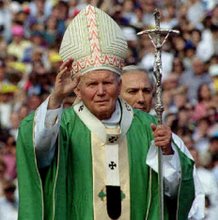
 … my Licentiate from the John Paul II Institute. However, I'm just one of very many. But I remain deeply grateful to Pope St John Paul II for his leadership, and to the Institute which he founded and from which I gained so much learning and vision.

Wednesday, 20 September 2017

New meter.

I've just added a new site meter to this Blog. The last meter dropped out somehow, a few years ago. Its last reading having recorded well over 100,000 visitors. I think that a meter is useful, letting me know the scope of interest in the Blog, particularly as this Blog has never elicited many comments.

Friday, 15 September 2017

Hoping to get back.

I'm sorry that there has been a lapse in posting. This has happened through default, rather than by decision. My mother's death a year ago set me back somewhat, and the Blog suffered. I hope therefore to get back to it in due course.
Friday, 23 September 2016

The last one.

I took this photo on 16th August 2016, in Otley, cooking a paella (paella valenciana) in the back of my car. I realised, about a week afterwards, that this way of cooking - in the street, in the back of a car - had been learned by me at least 20 years earlier. In the 1990's I had watched and enjoyed many cooking programs by Keith Floyd (in fact, he was magnificent). His influence, twenty years on, was now quite evident.
This paella, in mid-course, was the last paella that I made for my mother. After returning from Valencia in the year 2000 I made many, many paellas, which became a particular delight of my mother. In her last years, she enjoyed my paellas more than any other food. She and I shared this paella; it was to be her last. She died on 11th September. The victory belongs to Christ Jesus. May she rest in peace and rise in glory. I will miss her.

Friday, 19 August 2016

Before and after.

Here are photos of the side-chapel at St Ignatius, a couple of years ago and now.
This is what is used to look like:
And this is the chapel today:


Monday, 11 July 2016

30.7.16

This year the feast of St Ignatius of Loyola falls on Sunday 31st July; it is our patronal feast, here at the parish in Ossett and Horbury, WF5 0DQ.
As a part of our celebrations we are having a Votive Mass of St Ignatius, on Saturday 30th July at 12 noon, celebrated in the Extraordinary Form. The Rudgate Singers are coming to sing a Gregorian Mass setting. You are most welcome to take part.
Following the Mass there will be a celebratory BBQ in the garden (weather permitting). This is a donation event, and any monies donated will go to our new church windows fund.
If you would like to come to the BBQ, please indicate, either on this Blog, or on the chart in St Ignatius' church porch. Indicating your participation in the BBQ is essential because we will only source food for those we know are coming. 
Friday, 8 July 2016

A new look.
Here at St Ignatius' in Ossett we have re-decorated the side-chapel. I am especially grateful to Rob and Malcolm for their work. The side-chapel has become much more a place of dignity and serenity, for the celebration of weekday Masses.
Holy Mass is celebrated every Tuesday morning here at 8am in the Extraordinary Form and, in Winter, on Mondays, Wednesdays, Thursdays and Fridays as well (in the Ordinary Form).
There are one or two embellishments still to put in place, but our Eucharistic Lord will be exposed here regularly on the altar - especially in the colder months, when we can adequately heat the side-chapel. May He be glorified here!
Please check the parish website for regular Mass times: www.takenupingrace.wordpress.com 

Monday, 4 July 2016

Renovation: extras.

Here are a couple of pics which I took in May. The first shows the bio-filter and its overflow to a small water fall.
The second shows the overflow which we created at one section of the perimeter of the pond; this flows into a small channel which leads to a 10ft well. I have a pump in the well with which I can either pump water into the pond in the summer, or discharge in the winter after too much rain.
These pictures also show how badly green water affected the pond from March through to late May. In fact, the algae is now clearing significantly thanks to the filter and plant growth in the pond.
I'll take  a picture of the fish in due course.

Thursday, 16 June 2016

Carlos V.

I have just finished watching Carlos Rey Emperador. It has taken me two months to do so, but at my rate of watching stuff, that is quite good. This Spanish TV series of 2015 has 17 episodes, each of 75-80 minutes.
With a production style similar to that of modern soap operas, it is, nevertheless, very well made. The costumes and settings are particularly good, as is the acting. However, the episodes can become somewhat boring, as each scene inevitably portrays yet another domestic, studio-produced conversation between historical characters. Nonetheless, the vast career of this series grew on me as I watched. My favourite scene was at the end of Episode 16 when the Emperor retires to the Monastery of Yuste. The actual monastery was used, to great effect, in the filming of this scene.
Somewhat typically for historical dramas, history is manipulated. This production contained exceptionally good, and exceptionally bad parts. The worst, I think, was the portrayal of young Philip II just before his first marriage, and on the night of his first marriage. This portrayal marred badly the overall production.  
The actor, Alvaro Cervantes, who played the part of Carlos V, did so extremely well; in fact he was superb in the part. What particularly impressed me was the way in which he  aged as the series continued. It is hard to make a young man look like an old man, even with all the make-up. But the way that this actor portrayed the role, as the character became older, was remarkable. Carlos V is, after all, the most powerful ruler that the West has known.
I also felt that the viewer did need to have a fairly good understanding of history. Famous characters routinely appeared in scenes without any introduction. Once I realised this, I kept my mobile phone close by, and found Wikipedia to be an invaluable aid for identifying them and thus better appreciating the scenes in this epic production. 

Monday, 13 June 2016

Renovation 12.

On 25th April this year, with the evening sun picking out some colour, I took this photo. The renovation work is essentially complete, and I await the establishing of a new equilibrium in the ecology of the pond, through the use of the filter and the growth of plants in the water.

Tuesday, 7 June 2016

Renovation 11.

I took this photo on 20th April this year. The pond looks really well finished off with the Marsh Marigold in glorious bloom. You can see the gill nets which Rob and I fitted over much of the surface of the pond. Unfortunately these are a necessity; I haven't seen a heron near the garden since the nets were set in place.
The pond has the original five goldfish, together with five new ones. The frogs spawned profusely in March and by the time this photo was taken, the pond was 'newt city'!

Saturday, 4 June 2016

Renovation 10.

This photo was taken on 2nd April 2016. You can see the work Rob and I had done to finish off the edge of the pond with stones. This work involved a careful assessment of the water level round the entire circumference, so as to create a neat and level edge. We achieved this by creating an overflow in the bottom corner of the pond - which is out of picture. I'll endeavour to take a picture of this for a future post.
You can also see the small waterfall at the head of the pond, which is a lovely feature in both the movement and the sound it creates. I have a 2200 pump which feeds water into a large bio-filter, positioned behind the bamboo leaves (in the photo), and then, by gravity, to the simple water fall. I'll take a picture of this too.
BTW, the pond has a volume of 30,000 lts. It's quite a big one!

Tuesday, 24 May 2016

Renovation 9.

Although Rob and I did some work over the winter, trimming the edges of the liner and placing edging stones, the next pic was taken on 4th March 2016 after a light snow.
You can see the pond now clearly delineated, and the gill nets dragged by ice and snow onto the surface of the pond. But all is well.
To the bottom right you can just see the stone fire pit where I make paellas in the warmer months on a wood fire.

Friday, 20 May 2016

Renovation 8.

It was 3rd November 2016 before Rob and I reconvened. You can see in the photo above that there is now about a foot of water in the pond. This rise in level was due to rain and to ground water pumped up from the well. We had stretched gill nets over the pond to protect the fish from herons.
Our work that day consisted principally in collecting soil to build up the two new banks, after their original level had settled.

Sunday, 15 May 2016

Renovation 7.


At last the day came for us to put the new liner in place, laying on top of the old one. This was on 23rd October 2015. 
In the photo above you can see a large object in the pond. This was an old plant tub made of durable plastic and which Rob had opened the bottom of, intending it to be a refuge for the fish.
Once the liner was in place we were able to empty three water butts of rain water, and pump the contents of a well into the pond; in all, about 1000 litres. We put back the five goldfish which had survived the herons' visits, together with large clumps of the oxygenating weed.
At the end of the day there was about 8 inches of water in the bottom of the pond, and within minutes of being introduced the fish were enthusiastically exploring every inch of their new habitat.

Saturday, 30 April 2016

Renovation 6.

On Thursday 22nd October 2015 Rob and I met again to complete the building up of the two new banks. Once satisfied that we had put enough rock and soil in place, with the right contours, and had faced it with old pieces of carpet, we put the old liner back into the pond. Here it would act as an under-liner for the new one.
You can see from this picture how clean we had managed to get the old liner before putting it back it in virtually the same orientation that it had previously occupied.
I should say that during all this time we had perfect weather for the job. Apart from some rain which fell during the weekend, we had clear, sunny days, and temperatures of about 13C.

Tuesday, 26 April 2016

Renovation 5.

It was the following Tuesday, 20th October 2015, when Rob and I re-convened. I should say that each day we worked on this project, we spent up to three hours working together - between five and a half and six man-hours.

By the end of Tuesday 20th the two new banks were built up. You can see in the above photo a length of red carpet which we used to maintain the bank on the near side. You can also see a length of black hose leading into the empty pond cavity. This would stay in that place under the new liner and act as a release conduit for water accumulating under the liner.
We hoped that by replacing the old liner, which had indeed been leaking, we could cure the build-up of so much water under the liner.
The old liner had been rained on a few times over the weekend and, together with some scrubbing down from Rob and I, was now more or less clear of sediment on its upper side.

Monday, 25 April 2016

Renovation 4.

Overnight on 16th October it rained quite a bit. Rob and I were glad because the old liner would get a good soaking and make it easier for us to clear all the sediment from it. Sadly, I didn't take any photos of the old liner being cleaned. But during the next day, 17th October, we set to with brushes and a hose pipe, and did our best to remove more of the mud.
We also worked again on the two new banks that we were establishing for the pond. The photo below shows the results of our work that day. The new bank on the far side of the pond is a little clearer in this pic. And you can see water still pooling in the pond cavity.

Sunday, 24 April 2016

Renovation 3.

Next day,16th October 2015, Rob and I faced the hardest job of all; we decided to take the old liner out of the pond and lay it out so that we could clean it more thoroughly. We needed every ounce of strength to drag the liner out and across the grass to an open space where we could lay it out. There was still sediment on the upper side, and mud clung to the underside - it weighed a ton!
Our hope was that if it rained the upper side of the liner would get a good wash.
We were interested to see that water was already pooling in the open pond, and it soon became clear that the top soil of the garden was laid over a solid seam of clay.
We then began a new task. We had decided to make the pond a little smaller by creating two new banks. Our work would result in reducing the size of the pond from being an irregular 6m diameter circle, to being 6m in one axis, and 5m in the other.
We started on the far bank, placing first rocks and then soil to build a new bank. You can just make out, in the photo above, the new soil (and rocks) which we put in place along an eight or nine foot segment along the far side of the pond. This was another back-breaking task which ended the third day's work.

Saturday, 23 April 2016

Renovation 2.

The following day, 15th October 2015, Rob and I emptied all the sludge out of the pond by hand. We used a bucket and a washing-up bowl to scoop out the knee-high sediment, which we then spread all over the garden among the plants and bushes - back-breaking work. In two and half hours we had just about cleared all the mud out.
Having revealed the liner we were able to make an inspection for puncture holes. We found a few holes, two of them on the pond sides were about an inch long - yes, there had indeed been a slow leak.
As we gazed at huge expanse of exposed liner we knew that the next day's work was already presented; we would have to clean up the old liner quite a bit more.

Friday, 22 April 2016

Renovation.

Here in the presbytery garden at St Ignatius' there is a wonderful pond, which was created by one of my predecessors twenty five years ago. Last year, 2015, the pond was so over-grown that I even launched an inflatable into it so that I could do some weeding.
I also suspected that the pond liner was leaking. The question then was, should I attempt a small clearing up job, or should I replace the liner. 
The pond is an irregular circle with a diameter of 6 meters, so emptying the pond and replacing the liner would not be an insignificant task. This is what I decided to do.
With the help of Rob, from the parish, the two of us began this huge work of renovation on 14th October 2015. We pumped some of the water out of the pond so that we could catch the fish. I should say, at this point, that there had been nine good-sized goldfish and one large dark fish in the pond. We retrieved only five goldfish - the herons had taken the rest. The pond is also full of frogs and common newts.
This is how the pond looked after our first day of work:
By the time we started work on the pond the newts had already migrated into the garden to overwinter; many of the frogs on the other hand, made their own escape out of the pond as we worked, others tried to conceal themselves in the deep mud, hoping that we hadn't seen them. 
Having pumped much of the water out, we discovered that there was about 16 inches of sludge and sediment right across the bottom of the pond. No wonder the weeds were so prolific! We would have to remove all of this by hand. It suddenly became became clear to us the size of the job which we had undertaken.
To be continued.

Thursday, 21 April 2016

A very happy birthday ...

… to our dear Queen, Elizabeth II. She is our longest lived monarch. May God bless her on her ninetieth birthday, and through her, the whole nation.

Saturday, 2 April 2016

Undimmed witness.

The memorial to the martyrs of Durham is by the small roundabout on Framlingate, north of the city and close to Durham City Hall. The memorial (photo above) could easily be missed, so it is better to park the car and walk over to see it. The inscription reads: "Without doubt these priests were martyrs to God."
It is good that this memorial exists, but the place where six priests and three laymen gave their greatest witness is a quarter or a mile further north, on the very crest of the hill. Here, nineteen years ago a gully named 'Dryburn' was filled in with ballast so that a new hospital, The North Durham University Hospital could be built.
On this arial photograph of the hospital, somewhere in the top part of the picture stood the ancient gallows of Dryburn, which was last used in 1805. Here on 27th May 1590, Frs Richard Hill, John Hogg, Richard Holiday and Edmund Duke were hung, drawn and quartered. These four were beatified by Pope St John Paul II in 1987.
On 4th February 1594, Mr John Speed was hung for having assisted Fr John Boste.
Then on 24th July 1594, Fr John Boste was hung, drawn and quartered. He was canonised by Pope Paul VI in 1970.
Then on 9th August 1600 Fr Thomas Palaser was hung, drawn and quartered, and Mr John Newton and Mr John Talbot were hung. Fr Palaser and Mr Talbot were beatified by Pope St John Paul II in 1987.
What a record! What a blessed site for healing!
All these martyrs would have been held, before execution, in the old Gaol, which was the then north Gate of the old city of Durham, part of which still exists just behind the shops near where Owengate and Saddler Street meet.
Also, we must include Fr Thomas Plumtree, who took part in the Northern Rising of 1569 and celebrated Mass in Durham Cathedral. He was captured and hung, drawn and quartered in the the Market Place at Durham on 4th January 1570. He was beatified in 1886 by Pope Leo XIII.
The Market Place (photo above) is as busy as ever, but holds no memorial to Durham's first saint.
All these martyrs are commemorated in the beautiful Church of St Godric, just to the west of the old city, and where there is Eucharistic Adoration every day.

May the life and witness of these ten men be a light for many, a light that will never grow dim.

Tuesday, 22 March 2016

The faith of men.

I like the film "Risen", particularly because it enters into the reality of masculine faith. The encounter with the death and Resurrection of Jesus by the Tribune Clavius, played by Joseph Fiennes, presents a realistic and timely version of how men are called to become men of faith.
In the encounter with the Mystery of Christ, the film expresses really well those first uncertain steps when a man seek to rationalise and manage the situation, the struggle to respond in a mature and responsible way whilst not understanding, and the acceptance of a new way of living. Above all, it is the inner transformation of the man which "Risen" explores. We see the hard-working Clavius exercising his profession and authority diligently and prudently, with hopes of a more assured and peaceful future, only to see him achieving those hopes, not through blood and sweat but through the gift of another. His transformation becomes tangible in his personal contact with the Risen Christ. For me, the best scene is when he climbs to sit by Jesus who, at night time, is awake in prayer to his Father. Clavius readily acknowledges his faltering heart to Jesus; he doesn't know how to approach Jesus, nor what to say to him, and yet his joy and wonder at sitting beside Jesus confirms his inner conviction of faith.
This is a film about discipleship that should move most men in some way, as it traces the outlines of the same journey which all disciples of the Lord have made. Although the film ends with Clavius as a lone pilgrim setting out in his Christian life, I would have preferred to see him setting out with a group of disciples, as a part of the Church and sharing the same mission. Nonetheless, the film ends with us knowing that Clavius has been transformed, changed, in his whole person, and that that change was the work of Jesus, and that what matters most is what Jesus does, and not all the other stuff which human beings who are not connected with Jesus do. 
If you're a man - go and enjoy this film!

Monday, 7 March 2016

The Coxhoe Four.

Four young men were arrested at this village and condemned to death. We can't forget them.
Coxhoe is a village in County Durham about six miles south east of the city of Durham. One mile east of the present village is the site of old Coxhoe. The above photo shows the site of Coxhoe Hall, which was demolished in the 1950's. Most likely, somewhere near this place these four young men, Edmund Duke, Richard Hill, John Hogg and Richard Holiday, were arrested in the spring of 1590. Edmund was twenty-seven years old, the others were all twenty five years old. They had arrived from the continent only a few days earlier, disembarking at South Shields.
They were all Catholic priests and, having not found the friends they had expected to meet at South Shields, they were heading south for Yorkshire. Having been arrested they were taken to Durham, tried and condemned to be hung, drawn and quartered. Their execution took place at Dryburn, just north of the city of Durham on 27th May 1590.
I visited Coxhoe recently, both the new village and the site of the old, and as I stood looking south over the site of the old hall to the site of the old village just below, I was overwhelmed by the thought of the character of the these four young men who, not having yet been able to exercise their priesthood in this country, were so willing to give up any part in society, even a society that rejected them, in favour of the most complete exercise of their priesthood. 
The Coxhoe Four were all beatified by Pope John Paul II on 22nd November 1987.
Blessed Edmund, Richard, John and Richard, we humbly seek your prayers.

Wednesday, 2 March 2016

Not a one man job.

At the start of the year I was just moving one of Satan's tabernacles when my grasp slipped and it rolled over onto my foot. Well, I was limping badly for a few weeks while my toes recovered their usual stance. 
Moving a large set, like the one I had hanging around, really is a two-man job.

Wednesday, 18 November 2015

The Ordinary Prayers

The other day I received a complementary copy, from the Latin Mass Society, of their new booklet, The Ordinary Prayers of the Traditional Latin Mass. This is a tremendous publication which they have clearly put a lot of work into.
The Ordinary Prayers is not so much a pocket missal as a Liturgical prayer book, which is so presented as to lead to a greater participation in the Mass. Indeed, it is a booklet which truly appreciates the Mystery which takes place in the Mass. Its simple presentation of the Prayers of the Mass, with marginal notes and accompanying icons, will do much to lead to that interior participation in the Mass, which was so desired by the Second Vatican Council.
If you can get hold of a copy, I do recommend it to you. And I hope that this small but significant publication, will lead to a much needed re-focus, within the Church today, not only of what takes place in the Mass, but of us being present to the saving Mystery, by our participation in the prayers and actions of the Mass.
I have never seen a comparable publication for the Novus Ordo, and the Latin Mass Society should be congratulated for their service to the Liturgy of the Church.