Monday, 5 October 2009

I'm back


Apologies for the blog-gap, but I went up north during the mid-term break. I drove up to Brisbane, a mere thousand kilometers (each way); my first road trip in Oz since I arrived here. I do like Brisbane; this is my second visit, and the drive was thoroughly engaging. I shall post on my travels in due course. Meanwhile feast your eyes on this little stick insect which we found loitering on Campus at the end of last term. Even the sparrows have to watch where they tread!

Wednesday, 23 September 2009

Normality reigns again


If yesterday morning looked like the Last Day, then today looked like the First. This was the view from my front door at 6.45am.

Red sky at dawn

This was the view from my front door at 6.30 this morning. Everyday by 6.30am the sun is already shining through the trees, catching the buildings and filling the garden with light. This murky red light disoriented me somewhat - had my clock stopped, was the end of the world taking place or had there been a bush fire down the street? In fact, what had happended was that yesterday much of Australia had experienced severe and unusual weather. In Melbourne there were two 'small' earthquakes, in Victoria and NSW there were thunderstorms and high winds, on the NSW coast there was and is a gale warning. Red soil dust from central Australia, well over 1000 miles away, had blown across the continent and shrouded the whole city of Sydney. I gather that this is the first time that this has happened in Sydney. You can imagine that all our noses and throats are very congested and that there is a red dust over everything!

Monday, 21 September 2009

The inferiority of a life lived online

There is an excellent Editorial in "The Australian" this morning which challenges the quality of computer culture - that "Facebook friends and online adventures are not the real thing". "Hear! Hear!", say I.
You may think that I have joined another bandwagon, but, fifteen years ago as young parish priest in Leeds and before I had a computer myself, I became aware of how many people were on the threshold of living their lives vicariously through Soap Opera dramas, even to the point that it seemed as though the family drama on the TV was more real to them that the lives of their own families. With older people it was sometimes the case that loneliness and the lack of a supportive family led them to follow the Soap Opera drama too personally.
Today the emphasis has shifted to on-line culture which draws young people in so addictively. Today's Editorial quotes Baroness Greenfield: "the more young people are on-line, the less time they spend in the company of human beings, learning how the real world works. ... And exercise is far better for everybody than obsessively slaying monsters or indulging adolescent interests in on-line pornography."
Yes, "children and adolescents need to see their friends in the flesh, and talk, not tweet." I joined Twitter a couple of months ago but left a few days later when I saw how vacuous it was.
Actually, children and young people first need parents who will kick the computer and the mobile into touch and then spend time with their offspring, conversing and eating together, taking them out to play sports, to visit museums and to discover the countryside, and thereby build real, not virtual, culture - based upon real human contact and upon the real roles of parents.
This Blog, too, hardly makes the grade - there are as many good reasons to delete it as there are to maintain it!

Familiaris Consortio revisited 13

FC, 32
Our culture has seriously misinterpreted sexuality by separating it from it from the person. In this context the Church knows that her mission is to build up human life on the basis of an integral vision of the person. Human love is based upon the nature of the human person. Sexual love within marriage does not depend merely upon subjective intentions, but upon objective standards.
If we have an integral vision of man and his vocation we can see that there is an inseparable connection between the two meanings of married love: the procreative and unitive meanings are intrinsically linked.
Contraception separates these two meanings, acts as arbiter of the divine plan and degrades human sexuality. Contraception changes the innate language of total reciprocal self-giving by contradicting it. Thus, human sexuality is closed to life and the inner truth of married love is made false.
On the other hand, natural methods of fertlity management, which have recourse to the periods of infertility, respect the inseparable bond between the procreative and unitive meanings of sexual love and act as ministers of God's plan leading the spouses to benefit from their sexuality (becoming more human)!
Indeed, such is the difference between contraception and natural fertility management at both the moral and anthropological level, that they actually flow from two irreconcilable visions of the human person. Living natural fertility management leads spouses to experience the inner soul of sexuality through the tenderness, affection and dialogue by which it is embraced. Person and nature in the unity of body and soul are reverenced, not broken apart.

Friday, 18 September 2009

Pastoral developments


There have been significant pastoral developments at Campion College this early Spring time. First, the vegetable plot which I dug and prepared in February is now burgeoning with mediterranean provender.

Secondly, we have inaugurated a chicken coop, and after only five days the little yellow balls of fluff have already become young birds. They are here for there eggs only (although our faithful farmyard friend has so much to offer!)

Monday, 14 September 2009

Idyllic


The continuing good weather in Sydney is like high summer in the UK. It is the beginning of Spring here and some of us ventured out for a picnic on the banks of the Nepean River, just west of Sydney. The afternoon sun lit up the trees on the banks of a tributary of the river and created for us a scene out of Lothlorien (the wood of the Elves - for non-Tolkien readers.)

Thursday, 10 September 2009

Demographic Bomb


Recently I watched the sequel to the film "Demograhic Winter". This second film "Demograhic Bomb" charters statistically the projected slow death of a civilisation becuase of its low birth rates. It is a well made "wake up call" type documentary. At one point in the film a commentator describes how large families are viewed by some who advocate low birth rates (for instance, the United Nations): "Having five children is morally equivalent to robbing a bank!"

These films are good in that they expose the changing and prejudicial situation which is developing in Western countries becuase of low birth rates, and because they put anti-life paradigms into relief enabling us to see them with greater clarity. However, one detects a rather neurotic attitude which typically accompanies statistical presentations about human destiny.

I would certainly recommend watching this film, but as you watch it to keep in mind how different and how liberating and how much better is the Gospel in its approach to the human condition.

Tuesday, 8 September 2009

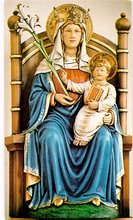
The Wounded Madonna

When I was back in the UK during the English summer this year I was pleased to see a small statue which I had ordered for my mother from the English College, Valladolid, Spain, where I trained for the priesthood.
The College's great treasure is a fifteenth century statue of Our Lady which belonged to a church in Cadiz but which was mutilated by Drakes' soldiers in 1586 and has been venerated by English seminarians in Valladolid since 1600. She is called Our Lady Vulnerata. The original statue was very badly damaged by the English soldiers in Cadiz; they hacked the Christ-child from her lap and cut deep scars into her face.

I ordered one of these statues and had it deleivered to my mother who was very moved to receive this miniature replica of the actual statue which is about three feet tall. I placed a CTS pamphlet next to the miniature so you can gauge its size - about seven inches tall.

In Valladolid, Our Lady Vulnerata is still honoured each week with prayers of reparation and prayers seeking her intercession for the conversion of England.

Our Lady Vulnerata, pray for us.

Monday, 7 September 2009

Summertime special

It may be the tail end of the summer in the UK, but here in Oz we have just had the first day of Spring. The pundits have said that this Winter has been the warmest recorded in Oz since records began. The weather has indeed been idyllic. The other day some of the students here at Campion went to cool off under the lawn irrigation system. Let's hope that the Australian summer, when it comes, will equally idyllic.

Tuesday, 1 September 2009

The heart of the matter

The newly published book "A pure heart create for me" contains a paper given in Soho in 2008 by Fr Anthony Doe (of the Westminster Diocese). Although the book contains a variety of papers given to honour the 1968 promulgation of Humanae Vitae, this paper, in my view, goes to the very heart of the matter. Fr Anthony Doe speaks not so much about the issues surrounding the truth of the Church's teaching but focusses instead on humanity's need of Christ; Christ uniquely transforms human life and makes it into what it is called to be. It is a tremendous teaching, coming from the heart of the Church to direct the hearts of all believers to the Corner Stone of human life.
His paper does not hinge upon the truth of Natural Fertility Management but upon transformation in Christ. Baptism, he says, is "not just a casual invitation to be formally religious but a totally all-consuming call to personal holiness." Here is the message of the Church - a message which has been somewhat overlaid by all sorts of 'human projects'. For many today, says Fr Doe, instead of the baptised being focussed upon a "supernatural grounding ... animated by the Holy Spirit", we have seen the "spirit of the Age ... demand the right to interpret the Gospel and the teaching of Jesus."
No wonder it has been so hard for many to grasp the teaching of Humanae Vitae, since the starting point for many has been and is the wisdom of this age, and not the mighty power of the Redeemer. It is only in a relationship with the Redeemer that the whole truth about our lives becomes evident - however challenging that may be to any one of us. Fr Doe in his masterly paper points the baptised to their real and essential focus in life. So true it is, that without the priority of grace, the "radicalism and total generosity that is at the centre of the Lord's call to discipleship will then begin to disintegrate, and the joy that always accompanies the anthentic transmission of the Gospel will no longer be able to heal and animate the hearts of the faithful."
Fr Doe then goes on to present in concrete detail the objective Spiritual life of the Christian. In this wonderful treatise he describes how Christ enables a person to surrender his or her life to God and how, with Christ, he or she can confront the reality of his or her sinfulness. That Christ's desire "is to transform us so completely that our communion with him will be an encounter of reciprocal spousal love and this experience of mutual self-gift will become our total reality."
Now when you put this vision for life into the discussion/argument over the Church's teaching on birth control you have a very different perspective from that of the world: transformation in Christ v changing the Gospel to suit present values and ideas. Christ at the centre or Christ on the margins. Human life, the gift of God or human life, my own project. An integral vision for life v a fractured one.
Thank you Fr Doe for reminding us to base our lives upon a preferential option for Christ.
(The photo above shows the building of a new font in Salisbury Cathedral.)

Thursday, 27 August 2009

Awaken the hearts of young men

The Seminary of the Archdiocesan Seminary of Sydney has done a very timely re-vamping of its website. The Year of the Priest is very much being embraced by this Seminary in order to really develop its vision as a major seminary in today's Church. I do recommend this site to you and would be interested to hear your comments. Visit http://www.sgs.org.au/ I particularly recommend the page "How did I get in here?" which contains audio-visual clips of some of the seminarians speaking about their vocation. May this website be a channel of grace for many.

Friday, 21 August 2009

A former Yorkshireman

I have recently enjoyed reading the remarkable Autobiography of Archbishop Ullathorne, one of the last Vicars Apostolic of England and the first Archbishop of Birmingham. Previous to these posts he was first Vicar General to the whole of Australia for eight years, 1832 - 1840. What an extraordinary appointment! Before ever there was a Bishop in Australia, Ullathorne was given ecclesiatical authority over a continent whose size is larger than the greater Europe!
William Ullathorne was from Pocklington in East Yorkshire and although I am a native of Hertfordshire I have spent much of my life in Leeds and so align myself somewhat with him. My experience of coming to Australia bears little in similarity with that of Ullathorne except in the essentials - he and I came here on mission as priests. (Indeed, the Annuaire of the St John Vianney Society states that I am en mission en Australie.) Ullathorne's experience of being on mission is Australia was very challenging. He arrived just fifty years after the founding of the colony; the convict system was firmly in place and his ministry was largely with convicts. My experience has not been like that - indeed, I have been inserted into a very vibrant Church and been received by a very warm and hospitable people. Ullathorne is a much more important figure in the Australian Church than I will ever be and he is a great witness and model to priestly life and ministry. Ullathorne lived at a time when the Church in England was very aware of being on mission, and his being sent to Australia is a sign of how missionary the English Church was back then. My sense of the Church in Sydney is that it is aware of the need to really embrace that attitude and identity - being a Church of Mission.
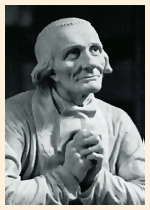
A very remarkable detail from Ullathorne's life was the visit he made to see Fr John Vianney in Ars in 1854. He went to seek the counsel of the saintly Cure and spoke to him about how difficult is was to evangelise England. St John Vianney, listening, sat with bowed head. When Ullathorne finshed speaking he at last looked up and said "Ah yes, but that will not always be the case." Let's hear it for the New Evangelisation! Australia, I think, has the lead on England today.

Tuesday, 18 August 2009

Living in the sanctuary of the Catholic faith.


I don't know how many of our Bishops - or priests - have published or are about to publish books on the Priesthood during this Year of the Priest, but one of the auxiliary Bishops of Sydney has done just that.
Bishop Julian Porteous has just published the book "After the heart of God", about the life and ministry of Priests at the beginning of the Third Millennium. After a brief appraisal, at the start of the book, of the changes in the Church in recent decades and their influence upon priests, the reader senses a shift to a level of undertanding and proclamation about the nature of the priesthood which we have previously glimpsed and overheard in the life and teaching of the both the late and the present Holy Father.
This is a book written by a Bishop who lives, breathes and desires a renewed Priesthood. The Priesthood, he says, "is more than a function: it is a radical re-orienting of the whole reality of the person. He is changed at the level of his being." The author presents, simply and clearly, a whole panorama of the life and identity of the Diocesan Priest, and he does so using the language of the New Evangelisation. Implicit in the book is a call for a renewed Priesthood - an essential ingredient of the New Evangelisation.
Bishop Porteous speaks particularly powerfully about Priestly fraternity as a basis for the daily mission of the priest. He renews the call for priests to make the preaching of the Gospel their primary focus, and for priests to become missionaries not managers.
This is a book which I would recommend to priests, to seminarians, to young men who are discerning a vocation, as well as lay people who themselves look to better undertand the nature and challenges of the Priesthood at this moment in history and who, in this Year of the Priest, wish to better support their own priests who live their lives "in the sanctuary of the Catholic faith."
Thank you Bishop Porteous for this immensely encouraging book - a book whose language, style and message has flowed out of your own priestly heart.

Saturday, 15 August 2009

"The child leaped in her womb"


This morning, on the Feast of the Assumption, Bishop Porteous lead a Vigil outside Sydney's oldest Abortuary. There is a joy and hope in the heart of the Church which no darkness can eclipse - and She, the Queen of Heaven, is very powerful - She leads the overthrow of the culture of death.

Thursday, 13 August 2009

The English Section

How nice it was to have had my first visitor to Sydney from England. As you have read and seen from previous posts, Fr Julian came out to Sydney to take part in the SCENE Congress. I marvelled at his courage and tenacity in making that return journey within the space of just nine days. However, once here we were able to join in fraternity and offer ourselves to the Congress as the entire English Section of the St John Vianney Society. Of course, I was delighted to share some of my experiences of Australia with a friend from back home, and to work together again in the Sydney Congress as we have done so many times before in England.
The photo shows Fr Julian preaching in the Cathedral in Sydney at a Congress Mass on the Feast of St Mary Magdalene. In this sermon he spoke about how the Magdalene is a model for us today in the New Evangelisation. He preached twice during the Congress, gave one Workshop on Paul VI's letter "Evangelii Nuntiandi", shared another one with me on "The Priesthood in the New Evangelisation" and took part as a panel member in the Congress Forum. His interventions in the Congress were very well received by all the delegates. These days were days of grace for both of us, given during this Year of the Priest, to strengthen the fraternity in which we both share - a fraternity separated presently by the huge distance between the UK and 'down under', but now brought together again by the New Evangelisation.

Friday, 7 August 2009

A timely Congress


One year on from WYD and a portion of the Church in Sydney was ready for the next step forward which God had planned. A Congress of the New Evangelisation is an unusual event - to say the least. However, the Church in Sydney is further ahead than might appear to the casual enquirer. For to bring together an eclectic planning team, to invite foreign religious and missionaries, to envisage an eight day event which was extremely difficult to describe or convey any real sense of, before the event itself, to plan an event which was itself an interweaving of many sub-groups and sub-events; this set the Congress apart for success. From day one there was a sense of joy that the Church was truly revealing herself - the Church of the New Evangelisation - a revitalised Church, revitalised becuase she had taken the Gospel to her heart, but not so as to keep it to herself but to make it available, as she had been asked. Frankly, the Congress was a whole Christian culture, and to be immersed in it as we were was to be filled with a joy and a life which witnessed to an outpouring of grace on the Church and on the city that week. Many said that the Congress had been a far greater grace to them than WYD had been!
The Congress revealed the Church of the New Evangelisation in Sydney. A Church made up principally of young people, the new movements and a small number of older people who thirst for the renewal of the Church. The Congress revealed at the same time who is not a part of the New Evangelisation - the clergy, the parishes, the schools and many, many rank and file Catholics. The Congress revealed in some way the capacity of the Church in Sydney for the New Evangelisation - the 'can-do' mentality set next to a tremenous talent pool enabled an expression of Catholic life and mission far greater than had been envisaged or planned by the planners.
The Congress was God's Congress. We had opened ourselves to God and allowed ourselves to be used by Him. What took place during those eight days far exceeded our competence and skills. The life and mission of the Church in Sydney has been changed by the Congress. The embracing of the New Evangelisation has changed those who allowed themselves to be influenced in this way by the Gospel. This is the part of grace in our lives - this is the gentle power of grace which gave to the Church, on the first day of Pentecost the ability to live and breath the life of Christ. Here in Sydney we felt that power again.

Wednesday, 5 August 2009

Catholic Underground


Frs Christopher, Loius and Anthony CFR came out from New York for the Congress and were present on the streets of the city evangelising each day, they gave workshops, took part in the pub talks and on both Saturdays of the Congress led a floor-packed Catholic Underground. Upwards of 500 young people took part in these two evenings. A first for Sydney and hopefully a kick-start to Sydney's own burgeoning Catholic music movement.

Vocations Expo


During WYD SYD a huge Vocations Expo was held on Darling Harbour, during the Scene Congress a smaller but very enterprising Vocations Expo was held in Martin Place - the central pedestrian precinct of the CBD. Around fifty Communities, Movements and groups in the Church established themselves in the heart of the public domaign for three days of the Congress. On the first day, Monday, there was a sense of surprise in the air, that Catholics had 'taken over' this important area of the city, but over the course of the next two days the mood relaxed and many who were either curious, intrigued or simply very interested came to investigate and to speak with those who were running stalls.

The Vocations Expo was a tremendous success - a success in terms of the Church presenting herself with a friendly face in the heart of the city. We were grateful to veteran street evangelisers like the Friars of the Renewal for their presence. And of course, there were the stories which came back each day. One about a group of three smartly dressed Sydney businessmen who had approached the Friars and asked how they could join the Community. Another, of a business who on being handed a Miraculous Medal, at first put it in his pocket, but later came back to the giver and asked for it to be blest before secreting it more carefully in his wallet. The Martin Place Vocations Expo represents the 'can-do' mentality which is prevelant in the Australian Church. Street Evangelisation took place in other parts of the city and was often animated by musicians who gave of their time and talent. Even late on into the evening you could encounter large groups of delegates who were so enthused by the Congress that they had wanted to share their enthusiasm and grace with other city users.

Tuesday, 4 August 2009

Special thanks


During the Scene Congress two people particularly put in a tremendous ammount of work as the MCs of every Congress session. Special thanks to Lewi and Jovina who animated the Congress sessions from the start of each day till our break for lunch after Holy Mass. Lewi is a seminarian of the Archdiocese and Jovina is a Sydney Medical student and both brought much grace and professionalism to the Congress.