Tuesday, 2 September 2008

Down in the city again


The other day I finally made it into Sydney during the day; I took the RiverCat ferry from Parramatta to Circular Quay which is right beside the Opera House.As the ferry drew near the city the harbour widened and the final approach to the quayside was quite spectacular, passing under the harbour Bridge and passing alongside the Opera House - which is magnificent.
The glittering buildings of the CBD had been so recently the focus of the Church's life during WYD, especially Sydney's noble Cathedral.
These pictures will evoke great memories for those who took part in that event. Grace has rained down on this new city; visited as it has been by the two great architects of the New Evangelisation. I am already beginning to meet and make contact with many of Christ's agents here.

Saturday, 30 August 2008

Book launch in Melbourne


A worshipper's guide to the Order of Mass of 1962 has been launched in Melbourne. For further details follow this link:

Thursday, 28 August 2008

Down in the city

A new Planned Parenthood clinic in a minority neighborhood of Denver should be taken as an offense, affirmed the archbishop of the city. Archbishop Charles Chaput said this at a prayer vigil and march at the site of Planned Parenthood's new clinic in a primarily Latino and African-American suburb of Denver.
"Here in America, and especially here tonight, we need to remember two basic truths. Here's the first truth; Society has an obligation -- and Christians have a Gospel duty -- to provide adequate and compassionate support for unwed and abandoned mothers; women facing unintended pregnancies; and women struggling with the aftermath of an abortion. It's not enough to talk about 'pro-life politics.' The label 'pro-life' demands that we work to ensure social policies that will protect young woman and families, and help them generously in their need. Here's the second truth. Killing an unborn child is never the right answer to a woman's or society's problems. Acts of violence create a culture of violence -- and abortion is the most intimate form of violence there is. It wounds the woman, it kills the unborn child and it poisons the roots of justice and charity that bind us all into one human family."
(The photo is not of Denver, but of Darling Harbour in Sydney. But the whole of the Western World must be called to bear for its promotion of abortion.)

Wednesday, 27 August 2008

Side by side


I celebrate the extraordinary form of the Mass every week in the College chapel at Campion. This has been a tremendous experience for me; hitherto, I have been celebrating Mass in the Old Rite just a few times a year and have never before had the opportunity to develop an intimacy or rythmn with the Old Liturgy. I look forward to developing a much better honed practice and understanding of this form of the Mass together with the students, who almost fill the chapel when this Liturgy is celebrated.

Sunday, 24 August 2008

Straight in at number one

My first visit to Sydney city centre the other evening was with a small group of Campion students - we went in on Friday evening to find some of the city's homeless and to offer them food and friendship. This was a student initiative to reach out to the homeless in the spiritual abyss of a Friday evening in down town Sydney. We met and spoke with many people down by the harbour and in some of the main streets of the CBD. It was an attempt to express and share our faith. We met with openess and ease of conversation.
A sign of things to come - from small beginnings - the New Evangelisation.

Thursday, 21 August 2008

If I were in England I would ...

... want to participate in this:
The Faith, The Family, The Future 25th-26th October 2008 at All Saints Pastoral Centre, London Colney, St. Albans A conference of hope for young people and families, focusing on:
• Fostering and exploring the beauty of the Church’s vision for marriage and the family
• Passing on the faith to the next generation and the role of the family in this work
• Promoting the growth of Catholic culture and vocations through the family
• Celebrating the 40th Anniversary of Humane Vitae.

Over the weekend there will be many speakers, representing a broad panorama of Catholic thought and culture. With programs specially tailored to each age group, combined with the opportunity for retreat, spiritual reflection and renewal, the weekend provides a great opportunity for Catholics to renew their spiritual life, strengthening their families through meeting other young Catholics who share their hopes and views.For details, and booking, see the dedicated website www.faithandfamily.org.uk or email faithandfamily2008@yahoo.co.uk

Monday, 18 August 2008

After WYD SYD


The first "Theology on Tap" after World Youth Day in Sydney was quite a gathering. Four to five hundred young people met at one of the city's many pubs to listen to Bishop Fisher speak. Bishop Fisher, an Auxilliary Bishop in Sydney, was the Co-ordinator of WYD SYD.
The enthusiasm and interest of the young people was overwhelming as Bishop Fisher spoke. He told us that a huge number of Bishops from across the world who had taken part in WYD had contacted him to say that WYD SYD had been the best WYD ever! He had received innumerable emails from young people speaking of how they had encountered Christ in Sydney and experienced His Spirit. The Holy Father too, since his return to Rome, has spoken at every public ocassion about the event - he can't get it out of his head. Bishop Fisher spoke directly and warmly to the young people challenging them to respond to the Holy Father's call - to become the World Youth Day Apostles that the Holy Father had asked them to be.
Fr Fleming, President of Campion College, many of its students and myself took part in this evening's gathering; we sensed the keenness and the eagerness of this great throng of young people to exercise the Spirit's gifts in the New Evangelisation which is gathering momentum in Australia. It is a very exciting time to be "down under".

Saturday, 16 August 2008

Picking up the ball again

Here I am with a whole new group of young people, picking up the ball again; in this instance an in-house soccer tournament called "The President's Plate". It began, in the early morning sun, with me blessing the tournament of four teams, one named after the Pacific's martyr saint St Peter Chanel, the other three named after English Martyrs. I wasn't at all surprised when the team with the College's English student won the trophy.

Friday, 15 August 2008

A centre of Christian Life


I have slipped into the life of Campion College very easily - I take this as a sign of the vibrancy of the life of the Church here on the Campus, a centre of the Christian Life and a centre of formation for the Church today. For me, spending a day in the air, crossing the Equator and travelling to the other side of the planet happened and I scarcely noticed it. Far greater was the contrast in having left a place where the Church seemed alseep, to arriving in a place where the Church is immediately tangible and apparent. I haven't had the time yet to allow Australia to have an impact on me - Campion College has received and welcomed me from a far-flung corner of Europe, and I'm already at the living, breathing heart of the Catholic community of the students and staff of Australia's first Catholic Liberal Arts College. My appointment is as Chaplain to the College.

It is already evident to me that the College, like its patron - St Edmund Campion, who was at the forefront of the Mission of the Church in England during the second part of the sixteenth century, is leading the way in enabling young people to prepare themselves for the needs of the Church today. To endeavour to form leaders for the Church is a very courageous project, and I have been struck especially by the way in which the College resources and supports the students in terms of human, spiritual, intellectual, communal and recreational formation.

Young people in the UK who are looking for a place to study should definitely consider Campion College - this is a real Catholic centre of formation. Check out the website: http://www.campion.edu.au/

Tuesday, 12 August 2008

Jesus walks

One legacy of World Youth Day which I have encountered since arriving in Sydney is the project http://www.jesuswalksart.com/ whose works were exhibited "down town" during WYD. I was most surprised by the subject which the various artists worked upon, and extremely surprised by what they created. You see more of these ghastly statues on the Website.
However, I would be even more surprised to find such works of art in the UK. The British secular movement has cast all civic Christian religious forms to the four winds. Yet, here in Australia, the JesusWalks project is an evident sign of the need for the New Evangelisation. The website presents this project as follows;

Each work engages with the idea of “faith” in the contemporary cultural context. The artists incorporate their interpretations onto a fibreglass sculpture of the iconic image of the Sacred Heart of Jesus.


An "idea" of faith is not Faith. In the UK we are used to the neo-Pelagian project which, while keeping Christ conveniently packaged as an idea which we should know about and even toy with, nevertheless holds back from embracing Him as the necessary fulfillment of human life. It seems to me that this Australian art project reveals a keener openness to the New Evangelisation than neo-Pelagianism does, for these "ideas" focus, as you can see, upon the Sacred Heart of the Redeemer and therefore touch upon the centre of the Mystery of Faith. We should pray that this art project will lead many beyond the "idea" to the person of Christ himself. Incidentally, the statue I photographed is the only statue of the Sacred Heart I have ever seen whose hands are pierced. These holes in the fibreglass say a lot more than do all the pretty colours!

Saturday, 9 August 2008

Safe arrival

This is my ninth day in Australia; in moving parish I would expect a good two weeks before you could get any sense out of me. Such is the warm welcome at Campion College that John and Neil, who have been in Sydney for World Youth Day, spent a day here with me, the students and the staff. John gave his testimony and, such was the impact that we are all still speaking about him.
The air is crisp, the sun is strong and the trees are full of bird-song. It is winter here, but it feels like high summer to a newly arrived englishman. My life as Chaplain to Campion College has begun; the second term started on Monday and the very full but rounded schedule of the College is in full swing.
It feels to me as if some big event has recently taken place in this locality; I have even bumped into groups of young people from England who have been here in large numbers. It is as though Sydney has just been the focus for a huge number of people!
Indeed, it has been a very good time to arrive, and I hope to return to a more regular posting.

Sunday, 27 July 2008

I almost forgot ...

... last Friday, 25th July, was the 40th Anniversary of the promulgation of the Encyclical "Humanae Vitae" - great light for our age. The huge value of the vision and teaching of this Encyclical is perhaps more evident now than it was in 1968. This teaching was given to us just in time as the great secular movement of our age was embracing anew the culture of death. "Humanae Vitae" is light for Christian spouses helping them to distinguish the path in a dark age. Christian marriage and the culture of death are poles apart. Many in our day have been entrapped by the culture of death and cannot see the path. We must thank God for the extraordianary graces which He gives to Christian spouses today enabling them to live their marriage in His light. But a great work still lies ahead - to open up the path to many men and women who are lost deep in the forest. No one should take the grace of "Humanae Vitae" for granted for the culture of death is today almost impenetrable.

Thursday, 24 July 2008

An apostolic summer

Fr Julian, together with a group of students, is presently in Cairo working with the Missionaries of Charity. This project was planned some time ago and we look forward to hearing about their experience when they return next week.
In a few days I shall be flying out to Sydney to begin my new mission in Campion College. The Year of St Paul will be an unforgettable year for both of us. This will be my last post on the Blog till I become chemically stable again on the other side of the world. I'll post again from Sydney.

Wednesday, 23 July 2008

The new Pentecost in the Southern Land of the Holy Spirit

We have been witnessing, these days, the second great Apostle of the New Evangelisation bringing the Church together in Sydney in order to hear and embrace the great call to announce Eternal Life.

We can neither understate nor preconceive the effect which WYD will have upon the Church in Australia and the young pilgrims from other lands who took part in this celebration. The New Evangelisation is actually taking place there. Pope Benedict's words about the power involved in this Movement leave no doubt: 'It is the power of God's life! It is the power of the same Spirit who hovered over the waters at the dawn of creation and who, in the fullness of time, raised Jesus from the dead. It is the power which points us, and our world, towards the coming of the Kingdom of God.'
Indeed, the New Evangelisation is like Pentecost - that the Church of the Heavenly Jerusalem is being formed here and now on this planet, that the Culture of grace is being fashioned in human hearts, that a person's true identity is Christ!
I am overwhelmed to have been asked to go out to Australia at such a time as this!
The first Christians were stirred by the Holy Spirit to believe in Christ and to proclaim him as the world's only Saviour, sent by the Father. In every age, the true agent of renewal and evangelization is the Holy Spirit, who surely will not fail to help the Church now to find the evangelizing energies and methods needed in rapidly changing societies. Nor will the new evangelization fail to bring to the peoples of Oceania the wonderful fruits of the Holy Spirit as experienced by the first Christians, when they encountered the Risen Lord and received the gift of his love which is stronger even than death. (JPII, Ecclesia in Oceania)

Thursday, 17 July 2008

There's a ship lies rigged and waiting in the harbour ...


At the end of the month I leave England to take up a new appointment as Chaplain to Campion College, Sydney, Australia. This appointment has come 'out of the blue' and will take me, for a few years, to live abroad for the third time. Campion College (http://www.campion.edu.au/) is Australia's first Catholic Liberal Arts College - a new foundation and a place a real Catholic formation. With World Youth Day taking place in Sydney right now, Australia is a focus for the New Evangelisation. This appointment is a very exciting adventure for me - but Fr Julian and myself intend to continue with this Blog and our SJMV fraternity. This Blog will no doubt have whole new focus and perhaps will become a link between the New Evangelisation in Oz and in the UK.

Wednesday, 16 July 2008

A simple celebration

Today, the Feast of Our Lady of Mount Carmel, is my 20th Anniversary of Ordination. I will never forget that era of my life, between the ages of 19 and 21, when I was receiving my vocation to the Priesthood. Twenty years after ordination and I am so pleased to be a priest at the time when the Church is beginning to embrace a genuine Liturgical reform. But above all, I am overtaken by the awareness that my task in life is to be a priest of the New Evangelisation. Please pray for me, that I will be able to totally embrace my calling.

Sunday, 13 July 2008

Pray him in

The matter of the election of a new Archbishop of Westminster and Primate of England and Wales is an intention for vigil and novena; we really should be praying that the Holy Spirit will be given freedom to choose in this matter. The pundits and the Blogs are loaded with speculation about who will step into this important role; how much more should we be praying for the right man. In the New Evangelisation it is important that we have pastors who will lead the Church from being a Church of maintenance to being a Church of Mission.

Saturday, 12 July 2008

By way of

The state of our parishes reflects the way in which Catholics have allowed themselves to be drawn into the forces of secularism, conforming to contemporary trends - supermarket culture and the ever present drone of subjectivism. In the midst of this, the New Evangelisation has already highlighted the importance of the family through which passes the future of humanity and the Church.
The family lies at the heart of the Church and of our parishes, yet in our day it has come under intense pressure, its essential and organic roles being overwhelmed and replaced by Goverment, State, agency, medic, media and school. So intrusive has this phenomenon been that fathers have been unable to fulfill their role, mothers have been turned into blood by abortion, and children and young people have been utterly bewildered and have lost the way.
In fact, the Family possesses the necessary forces for love and life and for the building of civilisation. This is why the Family is an essential part of the New Evangelisation. What this means in practice was laid out by JPII in Familiaris Consortio and reworked in The Letter to Families. However, in Britain we have paid more attention to Government, medic and media than we have to the wonderful domestic economy of Salvation - the family.
In my experience, those who are best at releasing the forces of good from within the family are the spouses themselves. Spouses who are attuned to the Plan of God and presence of grace are already engaged in the New Evangelisation. Not necessarily an easy task, but a grace-filled one.
These are the families for whom the spiritual and moral support of the Church is indispensible - because they are engaged in building the Church. It is a support which recognises the primary and organic roles which the two spouses play in the formation of their lives and those of their children, roles which far supercede that of Goverment, agency or school. (Spouses are the procreators of offspring, not medics with test-tubes!)
I believe that the New Evangelisation will not advance at it should unless there takes place and organic integration of Familiaris Consortio within the Church in Britain, for the place of the family is central to the life of the Church and the world.
One of today's great blessings are the numerous and fruitful Catholic marriages - where two praying young people wed in Christ. But we dont want young people to get married and to lose themselves in marriage, rather, we need them be open to the greater call which is made to Christian marriages - to be a leven for society and the Church. We have much ground to cover here in throwing light upon the truth about marriage and family, and in nurturing all the grace that is present in families who are trying to live by grace.

Friday, 11 July 2008

The following of Christ

In the great movement which is the New Evangelisation the parishes are called to respond in a new and radical way. In this fifth post about this subject I want to speak about our parishes and their responsibility at this time.
Parishes sprang out of the last era of evangelisation when, after the Christianisation of the Roman Empire, missionaries went out into the countryside and evangelised the rural peoples (pagani). In those places where the faith was embraced and became integrated into the culture of the people, the local Bishop would establish permanent communities of faith (parochii) at whose heart was the celebration of the Eucharist. Parishes have then, endured for many centuries; the Catholic parishes of England and Wales represent a part of the last thrust of that era of evangelisation.
Today however, faith and culture have come apart (that is why we need a New Evangelisation) and the lack of integration of faith in a particular community is now a cause for concern. We have parish buildings, but they are used, for the most part, only as structures for the fulfilment of Sunday Obligation. In some cases parishes have become centres of social activism, reducing the Church to being a exclusive club for its members. The focus of such parishes is generally neo-Pelagian spirituality and social issues. In other cases parishes have become merely Mass centres - in these instances, people will come to pray and to take part in the Mass but are closed to any further engagement with the Church. Neither of these responses is adequate, and both are actually closed to the New Evangelisation. Occasionally, one hears of a parish which is responding.
Ultimately I would like parishes to be able to respond to the call of the New Evangelisation, but I think that generally they are actually having to respond to the reorganisation and rationalisation processes which are taking place in many of our Dioceses.
Ours is not a stable era; we have a changing population and changing needs. The need today is not so much to reorganise the structures and the buildings, as it is to put in place the elementary needs for the following of Christ: centres and schools of prayer, of Formation, of Mission, and to build up individuals and groups within an area - to build the Church upon people, people who are open to the call of the New Evangelisation (conversion, personal holiness, mission, knowledge of the Faith). Again, it was Cardinal Ratzinger who remarked that those who were responding to the call of the Second Vatican Council are the Ecclesial Movements. In the light of the New Evangelisation there will be a general restructuring of parishes. Some will close, some will be given time to change, some will become beacons.
A Saint for this age is St Catherine of Genoa who, when things were beginning to get a bit iffy at the start of the Protestant Reformation, decided she had to do something positive for God. She was a housewife and she began a prayer-group in her house. Little did she know at the time, but she was single-handedly beginning that great movement of holiness in the Church which we now rather prosaically call the Counter-Reformation.

Monday, 7 July 2008

Everyone needs the Gospel

"The Gospel is destined to all and not only to a specific circle and this is why we are obliged to look for new ways of bringing the Gospel to all", said Cardinal Ratzinger in his Jubilee Address to Catechists. In this fourth post about the New Evangelisation of England I want to focus on the evangelisation of young people. That is to say, leading young people in our culture to embrace the Mystery of Faith and to live in the Church.
In my experience of parishes, young people are either not present, having lost contact with the Life of the Church, or they are present, but only in a cultural sense - they belong to a group of people for whom going to Church is a cultural expression. Where I have come across young people who are genuinely praying and discenrning God's Will in their lives, I discover that the root of their faith and spirituality lies outside the parish structure. And yet, having said this, I find that young people are searching for truth and are very open to the Gospel.
A Mission to young people is necessary today and, I believe that it is a question of bringing that mission alongside a parish or group of parishes and establishing a new structure to enable the evangelisation of young people to take place. Of course, one needs to establish the target age group or groups; my experience would lead me to propose two target age groups: 13 - 15 and 16 - 21. Of the second group I would envisage forming future leaders.
A Mission to young people in a particular area first of all presupposes leadership. That is to say, individuals who have the gifts of leadership, who know where they are leading young people and who are discerning of the characters and needs of their "flock". Leadership is the single most important dimension for a Mission to young people, for it is in recognising how the Mission can be built and in discerning the capacities and needs of the young people in the group - that is, their spiritual as well as human needs, that an organic project of evangelisation can be considered. Of course, these leaders need to be identified and formed, and they will need personnel to support and promote their leadership. Indeed, the leadership will need its own structure to facilitate and guide the work of the Mission. A leader cannot be an isolated individual - we are talking about a team.
Remembering that the New Evangelisation in England is changing the Church from being a Church of administration into being a Church of Mission, establishing a Mission to young people is going to necessitate looking beyond the already existing structures of parishes and deaneries. The Cell-group model is already employed by the Evangelicals with grest success; we should take a leaf out of their book. The Cell Group proposes a social network, when properly led, enables any young person to engage with it, find their place within it, contributing as well as receiving, and offering a wide range of content - social, cultural, spiritual, but set within an evangelising environment.
As well as attending to the genuine spiritual needs of young people: Conversion, (re)discovering prayer, Baptism, Confirmation, participation in the Mass, Catechesis, formation for discernment, formation for mission, the group should be involved in organising regular small and large events of various styles in order to invite and attract other young people.
Establishing a Mission to young people in a parish, or better still, an area, would require prayer and generosity on the part of many, and it would require that support throughout, that many, many young people would hear the call of the Gospel, be encouraged to respond, come to know Christ in a relationship of friendship and take part in the Life of the Church.

Sunday, 6 July 2008

The Art of Living

In this third post about the New Evangelisation of England I want to focus on an element which is implicit in both previous posts about this subject. If the most important aspect of the New Evangelisation is people, and people who are switched on, alert to the call and trying to respond, then those people need appropriate formation, both human and Christian. Catholics today can't rely on the surrounding culture to form them, although it seems that such a project is widespread. We need to create within the Church the vision, skills and competence to engage in formation for evangelisation. In fact, the vision has already been discerned by the Church, it remains for the Church in England to embrace this vision and then build itself upon that vision. I remember John Paul II, during the last "Ad Limina" visit of the Bishops of England and Wales, using the word "bewildered" of the people/Church of Britain. The vision and the teaching of this great architect of the New Evangelisation is key the building of the Church in Britain at this time.
So, it is necessary for us to put in place some essential elements of formation so that we are able to form and equip ourselves to take part in the New Evangelisation. My experience tells me that the Ecclesial Movements have been at the forefront of trying to respond to the need to offer formation. And, I am aware that many young people have sensed their own need for formation and have gone to those who have been offering it. These have included the Sion Community, Youth 2000, Faith, SPES, Opus Dei, Community of St John, Beatitudes Community, Craig Lodge and Maryvale. Some of these organisations and groups only exist abroad, and others in our own country offer only sporadic resources. And apart from some notable parishes in the land there still remains a culture in the Church where formation is basically absent. It is essential in the New Evangelisation that this culture change.
I think that there are two inadequate notions abroad. First, we rely upon Catholic schools and colleges to form our young people. By and large, our Catholic schools and colleges are not Catholic and do not impart Christian formation. Secondly, we hold back from offering direct formation, thinking that this is something that a person aquires along the way. This indeed maybe the case, but such an attitude actually has let us down, both in our individual need and the need of the Church as a whole to be lead progressively to embrace the Mystery of Faith and live by it, and to take our part in the Mission of the Church today.
Both the Mystery of Faith and the Mission of the Church seem to be very remote to the bewildered people of Britain.
In fact, there is now an urgent need for centres of formation throughout the land at many different levels. The old centres of formation appear to offer little more than neo-Pelagianism: Ceramics, Enneagrams and other Psychosystems. On the other hand what we need is top quality Catholic Sixth Form Colleges which give real Christian Formation, Centres of Catechsis for Catechumens and baptised adults, Centres of Spirtuality and Prayer, Centres for offering the Gospel of Life, Centres for teaching personhood and the Theology of the Body, for the formation for young people in relationships and pre-marriage formation, Centres for the Family, Centres to resource home-schooling, Centres for formation for Evangelisation, for Media, for Liberal Arts in a genuine Catholic perspective, a Catholic University and renewed seminaries to train priests for the New Evangelisation. We have needed all of this for some time now.

Thursday, 3 July 2008

The Mustard Seed

In this second post about the New Evangelisation of England I would like to focus on something which Cardinal Ratzinger said in his address to Catechists in Rome during the great Jubilee. (The full text is available on http://www.communityofgrace.org.uk/) He spoke about the principle of the Mustard Seed; of how the New Evangelisation was not going to be expressed by large numbers of people thronging to our churches, but by individuals and small groups responding to the Gospel. In fact, the most important dimension of the New Evangelisation is personnel - people.
My own experience of parishes in recent years is twofold. I have experienced communities whose focus is their own part in the life of the parish, they are exclusive and essentially neo-Pelagian - their parish is active but is the project of their own lives; Christ figures little. I have also experienced communities which are essentially groups of individuals who come to Mass, for some the Mass is genuiely important, for others there is a note of mere convention and of superstition, but for whom there is no further desire to engage with the life of the Church. In both instances I have found a real closedness to the reality of the Gospel and the Life of Grace. And in both instances I have found myself, as a priest, being looked to only in an administrative capacity - to provide copies of Baptism Certificates and to countersign Passport Applications.
However, in both instances I have encountered indivuduals, groups, a family, a group of families who are open to the Gospel and the Life of Grace, and that these individuals are actually engaged in the building up of the Church in real ways - through prayer groups, organised times of recollection for adults or children, genuine catechesis, family days etc. And that it has been immediately obvious to me who these people are because of certain signs: not only do they go to Mass but they pray, they go to Confession regularly, they have regular times of Adoration. Here is the lived out principle of the Mustard Seed, and here I have become very engaged as a priest in a parish leading and accompanying people in the Life of Grace.
What this tells me is that parishes are not spiritually alive as they should be. Indeed, many operate at the most minimal level - by providing a means of fulfilling the Sunday Obligation and offering the Liturgy in the most banal way. On the other hand, priests and people who are engaged with the Life of Grace seem to be so because they have been "switched on" either by a special grace or because they have sought God out through taking part in some special event - a pilgrimage, a retreat etc. And what is also apparent to me is that these "Mustard Seeds" are giving life to the Church through their witness and through whatever endeavour they are engaged in.
So, whatever else I could say about the need for personnel to help engage with the building of the Church today - this is how it is actually happening.

Wednesday, 2 July 2008

Inspiring the New Evangelisation

I hope that the Pauline Year will be a time of inspiration for us as we look to take part in the New Evangelisation. The Apostle of the Gentiles had neither Blueprint nor the accumulated experience of the history of the Church's Mission to guide him; he was its forerunner, building the Church and the culture of the New Covenant upon the basis of his own openness to Christ.
"Not only do we ask ourselves, "Who was Paul?" Above all, we ask ourselves "Who is Paul?" "What is he saying to me?" At this hour of the beginning of the Pauline year that we are inaugurating ... " (Benedict XVI, 28.6.08)
Such a statement leads us to consider what the character of the Catholic should be today. This is an important appreciation to have at a time when, in England, we have experienced a general winding down of the Church in recent decades. I would like to make a number of observations about this; the first point that I would emphasise is that a Catholic in England today needs to have "the necessary critical apparatus". This is a phrase which I have coined and by which I mean that a Catholic today needs to be able to discern the presence of grace and be able to embrace it. This means being aware of the ending of the era of the Old Evangelisation in the Church and being aware that a new era is now beginning - the New Evangelisation. From the perspective of the Church in England this means turning the Church from being a Church of maintenance into being a Church of Mission.
The necessary critical apparatus then, means being aware of our life in relation to the Gospel and in relation to secular society; it involves the whole culture of our personal lives - the way we live. Is it a life in which we seek Christ or, as Fr Julian remarked in an earlier post, it is a "practical paganism". But it is not simply awareness, it involves making a response to either Christ or the world. This in turn means the way we build our lives upon a relationship with Christ in prayer and in the Sacraments. It also involves a certain approach to actively forming our lives either in conformity to grace or to the world. And it necessarily involves decisions by which we seek place our lives at the service of Christ in one way or another. All this presumes that in some way the Catholic today is hearing the Gospel and the call which the Church is making to us especially through John Paul II and Benedict XVI.
Having the necessary critical apparatus above all refers to my awareness, and how I seek to make myself aware. It speaks in a personal way about the individual Catholic today; that the New Evangelisation isn't something that may be happening to other people, no, it is the call which is being made to me. It tells me that I cannot be sufficient of myself, or rely upon culture, but that I must be open to God and to others, and seek to know what God is asking of me.
St Paul, pray for the Church in England and Wales.
I shall return to post on some of the inferences which I have made here and upon other practical facets of the New Evangelistion today.

Monday, 30 June 2008

Young People gathered around the Eucharistic Lord


One of the things I pray every day in Eucharistic Adoration is the invocation "Lord Jesus, draw more young people to adore you in the Eucharist". I think this prayer has been a tremendous strength in my ministry here and has been behind many of the good things happening in the Catholic Chaplaincy at Birmingham University. It was a great joy, then, to join the young people who were at the International Eucharistic Congress in Quebec, for a night vigil of prayer before the Eucharistic Lord. The organised part of the evening was not bad, but was rather 'Quebec'. You'd have to experience it to know what I mean by that. But the homily given by Cardinal Tomko, and then the message from the Holy Father, the Procession of the Blessed Sacrament around the arena where we were gathered, and then the led meditative adoration were absolutely tremendous and powerful. Here is the text of the Holy Father's message to young people:

I invite you to ceaselessly meditate on "this great mystery of faith", as we proclaim it in every Mass after the Consecration. First of all, in the Eucharist we relive the Lord's Sacrifice at the end of his life, through which he saves all men. In this way we remain close to him and receive in abundance the graces we need for our daily life and our salvation. The Eucharist is par excellence God's act of love for us. What could be greater than giving one's life out of love? In this, Jesus is the model of the total gift of self, the path on which we too must walk in his footsteps.

The Eucharist is also a model of the Christian journey which must shape our existence. It is Christ who convokes us to gather together, to constitute the Church, his Body, in the midst of the world.
To be admitted to the twofold table of the Word and the Bread, we must first receive God's forgiveness, the gift which sustains us on our daily journey, restores the divine image within us and shows us the point to which we are loved. Then, just as in Luke's Gospel he addressed Simon the Pharisee, Jesus continuously addresses us through Scripture: "I have something to say to you" (7: 40). Indeed, every word of Scripture is a word of life for us that we must listen to with great attention. In a particular way, the Gospel constitutes the heart of the Christian message, the total revelation of the divine mysteries. In his Son, the Word made flesh, God has told us everything. In his Son, God has revealed his Face to us as Father, a Face of love, a Face of hope. He has shown us the way to happiness and joy. During the consecration, an especially important moment of the Eucharist because in it we commemorate Christ's sacrifice, you are called to contemplate the Lord Jesus, like St Thomas: "My Lord and my God" (Jn 20: 28). After receiving the Word of God, after having been nourished by his Body, let yourselves be inwardly transformed and receive your mission from him. Indeed, he sends you into the world to be messengers of his peace and witnesses of his message of love. Do not be afraid to proclaim Christ to the young people of your age. Show them that Christ does not hamper your life or your freedom; show them that, on the contrary, he gives you true life, that he sets you free to fight evil and to make something beautiful of your life.

Do not forget that the Sunday Eucharist is a loving encounter with the Lord that we cannot do without. When you recognize him "at the breaking of bread", like the disciples at Emmaus, you will become his companions. He will help you to grow and to give the best of yourselves. Remember that in the Bread of the Eucharist, Christ is really, totally and substantially present. It is therefore in the mystery of the Eucharist, at Mass and during silent adoration before the Blessed Sacrament of the altar, that you will meet him in a privileged way. By opening your very being and your whole life under the gaze of Christ, you will not be crushed - quite the contrary: you will discover that you are infinitely loved. You will receive the power that you need in order to build your lives and to make the choices that present themselves to you every day. Before the Lord, in the silence of your hearts, some of you may feel called to follow him in a more radical way in the priesthood or the consecrated life. Do not be afraid to listen to this call and to respond with joy. As I said at the inauguration of my Pontificate, God takes nothing away from those who give themselves to him. On the contrary, he gives them everything. He comes to draw out the best that is in each one of us, so that our lives can truly flourish.

The Pope on the Eucharist


It was a real privilege to concelebrate the Statio Orbis Mass which was the summit of the week long 49th International Eucharistic Congress in Quebec city. The Statio Orbis is the Station Mass of the whole world. The Station Mass in a Diocese is a Mass celebrated by the Bishop, usually with priests concelebrating and the participation of the faithful. It is a wonderful sacramental demonstration of the nature of the local Church, revealing it to be the Catholic Church present in a particular place and time. It is revealed most fully because the celebration of the Eucharist is that which at the same time reveals and renews the Church. The Statio Orbis is therefore a Station Mass of the whole world, as it reveals the whole universal Catholic Church. This is why it is always celebrated by the Pope, either in person or, as in this case, by his personal Legate. The Legate for the 49th IEC, like the 48th IEC which took place in Guadalajara, Mexico, is the tremendous Cardinal Jozef Tomko. So the Statio Orbis Mass is a celebration of the Mass which reveals the whole Catholic Church, presided over by the Pope, with the Bishops in communion with him, and in turn the priests and people. It is the Eucharist alone which can reveal in such an excellent way the whole Catholic Church.

Although no doubt it gave the 'liturgists' kittens that the homily should be preached by someone who was 'absent' from the celebration, the Pope preached a tremendous homily during the Station Orbis. (Of course the Pope was physically absent from the celebration, but he was actually present because this is the Statio Orbis and he was present through his Legate.) I just thought I'd share some of the important points that the Pope made, in that he gives us a real programme of work to take away from the Congress:

1. The first point that stands out to me is the way in which the Pope teaches that the Eucharist should shape the way in which we view the lives of others. The Eucharist is what makes us sensitive to the reality of the dignity of the human person.

"Participation in the Eucharist does not distance our contemporaries. On the contrary, since it is the expression par excellence of God's love, it calls us to join forces with all our brothers and sisters to confront today's challenges and make the earth a place that is pleasant to live in. This requires that we constantly fight to ensure that everyone is respected, from conception until natural death, that our rich societies welcome the poorest and restore dignity to all, that everyone has food and can enable his family to survive and that peace and justice shine out on all the continents."
I think that this is really important. We can often make a sort of distinction between doing the right thing in the Mass, and get very caught up over liturgical correctness - in indeed we should seek to celebrate the Mass as the Church desires - but it is easy to forget that this then impinges on the way we live our lives, and demands that we live in a radical way. This radical way is firstly to recognise the way in which our dignity is celebrated in the Eucharist, so we should live the risen life of freedom from sin. This radical way also means that we should recognise the absolute dignity of the other person too, even when this is most inconvenient. There can be no easy moralism of loving the poor, but disregarding the unborn - nor vice versa. The Eucharist proclaims the dignity of every single human person from the first to the last moment of their life, and beyond.

2. The Pope wants us to study the Liturgy in order to celebrate it better. The whole liturgy reveals, in its words and in its gestures, the meaning of the Christian mystery. The celebration in the vernacular (especially the impoverished vernacular of 1974 ICEL texts), and the flowering of experimentation with liturgy, has rather obscured this vital link between the words and actions of the Liturgy and the Mystery of Faith. Too often we think of liturgy as something we do, and therefore we have to make it as expressive as possible of ourselves. Instead, the Mass has an innate sense which can be obscured when it is overlaid with rituals and words of our own. I believe the reason that the Pope has returned the Extraordinary Form of the Mass to the mainstream is that he desires that there grow an organic unity between the two forms of the Mass, in order that there grow one single Roman Rite once again. Not by rescript of men in offices in Rome, but by the organic growth which comes from the prayer of the faithful. This can only come about if there is a study, and a dedication to praying the liturgy. This is why the Pope in this homily is asking us to return to the texts of the Second Vatican Council. We need to reread Sacrosanctum Concilium in order to understand what the Council actually said, and not what we have so long heard that it was meant to say by those who have a rather different understanding of the liturgy.

3. The importance of Sunday Mass. In a way it ought to go without saying, but how many people claim to be 'Catholic' while never darkening the door of a Church on a Sunday. The Sunday Mass is the hallmark of a Catholic. It is what gives us identity. It is where we experience the Incarnation, the Sacrifice of Calvary, the Resurrection and Pentecost. We were reminded during the Congress of the martyrs of the early centuries who said 'We cannot live without the Sunday Eucharist'. For many Catholics today, the Sunday Eucharist is the exception not the rule, the reserve of the old or pious, a high and remote ideal. This needs to change. And we need to be honest and recognise that those who call themselves 'Catholics' and not being part of the assembly of the People of God on Sunday, are actually practical pagans.

4. The Pope wants us to prepare better for receiving Holy Communion. Certainly more regular confession of sin is necessary. Even among those Catholics who continue to go to Mass every Sunday, there are very few who really take the Sacrament of Reconciliation very seriously. Once or twice a year before the major feasts is not even really a minimum if Penance is going to be a real lived part of our Christian lives. Monthly confession should be the rule for all Catholics. Not as a law, but so as to open the floodgates of grace. As the Pope says in the homily, "Sin in fact, especially serious sin, impedes the action of Eucharistic grace within us."

5. The last thing the Pope desires is that we prepare for the next Eucharistic Congress in Dublin in 2012. This should, for us in Britain, be a real focus to be renewed in our living, celebrating and adoring the Eucharist.

There is quite an agenda of work there in such a tremendous short and succinct homily. Let's get to work.


Remains of Aughton

Last week my mother and I called in at the East Yorkshire village of Aughton on the banks of the river Derwent. Here is the site of Aughton Manor, the home of Robert Aske the great Captain of the Pilgrimage of Grace. It was on his return to Aughton from London in 1535 that Robert Aske encountered the armies mustering during the Lincolnshire Rising in response to the Dissolution of the Monasteries. After the failure of this rebellion, Yorkshire, Northumberland and Westmorland rose to challenge Henry VIII over his policy of dissolution, and in this "Pilgrimage of Grace" Robert Aske became Captain of almost 50,000 men.
Today, not one stone of the Aske's former fortified Manor stands. I should be very happy if someone knew of the history of Aughton Manor after Tudor times. The photo above shows the present approach to Aughton church, itself posssibly the original causeway. On the right you can make out part of the original moat, and the bush-clad mound is all that now remains of the original motte.
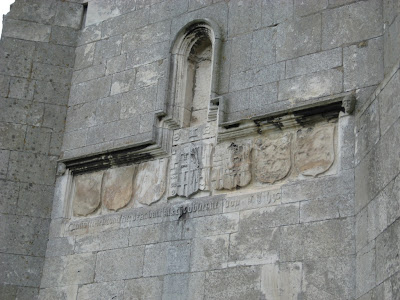
There is a veiled memorial to the Pilgrimage carved on the church tower. In 1535 the tower fell down and was rebuilt in 1536 by Robert's brother Christopher. The inscription reads: "I, Christopher, should remember this year, 1536".

The view east from the church looks towards the river Derwent and beyond, towards York. All is peaceful now and somewhat remote from the great cause that was entered upon in 1536/37 by Robert Aske. After the failure of the Pilgrimage its leaders were executed by Henry VIII. Robert was the last to be executed; he was hung in in chains York in 1537. Perhaps the Manor was deserted by the rest of the family, perhaps it was sold off or dismantled being regarded as the house of a traitor. Reading about Robert Aske's part in the Pilgrimage of Grace leads me to think that he was a good man fighting for a very difficult cause in a noble way. After all, Thomas Percy, who lead the Northern Rising in 1569 and was executed in York in 1572, is named amongst the Blessed.

Wednesday, 25 June 2008

Tuesday, 24 June 2008

New SJMV website

The Societé Jean-Marie Vianney, the association for Diocesan priests which both Fr Richard and I belong to, has a new website. At the moment only in French (I wonder who'll get the task of translating it into English!), but it's better than what went before. The Seminary of the Society in Ars has ordinations this week, so please pray for those young men who are being ordained priest or deacon there, as well as for those ordained deacon at Oscott College on Saturday last, and those to be ordained priest in the coming weeks.

The Eucharist - Christ in us

Certainly the best of the catecheses in English at last week's International Eucharistic Congress was given by the Bishop Luis Antonio Tagle, Bishop of Imus in the Philippines, on the theme of the Eucharist as our connection to the Paschal Mystery. He speaks on the nature of true adoration. Worth watching when you have a spare 50 minutes!


Eucharistic Unity and Ritual Diversity


The 49th International Eucharistic Congress in Quebec is notable for being the first International Congress at which the eastern Catholic Church has been not only represented, but also celebrated the Divine Liturgy. On Wednesday last week, the Byzantine Metropolitan of Winnipeg (yes, there is such a person) concelebrating with other Byzantine rite Catholic bishops, including my friend Bishop George, the Melchite Bishop of Tyre in Lebanon, celebrated the Byzantine Liturgy of St John Chrysostom. Because of the environment, this look quite different to a celebration of the Divine Liturgy in a church, however, it was good to remember that the Catholic Church is a communion of diverse ancient rites. What this celebration did for the Eucharistic Congress was to remind us that the liturgy is not something we do, and it certainly not entertainment. It is an entry into the mystery of Christ. Through the words and actions of the liturgy we enter profoundly into the mystery of the Trinity (represented by the three branch candlestick which the Bishop carries) and the mystery of Christ (represented by the two branch candlestick, being the two natures of Christ). This is something which the Holy Father reminded us of in the homily at the close of the Congress - more about that later.

Here are a few videos of the celebration. Firstly, the preparation for the Gospel:


Here is the homily by Mgr Lawrence Huculak:


And the cherubic hymn:

A new start in Hammersmith

Vocations Discernment Community for Men.
The purpose is to give young men, aged 20-36, a year (September – July) where they can learn about priesthood and the various forms of religious life, and come to some conclusion about where God may be calling them. It is for men who are aware of God’s calling but are not sure how specifically to respond, or who need some time for personal or academic development.
Pattern of life: During their year in community they can be working full-time in normal jobs or doing voluntary work or in studies. Meals and prayer (morning and evening) will be in common. We will try to have Mass together also. In the evenings there will be talks, prayer and discussion groups. Weekend activities will include retreats (both giving and receiving), trips, and experience of actual religious life.
Social activities will be part of the mix, as will free time.Types of input: We will have members of different religious orders and diocesan priests come and give talks. There will be input and discussion on the various forms of calling. The members will individually spend two or three weekends in religious or diocesan households. We will participate in and collaborate with other vocation-related initiatives.
Personal development: We will encourage pastoral development through having the members run prayer and discussion groups, weekend retreats, and social activities. Some might need to catch up on A-levels or learn about basic Christianity (e.g. Maryvale Catechism course). Others might need help with personal issues. We can supply some psychological counselling. We would encourage spiritual direction. There will be talks and discussion on sexuality, celibacy and other relevant areas. The main intent is that at the end of the year the members will be enabled to move in the direction they have discerned.
Location and start: Hammersmith, London on 28 September.
Cost: £90 per week (negotiable) to cover food, utilities, occasional trips, speakers’ expenses and resources. Depending on circumstances we could partially subsidise the year.
Contact: Fr. Stefan Park OSA. Mobile: 07789 872715 parkstefan@hotmail.com

Monday, 23 June 2008

A real Eucharistic festival


I'm just back from the 49th International Eucharistic Congress in Quebec City, Canada. It has been a real festival of Catholic faith in the Eucharist. I can't say it any more simply than that. It was a tremendous week, despite my forebodings, based upon my experience last year. The liturgy was very much shaped by the Holy Father's desire for the reform of the reform. It is the first international Catholic gathering that I have been to where Mass each day included Latin in the Canon and plain chant ordinary (and not just Missa de Angelis either), for example. For an event taking place in such a secular environment, it was quite impressive, and can only have a beneficial effect on the Church in Quebec. I will post more stuff in the next few days about the content of the catecheses, etc. Just for now I'll share a video of the procession of the Blessed Sacrament leaving the opening Mass to be taken to the place of adoration. The monstrance is slightly strange in shape and material (wood was used), but once you get beyond that the experience of being at this tremendous event comes back to me. The applause is for the Eucharist - you can't stop the Latin Americans showing that sort of appreciation for the Eucharistic Lord. And it was infectious.

Sunday, 22 June 2008

A great day

This image of the rebel Cardinal, St John Fisher, hangs in the cell in the Bell Tower which he vacated this day, 1535, being executed on Tower Hill at about 9.00am. He was then the only Bishop in the realm to stand up for the truth of the Gospel. What a singular act he undertook - making of himself an outcast in the sight of society and having his head struck off in public view. Although his head was placed on a pole upon London Bridge, the King was so incensed by the witness of this one bishop that he ordered his naked body be left to the public view upon the scaffold throughout the day.
But this was the way in which the Church was called to become visible on that day, and through the life and death of Bishop John Fisher the mission of the Church has been renewed in this island.
We are indebted to St John Fisher for his life and witness; we are full of wonder at the greatness of God's plan for us, and on this feast day we seek to embrace God's plan for the Church in this age. St John Fisher, pray for us.

Saturday, 21 June 2008

A matter also for study

Now that the Roman Rite of Mass has two forms side by side it is important, I think, not only that these forms be celebrated but that they be studied.
A classic text which should be central to this is Jungman's The Mass of the Roman Rite. This great book, perhaps more than any other like it, speaks about how the classical liturgy developed and the significance of its elements.
Other necessary texts are Sacramentum Caritatis the recent Apostolic Letter of Benedict XVI which is a magnificent and over-arching presentation of the Liturgy to date, and which seeks to direct organic liturgical development.
Redemptionis Sacramentum is also a necessary document as it defines the reformed Rite of Paul VI, distinguishing clearly its genuine elements from false appropriations.
There are two other essential documents for today's study of the Liturgy: the Council's text Sacrosanctum Concilium which tells us how the Church wishes to embrace the Litugical Movement, and Pius XII's Mediator Dei which originally gave focus to the Liturgical Movement.
These are the texts we should be looking at and discussing today as we endeavour to enter into the Liturgy of the Church in this age. When you've got through this lot, get in touch and I'll give you another reading list!

Quebec Eucharistic Congress

Fr Julian has been taking part in the Congress as the Delegate of our Bishops' Conference and we look forward to him posting about it on his return. In view of this short video we hope he will return safely:

Thursday, 19 June 2008

English College annual reunion

On Monday and Tuesday of this week the Valladolid Association held its annual meeting in Bromsgrove. On the Monday evening we had the pleasant company of Ann Widdecombe MP who spoke to us, after dinner, about the role of Christians in Parliament. This shrewd and right-thinking lady was a delight to be with, entertaining us and teaching us much about the political culture of our times.
The following day we celebrated Mass together. The Silver Jubilarians were those who had been deacons when I first came to the College in 1982 - of these five only Alan, Greg and Frank had been able to come to this year's meeting. But it was a real joy to see them again; they had been very influencial in my year group - looking after us with particular care during our first year in the seminary.

As usual we celabrated the Mass of St Alban, patron of the English College, Valladoild, in the beautiful Church of the Sacred Heart in Droitwich.

Monday, 16 June 2008

Cooking for 80


Last Thursday, Birmingham University CathSoc held its annual dinner at Newman House and again invited me to cook the meal. The members of CathSoc and the wider chaplaincy are a very fine body of students, and it was a great joy and privilage for me to be involved with their end-of-year dinner for the second time. Making such a meal for so many is indeed a part of the Culture of Life. Fr Julian is to be commended for the tremendous sense of the Church which he has helped to fashion among the students at the University.


We dined on Gazpacho, Roast Salmon with Tarragon Pesto, Fruit Salad with ice cream and rataffia biscuits. Special thanks to David who worked with me in the kitchen throughout the day.

Saturday, 14 June 2008

A worthy memorial

Fr Tim Finegan has posted recently on the site of the Tyburn in London near Marble Arch. The memorial, in a traffic island, is very simple and not at all evident to passers by. The traffic island is presently being refashioned and we wait to see how the new site will appear. In York, however, the site of the Tyburn at the side of the Knavesmire has long since had a worthy memorial. It was here that I offered Mass on Pentecost Sunday for good of our country in the face of the HFE Bill.

There are, of course, many other Tyburns throughout the country where the Martyrs were executed, and most are without memorial - Chester, Wrexham, Lancaster, Derby, Norwich and others. Perhaps we should do something about this, including offering Masses on these sites for the overturning of all Laws which are against life.

Pam in Leeds

Apologies for the short blog-gap; this past week has been an apostolic one - doing caetchist training in London, holding a culture of life film night with the Friars in Canning Town, and then cheffing for 80 at the Brum Uni CathSoc annual dinner.
However, during the previous week Pam Stenzel gave the "Sex has a price tag" talk at Trinity and All Saints Colleges" in Leeds. The talk, which was essentially giving the truth about the consequences of sexual intercourse outside marriage - facts which our culture witholds from us, was a real breakthrough into a culture where there is a silent monopolisation by falsehood. This was the first public talk concerning the subject of sex education, in its widest sense, that has taken place in the Leeds Diocese during my lifetime. It was interesting to note that Pam also gave her talk in two High Schools in the city of Leeds during her visit - both of them State schools.
The sixty or so people who came from across the north for her "Trinity and All Saints" talk were very enthused; it is hoped that Pam will return to speak in Catholic High Schools in the Diocese too!
Special thanks to Christine who was at the heart of organising Pam's visit to Leeds.