You are invited to take part in a Day of Mission, under the patronage of Our Lady of Lourdes, in my parish next Friday, 18th May. St Patrick's Evangelisation School in Soho are coming to Huddersfield and we have planned a schedule for Friday:Friday, 11 May 2007
Day of Mission.
You are invited to take part in a Day of Mission, under the patronage of Our Lady of Lourdes, in my parish next Friday, 18th May. St Patrick's Evangelisation School in Soho are coming to Huddersfield and we have planned a schedule for Friday:Well anchored.
Thursday, 10 May 2007
The right direction.

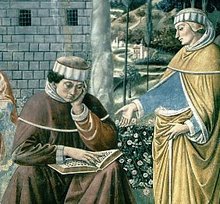
Last Sunday the Holy Father, while visiting the Italian city of Pavia, where St Augustine's relics are venerated, spoke of the three decisive conversions of this saint.
His first conversion was "the inner march towards Christianity, towards the "yes" of the faith and of baptism." "He desired to find the life that was right and not merely to live blindly, without meaning or purpose." He accepted the humility of faith "which lays down its self-important pride and bows on entering the community of Christ's Body." This is the conversion we remember him for when he gave up his pagan roots and became a follower of Christ. The Holy Father goes on to speak about further huge conversions in his life after being baptised and ordained to the Priesthood.
As a newly baptised Christian, Augustine had wanted to lead a contemplative life and dedicate himself to meditation in solitude. But the people of Hippo forced him to become a priest in order to serve the city of Hippo. Now he had "to live with Christ for everyone. He had to express his sublime knowledge and thoughts in the thoughts and language of the simple people of the city. The great philosophical work of an entire lifetime, of which he had dreamed, was to remain unwritten." "Instead, we have been given something far more precious: the Gospel translated into the language of everyday life and of his sufferings." As a priest he underwent this second profund conversion: "to be available to everyone, time and again, to lay down his life for Christ so that others might find him, true Life." This second conversion was a particularly telling conversion for a priest to undergo. But this is not all ...
A third conversion happened after twenty years as a priest. At this time Augustine wrote his Retractions "in which he critically reviewed all the works he had thus far written." "Augustine had learned a further degree of humility - not only the humility of integrating his great thought into the humble faith of the Church, not only the humility of translating his great knowledge into the simplicity of announcment, but also the humility of recognising that he himself and the entire pilgrim Church needed and continually need the merciful goodness of a God who forgives everyday."
The way forward is not always clear, whether you are bishop, priest or layperson, but conversion is always the right direction.
St Augustine of Hippo, pray for us today.
Wednesday, 9 May 2007
Islands, oases and great stretches of land.
Since a consumer culture exists that wants to prevent
us from living in accordance with the Creator's plan, we must have the courage
to create islands, oases, and then great stretches of land of Catholic culture
where the Creator's design is lived out.
Tuesday, 8 May 2007
So long, farewell, auf wiedersehen, goodbye
So, farewell Bishop John Crowley. I read on the Bishops' Conference Website that the Holy Father has allowed the Bishop of Middlesborough to step down because of ill health. I don't wish to make any value judgements about the retiring incumbent. But let us pray for the appointment of a courageous and visionary new Bishop. It's about time England had a diocesan bishop who was significantly different from the gentlemen's club don't rock the boat too much type we are used to.
Exam prayers
So if you have exams - or anyone you know has some - just click on the date on the right when they have the exam (or essay deadline) and in the combox add your intention for prayer. These will be remembered at Mass and Adoration each day, and also be in the prayers of other Christian societies too.
Vocations promotion???

I must agree with Dave Walker, the cartoonist, that the vocations promotion stuff that came out for Good Shepherd Sunday has not exactly hit the spot. I was so appalled by the type of imagery - I understand that 'manga style' is something Japanese - that I chucked the posters in the bin. They didn't strike me as something that would engage anyone over 12, never mind sophisticated (sic) University students. Dave Walker says this on his website:
"I can see why they are only targetting it at 10 year olds - 8 or 9 year olds just wouldn’t be suited to being in a religious order at all.Dave also criticises the Bishops' Conference website, and I quite agree:"The cartoons are in a ‘manga’ style apparently. I don’t really ‘get’ manga, but then I don’t get lots of things because I am old. I have to say I like the stories of real people on the website, but the poster doesn’t really make me want to look at the website in the first place as it doesn’t give me any idea what it is about."
"As an aside, the Catholic Church website in England and Wales must be the worst religious website in the UK. I can’t look at most of it because the menus quite simply don’t work. It might just be Firefox they don’t work in, but I’m not about to fire up Internet Explorer to find out in case I break something."It's about time we really got to grips with communications. Maybe if we had something decent to put out there people might give more to the Catholic Communications collection.
Back with the Blog
Sunday, 6 May 2007
An Easter Garden Party
Friday, 4 May 2007
A great day.
Today is a great day for England and Wales; it is the Feast of our Martyrs. There are forty two Canonised and about two hundred and fifty Beatified Martyrs. The site of the Tyburn in London, one of many throughout the country, at which so many men and women gave their lives for Christ and the Church is a sign of their witness - these men and women spoke for the truth about our country: it is a land which is called to bear the mark of Christ and the Gospel, and it is the Dowry of Our Lady!Thursday, 3 May 2007
God has been faithful during the past 39 years.
The gift of love and its fruits have been received and rejoiced in by a countless multitude. If we look back to the year 2000 we remember how twenty seven million people passed through the Jubilee Holy Door in St Peters - a sign of humanity's indebtedness to grace and the universal call to respond to God's love by living it in holiness.
How can we, next year, celebrate the Encyclical "Humanae Vitae" of Paul VI? Have you read it? I ask especially, spouses, married people to consider in what way we might celebrate the truths which Paul VI taught, and express our own confidence in the teachings of the Church about human sexuality. The Civilisation of Love is called to honour God, who for the past 40 years, during which so much truth has been rejected, has been a faithful and loving Father to us all.

Paul VI promulgated this Encyclical in 1968 in response to the question about the use of contraception between spouses. In it he describes the nature of human love, the nature of responsible parenthood and teaches that the use of contraception between spouses is always wrong. This teaching has been largely rejected both inside and outside the Church, but for those who have embraced it, the blessing of the Civilisation of Love has been given. "Humanae Vitae" is a prophetic teaching.
Wednesday, 25 April 2007
Tuesday, 24 April 2007
I'm going fishing. We'll come too!
Fishing with nets was an extraordinary and poignant experience for a priest - especially just after Easter! And it is a great blessing for a priest to know a fisherman (with a boat).
Saturday, 21 April 2007
Christ alive in Huddersfield
Sunday, 15 April 2007
Step in
I lived in this world of ours totally cut off from God because the divinities were dead and God was not visible. And in seeing Christians I thought: it is an impossible life, this cannot be done in our world! Then, however, meeting some of them, joining their company and letting myself be guided in the catechumenate, in this process of conversion to God. I gradually understood: it is possible! And now I am happy at having found life. I have realised that the other was not life, and to tell the truth, even beforehand, I knew that it was not true life.
Saturday, 14 April 2007
A true road
The advent of calendars with photographs of priests who look like models is not something for us to be too flippant about. Priests rarely get a good press from the pagan media and if we want to see priests in a good light then we must look beyond the images which our culture promotes.Thursday, 12 April 2007
Days of faith
Monday, 9 April 2007
Easter Monday
Now that we have been witnesses of Christ's work during these days of the celebration of the Paschal Mystery, we are called to climb out of the darkness into the Light of Christ. There is so much in our culture to suggest that Satan has the upper hand - in the oppression of truth and the rejection of the Gospel - yet, everything now belongs to Christ. These are some of the Holy Father's word taken from his Easter Message:Dear Brothers and sisters, through
the wounds of the Risen Christ we can see the evils which afflict humanity with the eyes of hope. In fact, by his rising the Lord has not taken away suffering and evil from the world but has vanquished them at their roots by the superabundance of his grace. He has countered the arrogance of evil with the supremacy of his love. He has left us the love that does not fear death, as the way to peace and joy. “Even as I have loved you – he said to his disciples before his death – so you must also love one another” (cf. Jn 13:34).
Sunday, 8 April 2007
Easter
Saturday, 7 April 2007
Holy Saturday
Friday, 6 April 2007
The Cancer Hospice: A place of death in the Culture of Life
Just before she went in to the hospice at the beginning of the week I'd had a chat with Mandy, just me and her. There had been some moments of anxiety during her last days in hospital before going to the hospice, but she shared in that conversation her deep faith in God and his love. And she was looking forward to seeing dad again.
I'd just like to share my reflection on the hospice itself. I know that the Douglas Macmillan Hospice - like all cancer care hospices - is trying to get away from the image of being a place you go to in order to die. These days they offer day care, respite care, and many other services which help in the palliative care of cancer sufferers. But the experience of our family has been that of the hospice as a place to help in the last days of life. You might think that a place like the in-patient unit of the hospice would be a sad and mournful place. It is after all a place of death. But this is not the case at all. It actually more resembles a rather nice hotel - or better still, an extension of home. Unlike a hospital with visiting hours and the rather clinical environment, the hospice is a place where families are welcome, everyone is treated with respect and generosity and even love. There is something particularly special about the members of staff who work there - doctors, nurses, and other staff - such that they demonstrate a deep respect for the dignity of the dying person. This is not the false dignity of the culture of death, which seeks to preserve dignity through mercy killing. This is the true culture of life, respecting the person and every dimension of their life, in the midst of their human weakness and suffering. Some people imagine that the drug regimes in hospices are there not only to make the last moments of life pain free, but also to help that last moment come. This is evidently not the case. Indeed we can be assured by palliative medicine specialists that keeping patients pain free is more likely to keep them alive longer than otherwise.
In these days I reflected on what it must have been like to die with the more excrutiating forms of cancer in the days before palliative cancer care. I can't even imagine what that 'last agony' could have been like. I am therefore very thankful to the hospice movement, begun by Douglas Macmillan back just under 100 years ago, which now results in such fine care being given to cancer sufferers in their last days. I am grateful that, in the middle of a society which is so marked by the culture of death, the culture of life is alive and well in these well-respected and valued institutions. Of course pain and suffering united to Christ is redemptive, and the Church recognises that. But the Church also tells us that:
Even if death is thought imminent, the ordinary care owed to a sick person
cannot be legitimately interrupted. The use of painkillers to alleviate the
sufferings of the dying, even at the risk of shortening their days, can be
morally in conformity with human dignity if death is not willed as either an end
or a means, but only foreseen and tolerated as inevitable Palliative care is a
special form of disinterested charity. As such it should be encouraged. (CCC 2279)
Finally, I'd like to pay tribute to my dear sister, Amanda Louise Buxton, who was always called Mandy by everyone. She was a devoted wife and mother, and a great influence for good in the lives of many young people as a scout leader for 20 years. Her 49 years may be short compared to average life expectancy but she achieved so much, and especially in the last nine years since she was first diagnosed with breast cancer. I know she had great faith and love in her heart, and that these are what the Kingdom of God are made from. I thank God that in answer to so many prayers, she was freed from her initial phase of depression over Christmas, and that she was able to live these last weeks sharing her love with family and friends. I pray she may rest in peace, and I pray for my family.Good Friday
Today is both a good day and a bad day for friends of Christ. On the one hand, hardly any showed up, on the other hand Christ was forging his friendship with us in the most definitive way - he was giving everything to this friendship.We cannot conceive of immediately
living a life that is 100 percent Christian without doubts and without sins. We
have to recognise that we are journeying on, that we must and can learn, and
also, gradually, that we must convert. Of, course, fundamental conversion is a
definitive act. But true conversion is an act of life that is acheived through
the patience of a life-time. It is an act in which we must not lose trust and
courage on the way. (B16, 22.2.07)
Thursday, 5 April 2007
Maundy Thursday
What can we say about today - there is so much to say and so little of it suffices. I will say just a little. The Eucharist was utterly unexpected. Christ had already given himself to humanity by being born as one of us and we would never have expected him to give himself to us in the fullest way possible.
I'll make a few references to the Holy Father's letter "Sacramentum Caritatis" - we haven't had a document like this since Pius XII's "Mediator Dei"! After all the recent liturgial changes, after all the neccesary anthroplogy which JPII gave us and especially the Theology ofthe Body - which we need to insert more fully into our understanding of human matters, and his Eucharistic letters, Benedict 16th renews our understanding of the meaning of human life upon the basis of the Eucharist and its insertion into the Church and into the world.
"Since only truth can make us free, Christ becomes for us the food of truth." In the Eucharist uniquely, we are able to undertake the Life of Grace, the only kind of life we were ever destined to live. In the beginning, the Holy Father says, men and women were given "some share in God's breath of life", but in Christ we are made "sharers of God's inmost life". We see this same dynamic most commonly taking place in the Sacrament of marriage and in those who enter into a genuine natural marriage. That two people enter into one another's lives in a mysterious yet personal way, and in so doing they begin to live in a new way - they live a life of communion.
We had "forgotten" our primary purpose in life - we were to live for God and with God. The gift of Christ's body and blood, a gift which would bring forth the gift of his Holy Spirit, makes possible the same, but greater, dynamic which can be called "friendship with Christ", but which is more properly called the Life of Grace. "The Eucharist draws us into Jesus' act of self oblation ... we enter into the very dynamic of his self-giving." And here the Holy Father draws on an image he used at the Cologne World Youth Day; the Eucharist, he says, introduces into creation "a sort of nuclear fission ... which penetrates to the heart of all being ... to the point where God will be all in all." This is indeed the great mystery upon which our lives are built, directed and filled.
There will be opportunities in later postings to comment on the massive treatment which the Holy Father gives to the Liturgy in this letter. Here, I would like to note that with this document he is paving the way for the "reform of the reform". In the third paragraph a simple sentence states the whole principle of this reform: "Concretely, the changes which the Council called for need to be understood within the overall unity of the historical development of the Rite itself, without the introduction of artificial discontinuities."
Well, here we are - at the very threshold of the Church's celebration of the Paschal Mystery, the hinge of our lives, our spritual lives, our moral lives, our social lives, our family lives, our work and our intellectual lives. The world will seem to stop as we open ourselves to the decisive action of the Blessed Trinity in human life.
Wednesday, 4 April 2007
Spy Wednesday

remain enslaved, exploited and
stripped of their dignity; others are victims of racial and religious hatred,
hampered by intolerance and discrimination, and by political interference and
physical or moral coercion with regard to the free profession of their faith
.... those who are misled by facile prophets of happiness, those who struggle
with relationships and are incapable of accepting responsibility for their
present and future, those who are trapped in a tunnel of loneliness and who
often end up enslaved to alcohol or drugs .... what are we to think of those who
choose death in the belief that they are celebrating life?
Such is the picture that Judas and secular neo-pagan culture gives to us, and in the midst of this Christ is filling his followers with light, the light of grace. If we have been "doing our homework" this Lent then we should be choosing Christ with enthsiasm and love - ready to stake our lives upon God's plan for us and for the world. The alternative to choosing the culture of death is to want Christ.
In our own lives we may be poised between choosing good or evil, between life and death, yet in the depths of our hearts we know that we need to be saved. The directions and directives of our post-modern society will not help us to choose, just as the authorities in Jerusalem were incapable of helping Judas, but Christ is totally available to us and the Life of Grace is one step away.A community saved by Christ. This
is the true nature of the Church, which draws her nourishment from his Word and
his Eucharistic Body .... knowing that the One she proclaims takes away nothing that
is authenically human, but instead brings it to fulfilment. In truth, Christ
comes to destroy only evil, only sin; everything else, all the rest, he elevates
and perfects. Christ does not save us from our humanity, but through it; he
does not save us from the world, but came into the world, so that through him
the world might be saved. (B16, 25.12.06)
Tuesday, 3 April 2007
Prayers please
Holy Tuesday
Today our attention is directed by Our Lord to the nature of our own discipleship. Even though, at this part in the week, Our Lord was teaching everyday in the Temple in Jerusalem the Gospel focusses on the Apostles themselves and the only indication we have about what was going on within the apostolic group comes from St John's narration of the Last Supper.
We should pray for priests, those who are like Christ, brother, father and spouse, that their friendship with Christ will be everything to them. The few Masses that remain to us this week must now be moments of intense trust in Christ and prayer for the loyalty of the Church.Monday, 2 April 2007
Holy Monday
We are moving in dangerous times; the truth which God wants us to know, live by and hand on to others is already reckoned by our society as inappropriate and we are at the threshold of this truth being unlawfull. The laws which we used to hold to about marriage and the way in which men and women relate with one another are not arbitrary laws because they are laws from God. Sunday, 1 April 2007
Holy Week begins
Thursday, 29 March 2007
Claire Short at Hinsley Hall

Hmmm. Sometimes I feel like a fish out of water. For most of this week I've been at Hinsley Hall - the pastoral centre of the Diocese of Leeds - for a meeting of the National University Chaplains group. I don't want to give a whole report on the meeting. I have to say I found it difficult. Anyone who has read this blog at all knows something of my understanding of priesthood, the Church, the mission of the Church, and key moral issues. It's easy, as a priest, to presume everyone else who calls themselves 'Catholic' more or less believes the same things, especially if you get involved in movements and organisations which are pretty well attuned to where the Church is today. Well, it was a little bit of a shock to the system to be transported back to some of the attitudes that were around when I was in seminary. Although not stated, these are some of the things I picked up (not in everyone I hasten to add):
- Priests not concelebrating Mass because it's not important to them to celebrate Mass every day, and moreover not wanting to offend women who were there as it would remind them that they cannot be priests.
- 'Spirituality' being a rather disincarnate search for another plane not really connected to the person of Christ or the spiritual tradition of the Catholic Church.
- The ultimate importance of counselling and psychology in the Christian life almost in place of grace.
- The ministry of a non-ordained 'chaplain' is much the same as that of a 'priest chaplain'.
- Life as continuous stress which needs to be dealt with.
- The centre being me rather than Christ, and my needs before those of the ones I serve.
- The need to pat ourselves on the back for all we have done.
Let me not be unfair. I like a maverick. I like the way she does say what she thinks. Though one has to be rather circumspect when such a person remained in a government during a war which she characterises as evil. But it offends me that such a person (who is honest enough to call herself a 'cultural catholic' and, although going to Mass with her mother each week, does not go to Communion, which is at least an honest position) is treated with near uncritical adulation by Catholic University chaplains, who should be at the cutting edge of the dialogue between faith and culture, and leading the moral intellectual crusade against the culture of death. I pray for Claire Short. I pray more for our Universities.
Archbishop Couve de Murville's Silver Jubilee of Episcopal Ordination
One thing is certain: during Archbishop Maurice's episcopate, there were always plenty of stories connected with the Archbishop doing the rounds. It was an interesting time in the Archdiocese. Never one for holding back from saying what he was thinking, there were always gleeful - or exasperated depending on you point of view - stories being told about him and what he had said, no doubt some of them apocryphal. He had a great esteem for the history of the Catholic Midlands, and did all he could to restore and preserve the patrimony of the Church in this Diocese. He also sought to care for the spiritual and catechetical patrimony, often setting him against the other bishops. One bishop (who is now dead, but shall remain nameless) that Archbishop Maurice often found himself isolated at the Bishops' Conference, but he always stood by his decisions.
I have utmost admiration for Archbishop Maurice Couve de Murville. He certainly made life interesting. He was the Archbishop who interviewed and accepted me for seminary, who sent me off to Valladolid, who ordained me first deacon, in Spain, and then Priest, in my home parish, and then sent me to do further studies in Salamanca. Yes, he had his problems in this Diocese, and sometimes quite public ones, but as a man, although he might seem insensitive or brusque at moments, I saw him as a deeply committed and caring man who looked after the Diocese in a unique but fatherly manner. At least life was always interesting!
It was only right to celebrate with a solemn Mass in St Chad's Cathedral the 25th Anniversary of Archbishop Couve de Murville's Ordination as Bishop. Archbishop Vincent Nichols preached the homily (in the photos you can see that he presided from the cathedra in choir dress, while Archbishop Maurice celebrated the Mass, concelebrated by the Auxiliary Bishops) in which he spoke of the beauty of the Feast Day (the Annunciation) and the dignity of the office of bishop. It was a shame that Archbishop Maurice - who seemed a little uncertain and in need of orientation at times - did not speak at the Mass. But a Mass offered is the final word - the Incarnate Word of God made present.
For Archbishop Maurice's pedigree see here.
Wednesday, 28 March 2007
Being a leader
Lord, help us all to judge human
conduct rightly, based on the solid foundation of truth, enlighten us to know
the true value of actions and the solid criteria for evaluation. Help us to
distinguish good from evil, even where the social environment, pluralistic
culture and superimposed interests tend cloud our vision. And support with your
grace, all those who right now have engaged their consciences to live in truth.
Amen.
Tuesday, 27 March 2007
Reparation in Spring
Thursday, 22 March 2007
E-pilgrimage on suffering
Wednesday, 21 March 2007
Friends with Christ London Retreat
Just for fun - find out if you're in the right religion
Deploying the Gospel
Sacramentum Caritatis I
Right at the beginning of the document, the Pope says that the Eucharist makes present Christ who "laid down his life for his friends". The Eucharist is not an impersonal presence of Christ. It is the person of Jesus Christ, whose motivation in dying for us was in order to show himself as our friend, and to bring us from being mere servants, to enjoying a true friendship with him. The Eucharist is not the dead presence of Christ. It is the dynamic loving presence of Christ made present for us. The dynamism is such that the Eucharistic presence is an active loving presence of Christ who is loving us from the Eucharist. We experience this love in our lives when we receive Christ sacramentally, or when we bow in adoration of his Eucharistic presence.
This friendship with Christ, which is caused by the Eucharistic presence, is a friendship which has the purpose not only of building us up in faith, but of spurring us on to mission. Look at number 84 of the document:
In my homily at the eucharistic celebration solemnly inaugurating my Petrine ministry, I said that "there is nothing more beautiful than to be surprised by the Gospel, by the encounter with Christ. There is nothing more beautiful than to know him and to speak to others of our friendship with him." These words are all the more significant if we think of the mystery of the Eucharist. The love that we celebrate in the sacrament is not something we can keep to ourselves. By its very nature it demands to be shared with all. What the world needs is God's love; it needs to encounter Christ and to believe in him. The Eucharist is thus the source and summit not only of the Church's life, but also of her mission: "an authentically eucharistic Church is a missionary Church." We too must be able to tell our brothers and sisters with conviction: "That which we have seen and heard we proclaim also to you, so that you may have fellowship with us" (1 Jn 1:3). Truly, nothing is more beautiful than to know Christ and to make him known to others. The institution of the Eucharist, for that matter, anticipates the very heart of Jesus' mission: he is the one sent by the Father for the redemption of the world (cf. Jn 3:16-17; Rom 8:32). At the Last Supper, Jesus entrusts to his disciples the sacrament which makes present his self-sacrifice for the salvation of us all, in obedience to the Father's will. We cannot approach the eucharistic table without being drawn into the mission which, beginning in the very heart of God, is meant to reach all people. Missionary outreach is thus an essential part of the eucharistic form of the Christian life.
More to follow on the document, as I digest it...
Communion of Saints
No I've not disappeared. Days have gone by without posting anything, but it's a mix of not having inspiration to write and being especially busy at the moment.Just during the last couple of weeks, one thing which has impressed itself upon me is living in the communion of saints. I often look to certain saints for intercession, but it's only in looking back that one can often see the effect of trusting oneself to their intercession. I'd just like to bear witness to the particularly powerful effects that I have seen in the past few months of the intercession of Our Lady of Guadalupe and St John Mary Vianney.
When I was in Guadalupe last August, I had the opportunity to spend about an hour in prayer before the image of Our Lady. I went through a whole lot of things in my mind - doing the talking - but it was in listening that I heard like a voice speak to me in my head "Go to confession". And the more I prayed, the more I heard it. Since then I've made sure that confession isn't a hit and miss affair, but a regular and frequent element of the spiri
tual life and this has borne huge fruit and strength.St John Mary Vianney has been particularly influential on me too. You only have to read the posts we've already put on here about the SJMV to know that. I attribute to the intercession of the Curé of Ars my being here at the University as chaplain, as the offer to come here came just a week after making an act of abandonment to the divine will at Ars. When I was in Ars with Fr Richard recently I had the inspiration also to open my flat and the adjoining flat up and to use the space to bring together a discernment community. I am hoping that we may have two or three young men here next year living with me at Newman House, with daily prayer and a regular life together as a support for discerning God's will. Please pray for this initiative.