Wednesday, 13 October 2010

A new statue of the great martyr


On entering the grounds of Campion College in Sydney, the visitor is now welcomed by two statues; to the left, the older statue of St Peter Chanel whose mortal remains were once held on the site, and to the right, a newly made statue of St Edmund Campion. This striking image of the saint now holds a worthy position in the College grounds.
What a great model he is for us today, and especially for the people of Great Britain. Campion stands out precisely because he did not simply follow the prevailing culture of his day, but rather, from the midst of a so much change and confusion, he looked to build his life upon the genuine foundation of Christ, even at great cost to himself. He sought a formation that would really build him as a Christian man, a man who was surrendered to God. And this seeking lead him to become a priest, and ultimately to give his whole life in service of the Gospel, even at great cost to himself. Ultimately he gave his life in service to Christ.
What great inspiration he offers us today, pointing us to Christ who live in today's context of change and confusion, to seek our true greatness in Christ. He shows that we can step beyond today's bewildered culture to take hold of the life of grace. How timely and how valuable are his story and his witness for us today, especially in England, that many may aspire to and embrace a genuine vision for buidling up the Christian life there, where once Christ was so loved and welcomed.

Monday, 11 October 2010

A recurring theme


Hardly a week goes by when the Holy Father does not speak about friendship with Christ. In his General Audience on 6th October he said that the "school of Christian life, of the straight path, which shows us that the center of a happy life, of a true life, is friendship with Jesus the Lord."
This friendship, the Holy Father said, "is learned in love for sacred Scripture, in love for the liturgy, in profound faith, in love for Mary, so that one will increasingly really know God himself and thus true happiness, the goal of our life."

Thursday, 7 October 2010

The Friars new mission in the Sudan


Fr Sylvester CFR who I worked with in Yorkshire has just been appointed to the new Friary in the Sudan where Fr Herald Brock has already begun their mission. Fr Herald was the very first friar of the Renewal who I met. He and I joined forces with the Youth 2000 group for Paris World Youth Day in 1997. You can follow their mission on a new Blog: www.cfrsudan.blogspot.com I am glad that these friars have been able to establish this Blog because they really are at the 'cutting edge' and it is good for us to have some idea about where the mission is in today's world.

Tuesday, 5 October 2010

A silent terror


Yes, the Salt Water Crocodile at large! The day after visiting the Reef, John and myself hired a self-drive boat for a few hours and, crossing the estuary from Cairns - some 200 mtrs - we encountered our very first wild croc.
It was lying still and silent waiting for some unsuspecting visitor to come within range. It was about 7 ft in length. Shortly after we spotted another one amongst the mangroves. Then suddenly, our engine packed up and we were drifting back towards our first croc! Fortunately, help was only a mobile phone call away and we were soon on our way again, eventually sighting a third croc further up the Trinity Inlet. We thoroughly enjoyed these our first sightings ever of this deadly predator. On average there is one fatal attack each year in Australia. Trinity Inlet then remained quiet and undisturbing for its two passing visitors in a light craft.

Sunday, 3 October 2010

Plunging into the Coral Sea

Of all the things that one can see and do in Australia, the one experience that so many Australians have said is top of the list is seeing the Great Barrier Reef. So, with a few days break from work I set off with John Pridmore, who is currently on a speaking tour in Australia, to the tropical north of Queensland in search of the Great Barrier Reef. We flew to Cairns and caught our first sight, from the plane, of parts of the Reef; turquoise and coral patterns glistening in the azure blue sea. We had three day trip and, on the first day, we booked on a catamaran to go out the next morning to the Reef. We left at 8.00am and had a journey of one and a half hours to the first location where we stopped to explore. It was at a part of the reef which is called Flynn Reef. The photo below shows some of our company preparing to snorkel.
A part of the reef if visible in the photo, just below the surface and reflecting back the light of the sun. Onboard I was loaned some prescription goggles and a snorkel. We entered the sea, which was an immensely pleasant 27C and set off to explore. Well, even now I find it hard to describe the experience or to describe what I saw. What I saw under the ocean's surface was beyond all expectations, and I found myself thanking God for the wonder which He had brought us to. We snorkelled for about an hour and a half before coming back onboard for lunch. The boat at this time took us to another location - Tetford Reef, where again we doned our snorkels and explored for an hour. There were sharks, three of them, maybe two metres in legth and maybe twelve meters away; we had been told not to worry about them so we didn't. I have been swimming with sharks! The second photo, below, I didn't take. Eventually we set of back to Cairns arriving about 4.30pm.
I first heard about the Reef way back in the early 70s on 'Blue Peter', but I never in my wildest dreams thought that I would visit it. The Reef is so beautiful that it is hard to take it in. And to be snorkelling in and around the various coral formations, with fish of all kinds going about their business, is a sheer wonder. I have to say that this visit to the Barrier Reef and seeing it in the way that we did, is the most wonderful experience that I have had. If I have the opportunity, I would certainly return.

Thursday, 23 September 2010

A new dialogue


Who among us expected that heart would speak to heart in the way which we have just witnessed. The Holy Father has spoken to Britain and Britain has engaged in a new dialogue. The Holy Father's encounters with the British people at large, with representatives of the State as well as with its Head of State, with the leaders of many Christian communities, with representatives of many religions, and with the Church in Britain; an encounter which, at each step, was thrown into relief by the mass media - yes, the Pope has spoken to Great Britain. Perhaps not since the time of Gregory the Great has such a thing taken place! And this dialogue has been illumined in the most providential way by the Beatification of Cardinal Newman. The Cardinal now stands as a grace-filled advocate for a New Evangelisation of Britain, and everyone who has been a part of the dialogue which the Holy Father has initiated is now placed to be a part of that Spirit-led movement which we call the New Evangelisation.


No one who looks realistically at our world today could think that Christians can afford to go on with business as usual, ignoring the profound crisis of faith which has overtaken our society, or simply trusting that the patrimony of values handed down by the Christian centuries will continue to inspire and shape the futue of our society. ... But each of us in accordance with his or her state in life, is called to work for the advancement of God's Kingdom by imbuing temporal life with the values of the Gospel. (Holy Father's address at the Vigil in Hyde Park.)
Yes, the Holy Father has spoken to Britain (the very place that proclaims the value of dialogue), initiating a new dialogue of faith and reason, and Britain has already begun to respond. A New Evangelisation is underway at last - and who among us could have imagined it. Only God could do this, and the Holy Father has been His intrument of grace. I can hardly believe what I have witnessed!

Tuesday, 21 September 2010

A new springtime of grace


The Holy Father's visit was a grace beyond all expectations; and how long this nation has waited for such a great grace. Perhaps the anti-Papal frenzy of the media helped to set the Visit in relief, or perhaps it was a deep and ancient longing of the British people, somewhat hidden, but suddenly released by the presence of the Holy Father. One thing was certain: the immense and spontaneous joy on the faces and in the hearts of a multitude, from Her Majesty to the casual tourist, caught up in this grace-filled encounter. I remember so well, a joy and an excitement that was hard to contain when John Paul II visited the UK in 1982; I was then twenty one.
Frankly, I am overwhelmed by the nature and content of this State Visit. I imagine that that is also the case for many back home in the UK. It will take me some time to re-visit the tremendous papalvisit.org.uk website and to contemplate the Holy Father's discourses on video. As for the Church in the UK, and for its society as a whole, I can only state the obvious; that nothing will be the same from now on. Even the 'neo-pelagian congress of Twickenham' was not unaffected by the presence and message of the Holy Father.
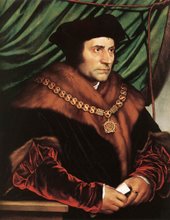
Before beginning to digest the the huge number of wide-ranging addresses of the Holy Father, I have to say that one address really stands out for me - the address in Westminster Hall. Again, it is hard to begin to appreciate the meaning of this event - the Holy Father, in the heart of the capital, speaking to the British establishment. And not only that, but he places before the citizenry of the UK the person of St Thomas More as a model of Britishness! And he invites us all to ponder the values of his witness to faith and reason, his witness to Christ; timeless values that anyone in any age can espouse to the betterment of the common good. How wonderful that this great Martyr of the English Reformation should be taken out from the devotional niche which has become his present-day place of honour, and has been placed again right of the heart of the public forum as a genuine point of reference for all the people of the UK.
I will, in due course, post again on the Visit, and I offer my own thanks to God for the extraordinary channel of grace that we have been given in the person of Benedict XVI. Thank you, Holy Father, for coming to the UK.

Friday, 17 September 2010

Ode to the United Kingdom


This, could I paint my inward sight, this were Our Lady of the Night; she bears on her forehead's lunacy the starlight of her purity: For as the white rays of that star the union of all colours are, she sums all virtues that may be in her sweet light of purity. The mantle which she holds on high is the great mantle of the sky. Think, O sick toiler, when the night comes on thee, sad and infinite. Think, sometimes 'tis our own Lady spreads her blue mantle over thee, and folds the earth, a wearied thing, beneath its gentle shadowing; then rest a little; and in sleep forget to weep, forget to weep!
(Our Lady of the Night by Francis Thompson)
No, weep not, for "the Kingdom of God is very near to you." With these words, Benedict XVI began his homily in Glasgow!

Wednesday, 15 September 2010

The two civilisations


It was in his Letter to Families that John Paul II contrasted the two civilisations which live side by side in the world today. The expression the "civilisation of love", he said, comes from the Second Vatican Council; that "Christ fully reveals man to himself and makes known his sublime calling." The Church is the herald and the promoter of this civilisation, and the family lies at its heart.

Another civilisation exists today, one which is linked to scientific and technological progress. It is agnostic in theory and utilitarian in practice. It is a civilisation of production, use and things, not of persons. In this civilisation, persons are objects for other persons, children and parents are a hindrance to each other. In this civilisation, the loss of truth about one's own self and about the family, leads to a loss of freedom, which leads to a loss of love.
The civilisation of use and things is embraced with particular vigour within the UK; excluding God and seeking success in whatever it decides to achieve. As Benedict XVI prepares to visit this island, I think of the visit of Gandalf to the Hall of Theoden in The Lord of the Rings; in the story Gandalf frees Theoden from the spell. May England be free to embrace the message of God's love which he brings, may England be free to embrace the Gospel.

Monday, 13 September 2010

Protecting the human embryo in Ireland

Thanks to Fr Sylvester CFR for this video. I first met Fr Sylvester at WYD 2002 in Toronto; subsequently he came to the Friary in Bradford where we did quite a bit of evangelisation together. He and the other friars are real trojans for the Gospel of Life.

Friday, 10 September 2010

A very reduced vision


Why is that there should be such anger shown towards the Holy Father from England? Leaving aside the question of whether this is a Media campaign or a widely held attitude from the people of the country, or both; the intensity of the invective against the Pope is quite surprising. Why?
I have been pondering this question from the other side of the globe as I have read some of the views which the Media has been disseminating. Now, I recall that John Paul II in speaking about contemporary secularism, once said that it arose from, what he called, a rationalist prejudice against the supernatural. In other words, rationalism has taken hold of so many people in this age, that they cannot admit even an enquiring mind, a mind that seeks to know, to love, to contemplate, to adore. In such a climate as this, the vision of what life is, is immensly reduced; rationalism and atheistic secularism have so reduced, clipped, trimmed, dulled and oppressed the soul of England, that it now lives in fear of its tiny world being shown up for what it is, and blown open by a greater vision of what human life is about. Today's anger springs from this fear.
What do I mean by the tiny vision of life which England has created for itself? Well, we see this in its extreme use of abortion and contraception, in its excessive focus on shopping culture, in the uncritical embracing of the media and media culture, in the un-thought-out rejection of the Christian life in favour of harsh and violent life-styles and moralities, and in its self-imposed individualism and culture of loneliness. How can human beings live in this culture? No wonder there is terrible anger and fear, now that a herald of the Kingdom of God is approaching.
What a tremendous grace then, the Holy Father's visit is; that in such an era of closedness and darkness, a light should shine. England's fear and anger arises, not from the Holy Father, but from its own inadequacy, its own self-imposed darkness. This is in no way a bad starting point - it's the real story of the human race - and this is why Christ came to us. The gentle herald of the Gospel who approaches will help England as best he can, to see a much greater horizon. England, step out from the darkness, see, hear, breathe and flourish!

Wednesday, 8 September 2010

Truth proclaimed


John Paul II, embracing the vision of the Council, taught the world how Christ saves man by enabling him to comprehend his true dignity and to live according to that dignity. This is what lies at the heart of all his teaching.

His first Encyclical Letter in 1979, Redemptor Hominis, was a proclamation of this vision. He taught that the central truth of man's life is the Redemption. In the Redemption God shares His life with man, and man is revealed for who he truly is.

The Church is the herald of this truth, and humanity, wherever it is found, and in whatever condition it is in, this same humanity is the place where the Church is called to go as a herald of the Gospel.

The New Evangelisation then, consists in embracing man's hopes and his anxieties and showing that they find their full response in Jesus Christ. Today's Christians are called to a 'Kingly' mission: service to Christ who uniquely reveals the full truth about man, and service to humanity which, although wounded by sin, is called to receive the healing love of God.

This in a nutshell is the message of grace of John Paul II in the midst of a world bewildered by secularism. Yet, alongside, there is a new generation which has received this message and welcomed it; the fruits are already beginning to ripen.

Sunday, 5 September 2010

Receiving the gift


Whatever happened to the Rogation and Ember Days? They were simply left aside by the Liturgical reform and still wait to be included into the celebration of the Christian life. This is the case in the UK, and in consequence, how impoverished and lacking in appreciation is our culture. In Australia however, one Ember Day is kept at the start of Spring and another at the start of Autumn.
Most of the world has seen a radical change in terms of life and progress. The preparation of the land and the sowing of crops, consigning ourselves to God's Providence, then the gathering in of the harvest and giving thanks to God for His munificence; these are now feint images from the past. Today, through the rise in prosperity for many nations and the acquisition of goods and utensils never before imagined, we are replete with material things of all kinds. But with our materialism has come an almost total lack of responsiveness to God; we neither depend upon Him, nor return to thank him.
All the good things we have today; not just food and drink, but our mobile 'phones, our broadband, our 'on suite' showers, our four-liter four-wheel drives and our airports of convenenience - these things are given to us, not for us to lose ourselves in, but in order to develop and perfect our humanity and that of our neighbour. We are all bound to the earth; the Church is bound to the earth, but this bond needs to be purified. It is purified and perfected precisely by not allowing ourselves to get lost in things, but to offer all the bounty of the earth to God.
How important were the Rogation and Ember Days, and how important in our material and profligate age that we reform our lives upon the basis of the gifts which the Creator bestows upon us, appreciating anew our part in preparing creation for its ultimate transformation. And by preparing ourselves for our ultimate transformation.
The old Liturgies of the Rogation and Ember Days can be found in the Liber Usualis. We need a renewed Liturgy for these today together with the development of a genuine human culture, recognising the Creator and the true meaning of His gifts to us. He gives us material and spiritual riches that we might become perfect in our humanity.

Friday, 3 September 2010

An icon of the realm


Congratulations to Edmund Adamus, Pastoral Director of the Westminster Archdiocese, for a very representative evaluation of many aspects of England today, as it awaits the visit of the Holy Father. His important discourse has been made available by Zenit; you can find it here. In the interview, he comments on the mosaic which stands above the entrance to the Cathedral; an image coming from the realm of faith, which expresses, symbolically, much of the truth about England which has been occluded in modern times.

Thanks also to Zenit for publishing this interview.

Thursday, 2 September 2010

What's up with men?

Jonathon Doyle has just launched a new blog which focusses on the essentials about men and masculinity; their identity and their mission. Jonathon is a leading agent in this field having already coverered much ground with his www.choicez.com.au . He and his wife, Karen, are very well known in Oz through their seminars and publications.

Sunday, 29 August 2010

A radical work in progress


During the past fortnight I gave a series of two talks to a group in Sydney on the legacy of Pope John Paul II. The first talk was an overview of his pontificate, and the second an overview of his thirteen Encyclicals. While preparing for the talks I was moved by the sense that, at the time that John Paul II had been giving the most extraordinary message of life and salvation to a bewildered world, I at that time was not amongst those who were hearing this message, but remember all sorts of very poltry considerations which I had been concerned with during many of those years.

The group I was addressing in Sydney these past two weeks numbered about sixty people and many of them confessed to me afterwards that they too had never really heard John Paul II's teaching - a teaching which was delivered in the most public, clear and straightforward way, across the globe, during a Pontificate which lasted twenty six years.

Now, there will be many reasons why Catholics have not yet heard the message that John Paul II gave us, some admissible, others very concerning. However, it is also the case that the world, in large part, either has not heard his message, or hearing it, did not heed it. States, nations, societies and cultures, are caught up today in the spell of secularism.

Our cultures today have emerged from that short era of rebuilding which engaged most of the world after the unimaginable devastation of two world wars. During, and immediately after, the second war, there was a hope that the West would have been rebuilt upon the foundation of the Gospel. But, as we are all now aware, once the 1950s was underway the movement of secularism was embraced with great eagerness. That movement is now in such full speight that the clarity and illumination of John Paul II's teaching, which makes available such a transforming power for individuals, communities, nations and the whole planet, appears now like a tiny glowing ember on an ice-flow.

Well, now is not the time to 'drop the ball'. It may be the case that the mass media is in the hands of a tiny but dangerous minority who skillfully direct, from hidden boardrooms, the various currents of secularism; that politicians, many of whom are self-styled atheists, find themselves on the front faces of unstable glaciers; that Market forces, having been unleashed, are now unworthy mentors, but the day is young. Yes, it may also be the case that many have never picked up this ball, but the legacy of John Paul II is very much with us. So, we should pick it up, run with it and hand it on. If you have never enquired into his teaching, then enquire. If you have heard or read some of it, read it again. Open it up, break into it, break it down and make it more and more accesible. Apply it. Teach it. Witness to it. John Paul II was immensely powerful in life; his power is greater now. Turn to him, enquire of him and ask for his intercession:
O holy Trinity, we thank you for having given to the Church Pope John Paul II, and for having made him shine with your fatherly tenderness, the glory of the Cross of Christ and the splendor of the Spirit of love. He, trusting completely in your infinite mercy and in the maternal intercession of Mary, has show himself in the likeness of Jesus the Good Shepherd, and has pointed out to us holiness as the path to reach eternal communion with you. Grant us, through his intercession, according to your will, the grace that we implore, in the hope that he will soon be numbered among your saints. Amen.

Wednesday, 25 August 2010

The road to Walsingham


The twelfth Youth 2000 International Prayer Festival at Walsingham, a four-day evangelisation event, under canvas, will begin this evening at Walsingham. The ancient Shrine of Our Lady, England's Nazareth, in Norfolk, is the venue for this annual event. It is presently the largest Catholic youth event in the UK bringing together over a thousand young people from all over the British Isles. The focus of the entire event is Christ's Eucharistic presence. If I weren't in the Antipodes I would be there. The above photo was taken at the event in 2005 showing the great body of priests who regularly take part in the festival. (Both the deacons in this photo are now priests.) May God bless this year's festival and cause a new flourishing of the Christian life in many.

Tuesday, 24 August 2010

Discovering the Council as the vision for the New Evangelisation


The two great documents of the Council are Lumen Gentium, which addresses the question, what is the Church?, and Gaudium et Spes, which addresses the question, who is man? In Lumen Gentium, it is the Mission of the Redeemer which is extended through history - to announce Eternal Life to the whole world. In Gaudium et Spes, the way in which the Church can address humanity is presented. It is not that the Church has the answer to all problems, but that the Church knows where truth can be found. The Council offers to the world the wisdom about man revealed in the person of Jesus Christ.
What is the world's view of the Church? First, the world believes that there is only an accidental collaboration between itself and the Church becuase the two have different goals. For the world, human work has no transcendental value and one's relationship with God takes place only in a private 'religious' ambit. Secondly, the world regards human development as the 'coming of the kingdom', and thinks that the Church should (keep quiet, or) put all its efforts into constructing the 'kingdom of man' on earth. The Church however, sees herself right at the heart of the world, but holds a radically different attitude. For the Church, all human actions will be fulfilled in Heaven, and the Kingdom of God is transcendent in history.
How does the Church see human development? By the acquisition of a way of living which is proper to man, in both temporal and spiritual dimensions. Human development does not happen automatically, but by the way in which we contribute to the betterment of this way of living. Not all development can be called good, but must be judged according to the truth about man.

Monday, 23 August 2010

The great movement in the world today


The Church today senses that the Gospel has not reached modern humanity and the new structures of modern society. The Faith seems to have lost its vigour and what is needed is a new systhesis of faith and culture. The Gospel needs to enter into dialogue with culture in order to evangelise it. This is what the Second Vatican Council speaks of, laying out the broad brush strokes for the New Evangelisation.
The Council taught that dialogue between faith and culture takes place first of all in the hearts and minds of Christians, who are citizens of both the spiritual and temporal cities. But, this dialogue does not happen when Christians either do not understand the culture or do not have a sufficiently formed Christian faith. The problem today is that Western culture has been de-Christianised so much that Christians are not sufficiently evangelised themselves to be able to engage in real dialogue and to form a culture which is inspired by the Faith.
Nevertheless, the Mission of the Church is to all people, forming a communion which is a reflection of the perfect society that will exist in Heaven. The Redemption restores man's unity with God and therefore so too, the communion of the human race. Thus, catholicism declares that there is nothing in the world which is set outside the saving Mission of the Church.

Thursday, 19 August 2010

An unexpected party


In 1989, the year after I was ordained, I received an invitation from the Lord Chamberlain at Buckingham Palace to attend her Majesty's Garden Party that July. For the occasion I borrowed a top hat and frock coat. The photo above was taken in the evening of that day in Feltham; sadly it is not a good photo, but it is the only photo that I have dressed in the said garb. It's not often you see a Catholic priest dressed like that, but I do have photos of my uncle who was a Jesuit walking on procession through the streets of Manchester and Preston in the 1950s wearing top hat and morning coat.

As for the Garden Party, it was tremendous; the Queen and Lady Diana were there. At one point I was quite close to the Queen, she looked my way and smiled. I doft my hat and bowed to her. She is exsquisite.

Tuesday, 17 August 2010

16th July 1988


As soon as I was given a date for ordination to the Priesthood, I realised that the day was a feast of Our Lady, Our Lady of Mount Carmel. I was very happy that I would be ordained on one of Our Lady's feasts. I was ordained priest in St Anne's Cathedral, Leeds, and this photo, taken a couple of days later shows something of the immense joy of the Priesthood which I was given. The photo was taken in the grounds of the Sacred Heart School in Kirkstall which I had attended as a child. But how much more marvellous it has been for me to have been brought close to, and conformed with, the Priestly Heart of the Redeemer. I am so glad that this photo was taken; it says so much about my identity and the identity of every priest.

Saturday, 14 August 2010

11th April 1987


A freshly ordained deacon steps into the Castillian sunlight. This photo was taken moments after the diaconal ordination Mass at the English College, Valladolid. After nearly five years of priestly formation in the seminary, I was ordained deacon by Bishop Kevin O'Brien of Middlesborough, on 11th April 1987. Up to that time, this day was the happiest in my life. The old spanish vestments, which we borrowed from the Cathedral in Valladolid for the occasion, mirrored the wonder which I felt inside and, in some way, expressed the gift which Christ made of himself to me on that day.

Thursday, 12 August 2010

A good step

At least, I hope this is a good step forward; a Catholic Radio Station for the Holy Father's visit to the UK in September. The Papal Visit Radio Station (www.heartgivesuntoheart.co.uk) will be broadcasting from 14th to 20th September from 7am to midnight. A Catholic Radio station has long since been appropriate, indeed, I tried to inaugurate one in the late 90's, briefly establishing the "Catholic Broadcasting Network" through a wide range of contacts at home and abroad. Sadly, it didn't get off the ground.
The Holy Father's visit is an extraordinary grace and we should be open to the momentum which such a grace can create in the Church. And should pray earnestly that the Church will be ready for the visit and be ready to respond to the grace. A Catholic Radio Station broadcasting concurrently with the Visit is a tremendous opportunity. I do hope however, that this Station will not be another neo-pelagian project.
As an Internet Radio station it will miss some sectors of the population, sectors for whom Radio holds an important place: the elderly, drivers and prisoners. This is a reason why we could really benefit from Catholic Radio that has a territorial frequency. One step at a time ...

Wednesday, 11 August 2010

En anglais


Just a quick post to point something out which happened about a year ago and which may be of interest to some readers. The St John Vianney Society added a page in English to its website; follow this link www.sjmv.net/spip.php?page=sommaire-en. I am very pleased about this small development because I can now direct non-french-speaking enquirers to this page. I am very pleased too, that more people should know about this priestly movement at the heart of Europe, of which I am a member.

Tuesday, 10 August 2010

What if ...

What if you learned that in the Church there was a group of people who were were looking, in a commissioned and dedicated way, at how the Gospel and culture can come together, and to develop a vision for the life of the Church today which is based upon that dynamic; would you not be pleased? Just such a thing is taking place right now under the direction of the Holy Father who is inaugurating the Pontifical Council for the New Evangelisation.
So much then, for all those (Catholics) who say that it doesn't matter that people, and especially young people, have no idea who Christ is and who don't come to Mass, saying that these people will find their own route in life. And all those who say how good it is that so many, and especially so many young people, are unhindered by the Church and can give their time and energy to all sorts of social and environmental causes. Or those who applaud the new society; that instead of meeting and engaging with people in essential and apostolic ways, we can now text them and pubilcise ourselves to them on internet networks.

Is there a need for the Gospel to meet culture? Yes, there is. And it will only take place when Catholics accept this reality, and when the Gospel is presented to culture in an audible way.

How wonderful then, that the Holy Father is creating a Council to help engender and enable the Church's primary focus and mission. We should support with prayer, Archbishop Fisichella (pictured) and all those who will work with him, that the gentle, yet life or death, message of the Gospel might be the overriding message in the world today.

Monday, 26 July 2010

A new leaf

It is some months now since I heard about the demise of "Family Publications" of Oxford, however, I wonder if a campaign, or something similar, has been initiated to continue the mission of, arguably, the best Catholic Publisher in the UK. What a marvellous work "Family Publications" did; surely there is the possibility within the UK of taking up this work.

Sunday, 11 July 2010

Scene 2010

Tomorrow, the second Sydney Congress of the New Evangelisation begins. This week-long event, centred on St Mary's Cathedral in Sydney, is giving expression to the new direction being taken in the Church in response to the huge change in culture which has taken place in the world in the last 50 years. Full details on www.scene.org.au . If you are in town, get involved; give it whole-hearted spiritual support.

Friday, 2 July 2010

Invocation 2010

What a marvellous opportunity for Grace is being offered by the Church in England this weekend - Invocation 2010 - a vocations discernment event at Oscott College in Birmingham. I still remember the powerful Vocations Exhibition which was held at The Queen's Hall in Leeds in 1966 (just before everything went haywire). I gather that over 300 young people from all over the country are coming to Birmingham today for this event. Support it with loads of prayer!

Monday, 28 June 2010

Real evangelisation


The relegation of the place of virtue by secular culture is, arguably, one of secularisms triumphs. Secularism coincides with a diminishing of humanity, whose essential hinge is the nurturing and exercise of virtue - the inner power of genuine humanity. Secularism has changed the goals which humanity set for itself and allowed itself to be formed by. Celebrity, life-style and conformism are some of the popular aspirations. In such a context, it is well to remember humanity's ultimate goal - adoration of God.
Here, let us recall the essential mission of parents (and education) in forming, first children and then young people, to be able to adore God. It would be valuable here, time permitting, to look at the virtues involved in this genuine human project. However, let me just note that those who are today the principal recipients of formation, the hinge of culture and civilisation are today's parents themselves. Young people who are considering the married vocation, or those who are recently married are they who should allow themselves to acquire the very best formation for the life and the task which they undertake today in a bewildered age.

Wednesday, 16 June 2010

The sublime to the ridiculous


Remember the bizarre film "Elizabeth - the golden years" and how Westminster Cathedral became the set for Philip II's "El Escorial". The secular world just doesn't know how to relate with Catholic churches.
On the Feast of the Sacred Heart while Cardinal Pell was ordaining six new priests in his cathedral, the City Lights Projector was making pretty pictures on its west facade (photo above). While inside the Cathedral a real enlightenment was taking place, outside images of another kind were being projected!

Tuesday, 15 June 2010

A visit


A visitation aims to accomplish something. It is symbolic of a greater encounter which it seeks to be the conduit for. The visit by the Holy Father to the UK in September will be a grace given by God to the UK, so that an encounter between the country and God might take place.
The Holy Father, Pope Benedict, is himself a grace; he is a part of Christ, a gift from Christ, because Christ has willed and desired both the Petrine Office and the bishop who he calls to receive this Office. His visit to the UK will take place in the order of grace; in other words, God wishes to express something of Himself to the country. Many - led by the Press - will endeavour to pervert this intention.
What is it that makes the UK so pretentious and intractable in its closedness to God? A psychologising of faith hasn't taken place until recently (I am referring to the Blair faith Foundation). The UK has never drunk deeply from German rationalism which infected so much of continental Christianity. Furthermore, the UK has the cultural legacy of conservatism and phelgmatism. Yet in Britain today, the only person to mention God on the TV on Christmas Day is Her Majesty the Queen. I have lived in the UK for most of my life and I am still at a loss in understanding why its culture and its people are so closed to God!
The Beatification of Newman - like lighting a candle in the darkness - is a humble gesture of hope and faith given by God to a people who are labouring in darkness. Newman himself showed that it is faith which brings us before the Mystery of God, opening our lives to His beauty and His love for us.
The coming Beatification is a clear indication of God's patient and gentle manner of handling the UK, and of His desire that all its people should know how much He loves them and wishes to draw them to Himself. In the midst of this Benedict XVI is the figure of beauty and truth whom He sends to the UK. What great gifts of grace are Cardinal Newman and Benedict XVI for the UK!
We should join in praying grace into the whole nation at this time, that its people might open up their souls to the Mystery of Christ.

Saturday, 12 June 2010

A year of grace.


In the evening of the Feast of the Sacred Heart, Cardinal Pell ordained six men to the priesthood in St Mary's Cathedral, Sydney. What a wonderful way to bring to a close the Year for Priests, and what a wonderful feast on which to be ordained a priest. The photo above was taken at the beginning of the Ordination Rite; the Cardinal is sitting on a faldstool in front of the altar. A huge number of priests took part in the Mass, filling both the Choir and the Chancel. The photo below was taken as the Cardinal blessed incense at the Offertory.

This Year has been an unexpected grace for the Church and especially for priests - a Year of renewal, confirming us in our configuration to Christ. How beautiful was the Holy Father's sermon at St Peter's yesterday for the Mass of the Sacred Heart, in which he emphasised the movements, affections and desires of Christ's heart, the source of grace and experienced in the Mass. Out of this heart has flowed the vocation and mission of all priests. Priests are a gift of grace to the Church and to the world because Christ has willed them; they are a part of Him, He has fashioned us in His heart.

He speaks about Mass as a doorway into Christ's heart. I love this; there is a whole spirituality, a whole life to be discovered and lived here when we approach the Mass in this way:

We are celebrating the feast of the Sacred Heart of Jesus, and in the liturgy we peer, as it were, into the heart of Jesus opened in death by the spear of the Roman soldier. Jesus’ heart was indeed opened for us and before us – and thus God’s own heart was opened. The liturgy interprets for us the language of Jesus’ heart, which tells us above all that God is the shepherd of mankind, and so it reveals to us Jesus’ priesthood, which is rooted deep within his heart; so too it shows us the perennial foundation and the effective criterion of all priestly ministry, which must always be anchored in the heart of Jesus and lived out from that starting-point.
For me, the Year for Priests has coincided with my unexpected move to Sydney where I have really felt my priestly ministry being embraced and draw out out of me by the Church here. The high point of the Year for me was in February this year when I gave an eight day Retreat to the Seminarians. I hope that this Retreat powerfully influenced them, because it has powerfully influenced me in my priestly life and spirituality. The fact that I do not live on my own in Sydney but with other priests - priests who are really seeking to live their priesthood at the heart of the Church - has also been a huge grace for me.

What a wonderful grace it is to be a priest. What a wonderful thing it is that the Church ordains men to the Priesthood. How wonderful it is that Christ's heart has been opened up and that the riches of His love and His desires for mankind can be experienced in the Eucharist. How wonderful it is that He wishes to share His Priesthood with so many men. How wonderful it is that the priest is a gift of grace to the Church and to the world!

Wednesday, 9 June 2010

Leaders in our times


When the Industrial Revolution was at its very height in the second half of the nineteenth century, and when so much of what was genuinely human was obscured in the pursuit of industrial and imperial progress, in this dark time, one man steps out as a leader and guide for many. John Henry Newman, recognising how submission to truth had been replaced by rationalism, joins the despised, little Catholic Church in England. In an age of impressionable darkness, he followed the kindly light that had led him, and stood for God's truth. What a great guide for our times, and how wonderful that he should be Beatified now, at this time when England is so cavalier about the truth, mocking both the Gospel and the Pope. Newman gave up all that, going against all the trends of the culture and society of his day, in order to embrace the unique light of truth.
About one hundred years later, just after the Second World War, an obscure nun decides to leave her teaching Order and to go and work with the poorest of the poor. This decision was one of the most important decisions of the Twentieth century, for entering into the physical and spiritual darkness which is the lot of so much of humanity in our cavalier world; but not just entering into it in folly, but entering into it with the light of Christ, Mother Teresa, perhaps more than anyone today, has secured a place for God's truth in the world.
We can speak also of John Paul II's witness to truth - these three are towering lights for our age.

Monday, 31 May 2010

Emerging from the dark side


I wonder if today we have really emerged from the Industrial Revolution. Yes, the depressing landscape of dark mills has, for most people, disappeared; our cities have been largely refurbished and we speak about a post-industrial age. Yet, the vital signs today, in my estimation, show that we have not emerged properly, or at all, from that era in which our humanity became obscured by technology and in which hope in God was exchanged for hope in human production.
Today human production no longer refers to what our factories can turn out, but rather a new embracing of the Enlightenment's claim that all things, even our knowledge of the things of God, are dependent upon ourselves.
Having recovered not just from one World War, but two, what we have seen take place in the West has not been a real nurturing of human life, but rather an embracing of the hopelessness that is a consequence of the Industrial Revolution; that we are on our own, that there is no God, and that darkness is at hand. The name we give to this is "secularisation", a phenomenon which represents an inability on the part of society, to emerge from the Industrial Revolution.
We experience this today, as I have said before, in the fundamental benchmark of humanity - that is, can we, or can we not, decide who dies? We have taken this decision to ourselves in Abortion and Euthanasia.
We experience it in choosing human autonomy above and beyond what we are given by God. We see this especially in our false, dehumanising, national and international economies.
We experience it in choosing a loss of human dignity and identity rather than by building that dignity and identity through openness to God. We see this in the way we dress and in the confusion of roles.
We experience it in the way we hand over our children to the new mills of state education systems, relinquishing essential and organic elements of human life, that is to say, childhood and parenthood.
You will, no doubt, be able to add to this list. But my question is, why? Why have we not been able to emerge from a dark era in human history? Why have we not been able to place our hope in Christ? And, perhaps most worrying of all, why has the Church been so slow to respond to the call to a new evangelisation - she who is called to be and give light?

Sunday, 30 May 2010

Dunkirk to expense claims


What has happened to Britain since the War? Dunkirk - virtue and nobility. The new government - a Minister claims expenses on behalf of his lover and the resigns. At Dunkirk the British showed themselves at their very best in modern times; nearly seventy years on and the signs are not so good. Indeed, Britain's contemporary liberal society and its parliament is going nowhere. We have totally misplaced our hope, and our new Government reveals the bewilderment of a society which cannot see the truth. At the heart of this lies the stark fact that while ever the claim can be made that we can decide who can be killed, which we do in the Abortion Law, we will not be able to attain that progress which the British Expeditionary Force, in 1940, faught and died for.

Wednesday, 26 May 2010

Sorry, more views!

Before I came out to Australia just after World Youth Day, I remember seeing photos which young pilgrims had put on the internet, and remarking on how beautiful the coastline of New South Wales looked. Recently, I made a trip south out of Sydney to a region of what is called the South Coast and experienced first hand the pristine beauty of the coastline; gracious and undeveloped. And, one morning, for the first time, I watched the sun rise over the Pacific horizon. What a wonderful part of the world this is!
The first two photos here were taken on Jervis Bay, and the third shows Kiama's 'blowhole'.

Sunday, 23 May 2010

The heart of the College


A few posts ago I said that the heart of Campion College was the celebration of Mass; and so it is. But not simply in the sense that we have the celebration of Mass every day, at a time in the day when nothing else is scheduled. No, it is also the heart of the College in the sense that as a community and as individuals we are being formed in the very core of our being - our relationship with Christ.
In the Mass Christ and the Church come together; it is the high point of the Christian life. His love is revealed, expressed and given in a tangible, sacramental but real way. The Mass is the moment when the movements of Christ's heart, his inner life, are experienced by the Church. At the same time, we who are present at the celebration of the Paschal Mystery, at this 'exposure' to Christ in the power of the Holy Spirit, are being formed in our affective, heart-felt, response to the gift of Christ's love. This takes place, above all, when we receive our Eucharistic Lord into that place in ourselves which we open to Him - our hearts.
Being able to respond to Christ's love means that a person is already different, that he or she has and is being transformed by grace. Such a person, such a community, is living in a new way. A community and a person who loves God, is in a totally different position as they approach the rest of their life, and all their activities are marked by grace.
We at Campion College, although aware of our human frailty, endeavour to offer our sinful human nature to Christ in the Mass, in which we know that our hearts can be engaged by the power of Divine love. The platform which we seek to base our studies on, is that we might have Eucharistic hearts.

Saturday, 22 May 2010

B16 - a witness to the Priesthood.

I wonder if you have seen the prayer of entrustment and consecration of Priests to the Immaculate Heart of Mary made by Pope Benedict at Fátima, Wednesday, 12 May 2010; he expresses here the truth about the Priesthood and offers all priests to God through Her heart.

"Immaculate Mother, in this place of grace, called together by the love of your Son Jesus the Eternal High Priest, we, sons in the Son and his priests, consecrate ourselves to your maternal Heart, in order to carry out faithfully the Father’s Will.
We are mindful that, without Jesus, we can do nothing good and that only through him, with him and in him, will we be instruments of salvation for the world.
Spouse of the Holy Spirit, obtain for us the inestimable gift of transformation in Christ. Through the same power of the Spirit that overshadowed you, making you the Mother of the Saviour, help us to bring Christ your Son to birth in ourselves too. May the Church be thus renewed by priests who are holy, priests transfigured by the grace of him who makes all things new.
Mother of Mercy, it was your Son Jesus who called us to become like him: light of the world and salt of the earth.
Help us, through your powerful intercession, never to fall short of this sublime vocation, nor to give way to our selfishness, to the allurements of the world and to the wiles of the Evil One.
Preserve us with your purity, guard us with your humility and enfold us with your maternal love that is reflected in so many souls consecrated to you, who have become for us true spiritual mothers.
Mother of the Church,we priests want to be pastors who do not feed themselves but rather give themselves to God for their brethren, finding their happiness in this. Not only with words, but with our lives, we want to repeat humbly, day after day, our “here I am”.
Guided by you, we want to be Apostles of Divine Mercy, glad to celebrate every day the Holy Sacrifice of the Altar and to offer to those who request it the sacrament of Reconciliation.
Advocate and Mediatrix of grace, you who are fully immersed in the one universal mediation of Christ, invoke upon us, from God, a heart completely renewed that loves God with all its strength and serves mankind as you did.
Repeat to the Lord your efficacious word: “They have no wine”,so that the Father and the Son will send upon us a new outpouring ofthe Holy Spirit. Full of wonder and gratitude at your continuing presence in our midst, in the name of all priests I too want to cry out: “Why is this granted me, that the mother of my Lord should come to me?”
Our Mother for all time, do not tire of visiting us, consoling us, sustaining us. Come to our aid and deliver us from every danger that threatens us. With this act of entrustment and consecration, we wish to welcome you more deeply, more radically, for ever and totally into our human and priestly lives.
Let your presence cause new blooms to burst forth in the desert of our loneliness, let it cause the sun to shine on our darkness, let it restore calm after the tempest, so that all mankind shall see the salvation of the Lord, who has the name and the face of Jesus, who is reflected in our hearts, for ever united to yours!

Amen."

Friday, 21 May 2010

I'm a podfather at last!


My first Podcast now streaming on www.xt3.com

Led by the Spirit


When I was a student in the very early 80's the question of being a student of Biology who happened to be a Catholic was something that really did come into focus. As a student of Biology I was part of quite a large and varied group of similarly aged young people. As a Catholic I was, by and large, on my own in that group. Yet, I saw both these dimensions of my life as important and endeavoured to fully embrace both. It was a rich mix and, ultimately, a vocation was discerned and I quietly left Biology behind for seminary formation in Spain.
For most students, whether Catholic, Christian, other faith or none, the University or College offers an intellectual pursuit whose context is broadly secular. Only a minority of Colleges offer a context for study in which the intellectual pursuit is set within the context of the deep foundation of the person in his or her dignity.
Campion College espouses the Catholic vision of formation; a project of integral formation of the person, who ultimately (and immediately) is led by the Spirit. A person is someone who acknowledges that he or she is in God's hands.
Being a student of the Liberal Arts here at Campion does not simply mean that a range of "classical" studies are followed, but that the call to enter into a deeper relationship with Christ, who has a mission to the world and to the Universe, is also acknowledged and engaged in. This is the essential ingredient of the being of a Catholic student.
At Campion College this ingredient is expressed in a rich variety of ways. First, students and staff share their time and their lives, at meals, in conversation, in discourse and in leisure. Secondly, whilst studying we are also at prayer; this is a College at prayer. Not during lectures of course, but communally and individually, we seek Christ's company. Thirdly, the schedule of the College's day, week and semester allows for a rich engagement of the College community with life, through study, friendship and the many opportunities for reflection.
The heart of the College's life is the celebration of the Liturgy. There are periods of Adoration of the Blessed Sacrament and there exists a level of Christian sharing and of witness to Christ, both on and off the campus, which enables us to make a sincere offering of ourselves to God during this privotal period in our lives.
Being led by the Spirit; knowing that you/we are in God's hands and that He is actively building up our lives, is the very greatest way of embracing student life. How great Catholic learning is, and how great it is to embrace this vocation during the few years that a person is able to engage with it.

Monday, 17 May 2010

Gaps and transitions


The original Pentecost novena was, for the Apostles, absolutely a period of withdrawal from the world, and a period of preparation and transition to a new way of living. The Apostles were hidden in the Upper Room for ten days before embracing publicly their mission under the inspiration of the Holy Spirit.
There is a sense in the life of every student that their studies offer them a period of separation, preparation and transition, away from the usual demands of life, and in order that they can be better prepared to contribute to the life of the world after they graduate.
Today, gap years offer recourse to some young people before University, who sense that they are not yet ready for such a period of preparation. Others sense the need for a gap year after University in order to fill out and complete that period of preparation and transition. And of course, as we know, there are some who, even then, do not feel ready to embrace a concrete role in life.
At Campion College, this sense of embracing a period of separation, preparation, and transition marks the whole ethos of the life of the College. The content and format of the study program, its relationship to the maturing of the personality and to the emerging adult Christian life of the students, enables Campion College students to really engage in a formative way with this era in their lives.
At the beginning of his Encyclical Letter "Fides et Ratio", Pope John Paul II spoke of how "the admonition Know yourself was carved on the temple portal at Delphi, as testimony to a basic truth to be adopted as minimal norm by those who seek to set themselves apart from the rest of creation as 'human beings', that is as those who 'know themselves'."
Our students at Campion are preparing themselves, during this rich 'interlude' in their lives, to become mature men and women, mature Christian men and women; Christian men and women who can enter into secular society as bridges to Christ, agents of Christ and of Christian living in a secular and often pagan milieu.
The life and the study of Campion College students, who enter into the three-year degree period of intellectual, spiritual and personal growth and formation, is a rich antidote to much of what contemporary culture impedes: knowledge of self and knowledge of Christ. These are the foundations of life.

Sunday, 16 May 2010

Here's one I made earlier


I love Spaghetti Vongole and, although I don't usually take photographs of my cooking, these shapes and colours were so unusual that I had to get of record of them.

Tuesday, 11 May 2010

The anchor

I was struck recently by some words spoken by an Australian Bishop, Bishop Brady, who pin-pointing the very heart of human life and culture, counselled that we should hold fast to the two tables - the family table and the Table of the Lord; if we jetison these then we lose the heart and soul of our civilisation. The family meal and the Mass are the two necessary ingredients of life, now as always.

Tuesday, 4 May 2010

A long-awaited publication


It is great news that the Holy See has approved the New Translation of the Altar Missal and that the process for catechesis about the Mass can now begin. I have already been introduced to the new Collects - the Opening, Offertory and Post-Communion Prayers, and look forward to being able to pray them in place of the current prayers. The new translations are so much richer, expressing very manifestly what is taking place in the Mass. I have a certain feeling that our congregations have lost the sense of prayer in the Mass; after all, the current prayers are so banal. The new translations however, express that which we seem to have forgotten: the action of Christ in the Eucharist and in us. To my mind, they are prayers which of themselves point to the fullness of the Christian life. They are the prayers of true Catholic spirituality - prayers that you want to enter into and live from.
Speaking about the current translation of such words as "fac", "concede", "da" and "presta", Archbishop Coleridge of Canberra says this:
In the translations we have known, these words are almost always translated as “help”, when in fact what they mean is “make”, “enable’, “grant”. This tends to foster a semi-Pelagian sense that God helps us to a certain point and then we ourselves take over. It’s like teaching a child to ride a bike: you hold on to the bike till you think the child has found his or her balance and then you let go as the child rides off into the future. But that’s never how it is with God and us. If ever God let go of the bike, there would be no bike.
God doesn’t just help us; God enables us to do what is necessary for life, makes us do it, grants that we do it. In that sense, we never reach a point where we are not totally dependent on God. This is what the Church believes and teaches about grace; and that is not trivial. It is at the very heart of the Gospel.

A multi-media resource, "Become one Body, one Spirit in Christ", has been produced to help lead a process of understanding and renewal before and as the new Missal is implemented. I have experienced some of what this DVD contains; it should enable an extraordinary period of renewal and reflection in the Church upon the Mass as the central focus of our lives. This is, of course, something which should have happened forty years ago. The sooner this magnificent resource is made available, the sooner we will have this tremendous new Missal on our altars.

Saturday, 1 May 2010

The Parish, the Nation, the World


My experience of Diocesan newspapers is variable. Some of half-decent, but the ones I am most familiar with are mealy-mouthed, neo-pelagian and sychophantic. Now, what I have to say here is already widely known and praised by many.
The weekly newspaper (52 editions per year) of the Archdiocese of Perth in Western Australia, "The Record", stands out as a magnificent arm of the Catholic Media. Its style and format is very, very well presented. Its content is up-front and Catholic, informative and formative; it expresses the Church and her life. It is a source of comment and teaching which is supportive of the Church and her mission today, and it would represent an attractive invitation to any who are discerning the Christian life for themselves. The Editor, Peter Rosengren, and his staff are to be commended; they are genuinely taking part in the Mission of the Church today.
You can visit the paper's website at www.therecord.com.au