Sunday, 16 October 2011

Memory and Identity: the Mystery of Mercy.


In this chapter of Bl JP II's book, he reflects upon the last and most important dimension of human freedom, a dimension that is largely overlooked today - that man's freedom exists only in relationship with God's love.

First, the Holy Father gives an exposition of Psalm 50, the psalm which speaks of the truth about man's moral fragility and the infinite Mercy of God. But how do we know about God's mercy? Our experience of God comes from God's self-revelation, ultimately in the death and resurrection of His Son.

Thus, the limit placed upon evil, of which man is both perpetrator and victim, is Divine Mercy. We might naturally presume to think that the limit placed upon evil would be Divine Justice. No, there is something greater than Divine Justice; Divine Mercy. For in mercy God draws good out of evil. The Paschal Mystery, which we celebrate in the Mass every day, confirms that good is ultimately victorious.

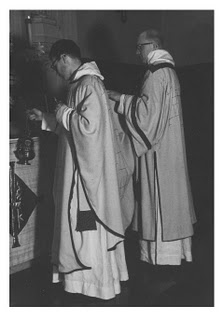
(The above photo was taken in 2007 as I celebrated Mass in my parish in Huddersfield.)

Memory and Identity: the lessons of recent history.


We have seen how Bl JPII speaks about human freedom; that grace doesn't take away our freedom but actually gives us our freedom. In this chapter the Pope speaks about the rise and the fall of the two great totalitarian systems in Europe during the last century; Communism and Nazism. He makes note of a very important factor here. That in Eastern Europe these systems were not only resisted, but that many people aspired to live by true values. Whereas in Western Europe the growth of false values has taken place alongside a certain marginalisation of true values.

Indeed, the West has actively taken part in the building of an "alternative civilisation", a civilisation which is not built upon true values. In such a civilisation men and women live as though God did not exist. This means that they live outside the parameters of good and evil. Such a civilisation is another form of totalitarianism, subtly concealed under the appearences of democracy. So, today B16 has spoken publicly of the "dictatorship of relativism".

How then, asks JPII, can we respond to this situation? We must return to the roots. We must return to the roots in both human and Christian terms.

In human terms, returning to the roots means reclaiming the fundamental truths and values about humanity, being able to see these clearly again. The purpose of this book, "Memory and Identity", is to help precisely with this. Reclaiming fundamental truths and values which were taken up by the Enlightenment and contemporary secularism and given either a false or a secondary meaning.

It also means returning to the person of Jesus Christ himself. "Learning Christ" anew, by penetrating into the depths of the revelation of the mystery of Christ, and experiencing anew the testimony of life which flows from Him, whilst recognising that God intervened powerfully in the events of the twentieth century.

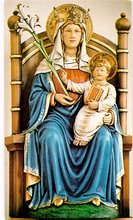
(The above photo I took, a year ago, of a former presbytery of mine in Huddesrfield. The house is now delapidated and souless as it was when I moved into it. Yet for three years this unprepossessing house became an oasis of the Christian life for the mission of the Church; during these years I had named the house "Our Lady Mother of Grace House".)

Thursday, 13 October 2011

Soho to Sydney

What a great joy it has been for the Church in Sydney to welcome Fr Alexander Sherbrooke of St Patrick's parish, London, on a week long visit. Fr Alexander was invited by the Archdiocese to give the main address at a colloquium which was titled "Parish renewal and the New Evangelisation". He addressed first the nature and significance of the New Evangelisation and then spoke about the Eucharistic Heart of the parish. These addresses together with a "pub talk' in the evening, in which he spoke about his work in London, were very well received. In the photo below Fr Alexander is speaking with Bishop Julian Porteous of Sydney who organised the colloquium. Below that is a photo of myself speaking at the event on the theme of the laity of the New Evangelisation.

The following day we were delighted to welcome him to the Seminary where he spoke, in an informal setting (photo below), about the need for priests to be alive in Christ and to keep His light alive in the Church. He spoke to us also of the freedom which faith and the language of faith still has in Australia, and how repressed are these dimensions of life in the UK; a call to these priests-to-be to promote and defend the faith in the public arena. Fr Alexander then made an overnight visit to the seminary in Melbourne to meet the seminarians there.


The following day he was welcomed at "Theology on Tap" in its pub venue in Parramatta. He spoke to over three hundred young people (photo below), calling them to participate in the New Evangelisation by seeking to develop their Christian formation, by adoring Christ in his Eucharistic Heart, and by being open to the poor and the way that God speaks to us through the poor.


We are extremely grateful to Fr Alexander for taking the time and the trouble to make the long return journey to Sydney and to give of himself to so many.

Tuesday, 11 October 2011

Memory and Identity: Freedom is for love.


The Pope has described how modern man has unsucessfully wrestled with his freedom, and that for freedom to truly be what it is, it needs grace. Man cannot be free on his own; man cannot be free without God. What then, the Pope asks, is freedom?

For Aristotle, the ancient Greek philosopher, freedom is a property of the will which is realised by truth. Freedom is therefore a task which man accomplishes through virtue. Human freedom comes about when man reaches out, through virtue, for that which is true. (It is this moral vision which was taken up by St Thomas Aquinas the medieval theologian.) Thus, human freedom involves the four cardinal virtues: prudence has an overall guiding function, justice regulates the social order, temperance and fortitude discipline man's inner life (his desires and emotions).

Yet Aristotle is not here proposing an abstract moral system, rather he is taking up man's real experience. St Thomas includes, in this moral vision, the light of Revelation, because if freedom comes about when man reaches out for what is true, then the greatest truth of all is God's Commandment's and the Revelation of Jesus Christ. It is in Christ that human freedom finds its fullest realisation.

So, the truth about freedom is that it is not an end in itself; freedom is for something. Freedom is for love. Human beings are free because they are called to love. Love perfects human nature, and without freedom man could never become who he truly is.

Once we know what the fundamental human vocation is - to love - then we can look at the many different dimensions of this vocation. Human freedom is the basis of all Catholic personal and social moral teaching, in which the Church shows how man is called to accept and to implement the truth about the good. In this way man can escape from the possibility of embracing evil and making himself worse off than he was before.

Freedom then, is the implementation of the truth regarding the good, such that freedom becomes good in itself. If freedom ceases to be linked with truth, it becomes corrupted and evil becomes a part of man's life.

(I took the above photo in October 2010 from a small boat in Port Stephens on the NSW coast.)

Monday, 10 October 2011

Memory and Identity:the just use of freedom


Next the Pope turns to consider human freedom. The nature of this human faculty is the fundamental question today. If I use my freedom well I become good; if I don't use it well then evil takes root in me and around me. So what is the proper use of freedom? How can freedom be used so as to avoid evil?

A problem for us today is that we speak about freedom as though it has no connection with morality, no connection with goodness or evil. Today, the appeal is made to freedom alone - mere choice. However, in the past we recognised the need for a criterion with which to regulate the use of freedom; the criterion which is most employed today is that of utility or pleasure. So, I choose according to what will be most useful or cause the most happiness.

Now if we analyse what is going on in a person when they choose, we see that a person's will and intellect come together in such a way that the person is responsibile for his actions. And to identify the moral character of an action we have to distinguish between the just good, the useful good and the pleasurable good.

The just good represents real objective goodness. For instance, observing the Highway Code when driving. This good is the traditional object of moral choice.

The useful good represents the advantage which will be gained by the person who is making the choice. For instance, choosing to drive only on narrow country roads. Such an object is morally neutral. This good has become the basis of modern morality.

The pleasurable good is actually the joy which accompanies acheiving moral goodness. It is linked therefore to objective goodness, to the just good. However in the modern view, the pleasurable good has become an end in itself; seeking the pleasurable good has displaced seeking the just good. In this vision the pleasurable good is not linked to the just good, it is free to be sought after for itself, even at the expense of the just good.

The philosopher Emmanuel Kant has influenced our vision of morality. He observed that giving priority to pleasure in the analysis of human action threatens the very essence of morality. He proposed the notion of subjective obligation. That we are called to act justly becuase of the presence within us of 'moral categories'. However, building morality on the basis of subjective obligation means that you lose sight of what is objectively good.

The fundamental criterion of moral evaluation is in fact man's freedom - his will. It is man who chooses, it is man who decides what criterion to apply to his decision-making, whether this be the criterion of objective goodness or that of utilitarian advantage. But we find that real goodness and the happiness that goodness brings us remains an impossible goal, whether by seeking pleasure for itself, or constructing an subjective vision of goodness, or simply by failing to choose objective goodness - our freedom remains a question for us.

The question of freedom, today as before, is in fact the manifestation of man's need for a Redeemer - that man cannot acheive the fullness of his desire unaided, and that his freedom, far from being fulfilled is a problem for him.

JPII responds to this need in his Theology of the Body.

(I took the above photo in March 2008 at Stone in Staffordshire as a barge enters a canal lock.)

Friday, 7 October 2011

Memory and Identity: the mystery of evil 2.
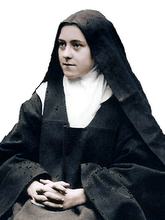


Bl John Paul II begins his book speaking about the co-existence of good and evil because this is the basic context of our lives, and because it is this context that Jesus Christ enters into. It is God, not man who puts a limit on evil; man cannot do this because he is divided in himself, and the limit which God places upon evil is the Redemption. Evil is radically overcome by the Redemption.

If we look round the world we can see the places which have suffered most from the presence of evil: those are the places where the Cross is most clearly revealed.

Sin is the greatest evil which affects man, and Christ forgives sin, indeed, he destroys it. Man's true greatness therefore lies in his conversion, by which he returns to God. However, this return to the Father is not about human effort, it is about grace. Man needs grace, and in Christ he is given grace.

Christ's death and resurrection reveal the full truth about man: that he is called to participate in God's life, and that this call is given to us in God's unconditional love for us; we are called to live a new life. The gift of grace is like light, given to us here and now in our divided condition.

The Redemption then is an unimagined victory for us, but it is also a task. It is a question of us receiving this gift into our lives. The Redemption will change us, but will we allow ourselves to be changed?

And so, we must speak about the Spiritual Life - our, my, relationship with God. This involves the way that I seek to keep God's Commandments; allowing Christ to conquer sin in me. It involves a growth in virtue as I allow God's light to pervade me. And this will lead to a certain experience of closeness to God, even now before I die, in anticipation of what is destined to be ours in eternity. It is Christ who reveals and teaches this way and accompanies those who travel.

So, we don't just need a way of understanding evil, we actually need to embark on the Spiritual Life, in which we personally participate in Christ's mission in which he defeats evil and restores goodness to us in superabundance.

(I took the above photo in January 2008 in the Fleurie hills of the Saone valley in France. Smoke rises from the burning of the dead wood of the vines in preparation for the new growth that will come in the Spring.)

Wednesday, 5 October 2011

Memory and Identity: the mystery of evil.


It is perhaps surprising that Bl JPII should start his book by speaking about evil. This is because we all encounter evil in life, evil alongside goodness. It is goodness which we strive for but evil is always a problem for us. So a realistic approach to life involves recognising the presence of evil. Indeed, JPII says that we actually need to have what he calls a "philosophy of evil" - a way of understanding and "approaching" evil, so that we are able to continue building our lives, inspite of the presence of evil.
It is only in light of the truth that we can genuinely see evil for what it is and maintain our lives in the direction of goodness. Foundational Truth concerns the Mystery of God, of Creation and of Man. In the light of Revealed truth we can begin to see that evil is a mystery in which goodness, which should be overabundant, becomes reduced or even hidden. It is precisely to combat evil and restore goodness to man that God, in the three Persons of the Trinity, has undertaken what we call the Redemption.
However, today's secular vision of life reduces God to being merely an element of human consciousness. In the secular vision, God is no longer the God of Revelation but is the God who we can think of as we please. But, at the same time our way of understanding evil changes. Man, not God, is now the central player; if man now descides what God is, he also decides what is evil and what is good. We have seen this most terribly in the extermination of certain peoples by others.

Even so, we also see that evil is limited. Divine Providence allowed Nazism to exist for twelve years only. Yes, evil is limited by goodness.

The Church calls evil by its name in order to show that it can be overcome; it is overcome precisely when we open ourselves to the love of God. Most importantly and wonderfully, we know that Christ has definitively destroyed the evil that affects humanity. Thus, it is essential that we understand how Christ overthrows evil. In this, the Holy Spirit is Himself our guide - he guides us through the redeeming work of Christ.

(To be continued.)

The above photo was taken in May 2007 as I was blessing the Parish Boundaries of what was then my parish in Huddersfield.

Monday, 3 October 2011

The Memory and Identity Sessions


Back in 2007, before I came to Australia, I lead some evenings in the parish in which we looked at the themes which John Paul II had developed in his book "Memory and Identity". I happen to think that this book should be standard reading for young people today. This is because we live in a society and a culture (in the West) which is so heavily influenced by the secular project of superficiality, opinion and consumerism, that essential truths, upon whose basis human society can be elaborated, have been forgotten.

Having listened to the Elton John and ACDC for decades now, having daily absorbed the "culture" of the Soap Operas, and followed the relentless call to be a consumer, and having placed in political power leaders who are partisans of "lifestyle living", and having largely set aside the pursuit of truth and virtue, it is hardly surprisng that we have the social and economic problems that exist today. But there remains the essential task of handing on and giving formation to young people, the foundations of human living and its accompanying ethics, that they might again be able to discern and build their lives upon this basis.

This is precisley what John Paul II did during his Pontificate, especially through the World Youth Days and, before he died, bequeathed us, in "Memory and Identity", a presentation of the foundational elements of human living for the modern era.

I shall re-work my orginal notes which I used back in 2007 and post, over the next few weeks, on the themes which Bl John Paul II wrote about in his book.

Sunday, 2 October 2011

For a new evangelical flourishing of wealth


Yesterday, I was privilaged to take part in a book launch by Fr Tony Percy, the Rector of the Sydney Seminary. What a great honour too that Fr Percy should draw a Cardinal of the Church to preside over the presentation. There are not many authors that I know of who get a Cardinal to their book launch!

The book "Entrepreneurship in the Catholic Tradition" was launched at Australian Catholic University in North Sydney. In the photo above Fr Percy is on the right, Cardinal Pell in the centre and Dr Gary Johns (Professor of Public Policy at ACU) on the left.

The impression that we have of Catholic Social Teaching is that it is mainly concerned with social justice and that the rich and weathly are somewhat 'evangelically disadvantaged'. Yet as any right-thinking public policy shows, wealth must be created before it can be distributed. Fr Percy's new book shows how much Catholic Tradition has appreciated businessmen and women for centuries. What follows I took from Fr Percy's presentation at the launch.

The entrepreneur is someone who is alert to new forms of knowledge and discovers new opportunities in the market place, who has an ability to engage the factors of production (land, labour, capital and enterprise) and is prepared to take a risk that the return will reward sufficiently. So, the Christian entrepreneur is someone who has an interest in money, but an interest which is moderated by a concern for the Common Good.

Delving into the tradition we find that entrepreneurship is appreciated in the Scriptures. For instance, in Sirach 42: 1,5 we read, "Of the following things do not be ashamed ... of profit from dealing with merchants."

St Thomas Aquinas reflects on the virtue of magificence (linked to magnanimity), and in doing so anticipates modern corporate finance theory. He argues that those who put their money away to earn interest are lovers of money, while those who undertake grand and magnificent projects for the Common Good demonstrate a capacity to moderate their love for money.

Since Leo XIII the Church has consistently defended the right to private property. Socialising property, historically, has lead to mass poverty. The Church has also defended the poor, giving rise to the principle of solidarity. And in the face of a collapsing social order (the unemplyement and depression which followed WWI), the Church articulated the principle of subsidiarity - that families, businesses and associations are prior to government, and that government is called to help not hinder them.

The Church then has clarified the importance of private property and private action for modern societies. This is a truth that needs to be proclaimed from the roof-tops in the twenty-first century, gripped as we are by big governments and big corporations who have stopped helping and are now hindering free initiative. This has happened by government lowering tax and interest for large corporations and shifting the burden onto individuals and families, and by raising the rate of Capital Gains Tax.

Pius XII, bewteen 1941 and 1956 repeatedly addressed the world of business and commerce in order to inspire a new breed of young people who would be both entrepreneurial and ethical.

JPII called for a society of free work, enterprise and participation, with the understanding that private property has a social mortgage on it, and that the goods of this world have a universal destination for all people. JPII admired entrepreneurs not only because they manifest freedom in the social order, but because they manifest a unique ability to bring people together to form a communion of persons in the work environment. If people are given responsibility for their own lives, with minimal government interference, then they will become responsible for the less fortunate; that subsidiarity leads to solidarity. The Common Good then, takes precidence over self-interest. Families, businesses and associations should be respected, not undermined by government.

Entrepreneurship goes to the heart of the pillars of Catholic Social Doctrine - human life and its dignity, the Common Good, and the principles of Subsidiarity and Solidarity. It is people who are the mian resource of any economy. Natural resources are helpful, but it is the people who make transform those resources into wealth; people create wealth which alliviates poverty. Life is not the enemy of economic development, death is. Indeed, reducing the abortion rate would offer significant help to ailing economies.

I hope that Fr Percy's book will create a new awakening to the wonderful truths which are guarded by Catholic Tradition, and that many will see new opportunities for their wealth, indeed, an evangelical flourishing of human resources.

"Entrepreneurship in the Catholic Tradition" is published by ConnorCourt Press.

Saturday, 1 October 2011

Mutually enriching


Before I went to America this June something had caught my eye on Zenit and I made a note to re-read this report. On 16th May there was a symposium held in Rome to reflect upon the Holy Father's "Motu Proprio" Summorum Pontificum. The symposium reveals that there is indeed in the Church an accurate understanding of this "Motu Proprio".

Not only is the Tridentine Mass an essential point of reference for the Liturgy today but, as the Holy Father said in his Letter accompanying the Motu Proprio, that "the two Forms of the usage of the Roman Rite can be mutually enriching".

In the light of this the secretary of the Pontifical Commission "Ecclesia Dei" said that the Motu Proprio is "the beginning of a new liturgical movement desired by the Pope", and should "be perceived by the Church as a sign of hope."

Today then, the two forms of the Roman Liturgy are called to purify, enrich and reform one another, something which is entirely in continuity with Sacrosanctum Concilium. Indeed, the Church, through Sacrosanctum Concilium, called for a reform of the Liturgy. However, the Liturgy was not reformed, but instead we were given a New Rite. And so we have the continuing presence of the Tridentine Mass; a Rite which is clearly in need of reform. Again, if we look at the New Rite, we find not only that there are many elements which are yet to be provided for, and a Rite which is somewhat unfashioned at the edges, but that "the sacrality which attracts many people to the former usage [should be demonstrated in the new Mass] more powerfully than has been the case hitherto". (B16)

The reform of the reform, which the Holy Father has spoken of is something which the Church will engender by a consistent and reflective celebration and study of both the Tridentine and the New Rite of the Mass, in other words through an organic and genuine liturgical formation.

No doubt this work will require of many that they leave behind entrenched liturgical positions and look to a time when the Church will indeed have one reformed Rite, totally Catholic, focused on Christ and the Paschal Mystery, and in which Christ's Mystical Body is genuinly revealed.

The report in Zenit is well worth reading in full.

Thursday, 29 September 2011

Growing light


While back in the UK in July I came across an article in the UK "Standpoint" magazine by George Weigel. The article, titled, "Benedict XVI and the future of the West" is the text of a lecture given by George Weigel at St Patrick's, Soho, this June. This magnificent article is a presentation of the "evangelical Catholicism" which both JPII and B16 have nurtured in the Church. Weigel is certainly someone who sees what is going on and is able to communicate that vision to others. Reading this article you will see the big picture of the new evangelisation as it is unfolding today. I agree with Weigel who, writing in another place, understands the polarity within the Church today not as traditionalist and liberal, but that on the one hand there are evangelical Catholics, and on the other insitutional Catholics.

And who are "evangelical Catholics"? They are "the men and women ... persons, families, communities, who decide to work in the vineyard of the Lord (Matt 21:33-43). Humble and generous workers, who do not ask any other recompense than participating in the mission of Jesus and the Church." B16, 18th September 2011.

Thursday, 22 September 2011

Walsingham and Fr Rear's new book.


During July, while I was back in the UK I read Fr Michael Rear's new history of Our Lady's Shrine at Walsingham, England, Walsingham: Pilgrims and Pilgrimage. Without doubt, this is the finest and fullest history of the Shrine that I know; Fr Rear has done a great service to Our Lady and to the Church. His research into the original house of Our Lady in Nazareth, the early documentation about the foundation of England's Nazareth (which certainly does point to the year 1061), the Shrine at its medieval greatness and its destruction, together with a presentation of the people and events (Catholic and Anglican) that surround the re-founding of the Shrine at the beginning of the twentieth century, give us a greater sense of the significance of this shrine. I hope that Our Lady's shrine at Walsingham will become, more and more, a real centre of the Faith in England; that many will be converted, awoken and renewed through the grace of Walsingham, and that the mission of the Church in England might be seen anew because of Our Lady's presence there. We are seeing this already, especially during August, when the great Festivals of Faith take place on the fields opposite the Slipper Chapel; "New Dawn", "Youth 2000" and other huge groups come there because She is there.

Finding gold


While participating in the IPF Course at Creighton University in Omaha in June, I ventured into the university library. On my first visit I proceeded to the Sacred Scripture section and my eyes lighted upon a set of volumes claiming to present the comments of the Fathers of the Church across the whole corpus of Sacred Scripture. I couldn't believe what I was seeing. Some of the vloumes had been published in 2000; how had I not known before about this extraordinary set of volumes!

Yes indeed, a group of scholars, Catholic and non-Catholic, have combed through the entire corpus of writings of the Fathers and aligned each reference to Book, Chapter and Verse of the Bible. This is Lectio Divina at its best; a work which allows us to read the Scriptures without this intervention of "Historical Criticism", and to see how the Scriptures have been interpreted directly in the light of Christ.

On returning to Sydney, I find that the Seminary has its own copy of the complete set of volumes in its own library, just ten yards from my office!

The "Ancient Christian Commentary on Scripture" is published by Intervarsity Press in twenty six volumes, and is also available for purchase on CD-rom.

Tuesday, 20 September 2011

The first shall be last.


Britain has wanted to be first, first in 'freeing up' Contraception (at the Anglican Synod of Lambeth in 1930), first in legalising Abortion (1968), first in embryo research, and now desiring full legal recognition of same-sex unions. It is impossible to promote human life and to build society with these laws.

In singular contrast, the Hungarian Parliament, adopted a new Consitution in April this year, a Constitution will come into being at the start of next year, 2012. The Magyar State, a somewhat remote enclave within the greater Europe, is acknowledging its Christian foundation and heritage, that society is founded upon marriage between a man and a woman, and that the foetus should be protected from the moment of conception!

This is an extraordinary development in the world. You can read the whole text of the Constitution here. It makes you want to be Hungarian! I think that we should find out more about what the Hungarians are doing.


Saturday, 17 September 2011

Madwyd


I'm still catching up on things; flying round the world sets one back a little. You will already have read enough about World Youth Day but I'll post here briefly on it.

I accompanied the Sydney 02 group. Sydney 02 group was made up of about 90 young Sydneysiders, travelling first to Barcelona for the Days in the Diocese. About three and a half thousand young Australians came to WYD, one third of these were Sydneysiders! Our group was very warmly welcomed by the Parish of St Mary Magdalene in Barcelona, who also provided guides to accompany us in the city, including the elderly parish priest, Fr Joachim, who was absolutely thrilled that his parish facilities had been taken over by ninety young Aussies.

From all that we saw in Barcelona, the Sagrada Familia church stands out in our memory. The superb architecture of Gaudi, and that of some of his successors, is a true contemplation of the Mystery of Faith. The columns rising above the ssnctuary and giving way to a light from above. Outside, on the Portico of the Passion, the extraordinary sculpture of Christ tied to the scourging pillar, caught our attention.

After Barcelona we travelled to Maresa and the cave of St Ignatius of Loyola, then onto Montserrat, before heading for Zaragoza where we spent the night.

On our first full day in Madrid all the Australians came together for a two-hour welcome event. The centre piece of this event was a tremendous proclamation of the Gospel by Bishop Chris Prowse.

One of the finest articles which I have read on Madwyd is by Michael Cook of Mercatornet.net: "7 reasosn for good cheer after Madrid". I attach the link here.

Finally, we came across this excellent still-life performer near the Plaza Mayor:

The Offerory Antiphon


Twenty fifth Sunday in Ordinary Time.


Si abulavero in medio tribulationes, vivificabis me, Domine: et super iram inimicorum meorum extendes manum tuam, et salvum me fecit dextera tua.
This is taken from Psalm 137, 7. My translation: If I walk is the path of tribulation, You will give me life, O Lord: and you will extend your hand against the hatred of my foes, Your hand will save me.

Tuesday, 13 September 2011

The awakening of a tremendous ministry


The Course which I undertook at the hands of the Institute for Priestly Formation in Omaha was called "A seminar for seminary Spiritual Directors".

The ministry/charism/gift of Spiritual Direction is something that I have been a part of since before I went to seminary; first in receiving spiritual direction, then later in giving it as well as continuing to receive it as a priest. Yet, I was never introduced to a vision of Spiritual Direction, nor led to better undertand it. I really do take my hat off to the IPF for having created the opportunity for the sharing of skills and insights, inspiring a greater appreciation of the nature of Spiritual Direction, especially in the context of priestly formation.

The Course was given by three priests: Fr George Aschenbrenner SJ, one of the founders of the IPF who, for many years now, has lent his considerable experience and skill to supporting the Diocesan priesthood. Fr Joseph Kelly of the New York Archdiocese, an experience seminary SD who originally fashioned this Seminar, and Fr Vincent Fortunato OFM, a seasoned director with a particular gift for teaching. We course participants are indebted to these three priests who 'took the lid off' the world of Spiritual Direction and guided us towards a much greater vision of this ministry.

I had expected that most of the priests undertaking the Seminar would have been mature, experienced priests, and yes they were there; but there were also many young priests, already sensing the importance of refining their skill and aptitude for this work. Every priest is a Spiritual Director by virtue of Ordination, but this ministry is so important that it should have special training and formation. And how wonderful that priests can develop their skills as directors in the early years of their priesthood. I wish that I had undertaken this Course some fifteen years ago!

The Seminar was given alongside afternoon sessions dedicated to presenting us with the whole vision of Diocesan priestly spirituality which the IPF has developed and which they form the seminarians in. The afternoon sessions were given by Fr Nicholas Rouch and Mgr Rob Panke, both gifted teachers and experienced priests who expertly led us to link Spiritual Direction with a concrete vision of priestly spirituality.

We were awoken to the tremendous nature of Spiritual Direction during this three week Seminar at Creighton University, Omaha, and I am indebted to the Sydney Archdiocese for giving me the opportunity to be a participant. I whole heartly recommend this Seminar to other priests, whether you work in the Internal or External Forum, or in a parish. The Seminar is first and formost a priestly experience.

The photo above shows the clouds gathering as a storm formed over Omaha and we were all called down to the basement; but no tournados developed. The photo below was taken some 30 mins drive outside Omaha; the bison of the great plains, still around, magnificent, if somewhat primordial in appearance.

Friday, 9 September 2011

A priestly movement in Nebraska


In June I flew out of Sydney and across the Pacific to take part in a course at Omaha, Nebraska. Here at Creighton University the Institute of Priestly Formation runs its summer sessions, comprised of a whole raft of courses and retreats for Diocesan priests and seminarians, with a special focus for the priest agents of priestly formation. This year was the seventeenth year that they have run their programs.
Briefly, the Institute for Priestly Formation was founded to assist bishops in making spiritual formation the heart of Diocesan priestly formation. Before arriving in Australia, just over three years ago, I had never heard of the IPF, but on reading some of their publications I was immediately struck by the endeavour which the IPF has made to form and renew the Diocesan Priesthood. And, speaking as a member of the SJMV (who have a similar endeavour), I was immediately enthusiastic about going to Omaha when I was offered the opportunity by the Good Shepherd Seminary here in Sydney.

I arrived in Omaha to find almost two hundred seminarians and about fifty priests taking part in summer courses. I was joining sixteen other priests participating in the "Seminar for Seminary Spiritual Directors". The concern for, and the joy of embracing the Diocesan Priesthood was palpable on the campus of Creighton University, which was almost totally given over to hosting the IPF courses. In Omaha city centre we encountered the magnificent bronze scuptures depicting the first pioneer wagon trains to cross the great plains (photo above), and the hugely swollen Missouri River (photo below), during its worst flood in 150 years. I'll post again, commenting on the course which I took.

The twenty fourth Sunday


This Sunday's Offertory Antiphon (from the Graduale Romanum, 1979) is:


Sanctificavit Moyses altare Domino, offerens super illud holocausta, et immolans victimas: fecit sacrificium verspertinum in odorem suavitatis Domino Deo, in conspectu filiorum Israel.
This is taken from Exodus 24: 4-5. My translation reads: Moses made holy the altar to the Lord, offering on it a holocaust, and immolating victims: he made an evening sacrifice of sweet perfume to the Lord God, before the sons of Israel.

Friday, 2 September 2011

The Offertory Antiphon


The Offertory Antiphon for this coming Sunday, 23rd of the Year is:


Oravi Deum meum ego Daniel, dicens: Exaudi, Dominem preces servi tui: illumina faciem tuam super sanctuarium tuum: et propitius intende populum istum, super quem invocatum est nomen tuum, Deus. (Taken from The Roman Gradual.)
A translation from NAB: "I prayed to the Lord, my God, and confessed, I Daniel: hear the prayer and petition of your servant; let your face shine upon your sanctuary: be attentive and act without delay, my God, because your name is imvoked upon your city and upon your people."