Thursday, 3 April 2008
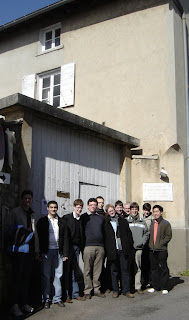
SJMV Pilgrimage to Ars
Sunday, 23 March 2008
A great Easter proclamation from Lancaster
Not only has the Scottish Cardinal made a great proclamation today, but the courageous Bishop of Lancaster is also proclaiming the truth of the Resurrection in a tremendous way. Here is his sermon:2. The angel’s extraordinary words terrified them and must have burned into their minds and hearts. One can imagine them repeating the words. In fact, it’s easy to imagine that, for the rest of their lives, they were ready to repeat them to anyone and everyone who would listen:
‘He is not here, for he has risen as he said he would. Come and see the place where he lay; then go quickly and tell his disciples. He has risen from the dead and now he is going ahead of you to Galilee. That is where you will see him.’
3. “He is not here” – not in the tomb – that place of sadness and terrible memories. He is risen from the dead. We hear these words, which are very familiar. But it would be easy to miss the wonder of it all.
The Gospel tells us that the women were ‘filled with awe and great joy’. And that was even before they saw Jesus coming to meet them.
4. The accounts of Easter Sunday pay great attention to the empty tomb. The angel invited them to come and see the place where Jesus lay. When the apostles heard the women’s news, they came running and they ‘saw the linen cloths on the ground’. They saw and they believed. The tomb was no longer a tomb. Is it likewise for us? Are we aware that Jesus is alive and offers hope to each one of us?
5. The Sequence of Easter expresses it like this:
‘Death with Life contended: combat strangely ended!
Life’s own Champion slain, yet lives to reign.’
6. Everything has changed, changed utterly. The one inescapable, inevitable, unconquerable reality - the reality of death - had seemed to defeat Jesus as it had defeated every human being, every living thing on earth. But the reality now is that Jesus conquered death.
7. We must hold on to the hope of these words: Jesus conquered death! We need to hold onto this truth today because death takes on so many guises;
· through legalised abortion – that kills nearly 200,000 children a year,
· through experimentation on the unborn, that has resulted in the deaths of 2.2 million,
· and euthanasia through the withdrawal of food and fluids, here the numbers are countless.
Jesus has conquered death, but the powers of death and evil still strive to overcome the light of love and life.
The tragedy is that the authority and power of Government seem to be behind the greatest threat to the dignity and rights of human life.
As your bishop, I want to join my voice to that of Cardinal Keith O’Brien and others, in protesting in the strongest terms against the Human Fertilisation and Embryology Bill.
If this bill becomes the law of the land, it will allow the creation of animal-human hybrid embryos for medical experimentation.
Supporters of this so called ‘medical’ experimentation, justify it by offering the hope that at some unknown date in the future the dissection and destruction of unborn human life will lead to cures for truly terrible diseases, such as cancers, Parkinson’s disease, Alzheimer’s and M.S.
All right thinking people will agree that we must seek to discover cures for diseases that cause so much human suffering. But compassion cannot result in us exploiting and destroying the life of unborn human beings.
Many in government, the media and research are so strident in promoting research on embryonic humans that they forget to mention that the greatest strides in discovering cures derive from adult stem cell research - not the defenceless unborn.
We need to ask who are these vested interests in the promotion of experimentation on embryonic humans and the creation of animal-human hybrids. I read about them but I’ve yet to find them in person.
The Prime Minister has made it clear that he wants Britain to be the world's number one centre for genetic and stem cell research. He sees it as building up the hi-tech sector of British industry and contributing to economic growth.
It is good to develop British industry and foster economic growth, but not through exploiting and destroying embryonic human persons.
A society that seeks medical cures and economic development at the cost of human rights, human dignity and human life is ‘monstrous’.
It is not the defenceless, human-animal embryo, that is ‘monstrous’; it is we ourselves who have become ‘monsters’ for allowing the exploitation of the unborn for our economic and medical gain.
On this holy night when we celebrate life conquering death, I want to make two appeals as your Bishop:
First, to the Prime Minister and his ministers. Please stop the Human Fertilisation and Embryology Bill. Stop exploiting embryonic human beings, and support adult stem cell research instead.
Prime Minister, if you insist on promoting this bill through parliament, allow members of your government and party to vote according to their consciences.
Second, I call on the Catholic community - clergy and laity - to speak with one voice and insist that parliament: protects and cherishes human life.
Pray, Protest, and Petition your Member of Parliament to stop this monstrous medical experimentation on human beings.
Never give up hope, nor allow it to be dimmed, because the light of Christ shines out in the darkness, and the darkness can never overcome Him.
8. We began our vigil outside the cathedral with the Easter Candle spreading its light through the darkness. We processed singing “Christ our Light!” In the Scriptures we heard how God rescued Israel from the Egyptians and how promised to quench their thirst by sending his Word, his Son. Tonight this promise is being fulfilled and we are given a new depth to that truth.
9. Only Jesus can satisfy our thirst and in a way that no human being had ever imagined. Here was a light that the darkness could never overpower. This was something far above and beyond our ways and thoughts.
10. It is so much beyond our ways and thoughts that we think about it with a strange, contradictory set of attitudes. On the one hand, we can take it for granted as if it were, almost something to be expected. We have heard the Easter story all our lives; we know that Jesus rose from the dead.
On the other hand, though we treat it so familiarly, we do not really let the wonder of what we are celebrating sink in. There is no more amazing truth than this, yet how far does it transform our lives and our attitudes?
11. Jesus has passed beyond suffering, death and graveyards into a life which is no longer subject to death. The Lord rescued Israel from the Egyptians, but for us he has done something even more extraordinary; the Lord rescued us from death. We live with him; we live a life that death cannot touch. Death has no more power over us. Death must give way to the resurrection as it did for Jesus.
That is the Gospel, the Good News. The Lord is risen indeed, alleluia!
+Patrick O’Donoghue, Bishop of Lancaster
Saturday, 22 March 2008
Pre-Vigil glimpse
A stunning proclamation
Visit here to read some of Cardinal O'Brien's Easter Sunday sermon.Silence before the Mystery
Today, is the day which "expresses the unparralleled experience of our age, anticipating the fact that God is simply absent, that the grave hides him, that he no longer awakes, no longer speaks, so that one no longer needs to gainsay him but can simply overlook him ... " (B16) Today, Christians are silent in their recollection of the Passion of the Christ. But for our culture, today is another day without God. As B16 has indicated, today is an unparralleled day in which Christian and secular culture seem to coincide: God is dead.Friday, 21 March 2008
My correspondance
I recently wrote to my MP, Colin Challen, asking him to seek ammendments to the HFE Bill which would favour the dignity of the person. He replied saying:Actually, I wonder how prepared most of our MPs are for the kinds of decision-making that goes on now in Parliament. What kind of education did they have to form their understanding of what comprises the basic platform of human existence: human nature, ethics, society, culture, history and law. Anyway, I replied to him with the following letter:On abortion, should any bill come to the House I will support the status quo. It is my view that the existing law provides sufficient protection for all concerned and maintains the principle that ultimately it is a woman's right to choose whether to have an abortion of not. ... On the issue relating to human tissues, and indeed inter-species embryos, I support research into the former, but am somewhat nervous about the latter. ... I do not consider an embryo in any sense can be described as a human being. I am concerned about inter-species tissue development, since I personally would prefer that experimentation on animals for human benefit were phased out as we develop better methods of addressing our own health concerns. I will not support inter-species proposals.
Dear Mr Challen,
Thank you for your letter regarding the HFE Bill and for the indications which you have made to me. I am glad that you don’t want to extend the legal provision for Abortion, but I have to remind you to that it is not possible to say that the Law “provides sufficient protection for all concerned”, for Abortion, as you know, involves the killing of the pre-born child.
Later in your letter you explain that you “do not consider an embryo in any sense can be described as a human being”. This is extremely dishonest of you, since we know from science that a human life begins at fertilisation. Discussion over vocabulary and terminology such as “person” and “human being” is made at a philosophical level, whereas science has already clarified the status of the human embryo. And it is questions of science that are being put before Parliament at this time.
The reason for this Bill is because the UK wants to lead the global scientific community into the unknown. Whereas we should be refocusing our attention on adult stem cell research; not to do so will be a grave injustice to people with spinal cord injuries and other illnesses who could benefit from these technologies.
As for the “right to choose” which you speak about: freedom is not a political category but flows from the right to life. To place freedom before life actually goes against the fabric of political life and will tend to destroy it.
Sadly, I have to say, on the basis of your views, that in an Election I could not vote for you to represent me or any other human beings. Nor, on the same basis, would I recommend that anyone vote for you.
Thursday, 20 March 2008
The foundations of Priestly celibacy.
St John Mary Vianney Society culture is a culture which helps priests to be born again each time they go up to the altar to celebrate Mass.Select Committee analysis
Thanks to Dr Tom Ward of the National Association of Catholic Families for this analysis (condensed) of the recent session of the Commons Select Committee for Schools meeting with the Bishop of Lancaster and others.In the mind of the Committee the first issue was the elimination of selection of candidates for Faith schools which they considered to be to the disadvantage of “the poor”.
The measurements of poverty being used were the percentage of special-need pupils within the school and the uptake of free school dinners (Community schools 15%, Catholic schools 13.50 % and Church of England 11 %.). One had the distinct impression that the Committee had already formed the opinion that Faith schools were guilty of such discrimination.
The second leitmotiv of the Committee’s concern was ‘community cohesion’. On this, a list of specific mandatory proposals were sought from the academics on tightening up admission policy to Faith schools These were to spell out what schools must do rather than relying on prohibitions.
The clearest evidence was given by Professor Mark Halstead of the University of Leeds.
In answer to the question “In what sense can you blame Faith Schools for a failure of social cohesion?” Professor Halstead made the following points:
· Multiculturalism is the problem, not the Faith Schools.
· People, locally, were very suspicious of the government’s Community Cohesion policy.
· In the Bradford riots, there had not been one rioter from a Faith School.
· Young Moslems learnt to drink a bottle of vodka not at the mosque, not at home, but in the Community schools.
· What they learnt at Community schools caused a confusing conflict with the values both of their homes and the Mosque.
· Only 5-6% of Moslems go to Faith Schools.
Professor Halstead concluded firmly that Faith Schools could not be blamed for the lack of social cohesion.
Fiona Mc Taggart MP (Labour) expressed her concern that government policy on social cohesion was unpopular. ‘Did the teachers need more guidance on this, indeed did the policy need more resources?”, she asked. Professor Halstead replied that Faith groups were largely unaware of the government’s policy on social cohesion but believed that the issue was moral rather than political.
When challenged on whether Faith Schools used the prism of religion to view the issue of tolerance, Professor Halstead said that social cohesion is a problem of adults not of children. He believed that the key issue was education in moral values. He added that the teaching of moral education was taken very seriously in Moslem schools, whereas the teaching of morality was squeezed out in Community schools.
In reply to Fiona McTaggart’s question on whether Faith Schools were better at teaching tolerance, Professor Halstead replied that tolerance implied a framework of values as a starting point. To be tolerant you have to have your own values and, in this, Faith Schools had an advantage over Community schools.
My conclusions (Tom Ward)
1. The dominant section of the select Committee would allow Faith Schools, provided that they conformed to their political agenda - i.e. that theological and moral absolutes were absent.
2. There was no hint of understanding on their part that the Government’s unremitting attack on marriage and the family was largely responsible for child poverty.
3. Basically, they regarded the solution as the problem and the problem as the solution.
Following this part of the Hearing the Right Reverend Patrick O’Donoghue Bishop of Lancaster was questioned.
Bishop O’Donoghue told the Committee that in the Lancaster Diocese he has 84 schools with between 13% to 50% Moslem pupils and an increasing number of Eastern European children. He dismissed the school dinner statistics as not relevant to the Catholic schools, and stated that there was no evidence that the Catholic system discriminated against the poor.
On his Fit for Mission document he made the following points:
· God would be at the centre of his schools, as would Catholic morality.
· Religious education was no longer to be marginalised in the schools in his diocese, but rather it must now be clear and pervade every aspect of the school.
· Anti-Catholic books, such as the work of Marx and Camus, would be banned. This vetting would take place throughout Catholic schools in his diocese.
· Red Nose Day and Amnesty International would no longer be supported, because of their support for abortion.
· With conviction and passion he said that the Church was under attack in the media and in certain political circles.
· His intention was to develop and deepen young peoples’ faith.
· On being accused of “proselytising”, Bishop O’Donoghue said that he would have nothing to do with coercion, pointing out that they were Catholic schools and that parents chose them.
When he insisted that the Faith not be compartmentalised in his schools, an MP claimed that the Bishop was going to “evangelise every pupil in the school”. Bishop O’Donoghue answered that they have their freedom to accept or reject what was taught - as indeed was shown by the figures for non-practising former pupils of Catholic schools. When asked by an MP if he felt that he would have been given such a difficult secularist cross examination were he a Moslem, the Bishop adroitly replied by saying that Moslems in Catholic schools were very sympathetic to Our Lady.
Mr Sheerman disrespectfully asked whether or not in the light of “the change of occupant in the Vatican” the Bishop supported combined Catholic/Anglican ecumenical schools. Bishop O’Donoghue insisted that Fit for Mission? Schools would apply, and that parents would have to approve of the schools.
When challenged on Fit for Mission? Schools, he said he would not change his policy, insisting that without identity, sustainability and mission there would be no survival for his schools. He made it clear that 800,000 Catholics voted with their feet for Catholic schools, that Roman Catholics pay tax twice, first as citizens and secondly through the Church which pays 10% of the capital cost. In addition they were also very generous in their financial support for their schools. Furthermore, that Catholics rights are enshrined in the 1944 Act and in European Law. When challenged that the Catholic Hierarchy had fought “tooth and nail against an admission quota for non Catholics he replied, “and we will again!”
I was left with following impressions:
1. Against a hostile cross-examination, the Bishop had courageously defended God and our children’s right to be evangelised.
2. The Bishop has, with skill and clarity, defended the Church’s vision of Catholic Education as represented by Fit for Mission? Schools.
3. His dignity, goodness and competence were, on the whole, respected by hostile politicians who might otherwise have been yet more aggressive.
4. In this battle with the dominant neo-pagan culture, the Bishop has bought us a little time to begin the re-evangelisation of our youth.
6. The issue of the parents being primary educators was firmly emphasised.
7. In this, the centre of Common Law Jurisdiction, the war between the Civilisation of Love and the dominant Culture of Death will not be won by the secularists, few of whom will go to the stake for their disbeliefs. Rather it will be lost by Catholics if other Bishops fear to support Bishop O’Donoghue’s courageous witness to Our Lord Jesus Christ.
8. Every Catholic family in the country owes a debt of gratitude to Bishop O'Donoghue for Fit for Mission? Schools and for his defence of Catholic truth against a liberal Parliament.
Wednesday, 19 March 2008
Holy Week and God's plan is clearer.
The themes for the three days of catechesis during World Youth Day have been announced; they are to be led by bishops from around the world in over 300 locations in Sydney. On Wednesday, July 16, the theme will be the call to live in the Holy Spirit, drawing from Galatians 5:25.
"Catechesis represents the spiritual heart of World Youth Day, when young people from various backgrounds and circumstances unite to listen, reflect, discuss and pray in harmony," said Auxillary Bishop Fisher, the Co-ordinator of Sydney World Youth Day '08. "I encourage all pilgrims who are attending WYD08 to begin reflecting on the catechesis themes now," he said, "so that come July, they are spiritually prepared to witness the Spirit and gain as much as they can from their WYD08 experience."
Saturday, 15 March 2008
Sheerman and friends

Barry Sheerman MP has taken up the baton in a mild way on behalf of Parliament. Others, such as Richard Dawkins already hold positions, created by the Government, to lead and inform popular media-making in issues related to faith, and especially the Catholic Faith. You can see him, and Sheerman, with others taking part in a TV debate (on Youtube) about the the place and influence of religion in schools. In fact, programmes such as these are very good to watch and analyse in order to see trends taking place in our culture. The media itself also has a 'big handle' on this and we are beginning to see a new phenomenon in TV: cameras entering into Catholic Churches and presenters speaking in a cynical way about the Christian Life. A good example is here. In this video insert you can see presenters, including so-called Catholics, speaking about the Faith in a disparaging way.
You may think that I am overplaying the point. However, over the past couple of decades we have seen the media intrude so intimately into the Family, that it has made families become and feel utterly vulnerable. The media has made society question the purpose and meaning of the family to such an extent that, for many in our society, the family has become an obstacle to the individual's freedom. Freedom of choice, over and against others, has corrupted our understanding of the Family and destroyed its irreplacebale role in society. And this has happened through the incisive and cynical way that cameras and presenters have entered into the privilaged territory of the family. The media has represented the family as an impersonal reality, it has presented false models of the family, especially in the Soaps, it has dominated the family and made it question itself, and it has offered 'the media family' so that living family life vicariously through TV dramas, people can step aside, as it were, from their real life mission.
This same process is now beginning to happen to the Church and its life. So, what you see now on the TV is the start of a concerted effort to make people of faith, and especially Catholics, feel vulnerable and seem out of sink with the general tenour of society today. And we will see the media and its cameras intrude more and more into churches and conciences, presenting them in a cynical and contemptuous way. Look at how the media has damaged families - do not under estimate the immense impact that this same project will have upon the Church.
"The time is sure to come when, far from being content withsound teaching, people will be avid for the latest novelty and collect themselves a wholoe series of teachers according to their own tastes; and then, instead of listening to the truth, they will turn to myths." (2 Tim 4: 3-4)
We need to be aware of this, so that the pagan media doesn't cloud our own vision, and so that we are able to respond directly to every instance where the media will play-down or distort the Christian Life.
The beauty of Fatherhood
With great joy we keep the Feast today of St Joseph, the great model of manhood for humanity and for the Church. St Joseph is the greatest model of manhood and of fatherhood for he embraced all the gifts and qualities which God desired for him. Its is here, in his openness to God's plan for him, for his life and for his personality that we see a man embracing the whole truth about spiritual fatherhood - something which God desires all men to have - the mission to create and form goodness in the world. And he embraces also the second stage of fatherhood given to many men, that of becoming a parent. Here we see St Joseph striving, like God, for his family and being a real guardian of his son's soul. What a great model of manhood and fatherhood, and how dis-similar St Joseph is to secular models. John Eldridge in his insightful book about men - "Wild at heart" - speaks about how false are the secular models of manhood. He cites two important examples: John Wayne (at least, the characters he plays) and James Bond. Both these represent men who are utterly sufficient in themselves; they do not need any help, they do not need God. Whereas, every man in fact needs to be plugged into God, who alone can lead him to the full stature of his personality. How great it was for the whole world to see spiritual fatherhood in operation in the life of JPII, and again in B16, the world's "grandfather". And how great it is when, in our parishes, we see fathers at Mass with their children or spending time with them; whenever we see fatherhood in action.Wednesday, 12 March 2008
Sheerman's get-together
Today the courageous Bishop of Lancaster faced Barry Sheerman MP and his Commons Select Committee for Schools at Westminster. You can watch it here; but I warn you, it lasts two and a half hours and you will need to skip through most of it.Tuesday, 11 March 2008
Annotations on the Tower
Sunday, 9 March 2008
Another pilgrimage of grace
Friday, 7 March 2008
An SJMV pilgrimage of grace
Through the Beauchamp Tower and along the Queens walk we entered the cell above in which St John Fisher, the rebel-Cardinal, had been held. This cell, somewhat better proportioned than More's cell was a place for a renewed encounter with that tremendous seam of grace which has been given to the Church in this country by the witness of the Martyrs.
After the Bell Tower we visited the crypt of St Peter's church where the bodies of More and Fisher were interred after their execution. Then we visited a sucession of cells in which the Martyrs had been held: in the Beauchamp Tower, Cradle Tower, Salt Tower, Broad Arrow Tower and Martin Tower. The photo above shows the inscription which St Henry Walpole made in his cell in the Salt Tower. This priest was tortured fourteen times in the Tower before being sent for execution at the Knavesmire in York. We were amazed by the enormous record left by the Martyrs and others on the stone walls of cells - no visitor to the Tower should miss the poignancy or the significance of these inscriptions which are a record of a great struggle which these martyrs endured for Christ.
Wednesday, 5 March 2008
HFE Moot for South Leeds
South Leeds Co-ordination meeting 7.30pm, Tuesday 11th March at St Brigid’s parish hall, Elland Road, Churwell, Leeds LS27 7QR.The Human Fertilisation and Embryology Bill presents a lot of seriously questionable material which needs to be opposed. There will be an informative talk followed by a discussion on an action plan to defend life and oppose the bill by writing and petitioning MP's, and to plan Prayer Vigils in South Leeds Parishes. It is important for us to act now before the Bill becomes Law and to help co-ordinate our response. Please come along, just one small thing you do to defend life could make the difference. A Speaker from LIFE will address the meeting.
Monday, 3 March 2008
The Priesthood is born from the heart of Christ.
Following the reflections from the Ars Priest's Retreat, Fr Frost spoke about how the Gospels show us how the Priesthood is born in the heart of the Church from the Heart of Christ.Saturday, 1 March 2008
Newman saw our day
In summer of 2000 I took part in Bioethics Conference at Cambridge; during a presentation by Fr Dermot Fenlon of the Birmingham Oratory I took some notes.Friday, 29 February 2008
The Bridegroom
One of the talks from our Ars Retreat focussed on Christ's intention as He gave himself in the Passion. St John prefaces the Passion with the scene of the Washing of the Disciples Feet in order to show us His intention: Christ is desiring a spousal union with His Church. His death is not a death for corruption but for Resurrection.Thursday, 28 February 2008
A moronic culture produces the HFE Bill
The Contraceptive Generation - the generation which welcomed and embraced the whole mentality and practice of contraception, thereby separating sexuality from procreation - is really leading us, as a society, deeply into the culture of death. And now that this generation is in control of the management of our society at all levels - Goverment, media, education, law, medicine and commerce - they have created a social Movement to change the focus of our society and of our culture in favour of a new ethics which rests upon the classical outlines of the culture of death, and they have done this, in a regular totalitarian way, by reducing the mentality and the culture of the people to a moronic level. This has enabled the leaders of this Movement to engender a massive social change without anyone really noticing. The UK may as well have been hijacked by a group of sinister Freemasons who have taken control of the major organs of our society and its communications services.Tuesday, 26 February 2008
An anniversary event
Contraception: Why not? A lecture by Prof Janet Smith. Thursday 6th March, Westminster Cathedral Hall, 7.00 - 9.00pm. £5 admission - places are limited - register at cathmacgillivray@rcdow.org.uk Prof Smith offers a stimulating opportunity to seriously reconsider the modern enthusiasm for contraception. Her message has captivated audiences all round the world, particularly married couples, those considering marriage, catechists, counsellors, doctors, priests and seminarians.Sunday, 24 February 2008
Youth 2000 in Harrogate
The rebel-Cardinal's Coat of Arms hung above the main entrance to the school and we passed beneath it each time we went to and fro from the school; surely with so great a Patron, the conversion and evangelisation of England can be conceived anew by this generation.
Friday, 22 February 2008
How does a priest enter into Jesus' prayer?
Saturday, 16 February 2008
A screening in Leeds.
Last night twenty three of us sat down to watch the film "Therese - ordinary girl, extraordinary soul" in my parish. We were grateful to Alanna for making the DVD available to us. The film presented all the significant events in the life of St Therese of Lisieux and was a worthy attempt in portraying the making of a saint. If you have watched the film then you will be aware of how sensitively the film-makers handled her life. Friday, 15 February 2008
Teaching in Soho
This week I visited the St Patrick's Evangelisation School in Soho in order to do a little teaching on my favourite subject: The New Evangelisation. It was very good to meet this year's student group who are taking part in this project of formation, community life and evangelisation in the heart of London.Monday, 11 February 2008
Entering into the Prayer of Jesus
Sunday, 10 February 2008
A pilgrimage of grace
Yesterday I had the privilage of taking a group of young people to the very ancient shrine of Our Lady in North Yorkshire at Mount Grace. The Lady Chapel at Osmotherly has roots which date back to the ninth century.Friday, 8 February 2008
A bright flame in Europe.
Last week Fr Julian and myself were in Ars with the other members of the John Vianney Society for its winter session. It was a week of grace! We took part in so many prayer-times and conversations with priests and seminarians which were full of the power of grace.
The Bishop of Belley-Ars was also with us throughout the session. Mgr Guy-Marie Bagnard is the founder of the Priestly Foyer and Seminary at Ars and the founder of the John Vianney Society. As Bishop he is now the guardian of the Charism of the Society: to seek the renewal of priestly interiority and spirituality through fraternity. One evening he wished to see both Fr Julian and myself, he shared his joy with us that we had become members of his society and he addressed us as brothers wanting to know both of us as persons. We were left in no doubt that the Bishop of Belley-Ars has the charism and gift of fatherhood in great measure - he is a real father to his priests and his seminarians.
One evening the whole house took part in a Holy Hour of silent adoration in the seminary chapel. The bishop was in a front bench, bowed in prayer throughout. Suddenly, it became obvious to us how this beautiful house for priests and seminarians has come about, and how the Society has come about - Mgr Bagnard has prayed them into existence. His prayer for us, for priests and for the Church was tangible in that Holy Hour. Not only was Christ feeding us in his presence, but the Bishop too was a channel of grace. This bishop is a light in the Church in Europe; he is a bishop of the New Evangelisation. His priestly frienship is very active - he is a brother, a father and a spouse. St John Vianney's prayers and the Bishop's prayers are bringing priests alive! Let us ask that their prayers and their lives will continue to bear much fruit for the Church in Europe.
Thursday, 7 February 2008
Is an immoral Government fit to rule?
Now that anti-life legislation is coursing through the British Parliament again - currently the matters at hand are the creation of huge numbers of human embryos for death, so that their stem cells can be harvested, and also the creation of human/animal hybrids - we should ask ourselves: Is an immoral Government fit to rule? I am slowly waking up to the realisation that our Government at its Parliament are not worthy of the Office which they hold.The Pelagian Herald
Will Gore, writer for the "Catholic Herald", gave us last week his take on John Pridmore's new book "A Gangster's Guide to God". Gore gives away his kind of faith when he says of the former gangster, John Pridmore, that "he turned around his life through faith." The rest of Gore's review of Pridmore's book is a rough scetch of how inadequately John did this. I'm sure John Pridmore would agree with him on that, but not on the abscence, in Gore's review, of any reference to Grace.Wednesday, 6 February 2008
A parish which is not missionary has no future.

Sunday, 3 February 2008
A letter from a father.

A Father speaks ...
After last Sunday's midday Angelus, the Holy Father spoke to school administrators, teachers, parents and pupils. He encouraged them, despite difficulties, to continue their work "which has the Gospel as its focus, following an educational syllabus that aims at the integral formation of the human person. He noted that education today "seems to be becoming ever more difficult. [...] Hence there is talk of an 'educational emergency,' confirmed by the failures that too often crown our efforts to form well-rounded individuals, capable of collaborating with others and of giving meaning to their lives. There is also talk of a 'break between the generations,' which certainly exists and is a burden, but is the effect rather than the cause of the failure to transmit certainties and values."The Holy Father said parents and teachers may feel the "temptation to give up" on education, and even run the risk "of not understanding what their role is." He identified "a mentality and a form of culture that lead people to doubt the value of the human person, the meaning of truth and of good and, in the final analysis, the goodness of life itself." Faced with such difficulties, "which are not insurmountable," the Pope said: "Do not be afraid! [...] Event the greatest values of the past cannot simply be inherited, we must make them our own and renew them through often-difficult personal choices." "However," he added, "when the foundations are shaken and essential certainties disappear, the need for those values returns to make itself imposingly felt. Thus we see today an increasing demand for real education." It is demanded by parents, by teachers, "by society as a whole, [...] and by the young people themselves who do not want to be left to face the challenges of life alone." He spoke of the need "to identify certain common requirements for authentic education," noting that "it requires, above all, the nearness and trust that are born of love." "It would, then, be a poor education that limited itself to imparting notions and information while ignoring the great question of truth, above all of that truth which can be a guide to life". The Pope contended that "the most delicate aspect of education" is that of "finding the right balance between freedom and discipline." However, he affirmed, "the educational relationship is above all an encounter between two freedoms, and successful education is formation in the correct use of freedom. [...] We must, then, accept the risk of freedom, remaining ever attentive to helping it and to correcting mistaken ideas and choices." "Education cannot forgo that authoritative prestige which makes the exercise of authority credible" the Holy Father wrote. He added that this is "acquired above all by the coherence of one's own life." He also highlighted the decisive importance of a sense of responsibility: "Responsibility is first of all personal but there also exists a responsibility we share together." In this context, Benedict XVI observed that "the overall trends of the society in which we live, and the image it gives of itself through the communications media, exercise a great influence on the formation of new generations, for good but also often for evil. Society is not an abstract concept; in the final analysis it is we ourselves."The Holy Father then referred to hope as the "soul of education," citing "Spe Salvi" and saying that "our hope today is threatened from many sides and we too, like the ancient pagans, risk becoming men without 'hope and without God in the world.'""At the root of the crisis of education lies a crisis of trust in life," he concluded. "Hope directed toward God is never hope for me alone, it is always also hope for others. It does not isolate us but unites us in goodness, stimulating us to educate one another in truth and in love." Which sect does he represent?
I lived in Barry Sheerman MP's Constituency of Huddersfield for three years - long enough to witness a population visibly labouring under the culture of death (endemic alcohol poisening, petty drug wars and endemic prostitution were the most obvious indicators). I wrote to him once about this, voicing my concern that whilst his own political ideas were against life, his constituency was showing clear signs of his influence. He replied saying that was sending a copy of my letter to my bishop with a complaint note attached. I heard no more.He has commented on a report by the Bishop of Lancaster, Dr Patrick O’Donoghue, ordering Catholic schools in the North-West to teach children that contraception was wrong and that sex should only take place within marriage.
He has also criticised the Bishop of Leeds, the Rt Rev Arthur Roche, saying he had been “very difficult to engage with” on the future of All Saints Catholic College at Bradley Bar.