Sunday, 21 September 2008

Spear fishing at Long Reef beach

It's extraordinary where Friendship with Christ takes you! On Sunday afternoon a few of us went with some friends of the College to do some fishing off Long Reef Point on Sydney's northern headland, in the open ocean. Armed with spears and spear-guns we got ready for the hunt. I have never used a snorkel before - so the the venture included some beginners training for me. Having swum out some hundred yards from the beach we began to catch fish. The photo below shows us launching our support boat which enabled us to accompany the fishing almost a quarter of a mile out. I didn't take the camera out on the boat so lost the opportunity of some extraordinary photos.
We caught about ten fish including this cuttlefish which you can see me preparing above. The previous photo shows our main trophy, held by Matt who used to work at the College. We prepared the fish while hungry pelicans waited on the lamppost above us avoiding an angry little terrier.
All in all, an extraordinary but grace-filled day.

In the early morning sun.

Campion College has been given a canoe and a kyack, so in the early morning sun three of us took these two boats to try them out on Lake Parramatta which is near the College. These pictures speak for themselves - the location and the experience of being out on the lake in canoes was exquisite. We'll certainly be having future adventures in these.

Saturday, 20 September 2008

The Living Poets Society

Last night we had a bonfire on Campus and, since the study of English Literature is a component of the Degree at Campion, we sat round the fire and read poetry to oneanother. The setting was completely absorbing: a warm, still night, near the lake under the trees. Everyone chose their favourite writers; some knew their pieces off by heart. Australian poets and classical English writers. I chose a part of "Mort d'Arthur" by Tennyson - " ... and on a sudden, lo, the level lake and the long glories of the winter moon ..." etc. Our recitations, together with some Tandoori chicken which I had prepared and some Australian beer, set the scene for some very good culture on Campus.

Thursday, 18 September 2008

The standard you walk past is the standard you set.


Today, the pornification of girlhood, even baby girls, is everywhere, and the fact that most of us see pornification images in Shopping Malls, Newsagents, Billboards etc and ignore them, means that we are compliant with the pornification culture as it is offered.

This was the opening message of a seminar given yesterday evening at Campion College by Melinda Tankard Reist. She revealed to what extent this part of the culture of death has pervaded our culture and how we can begin to respond.

First of all, don't buy products made by Lynx or Dove or Skins. These manufacturers are heavily involved in promoting porn.

Complain - to the mass media, retailers, the press.

Tell your friends about manufacturers and retailers which are promoting these products and the porn culture which they promote.

Stop comparing yourself and your image with the culture.

Don't diet at all. If you have a real problem, get real help.

Don't even consider cosmetic surgery - use your money properly.

Don't conform to the culture.

You can find out more about Melinda and the fightback against porn by visiting : www.womensforumaustralia.org. And for men who really want to set an example with your own lives, then check out these two sites: www.covenanteyes.com (being accountable for what you see online) and www.choicez.com.au (challenging pornography and changing behaviour).

Spread this message.

Wednesday, 17 September 2008

First sight

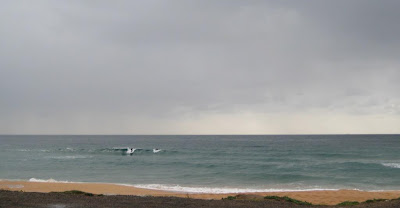
Today I had my first sight, and touch, of the Pacific Ocean. Myself and another member of staff went out to reconnoitre an area near the Hawksbury Harbour entrance for a possible place to launch some canoes which the College has acquired. Here are some photos of "Palm Beach" where they film scenes for the mindless Soap "Home and Away". It is always a very impressive experience when one first encounters a mighty Ocean. The day was somewhat overcast, as you can tell, but the location is absolutely fantastic and I look forward to going back with groups from the College and getting out there with the surfers.

Monday, 15 September 2008

Formal Hall

News from Sydney. Most Monday evenings we have Formal Hall in the College - an opportunity for the life and culture of the College to mature and be expressed. Here's of photo of myself in the gathering of the house just before Dinner. Invited speakers took part in the previous two Formal Halls which I have participated in, but this evening the house took part in a debate.

Saturday, 13 September 2008

Called upon

I'm sorry that I haven't been posting much recently, but I have to say - coming out to Sydney has been like coming out of retirement for me. In Leeds where I was last a Parish Priest, it was like being a retired person. I have been considerably busier in Sydney. A few days ago I was called upon to celebrate a Requiem Mass for a family of Sydneysiders whose father had died. The Mass took place in Rookwood Cemetery - the largest cemetery in the southern hemisphere. This huge park - named in pagan fashion, a "Necropolis", is ten square kilometers in size and is located near Sydney's Olympic Park.
These photos cannot convey either the size or the stature of this cemetery. I celebrated Mass in one of two Catholic Chapels which, along with numerous other chapels and funereal facilities, offer the people of Sydney the possibilty of holding huge or intimate but dignified funerals. The chapel we used was very modern but not inappropriate, and I was surprised to find that the sacristy was fully and expensively fitted out with everything necessary for Mass. Quite unlike anything I have ever seen before.

Tuesday, 9 September 2008

Friendship with Christ

The Gospel of today's Mass - the call of the first disciples - leads us into the Mystery of evangelisation through friendship. Christ himself evangelises through friendship. We hear how he spent the whole night in prayer - He is living an intimate relationship with His Father - he comes down from the hills and calls his first disciples - he wishes to share the relationship which he has with His Father with others. He chooses those who are open to his call. Those who ask questions or who have other matters to attend to first He leaves behind. Those whom He chooses do not know what lies ahead but they receive the call to live in community with Him and to have a deeper experience of His life and of His person. We respond to His call when we allow Him to establish our lives on His friendship and seek to build a simple rule of life with Him which will allow us to spend time with Him. Beginning the day in prayer, entering into the Gospel, taking part in daily Mass, if we can, spending some time in prayer with Him - especially in front of the Tabernacle, if we can, and ending the day with a short examination of conscience and thanksgiving. This friendship is at the heart of being a Catholic today.

Monday, 8 September 2008

Sense and sensibility

Recently, I came across this piece in the CF News log. When I was in Huddersfield I became aware of the mindless way in which sex education was foisted on young people in both Catholic and State schools, just as it had been in the early 70s when I was at a Catholic Grammar School in Leeds. Here Dr. Philip Ney speaks with sense and sensibility on sex-education:
I am a retired professor of psychiatry, having taught in 5 universities in different parts of Canada, Hong Kong and New Zealand. I have also run child and adolescent psychiatric units. I have been on school boards. It is from a review of the literature and from my experience that I write this brief opinion.
1) There is no particular need for 'sex education.' For many centuries there was no sex education, yet children were conceived and their parents enjoyed the process. Discovery of each other and what is pleasant in bed, on the wedding night and thereafter, is an important part of the exciting and unique pleasure that bonds the couple.
2) Sex education inhibits pair bonding. To educate young people about something that comes naturally robs them of the spontaneity and joy of sex that is vitally important for pair bonding and thus family stability.
3) The more sex education, the more sexual self-consciousness. There is substantial evidence that the more sex education, especially on technique, the more the couple is sexually inhibited. The greater the emphasis on sexual performance, the less communication and interpersonal intimacy there is.
4) The more sex education, the more sexual activity. It is quite conclusive now, that the more sex education, the more sexual activity and all the problems that go with that. The introduction of sex education is well correlated with the increase in abortion, STDs and boy-girl interpersonal problems. Good education gives people the desire to try it out or learn more experientially. Paradoxically, in that respect, current forms of sex education are good education but have the wrong results.
5) The earlier the sex education, the younger children explore sex and try various sexual techniques. Present evidence makes it possible to also conclude that the earlier the sex education, the earlier the sexual behavior. Thus sexual education is sexual titillation.
6) In preventing disease and pregnancy, sex education has been a failure. Sex education has had the opposite effect in preventing young people from engaging in 'risky sexual behavior.'
7) The idea of 'safe sex' has failed. Frightening children with the dangers of 'unprotected sex', drugs, fast driving, alcohol, etc. for many children has the paradoxical effect of increasing their interest in trying it.
8) The reliance on condoms has been dangerously misleading. There are sexually transmitted diseases (eg. Human Papilloma Virus) for which condoms offer no protection. The most effective use of the best condoms offers 87% protection from lethal HIV, transmitted by anal intercourse. Condom use has failed particularly in Africa. Condom use creates the false impression of safety, thus encouraging sex, when there is a 13% (at least) chance of dying as a result.
9) There is nothing in sex education that cannot be part of a more effective general health education. Everything of value in sex education can be integrated with the necessary knowledge of how the body and mind work. We found that by using the young person's curiosity and letting them discover how their heart, lungs etc. work, gives them a natural desire to protect something very precious - their body and mind.
10) The sex industry profits from sex education. There is an enormous sex industry that financially profits from natural biological drives and makes billions on fashions, condoms, contraceptives, etc. It is understandable they contribute to the sex problems.
11) Sex education creates mind absorbing conflicts and preoccupations. Exposing children to sexual titillation (sex education) creates conflicts and preoccupations that interfere with their mental health, education and personal development.
12) Sex education tends to result in mental images that interfere with the appreciation of nature and art.
13) No sex education teaches the beauty and hazards of pair bonding. To my knowledge there is no sex education program that informs kids about inadvertent pair bonding. Humans are made one flesh through sex. Thus many kinds of sexual behaviour create life long pair bonds. These interfere with the intimacy and durability of a later committed marriage. Statistics indicate that the more 'premarital' sex the more extramarital sex.
14) Many kinds of sex education, including 'chastity' education, leave a young person with the impression that any kind of sex except vaginal intercourse is okay when it is not.

Tuesday, 2 September 2008

Down in the city again


The other day I finally made it into Sydney during the day; I took the RiverCat ferry from Parramatta to Circular Quay which is right beside the Opera House.As the ferry drew near the city the harbour widened and the final approach to the quayside was quite spectacular, passing under the harbour Bridge and passing alongside the Opera House - which is magnificent.
The glittering buildings of the CBD had been so recently the focus of the Church's life during WYD, especially Sydney's noble Cathedral.
These pictures will evoke great memories for those who took part in that event. Grace has rained down on this new city; visited as it has been by the two great architects of the New Evangelisation. I am already beginning to meet and make contact with many of Christ's agents here.

Saturday, 30 August 2008

Book launch in Melbourne


A worshipper's guide to the Order of Mass of 1962 has been launched in Melbourne. For further details follow this link:

Thursday, 28 August 2008

Down in the city

A new Planned Parenthood clinic in a minority neighborhood of Denver should be taken as an offense, affirmed the archbishop of the city. Archbishop Charles Chaput said this at a prayer vigil and march at the site of Planned Parenthood's new clinic in a primarily Latino and African-American suburb of Denver.
"Here in America, and especially here tonight, we need to remember two basic truths. Here's the first truth; Society has an obligation -- and Christians have a Gospel duty -- to provide adequate and compassionate support for unwed and abandoned mothers; women facing unintended pregnancies; and women struggling with the aftermath of an abortion. It's not enough to talk about 'pro-life politics.' The label 'pro-life' demands that we work to ensure social policies that will protect young woman and families, and help them generously in their need. Here's the second truth. Killing an unborn child is never the right answer to a woman's or society's problems. Acts of violence create a culture of violence -- and abortion is the most intimate form of violence there is. It wounds the woman, it kills the unborn child and it poisons the roots of justice and charity that bind us all into one human family."
(The photo is not of Denver, but of Darling Harbour in Sydney. But the whole of the Western World must be called to bear for its promotion of abortion.)

Wednesday, 27 August 2008

Side by side


I celebrate the extraordinary form of the Mass every week in the College chapel at Campion. This has been a tremendous experience for me; hitherto, I have been celebrating Mass in the Old Rite just a few times a year and have never before had the opportunity to develop an intimacy or rythmn with the Old Liturgy. I look forward to developing a much better honed practice and understanding of this form of the Mass together with the students, who almost fill the chapel when this Liturgy is celebrated.

Sunday, 24 August 2008

Straight in at number one

My first visit to Sydney city centre the other evening was with a small group of Campion students - we went in on Friday evening to find some of the city's homeless and to offer them food and friendship. This was a student initiative to reach out to the homeless in the spiritual abyss of a Friday evening in down town Sydney. We met and spoke with many people down by the harbour and in some of the main streets of the CBD. It was an attempt to express and share our faith. We met with openess and ease of conversation.
A sign of things to come - from small beginnings - the New Evangelisation.

Thursday, 21 August 2008

If I were in England I would ...

... want to participate in this:
The Faith, The Family, The Future 25th-26th October 2008 at All Saints Pastoral Centre, London Colney, St. Albans A conference of hope for young people and families, focusing on:
• Fostering and exploring the beauty of the Church’s vision for marriage and the family
• Passing on the faith to the next generation and the role of the family in this work
• Promoting the growth of Catholic culture and vocations through the family
• Celebrating the 40th Anniversary of Humane Vitae.

Over the weekend there will be many speakers, representing a broad panorama of Catholic thought and culture. With programs specially tailored to each age group, combined with the opportunity for retreat, spiritual reflection and renewal, the weekend provides a great opportunity for Catholics to renew their spiritual life, strengthening their families through meeting other young Catholics who share their hopes and views.For details, and booking, see the dedicated website www.faithandfamily.org.uk or email faithandfamily2008@yahoo.co.uk

Monday, 18 August 2008

After WYD SYD


The first "Theology on Tap" after World Youth Day in Sydney was quite a gathering. Four to five hundred young people met at one of the city's many pubs to listen to Bishop Fisher speak. Bishop Fisher, an Auxilliary Bishop in Sydney, was the Co-ordinator of WYD SYD.
The enthusiasm and interest of the young people was overwhelming as Bishop Fisher spoke. He told us that a huge number of Bishops from across the world who had taken part in WYD had contacted him to say that WYD SYD had been the best WYD ever! He had received innumerable emails from young people speaking of how they had encountered Christ in Sydney and experienced His Spirit. The Holy Father too, since his return to Rome, has spoken at every public ocassion about the event - he can't get it out of his head. Bishop Fisher spoke directly and warmly to the young people challenging them to respond to the Holy Father's call - to become the World Youth Day Apostles that the Holy Father had asked them to be.
Fr Fleming, President of Campion College, many of its students and myself took part in this evening's gathering; we sensed the keenness and the eagerness of this great throng of young people to exercise the Spirit's gifts in the New Evangelisation which is gathering momentum in Australia. It is a very exciting time to be "down under".

Saturday, 16 August 2008

Picking up the ball again

Here I am with a whole new group of young people, picking up the ball again; in this instance an in-house soccer tournament called "The President's Plate". It began, in the early morning sun, with me blessing the tournament of four teams, one named after the Pacific's martyr saint St Peter Chanel, the other three named after English Martyrs. I wasn't at all surprised when the team with the College's English student won the trophy.

Friday, 15 August 2008

A centre of Christian Life


I have slipped into the life of Campion College very easily - I take this as a sign of the vibrancy of the life of the Church here on the Campus, a centre of the Christian Life and a centre of formation for the Church today. For me, spending a day in the air, crossing the Equator and travelling to the other side of the planet happened and I scarcely noticed it. Far greater was the contrast in having left a place where the Church seemed alseep, to arriving in a place where the Church is immediately tangible and apparent. I haven't had the time yet to allow Australia to have an impact on me - Campion College has received and welcomed me from a far-flung corner of Europe, and I'm already at the living, breathing heart of the Catholic community of the students and staff of Australia's first Catholic Liberal Arts College. My appointment is as Chaplain to the College.

It is already evident to me that the College, like its patron - St Edmund Campion, who was at the forefront of the Mission of the Church in England during the second part of the sixteenth century, is leading the way in enabling young people to prepare themselves for the needs of the Church today. To endeavour to form leaders for the Church is a very courageous project, and I have been struck especially by the way in which the College resources and supports the students in terms of human, spiritual, intellectual, communal and recreational formation.

Young people in the UK who are looking for a place to study should definitely consider Campion College - this is a real Catholic centre of formation. Check out the website: http://www.campion.edu.au/

Tuesday, 12 August 2008

Jesus walks

One legacy of World Youth Day which I have encountered since arriving in Sydney is the project http://www.jesuswalksart.com/ whose works were exhibited "down town" during WYD. I was most surprised by the subject which the various artists worked upon, and extremely surprised by what they created. You see more of these ghastly statues on the Website.
However, I would be even more surprised to find such works of art in the UK. The British secular movement has cast all civic Christian religious forms to the four winds. Yet, here in Australia, the JesusWalks project is an evident sign of the need for the New Evangelisation. The website presents this project as follows;

Each work engages with the idea of “faith” in the contemporary cultural context. The artists incorporate their interpretations onto a fibreglass sculpture of the iconic image of the Sacred Heart of Jesus.


An "idea" of faith is not Faith. In the UK we are used to the neo-Pelagian project which, while keeping Christ conveniently packaged as an idea which we should know about and even toy with, nevertheless holds back from embracing Him as the necessary fulfillment of human life. It seems to me that this Australian art project reveals a keener openness to the New Evangelisation than neo-Pelagianism does, for these "ideas" focus, as you can see, upon the Sacred Heart of the Redeemer and therefore touch upon the centre of the Mystery of Faith. We should pray that this art project will lead many beyond the "idea" to the person of Christ himself. Incidentally, the statue I photographed is the only statue of the Sacred Heart I have ever seen whose hands are pierced. These holes in the fibreglass say a lot more than do all the pretty colours!

Saturday, 9 August 2008

Safe arrival

This is my ninth day in Australia; in moving parish I would expect a good two weeks before you could get any sense out of me. Such is the warm welcome at Campion College that John and Neil, who have been in Sydney for World Youth Day, spent a day here with me, the students and the staff. John gave his testimony and, such was the impact that we are all still speaking about him.
The air is crisp, the sun is strong and the trees are full of bird-song. It is winter here, but it feels like high summer to a newly arrived englishman. My life as Chaplain to Campion College has begun; the second term started on Monday and the very full but rounded schedule of the College is in full swing.
It feels to me as if some big event has recently taken place in this locality; I have even bumped into groups of young people from England who have been here in large numbers. It is as though Sydney has just been the focus for a huge number of people!
Indeed, it has been a very good time to arrive, and I hope to return to a more regular posting.

Sunday, 27 July 2008

I almost forgot ...

... last Friday, 25th July, was the 40th Anniversary of the promulgation of the Encyclical "Humanae Vitae" - great light for our age. The huge value of the vision and teaching of this Encyclical is perhaps more evident now than it was in 1968. This teaching was given to us just in time as the great secular movement of our age was embracing anew the culture of death. "Humanae Vitae" is light for Christian spouses helping them to distinguish the path in a dark age. Christian marriage and the culture of death are poles apart. Many in our day have been entrapped by the culture of death and cannot see the path. We must thank God for the extraordianary graces which He gives to Christian spouses today enabling them to live their marriage in His light. But a great work still lies ahead - to open up the path to many men and women who are lost deep in the forest. No one should take the grace of "Humanae Vitae" for granted for the culture of death is today almost impenetrable.

Thursday, 24 July 2008

An apostolic summer

Fr Julian, together with a group of students, is presently in Cairo working with the Missionaries of Charity. This project was planned some time ago and we look forward to hearing about their experience when they return next week.
In a few days I shall be flying out to Sydney to begin my new mission in Campion College. The Year of St Paul will be an unforgettable year for both of us. This will be my last post on the Blog till I become chemically stable again on the other side of the world. I'll post again from Sydney.

Wednesday, 23 July 2008

The new Pentecost in the Southern Land of the Holy Spirit

We have been witnessing, these days, the second great Apostle of the New Evangelisation bringing the Church together in Sydney in order to hear and embrace the great call to announce Eternal Life.

We can neither understate nor preconceive the effect which WYD will have upon the Church in Australia and the young pilgrims from other lands who took part in this celebration. The New Evangelisation is actually taking place there. Pope Benedict's words about the power involved in this Movement leave no doubt: 'It is the power of God's life! It is the power of the same Spirit who hovered over the waters at the dawn of creation and who, in the fullness of time, raised Jesus from the dead. It is the power which points us, and our world, towards the coming of the Kingdom of God.'
Indeed, the New Evangelisation is like Pentecost - that the Church of the Heavenly Jerusalem is being formed here and now on this planet, that the Culture of grace is being fashioned in human hearts, that a person's true identity is Christ!
I am overwhelmed to have been asked to go out to Australia at such a time as this!
The first Christians were stirred by the Holy Spirit to believe in Christ and to proclaim him as the world's only Saviour, sent by the Father. In every age, the true agent of renewal and evangelization is the Holy Spirit, who surely will not fail to help the Church now to find the evangelizing energies and methods needed in rapidly changing societies. Nor will the new evangelization fail to bring to the peoples of Oceania the wonderful fruits of the Holy Spirit as experienced by the first Christians, when they encountered the Risen Lord and received the gift of his love which is stronger even than death. (JPII, Ecclesia in Oceania)

Thursday, 17 July 2008

There's a ship lies rigged and waiting in the harbour ...


At the end of the month I leave England to take up a new appointment as Chaplain to Campion College, Sydney, Australia. This appointment has come 'out of the blue' and will take me, for a few years, to live abroad for the third time. Campion College (http://www.campion.edu.au/) is Australia's first Catholic Liberal Arts College - a new foundation and a place a real Catholic formation. With World Youth Day taking place in Sydney right now, Australia is a focus for the New Evangelisation. This appointment is a very exciting adventure for me - but Fr Julian and myself intend to continue with this Blog and our SJMV fraternity. This Blog will no doubt have whole new focus and perhaps will become a link between the New Evangelisation in Oz and in the UK.

Wednesday, 16 July 2008

A simple celebration

Today, the Feast of Our Lady of Mount Carmel, is my 20th Anniversary of Ordination. I will never forget that era of my life, between the ages of 19 and 21, when I was receiving my vocation to the Priesthood. Twenty years after ordination and I am so pleased to be a priest at the time when the Church is beginning to embrace a genuine Liturgical reform. But above all, I am overtaken by the awareness that my task in life is to be a priest of the New Evangelisation. Please pray for me, that I will be able to totally embrace my calling.

Sunday, 13 July 2008

Pray him in

The matter of the election of a new Archbishop of Westminster and Primate of England and Wales is an intention for vigil and novena; we really should be praying that the Holy Spirit will be given freedom to choose in this matter. The pundits and the Blogs are loaded with speculation about who will step into this important role; how much more should we be praying for the right man. In the New Evangelisation it is important that we have pastors who will lead the Church from being a Church of maintenance to being a Church of Mission.

Saturday, 12 July 2008

By way of

The state of our parishes reflects the way in which Catholics have allowed themselves to be drawn into the forces of secularism, conforming to contemporary trends - supermarket culture and the ever present drone of subjectivism. In the midst of this, the New Evangelisation has already highlighted the importance of the family through which passes the future of humanity and the Church.
The family lies at the heart of the Church and of our parishes, yet in our day it has come under intense pressure, its essential and organic roles being overwhelmed and replaced by Goverment, State, agency, medic, media and school. So intrusive has this phenomenon been that fathers have been unable to fulfill their role, mothers have been turned into blood by abortion, and children and young people have been utterly bewildered and have lost the way.
In fact, the Family possesses the necessary forces for love and life and for the building of civilisation. This is why the Family is an essential part of the New Evangelisation. What this means in practice was laid out by JPII in Familiaris Consortio and reworked in The Letter to Families. However, in Britain we have paid more attention to Government, medic and media than we have to the wonderful domestic economy of Salvation - the family.
In my experience, those who are best at releasing the forces of good from within the family are the spouses themselves. Spouses who are attuned to the Plan of God and presence of grace are already engaged in the New Evangelisation. Not necessarily an easy task, but a grace-filled one.
These are the families for whom the spiritual and moral support of the Church is indispensible - because they are engaged in building the Church. It is a support which recognises the primary and organic roles which the two spouses play in the formation of their lives and those of their children, roles which far supercede that of Goverment, agency or school. (Spouses are the procreators of offspring, not medics with test-tubes!)
I believe that the New Evangelisation will not advance at it should unless there takes place and organic integration of Familiaris Consortio within the Church in Britain, for the place of the family is central to the life of the Church and the world.
One of today's great blessings are the numerous and fruitful Catholic marriages - where two praying young people wed in Christ. But we dont want young people to get married and to lose themselves in marriage, rather, we need them be open to the greater call which is made to Christian marriages - to be a leven for society and the Church. We have much ground to cover here in throwing light upon the truth about marriage and family, and in nurturing all the grace that is present in families who are trying to live by grace.

Friday, 11 July 2008

The following of Christ

In the great movement which is the New Evangelisation the parishes are called to respond in a new and radical way. In this fifth post about this subject I want to speak about our parishes and their responsibility at this time.
Parishes sprang out of the last era of evangelisation when, after the Christianisation of the Roman Empire, missionaries went out into the countryside and evangelised the rural peoples (pagani). In those places where the faith was embraced and became integrated into the culture of the people, the local Bishop would establish permanent communities of faith (parochii) at whose heart was the celebration of the Eucharist. Parishes have then, endured for many centuries; the Catholic parishes of England and Wales represent a part of the last thrust of that era of evangelisation.
Today however, faith and culture have come apart (that is why we need a New Evangelisation) and the lack of integration of faith in a particular community is now a cause for concern. We have parish buildings, but they are used, for the most part, only as structures for the fulfilment of Sunday Obligation. In some cases parishes have become centres of social activism, reducing the Church to being a exclusive club for its members. The focus of such parishes is generally neo-Pelagian spirituality and social issues. In other cases parishes have become merely Mass centres - in these instances, people will come to pray and to take part in the Mass but are closed to any further engagement with the Church. Neither of these responses is adequate, and both are actually closed to the New Evangelisation. Occasionally, one hears of a parish which is responding.
Ultimately I would like parishes to be able to respond to the call of the New Evangelisation, but I think that generally they are actually having to respond to the reorganisation and rationalisation processes which are taking place in many of our Dioceses.
Ours is not a stable era; we have a changing population and changing needs. The need today is not so much to reorganise the structures and the buildings, as it is to put in place the elementary needs for the following of Christ: centres and schools of prayer, of Formation, of Mission, and to build up individuals and groups within an area - to build the Church upon people, people who are open to the call of the New Evangelisation (conversion, personal holiness, mission, knowledge of the Faith). Again, it was Cardinal Ratzinger who remarked that those who were responding to the call of the Second Vatican Council are the Ecclesial Movements. In the light of the New Evangelisation there will be a general restructuring of parishes. Some will close, some will be given time to change, some will become beacons.
A Saint for this age is St Catherine of Genoa who, when things were beginning to get a bit iffy at the start of the Protestant Reformation, decided she had to do something positive for God. She was a housewife and she began a prayer-group in her house. Little did she know at the time, but she was single-handedly beginning that great movement of holiness in the Church which we now rather prosaically call the Counter-Reformation.

Monday, 7 July 2008

Everyone needs the Gospel

"The Gospel is destined to all and not only to a specific circle and this is why we are obliged to look for new ways of bringing the Gospel to all", said Cardinal Ratzinger in his Jubilee Address to Catechists. In this fourth post about the New Evangelisation of England I want to focus on the evangelisation of young people. That is to say, leading young people in our culture to embrace the Mystery of Faith and to live in the Church.
In my experience of parishes, young people are either not present, having lost contact with the Life of the Church, or they are present, but only in a cultural sense - they belong to a group of people for whom going to Church is a cultural expression. Where I have come across young people who are genuinely praying and discenrning God's Will in their lives, I discover that the root of their faith and spirituality lies outside the parish structure. And yet, having said this, I find that young people are searching for truth and are very open to the Gospel.
A Mission to young people is necessary today and, I believe that it is a question of bringing that mission alongside a parish or group of parishes and establishing a new structure to enable the evangelisation of young people to take place. Of course, one needs to establish the target age group or groups; my experience would lead me to propose two target age groups: 13 - 15 and 16 - 21. Of the second group I would envisage forming future leaders.
A Mission to young people in a particular area first of all presupposes leadership. That is to say, individuals who have the gifts of leadership, who know where they are leading young people and who are discerning of the characters and needs of their "flock". Leadership is the single most important dimension for a Mission to young people, for it is in recognising how the Mission can be built and in discerning the capacities and needs of the young people in the group - that is, their spiritual as well as human needs, that an organic project of evangelisation can be considered. Of course, these leaders need to be identified and formed, and they will need personnel to support and promote their leadership. Indeed, the leadership will need its own structure to facilitate and guide the work of the Mission. A leader cannot be an isolated individual - we are talking about a team.
Remembering that the New Evangelisation in England is changing the Church from being a Church of administration into being a Church of Mission, establishing a Mission to young people is going to necessitate looking beyond the already existing structures of parishes and deaneries. The Cell-group model is already employed by the Evangelicals with grest success; we should take a leaf out of their book. The Cell Group proposes a social network, when properly led, enables any young person to engage with it, find their place within it, contributing as well as receiving, and offering a wide range of content - social, cultural, spiritual, but set within an evangelising environment.
As well as attending to the genuine spiritual needs of young people: Conversion, (re)discovering prayer, Baptism, Confirmation, participation in the Mass, Catechesis, formation for discernment, formation for mission, the group should be involved in organising regular small and large events of various styles in order to invite and attract other young people.
Establishing a Mission to young people in a parish, or better still, an area, would require prayer and generosity on the part of many, and it would require that support throughout, that many, many young people would hear the call of the Gospel, be encouraged to respond, come to know Christ in a relationship of friendship and take part in the Life of the Church.

Sunday, 6 July 2008

The Art of Living

In this third post about the New Evangelisation of England I want to focus on an element which is implicit in both previous posts about this subject. If the most important aspect of the New Evangelisation is people, and people who are switched on, alert to the call and trying to respond, then those people need appropriate formation, both human and Christian. Catholics today can't rely on the surrounding culture to form them, although it seems that such a project is widespread. We need to create within the Church the vision, skills and competence to engage in formation for evangelisation. In fact, the vision has already been discerned by the Church, it remains for the Church in England to embrace this vision and then build itself upon that vision. I remember John Paul II, during the last "Ad Limina" visit of the Bishops of England and Wales, using the word "bewildered" of the people/Church of Britain. The vision and the teaching of this great architect of the New Evangelisation is key the building of the Church in Britain at this time.
So, it is necessary for us to put in place some essential elements of formation so that we are able to form and equip ourselves to take part in the New Evangelisation. My experience tells me that the Ecclesial Movements have been at the forefront of trying to respond to the need to offer formation. And, I am aware that many young people have sensed their own need for formation and have gone to those who have been offering it. These have included the Sion Community, Youth 2000, Faith, SPES, Opus Dei, Community of St John, Beatitudes Community, Craig Lodge and Maryvale. Some of these organisations and groups only exist abroad, and others in our own country offer only sporadic resources. And apart from some notable parishes in the land there still remains a culture in the Church where formation is basically absent. It is essential in the New Evangelisation that this culture change.
I think that there are two inadequate notions abroad. First, we rely upon Catholic schools and colleges to form our young people. By and large, our Catholic schools and colleges are not Catholic and do not impart Christian formation. Secondly, we hold back from offering direct formation, thinking that this is something that a person aquires along the way. This indeed maybe the case, but such an attitude actually has let us down, both in our individual need and the need of the Church as a whole to be lead progressively to embrace the Mystery of Faith and live by it, and to take our part in the Mission of the Church today.
Both the Mystery of Faith and the Mission of the Church seem to be very remote to the bewildered people of Britain.
In fact, there is now an urgent need for centres of formation throughout the land at many different levels. The old centres of formation appear to offer little more than neo-Pelagianism: Ceramics, Enneagrams and other Psychosystems. On the other hand what we need is top quality Catholic Sixth Form Colleges which give real Christian Formation, Centres of Catechsis for Catechumens and baptised adults, Centres of Spirtuality and Prayer, Centres for offering the Gospel of Life, Centres for teaching personhood and the Theology of the Body, for the formation for young people in relationships and pre-marriage formation, Centres for the Family, Centres to resource home-schooling, Centres for formation for Evangelisation, for Media, for Liberal Arts in a genuine Catholic perspective, a Catholic University and renewed seminaries to train priests for the New Evangelisation. We have needed all of this for some time now.

Thursday, 3 July 2008

The Mustard Seed

In this second post about the New Evangelisation of England I would like to focus on something which Cardinal Ratzinger said in his address to Catechists in Rome during the great Jubilee. (The full text is available on http://www.communityofgrace.org.uk/) He spoke about the principle of the Mustard Seed; of how the New Evangelisation was not going to be expressed by large numbers of people thronging to our churches, but by individuals and small groups responding to the Gospel. In fact, the most important dimension of the New Evangelisation is personnel - people.
My own experience of parishes in recent years is twofold. I have experienced communities whose focus is their own part in the life of the parish, they are exclusive and essentially neo-Pelagian - their parish is active but is the project of their own lives; Christ figures little. I have also experienced communities which are essentially groups of individuals who come to Mass, for some the Mass is genuiely important, for others there is a note of mere convention and of superstition, but for whom there is no further desire to engage with the life of the Church. In both instances I have found a real closedness to the reality of the Gospel and the Life of Grace. And in both instances I have found myself, as a priest, being looked to only in an administrative capacity - to provide copies of Baptism Certificates and to countersign Passport Applications.
However, in both instances I have encountered indivuduals, groups, a family, a group of families who are open to the Gospel and the Life of Grace, and that these individuals are actually engaged in the building up of the Church in real ways - through prayer groups, organised times of recollection for adults or children, genuine catechesis, family days etc. And that it has been immediately obvious to me who these people are because of certain signs: not only do they go to Mass but they pray, they go to Confession regularly, they have regular times of Adoration. Here is the lived out principle of the Mustard Seed, and here I have become very engaged as a priest in a parish leading and accompanying people in the Life of Grace.
What this tells me is that parishes are not spiritually alive as they should be. Indeed, many operate at the most minimal level - by providing a means of fulfilling the Sunday Obligation and offering the Liturgy in the most banal way. On the other hand, priests and people who are engaged with the Life of Grace seem to be so because they have been "switched on" either by a special grace or because they have sought God out through taking part in some special event - a pilgrimage, a retreat etc. And what is also apparent to me is that these "Mustard Seeds" are giving life to the Church through their witness and through whatever endeavour they are engaged in.
So, whatever else I could say about the need for personnel to help engage with the building of the Church today - this is how it is actually happening.

Wednesday, 2 July 2008

Inspiring the New Evangelisation

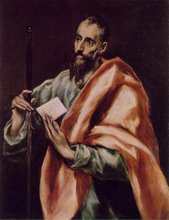
I hope that the Pauline Year will be a time of inspiration for us as we look to take part in the New Evangelisation. The Apostle of the Gentiles had neither Blueprint nor the accumulated experience of the history of the Church's Mission to guide him; he was its forerunner, building the Church and the culture of the New Covenant upon the basis of his own openness to Christ.
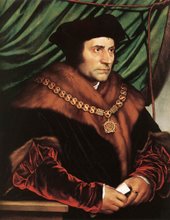
"Not only do we ask ourselves, "Who was Paul?" Above all, we ask ourselves "Who is Paul?" "What is he saying to me?" At this hour of the beginning of the Pauline year that we are inaugurating ... " (Benedict XVI, 28.6.08)
Such a statement leads us to consider what the character of the Catholic should be today. This is an important appreciation to have at a time when, in England, we have experienced a general winding down of the Church in recent decades. I would like to make a number of observations about this; the first point that I would emphasise is that a Catholic in England today needs to have "the necessary critical apparatus". This is a phrase which I have coined and by which I mean that a Catholic today needs to be able to discern the presence of grace and be able to embrace it. This means being aware of the ending of the era of the Old Evangelisation in the Church and being aware that a new era is now beginning - the New Evangelisation. From the perspective of the Church in England this means turning the Church from being a Church of maintenance into being a Church of Mission.
The necessary critical apparatus then, means being aware of our life in relation to the Gospel and in relation to secular society; it involves the whole culture of our personal lives - the way we live. Is it a life in which we seek Christ or, as Fr Julian remarked in an earlier post, it is a "practical paganism". But it is not simply awareness, it involves making a response to either Christ or the world. This in turn means the way we build our lives upon a relationship with Christ in prayer and in the Sacraments. It also involves a certain approach to actively forming our lives either in conformity to grace or to the world. And it necessarily involves decisions by which we seek place our lives at the service of Christ in one way or another. All this presumes that in some way the Catholic today is hearing the Gospel and the call which the Church is making to us especially through John Paul II and Benedict XVI.
Having the necessary critical apparatus above all refers to my awareness, and how I seek to make myself aware. It speaks in a personal way about the individual Catholic today; that the New Evangelisation isn't something that may be happening to other people, no, it is the call which is being made to me. It tells me that I cannot be sufficient of myself, or rely upon culture, but that I must be open to God and to others, and seek to know what God is asking of me.
St Paul, pray for the Church in England and Wales.
I shall return to post on some of the inferences which I have made here and upon other practical facets of the New Evangelistion today.